“The Mountain Cat”

Fabrizio del Wrongo writes:

wildcat

Released in 1921, Ernst Lubitsch’s “The Mountain Cat” (sometimes called “The Wildcat”) has little of the urbaneness of the director’s later work. It’s one of his Bavarian films, made (at least in part) on sojourns from his home base of Berlin, the body of which have a roughhewn, almost rustic quality that bespeaks a desire to unwind and cut loose. In fact, I take Lubitsch’s earlier “Meyer from Berlin” to encapsulate the aim of these pictures: It’s about a henpecked Berliner who convinces a doctor to prescribe an Alpine retreat  — without his wife. Tellingly, Lubitsch himself played Meyer; it was the last time he acted in a movie. If the much discussed (perhaps overly discussed) Lubitsch “touch” can be described as a crassness that is only barely redeemed by an an overriding sense of propriety, then perhaps the Bavarian films can be taken as an indulgence of crassness; their reliance on knockabout physical comedy is only slightly removed from the work of Mack Sennett.

In “The Mountain Cat” Lubitsch alternates between two worlds, a fantastical fort inhabited by a bumbling army, and the snow-covered mountains, the realm of a band of barbarous robbers. Though the worlds present a visual contrast, their constituents mirror each other, and it’s part of the joke that both parties have the dainty sensibilities of petit bourgeois householders. Rischka, the daughter of the chief robber, is the sole exception. She terrorizes both groups with gusto, and her inevitable neutralization, the expectation that she’ll allow herself to be absorbed into one of these nutty civilizations, gives the plot its principle motivation. Played by the Polish actress Pola Negri, Rischka may be derived from Constance Talmadge’s Mountain Girl from “Intolerance.” Negri expands on Talmadge’s spunkiness by giving Rischka a fervency that seems to pour out of the actress’ enormous eyes. Though she’s little discussed today, Negri was an unlikely combination of Mary Pickford and Theda Bara. This may explain Lubitsch’s attraction to her: She embodied the balance of cheeriness and decadence that characterizes his best work.

Though “The Mountain Cat” is clearly Lubitsch in knockabout mode, it’s not a stripped-to-the-skivvies production like the roughly contemporary “Romeo and Juliet in the Snow.” At this stage in his career Lubitsch was known as the American Griffith, and it’s clear that he wanted his audience to remember why: A crowd scene staged for the introduction of the male romantic lead, in which seemingly thousands of women pour into the streets to get a piece of him, is managed with as much bravado and attention to detail as anything in the director’s earlier “Anne Boleyn” or “Madame DuBarry.” Here, though, Lubitsch uses the crowd scene for comic exaggeration. He presents it as a trope, and he keeps embroidering on it until we’re laughing more at his formal cheek than at the lowbrow sexual gags sprinkled throughout the sequence.

Much of the movie can be taken as an exercise in formal and aesthetic exaggeration. The decor of the fort is wondrously absurd. Phallic cannon poke out of circular portals, one stacked on top of the other, as though intended for decoration rather than defense. And throughout most of the movie the vignetting — vignettes are shapes overlaying the square film image, intended to emphasize certain movements and details — is so absurdly overdone that it’s hard not to wonder what Lubitsch was thinking. Is he encouraging us to laugh at the material within the vignette, or the practice of vignetting itself? (Amusing at first, the vignetting is perhaps too clever; even Lubitsch seems to tire of it after a while.) If it’s hard to determine exactly what in the picture is funny, it may be because much of its humor is generated not by content but by form. Lubitsch has an uncanny ability to draw laughs from the way in which the physical qualities of the film — staging, framing, art direction — interplay with his characters and their situations, and the peculiar rhythm of the editing gets under your skin, makes you feel a little tipsy.

Few silent films seem to yearn so enthusiastically for sound. There are two implicitly musical sequences — an absurd orchestra recital staged on ice; a deliriously baroque ball — and the movie as a whole has the bounce and sway of popular song. This is evident both in its simple back-and-forth structure and the undulating quality of its art direction, the latter almost narcotic in its impact. It’s there, too, in the physical bits, notably one in which actor Paul Heidemann, as Lieutenant Alexis, seesaws on an enormous rocking horse, daintily sampling liqueurs whenever his hand returns to the bottles. Like other Lubitsch comedies of this period, notably “The Doll” and “The Oyster Princess,” “The Mountain Cat” is a precursor of the operettas the director would go on to make at Paramount and MGM; notably, the romantic triangle that develops between Rischka, Alexis, and the daughter of the fort’s commandant anticipates the 1931 “The Smiling Lieutenant.” Unfortunately, Heidemann’s Alexis, the roué whom women cannot resist, has none of the self-aware insouciance of Maurice Chevalier. His chief weapon is a toothy grin that communicates a mixture of coarseness and malice; it’s hard to understand what the ladies see in him. But then the movie is intended to play not as romantic comedy but as slapstick. We don’t yearn for any particular couple to make a go of it, and it doesn’t matter too much that Rischka’s romantic fate is somewhat disappointing. We’re in it strictly for the gags.

Related

Posted in Movies | Tagged , , , , , , , , | 1 Comment

Lessons from Across the Pond?

Fenster writes:

Are there lessons to be learned from the messages from across the pond?

fan mail


Continue reading

Posted in Politics and Economics, Uncategorized | Tagged , , | Leave a comment

Architecture and Color

Paleo Retiree writes:

Posted in Architecture | Tagged | Leave a comment

Juxtaposin’: King Press

Fabrizio del Wrongo writes:

9270

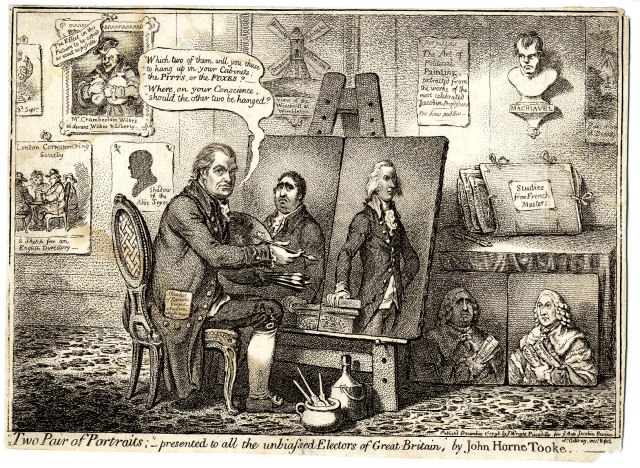
The Parliament of this period has become historically famous as the unreported Parliament. Such reports of the debates as reached the public ears were almost unintelligible. Two magazines there were, namely, the London and the Gentleman’s, which professed to give reports, but they only spoke with bated breath. Dr. Johnson in the pages of the Gentleman’s wrote the reports of the so-called Senate of Lilliput, and not daring to assign to each speaker the speech that he delivered, he gave merely the names of the debaters in a catalogue. His materials were scanty, and he eked them out by indulging in imaginative flights. He was even charged with fabricating bad arguments which he put into Sir Robert Walpole’s mouth. This was a state of things that plainly could no longer be endured, and several journals began to cater for their readers with better reports than any yet attempted. That they were very inaccurate is only natural under the conditions that prevailed. Wedderburn — better known afterwards under the title of Lord Loughborough — once remarked of a speech of his that was reported in the newspapers in this sarcastic vein: “Why, to be sure, there are in that report a few things which I did say, but many things which I am glad I did not say, and some things which I wish I could have said”. His experience, no doubt, was that of many others. Moreover a door was left open to a subtle species of corruption. Woodfall, for example, who was for his feats as a reporter nicknamed “memory Woodfall,” is said to have been paid £400 a year for reporting in the Morning Chronicle the speeches of Fox and Sheridan better than those of Pitt and Dundas. And Woodfall was one of the most distinguished of his class. The profession of a journalist was still one which was held and long continued to be held in very low repute. But however that may be, parliamentary reporting suddenly became a burning question. It was in 1771 that Colonel Onslow called the attention of the House to the fact that its debates were being reported in the newspapers, and he moved that the resolutions — which in 1728 had been passed upon the subject — be read. By these resolutions the newspaper reporting of debates was declared to be “an indignity to and breach of privilege of the House,” and offenders were ordered to be punished. In the course of discussion an ex-Speaker, Mr. Onslow, asserted the Parliamentary law and custom very clearly; reporting in the newspapers was, he said, “a modern practice completely unprecedented, and in direct violation of the privileges of the House of Commons “. The Colonel’s motion was carried, as might have been expected from the temper of the House. The next day he rose again in his place, and complained that the Gazetteer and the New Daily Advertiser had published a misrepresentation of his speeches. The printers of the papers, Thompson and Wheble, were thereupon directed to attend the House. Wilkes and Tooke now saw their opportunity and prevailed upon the printers to disobey the order. Then the House passed a resolution that an address should be presented to the King, praying him to issue a royal proclamation to order the arrest of the offenders. His Majesty — who in a letter to Lord North had called the printers ”miscreants,” and affirmed that “this strange and lawless method of publishing debates in the papers should be stopped” — was only too glad to comply with the request. Yet, in defiance of both King and Parliament, the reports were merrily continued, and in the following month the Colonel called the attention of the House to the fact that six more papers, the Morning Chronicle, the St. James’s Chronicle, the London Packet, the Whitehall Evening Post, the General Evening Post, and the London Evening Post, were publishing reports. A hot discussion followed, and, perhaps, the very first example of the use of obstructive tactics in the House. Twenty-three divisions were taken, and the debate was not closed until the morning sunlight was streaming through the windows. ”Posterity,” said Burke, in a speech in which he afterwards referred to the debate, “will bless the pertinacity of that day.” Then followed a series of events which were hardly less dramatic than those which had occurred in connection with Wilkes and his expulsion. Verily the times seemed out of joint. The printers of the incriminated journals were urged to persevere by the Bill of Rights Society, which provided them with funds. Then the printer, one Miller, of the London Evening Post, was summoned to the House; he refused upon the ground that he was a Liveryman of the City, and a messenger who had been sent to fetch him was himself arrested for assault. Brought before the Lord Mayor Crosby and Aldermen Oliver and Wilkes, who were sitting as magistrates at the Mansion House, the messenger was declared to have been legally arrested. Then Crosby and Oliver were ordered to attend in their places in the House, and were accompanied thither by great demonstrations of applause. At Westminster a riotous mob assembled and approaches to Parliament were blocked; Lord North’s carriage was wrecked, and the brothers Charles and Stephen Fox were pelted and rather roughly handled. The signing of the warrant for the arrest of the messenger of the House was declared a breach of privilege, and Crosby and Oliver were committed to prison; an event which Gibbon characteristically described as the sending of “two wild beasts … to the menagerie in the Tower “. The news of the committal was received by the people with a burst of indignation. On the Tower Hill the figures of the obnoxious persons were carried in carts, beheaded by a chimney-sweep and committed to the flames. Oliver and Crosby were received with every mark of honour in the City, and the Corporation presented them and Wilkes with silver cups in memory of the zeal they had displayed in the protection of the printers. Wilkes seized the opportunity to emphasise his Radical proclivities by choosing the death of Julius Caesar as a design for his cup, and the following lines from Churchill for an inscription: —

May every tyrant feel
The keen deep searchings of a patriot’s steel.

C.B. Roylance Kent

Trump’s attacks on the press have been aimed at what he calls the “mainstream media.” Six of the seven U.S. outlets in our study—CBS, CNN, NBC, The New York Times, The Wall Street Journal, and The Washington Post—are among those he’s attacked by name. All six portrayed Trump’s first 100 days in highly unfavorable terms. CNN and NBC’s coverage was the most unrelenting—negative stories about Trump outpaced positive ones by 13-to-1 on the two networks. Trump’s coverage on CBS also exceeded the 90 percent mark. Trump’s coverage exceeded the 80 percent level in The New York Times (87 percent negative) and The Washington Post (83 percent negative). The Wall Street Journal came in below that level (70 percent negative), a difference largely attributable to the Journal’s more frequent and more favorable economic coverage.

Thomas E. Patterson

Posted in Books Publishing and Writing, Media, Philosophy and Religion, Politics and Economics | Tagged , , , , , , , , , , , | Leave a comment

Linkage

Paleo Retiree writes:

Posted in Linkathons | Tagged , , , , | 4 Comments

For the Bright Side of the Painting I Had a Limited Sympathy

Fabrizio del Wrongo writes:

File-'Edgard_Poë_et_ses_oeuvres'_by_Lix_and_Dargent_6

In no affairs of mere prejudice, pro or con, do we deduce inferences with entire certainty even from the most simple data. It might be supposed that a catastrophe such as I have just related would have effectually cooled my incipient passion for the sea. On the contrary, I never experienced a more ardent longing for the wild adventures incident to the life of a navigator than within a week after our miraculous deliverance. This short period proved amply long enough to erase from my memory the shadows, and bring out in vivid light all the pleasurably exciting points of color, all the picturesqueness of the late perilous accident. My conversations with Augustus grew daily more frequent and more intensely full of interest. He had a manner of relating his stories of the ocean (more than one half of which I now suspect to have been sheer fabrications) well adapted to have weight with one of my enthusiastic temperament, and somewhat gloomy although glowing imagination. It is strange, too, that he most strongly enlisted my feelings in behalf of the life of a seaman, when he depicted his more terrible moments of suffering and despair. For the bright side of the painting I had a limited sympathy. My visions were of shipwreck and famine; of death or captivity among barbarian hordes; of a lifetime dragged out in sorrow and tears, upon some gray and desolate rock, in an ocean unapproachable and unknown. Such visions or desires – for they amounted to desires – are common, I have since been assured, to the whole numerous race of the melancholy among men – at the time of which I speak I regarded them only as prophetic glimpses of a destiny which I felt myself in a measure bound to fulfill.

— Edgar Allan Poe

Posted in Books Publishing and Writing | Tagged , , , , | Leave a comment

Naked Lady of the Week: Tiffany Walker

Fabrizio del Wrongo writes:

tw-cover

Tiffany Walker is Irish, and she was everywhere on the scuzzier portions of the internet circa 1998. Aside from that, I don’t know much about her.

Her mouth is really something: It seems to occupy some indeterminate state between pout and sneer. And it frames the gap in her front teeth in a way that’s rather compelling.

There was a time when young women who looked like your neighbor’s trampy daughter were all the rage in mainstream porn. “Barely legal” was a catchphrase that transcended the sex industry; the Strokes even used it for a song title. Then, the unmediated, “amateur” style seemed novel , coming as it did on the heels of decades of Playboy- and Penthouse-style glamor and adultiness. Now it’s somewhat old hat, and it’s the mode of glamor and sophistication that seems novel.

Nudity below. Have a great weekend.

Continue reading

Posted in Photography, Sex | Tagged , , , , | Leave a comment

Architecture Du Jour

Blowhard, Esq. writes:

Modernism: Making every place the same place for over a century.

Posted in Architecture | Tagged , , , , | 2 Comments

The Art of the Opening Title: True Detective, Season 1

Blowhard, Esq. writes:

A new series where I share some of my favorite TV opening titles. Sometimes I love the show, sometimes I don’t, but I think each montage captures the spirit and tone of the show in an entertaining way. A good title sequence is like the foyer of a building, or the steps from street level into a museum: it separates you from the everyday and welcomes you into a different world.

Posted in Television | Tagged , , | 2 Comments

Amazon’s Bricks and Mortar

Blowhard, Esq. writes:

After laying waste to meatspace retail book sellers, Amazon has bizarrely decided to get into the game. Their first NYC store opened over the Memorial Day weekend so I headed down there to check it out. My overall impression: if this was an airport bookstore, it’d be the best of its kind. Considered as a regular bookstore it’s decent-ish, but I doubt I’ll be spending much time there.

The store is located in The Shops at Columbus Circle, an upscale mall in the Time Warner Center that also houses a Whole Foods, various luxury fashion retailers, and some of the most expensive restaurants in the city. The store’s space, I’m told, used to house a Borders. It’s on the third floor opposite Thomas Keller’s Bouchon Bakery.

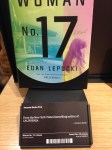
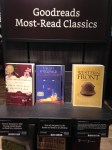
The first thing that jumped out at me is that there are relatively few titles for sale and each book is faced. No spines are visible.

The cumulative effect of the store layout — small stock, Amazon branding, use of reader reviews, and what I think is the Kindle Bookerly typeface for the signage — is a little disorienting. “Wow, am I inside the Internet? Is this how the characters in TRON felt when they first entered the game?” I thought, more than a few times.

It quickly becomes apparent that what’s being sold is Amazon’s metrics more than the books themselves.

The cost of each book depends on whether you’re an Amazon Prime member. Prime members get the Amazon.com discounted price while everyone else pays retail. There are three or four stations located around the store for you to check the price.

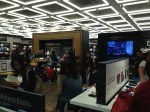
As you would expect, numerous Amazon gadgets and higher-end electronics are also on sale. I took the third picture in the series below from an area at the front of the store where the Kindles and Fires are prominently featured.

Amazon’s cheapo Basics are also available.

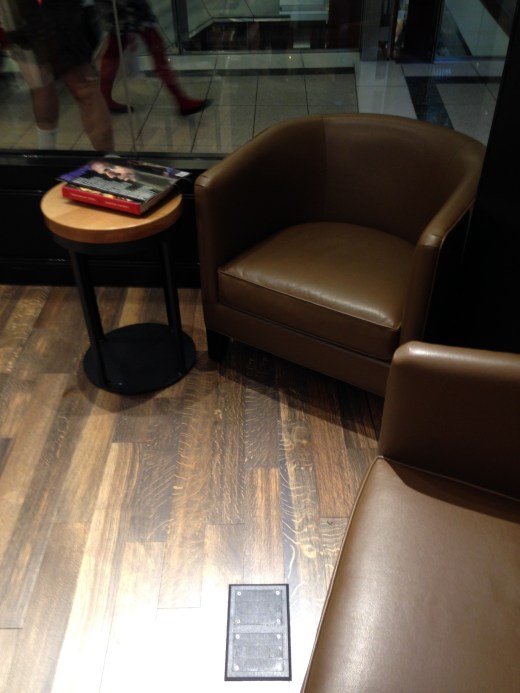
A mild attempt is made to give the store a Third Place vibe.

The view from the store of Columbus Circle and Central Park South is pretty nice.

You can pay with the Amazon app, but a friend who tried to do so said it didn’t work.

I opted for the regular checkout. There are about six of these stations at the point of sale. I walked up to one and started jabbing my finger at the screen, figuring it was a self-checkout, when one of the employees came over to inform me that I couldn’t use it by myself. When you pay with the credit card connected to your Prime account, you automatically get the Prime price.

I’m in the Columbus Circle area a lot, so it’s nice to have a bookstore nearby to browse. Also, sometimes two days is an excruciating amount of time to wait for a purchase to be delivered so, as an American, I’m delighted whenever anyone caters to my need for immediate gratification, particularly when that immediate gratification involves deep discounts. But given that the stock is limited to only very popular titles in a small number of basic categories, I don’t foresee spending much time there. Maybe if I must have the hot bestseller everyone is talking about and don’t feel like waiting for it, then I can see the advantage. Other than that, though, it doesn’t have much to offer me.

Which raises the question: What’s the point of this? What does Bezos hope to accomplish? In interviews his representatives have cited books as being part of Amazon’s core identity and others have said the point is to sell Prime subscriptions and Amazon’s various gadgets. Seems reasonable, I guess. But can’t they sell their gadgets anywhere, say Target or Best Buy? How many shoppers are going to go in expecting to pay $20 for a book only to plunk down another $100 for Prime? As for loving books so much, I’d rather they focus on persuading publishers to cut ebook prices, or even get them to bundle ebook versions with hard copies, the way many Blu-rays now include codes for digital downloads. My theory is that Bezos feels guilty about putting book retailers out of business, so these stores are an attempt to atone for that, but given that 1) I know next to nothing about his psychology and 2) there are plenty of other ways to be charitable, I don’t think my theory is any better.

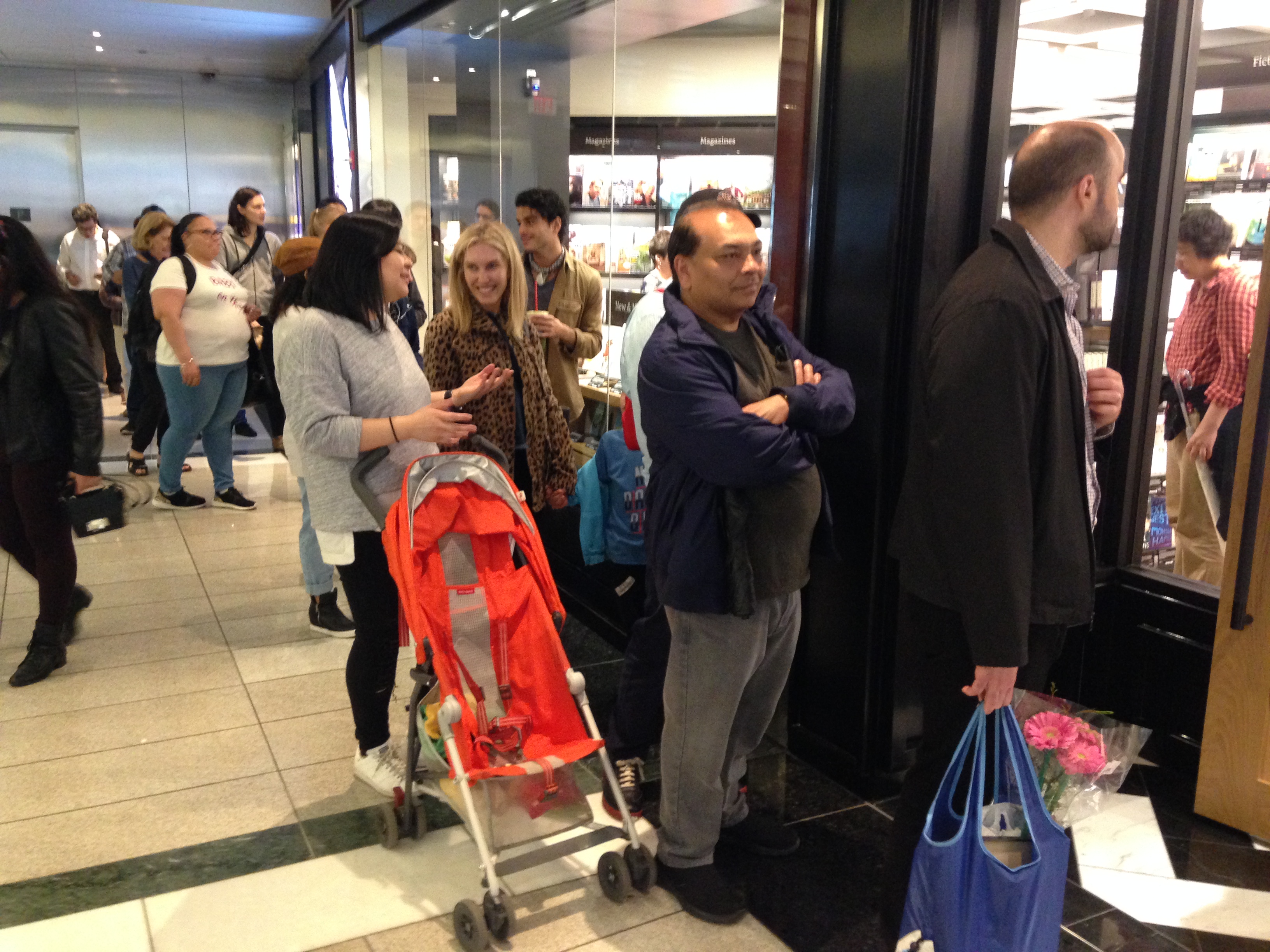
As I left the store mulling over these questions, it had become so full that they were holding people back so it wouldn’t get too crowded inside.

A gentleman tried to and the very polite security guard told him that he would have to wait in line. He apologized for not noticing, laughed at everyone standing there, and said to no one in particular, “Here’s the thing: you can get all this stuff online. I know, it’s crazy!”

Posted in Books Publishing and Writing | Tagged , , , | 7 Comments