Beyoncé, Carly Rae Jepsen, and The Song Machine

Blowhard, Esq. writes:

beyonce-lemonade

Please do not make eye contact with Her Royal Highness when she’s communing with the Muses on Mount Olympus.

Beyoncé has released a new album, Lemonade, to predictably rapturous reviews. Ever since her halftime performance during the 2013 Superbowl, her every emanation has been greeted by the Beyhive with an ecstasy that puts the average Marvel movie fanboy to shame. Curious about they hype, I decided to give it a listen and, though I have absolutely no shame about proclaiming my girlpop fandom, I thought the album was pretty boring. Fans have lauded its musical eclecticism, but it sounded unfocused and schizophrenic to me. “Hold Up” has a nice vocal hook, but I liked it the first time when Karen O did it in “Maps.” “Sorry” features a herky-jerky rhythm that recalls the black debate style that’s en vogue. “Love Drought” consists of airy vocals over moody atmospherics that wander aimlessly. (I was reminded of Zayn Malik’s latest — is this kind of production a trend in contemporary R&B?) “Sandcastles” is a lumbering piano ballad while in “Freedom” Beyoncé exhorts herself to “keep running because a winner don’t quit on themselves.” The only song I enjoyed was “Daddy Lessons,” a jazzy country rave-up. Don’t put your money on me, but I don’t see any future radio staples like “Crazy in Love” or “Single Ladies.”

What the album lacks in pop songcraft it makes up in raw attitude. It reminded me of contempo literary fiction — sure, it may be a drag to listen to, but it feels vital because it hits all the right themes. In this case, it’s “intersectionality,” that of-the-moment combination of black nationalism (“Freedom” and “Formation”) and feminism (“Hold Up,” “Don’t Hurt Yourself,” and “Sorry”). It’s the kind of work that gives Pitchfork writers and Millennial cultural critics a lot to gas on about.

carly-rae-jepsen

I’m a sucker for the ye-ye girl sweater-and-tights combo.

Beyoncé’s undeniable success the past few years is a good reminder that, above all, a pop star has to project a larger-than-life personality to command the public’s love. Good songs aren’t enough. Take the case of Emotion released by Carly Rae Jepsen last year. Song for song, Jepsen’s work is superior to Lemonade in terms of pure craft. Heavily influenced by 80s pop, Emotion bursts with candyfloss vocals, electro-dance beats, and perky hooks all held together by slick production. The album has plenty of fans, but sales have been disappointing and it hasn’t produced any major singles like Jepsen’s monster hit “Call Me Maybe.” As many critics have pointed out, the Canadian-born Jepsen doesn’t have a distinctive persona. All you learn from Emotion is that she likes boys and being in love. Like many former Idol contestants, she has the technical ability but lacks an interesting point of view. Even her album title is nondescript.

But the main thing that struck me about reviews of Beyonce’s album, and even Jepsen’s, is that the music press and fans seem to have a deep need to believe that La Knowles isn’t just a star performer — they need to believe she’s a musical genius. This GQ writer praises the album as a showcase for “the most formidable musical prowess on the planet.” He commends the “endless procession of musical details to freak out over” and is gobsmacked that “one artist is capable of making all [of the album’s] stylistic transitions.” At no point does he mention that the record had fifty-two — that’s a 5 followed by a 2 — writers and producers. This piece acknowledges Beyoncé’s phone book-like roll call of collaborators, then goes on to cite that as proof of her brilliance before likening her to Michelangelo overseeing a workshop of assistants. “Pop music is a kind of auteurism,” she writes:

It’s undeniable that Beyoncé had her hand on the controls for the creation of every piece of this album. Beyoncé is a credited writer on every single song. She is also a credited producer on every track but one. She touched everything. She tweaked the lyrics. She remixed the vocals. She made decisions big and small and perfected her art until it was ready for public consumption.

Right, and she probably mastered the album too before sitting down at a drafting table to create a new typeface for the liner notes. Look, Beyoncé has been in the music biz for almost two decades. During that time she’s been a part of 11 albums as either a group member or a solo artist during her climb to the top, so I’m not about to deny her musical savvy, but there’s little evidence that she’s an auteurist studio maven like Phil Spector, Brian Wilson, or Stuart Murdoch. More importantly, there’s nothing wrong with admitting that. Ella Fitzgerald, Billie Holiday, Frank Sinatra, and Aretha Franklin, to name just a few, are all considered titans of American song even though each did very little songwriting or producing during their careers.

Fans nowadays are determined to elevate their favorites to the status of golden gods. This Bustle article tells us that Jepsen, like a modern day Berlin or Gershwin, “wrote” 200 songs for songs for Emotion which she then whittled down to a mere dozen. Uh-huh, sure. More accurately, this review notes 200 songs “were assembled” from which Jepsen selected twelve. The passive voice of “were assembled” nicely avoids telling the reader those 200 tracks were written by a legion of professional songwriters.

Why the deception and weasel words? Have the recent deaths of Bowie, Prince, and others created an anxious need for musical svengalis? Madonna is irrelevant, Rihanna is floundering, and Lady Gaga is too weird, so perhaps there’s a Pop Queen vacuum that needs filling. OK, fine. But why are so many music writers clueless about how songs are actually created?

the-song-machine-john-seabrook

Maybe these questions are swirling around my head because I recently enjoyed The Song Machine: Inside the Hit Factory by John Seabrook. Seabrook, a staff writer at The New Yorker, gives a good tour of the music industry over the last couple of decades — from the death of CDs to the rise of filesharing and streaming services like Spotify. He looks at not only how the business of music has evolved, but how music production (at least for top 40 pop) changed. The book also contains a number of mini-bios of hitmakers like Dr. Luke and Max Martin. Martin, a Swede who prefers anonymity, is probably the closest heir we have to studio geniuses like Spector and Wilson. He’s written and produced dozens of hits, including:

If you hate this crap, now you know exactly who’s responsible for it! But what I appreciated most about the book was the songwriting anecdotes and behind-the-scenes gossip. For example, we learn that Martin was a huge fan of the Yeah Yeah Yeahs’ “Maps” but was frustrated by its lack of a killer chorus. So he rewrote the song with a killer chorus and came up with “Since U Been Gone.” As for gossip, I’ve read my fair share of pop music history and I’ve lost track of the number of times a singer is introduced to a song, they hate it, they’re practically forced by their record company or management to record it at gunpoint, yet the song goes on to be a huge, career-defining hit. To the list that includes The Supremes with “Where Did Our Love Go” and Françoise Hardy with “Tous Les Garcons et Les Filles” we can add Clarkson and “Since U Been Gone.”

People are already calling Martin’s latest work for Justin Timberlake the song of the summer. Hey, Beyoncé worshipers, this is what a pop genius sounds like.

Related

Posted in Books Publishing and Writing, Music | Tagged , , , , | 1 Comment

Couldn’t Do It Today

Blowhard, Esq. writes:

This one is a two-fer: not only is it a celebration of street harassment and the male gaze, you got white boys appropriating soul music. Music for shitlords/Trump supporters.

HT to Callowman for reminding me of this gem.

Posted in Music | Tagged , | 3 Comments

Music Recommendation Du Jour

Blowhard, Esq. writes:

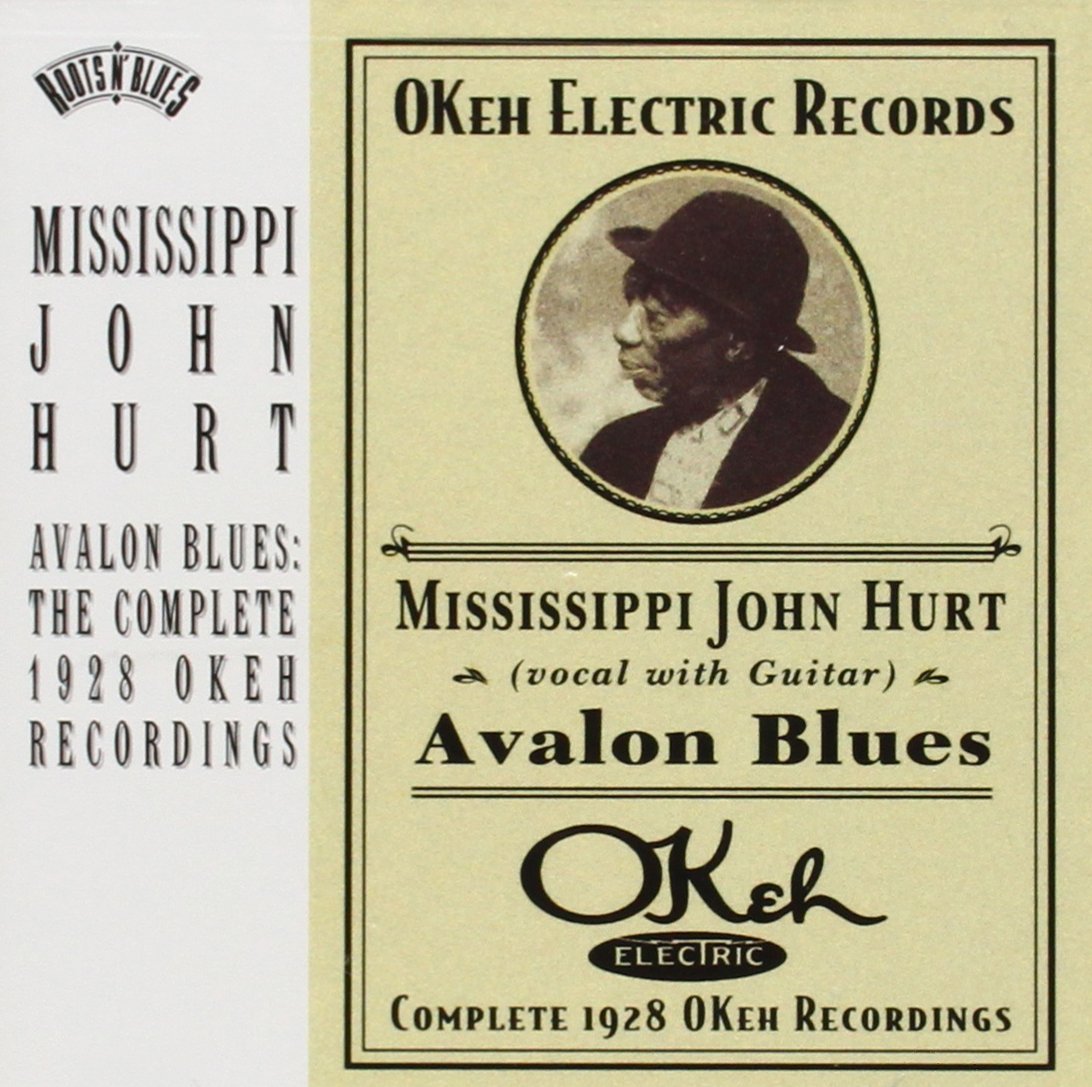
mjh1928okeh

I’ve been listening to a lot of classic albums lately and this collection sticks out as one of the best. Each song is like a little short story — the sometimes dark subject matter belied by Hurt’s warm, smooth voice and marvelous finger-picking guitar. At only $5, the album is a stealAs my friend Lloyd used to say, a copy belongs in every civilized home. Here are a few tracks for your previewing pleasure.

Posted in Music | Tagged , | 4 Comments

Faking It

Fenster writes:

Steve Sailer asks if fake hate crimes are against the law.  Apparently not, in a lot of places.  But should criminal penalties apply?  And is a fake hate crime itself a hate crime? And should it be prosecuted in the same manner and under the same legal logic as an “authentic” hate crime?

Sailer discusses the Whole Foods birthday cake dust-up but here’s another: the Albany bus incident.  Three black students at the University at Albany got into a fight on a bus as it was entering the campus.  They claimed they were attacked and were subjected to racial slurs.  Police brought in.  Large student protests ensue.  University president rushes to judgment before the alleged white perps could be found:

“I am deeply concerned, saddened and angry about this incident. There is no place in the UAlbany community for violence, no place for racial intolerance and no place for gender violence. . . .our student affairs personnel and our Office of Diversity and Inclusion staff are working together to support our young women.”

A video of the incident subsequently demonstrated that the attack was fabricated and that the black students were the aggressors.  That is what the video seems to suggest at least, and what civil and university authorities concluded.  The three students were expelled and also charged with assault.  Two were charged with falsely reporting the incident.

This is the consensus view of what happened.  Sites like Jezebel are keeping the door open to alternative explanations:

Still, there’s debate over whether the video of the incident released tells the full story about what could’ve incited the women accused of assault.

But the issue appears for the most part over and done.

Of course it is not over as political fodder, and the right has joyfully used this as another demonstration of the use and abuse of hate crime designations.  I am not going to jump in on that aspect here.  But it raises the issue of whether fake hate crimes should themselves be deemed hate crimes.

If we are offended by the particulars of this case we might rush to say yes.  But let’s first ask what a hate crime is, or should be.

I was for quite a while against hate crimes for the simple reason that motivation is hard to determine and in a sense irrelevant to actual harm done.  Shouldn’t people who murder face similar penalties without having to peer into the perpetrator’s brain to discover a motivating factor?  Doesn’t that serve to–if you will–privilege one set of victims and their friends and families over others?

But we distinguish between different kinds of crimes all the time.  Manslaughter is different from second degree murder which is different from first degree murder and so on.  The distinctions here can be hard to prove but distinctions are nonetheless made.  A dead body either way, but both the behavior and attitude of the perpetrator can make a difference ( was it willful? premeditated? committed with wanton indifference?).

In making these distinctions we are making a cultural values statement: we consider a depraved heart murder a more serious thing than other murders.  We do this because it both reflects our values and because we hope that a higher level of punishment will deter especially heinous crimes.

The law is not just concerned with righting individual wrongs.  Crime and punishment are not truly truly blind in that sense.  The treatment of criminal matters is unavoidably bound up with issues of social control and social values.  Punishment is not just a matter of socializing private vengeance, with an eye only on rectifying the private harm.  Laws as written and laws as enforced aim to do more than punish the guilty in a narrow sense.  Some on the right are uncomfortable with socializing private things but then even the “broken windows” approach popular among conservatives is all about foregrounding social effects and backgrounding the effect of the actual acts on the victims.

In this light, it is perfectly fair to argue that a murder intended to instill fear into an entire community–a vicious lynching, say–is a more serious matter than a love affair gone wrong.  Looked at this way it is not the motivation per se that is being punished in a hate crime.  It is the broad reach of the act beyond the private effect on the victim.  Moreover, if there is a social consensus that instilling collective fear is something in its own right to be punished then yes I think hate crime laws, properly written and fairly enforced using this standard, are quite sensible.  The State need not read the offender’s mind; it has only to reasonably conclude that the harm had large social effects in addition to smaller private ones.

Sometimes fake hate crimes, like real hate crimes, start with an actual offense.  If a Muslim wishing to build sympathy for Islam calls in fake bomb threats to a mosque the harm is as real and as substantial as if it had been called in by an anti-Islamic activist. Terror.  Evacuation.  Police presence.  Disruption of activities.  But what of Muslim who falsely claims he was subject to harassment and violence?  No actual event occurred.  In such a case the only offense is social, there being no actual private act of harm at the bottom of things.

So some fake hate crimes only exist as social harms, and have no aspect of individual harm with which the social may intertwine.  What of it?  Isn’t the social harm of sufficient consequence to bring the law into play?

Posted in Law, Politics and Economics | Tagged , , | 2 Comments

Eight Movie Posters for “Band of Outsiders”

Fabrizio del Wrongo writes:

“Band of Outsiders” is, I think, the tenderest of the great Godard films. It’s also, with the exception of “Breathless,” the one that looms largest in the public consciousness: The scenes showing Karina, Frey, and Brasseur doing the Madison in a Parisian cafe, or running through the Louvre in an attempt to break the visitor speed record (held, of course, by an American), are integral parts of the catalog of images we carry in our heads connected with the French New Wave.

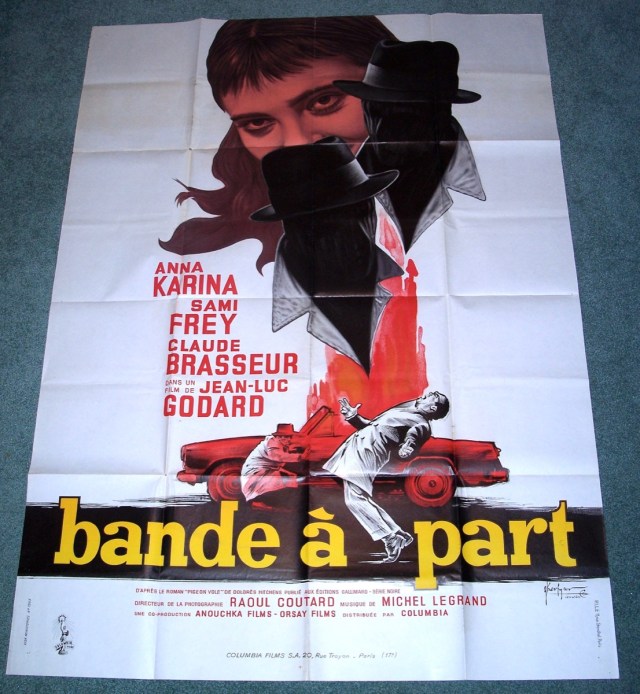
Band of Outsiders (French)

This large poster, the key marketing instrument for the film in France, features art by Georges Kerfeyser. I love the image of Karina’s mischief-laden eyes. The idea seems to be to hint at Karina’s role in influencing her male friends to commit ignoble deeds. The vignette of Frey and Brasseur at the bottom of the poster suggests the violence to which this may lead, though, if you’ve seen the film, you know the gunfight it represents is thoroughly mock in nature.

Band of Outsiders (French)

The smaller French poster features a more modernistic design emphasis. It may do a better job of encapsulating most folks’ sense of the movie’s tone. Even so, I think it’s too grim and lacking in charm. The mock gun battle makes an appearance at the top of the composition.

Band of Outsiders (UK)

This British poster rearranges the elements of Kerfeyer’s composition to suit the horizontal format of the traditional English poster. It loses something in the translation.

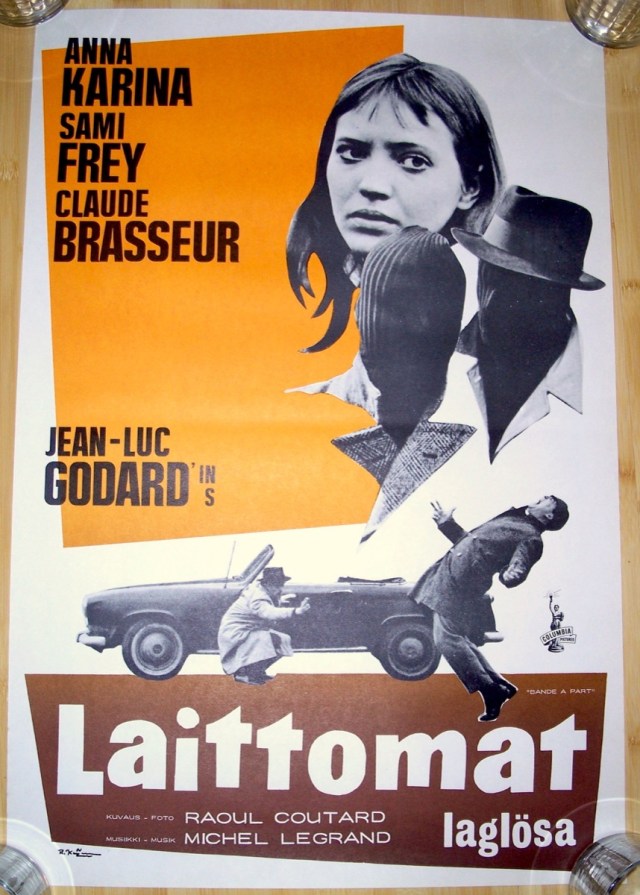
Band of Outsiders (Finland)

The poster used in Finland combines the elements of the Kerfeyser composition and the mod quality of the smaller French poster. It has an almost musical jauntiness. Note that Karina has been transformed from an effervescent muse into a disapproving grump.

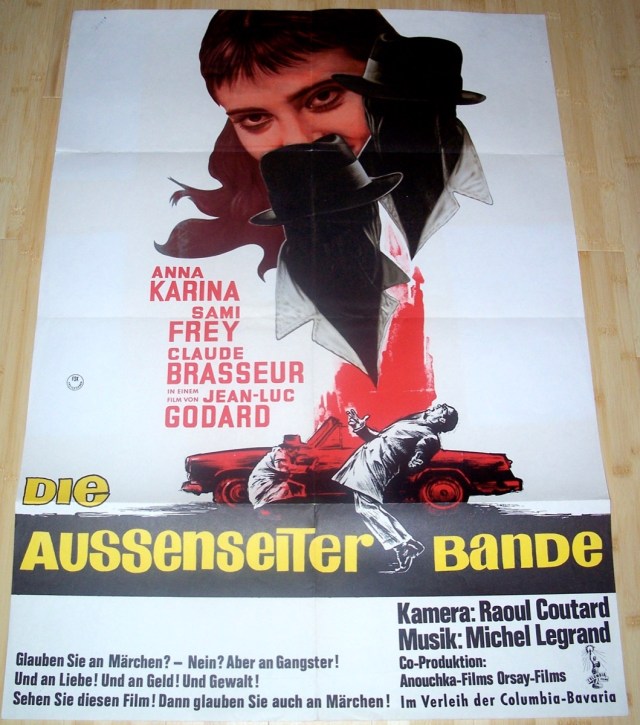
Band of Outsiders (German)

The German poster reproduces the French design.

Band of Outsiders (USA)

In the States, the posters used to advertise European art films often featured rudimentary designs and limited color palettes, and this poster for “Band of Outsiders” is no exception. The masked boys, familiar from the other posters we’ve seen, make an appearance, but the most notable aspect of the composition is that image of Karina dancing. As far as I know, this is the only original-release poster for “Band of Outsiders” to allude to the movie’s most famous scene.

Band of Outsiders (USA)

This is an American-made poster featuring the Spanish language. It was used either in Spanish-speaking parts of the U.S. or in parts of Mexico reached by American film distribution. The vignette of the masked boys echoes that featured on the English-language American poster in that one of the pair has been given a gun. But I find it more interesting that each has been provided with his own punctuation mark. Unless you’ve seen the movie, it’s hard to know what those hooded figures represent, even on the Kerfeyser original. Perhaps whoever designed this poster thought it best to hint at the fact that their arrival at the role of criminals was not without a degree of surprise and confusion. Though I can appreciate the attempt at liveliness, I think this poster is something of a mess, and fails to communicate a sense of the movie.

Band of Outsiders (Argentina)

Lastly we have an Argentinian take, which repeats the design of the U.S. Spanish-language poster seen above. It’s even more of a mess than its model.

Related

  • “Band of Outsiders” was recently revived in the States. Here’s critic Charles Taylor on the movie. And here’s Justin Chang.
Posted in Commercial art, Movies | Tagged , , , , , , , , | Leave a comment

Notes on “Cry Danger”

Fabrizio del Wrongo writes:

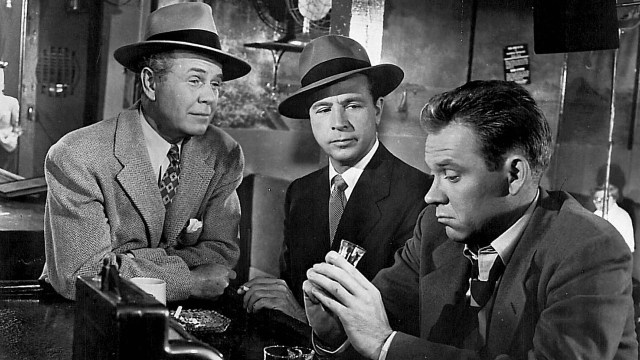
cry danger

“Cry Danger,” the first film directed by Robert Parrish, may come closer to the wry, frugal tone of Dashiell Hammett than even Huston’s adaptation of “The Maltese Falcon,” which leans rather heavily — and quite successfully — on comic grotesqueness. There’s little that’s grotesque in “Cry Danger,” though there’s plenty that’s comic: Screenwriter William Bowers salts the action with one-liners, and the actors reliably underplay them, winking at you through their readings. The picture has an air of studied nonchalance, one that seems to emanate from star Dick Powell. You’d call him cool if he weren’t so grave.

Noir fans often debate whether Powell or Bogart best embodies the qualities of the genre’s archetypal leading man. Powell has none of Bogart’s romanticism, which is really a sort of idealism that’s been allowed to decay and marinate in its own putrescence. He also lacks Bogart’s sadism. Rather, his toughness and cynicism are aspects of his wariness, and admissions of his vulnerability. It’s hard to separate Powell’s peculiar self-aware quality from his looks, which even in the raggedness of middle age carried the residue of collegiate cheer. Powell’s later performances are nothing if not negotiations with his ‘30s persona, and the way in which he allows you to sense that internal parley is sympathizing; it draws you into his humanity.

The plot features the expected skullduggery, yet the impression the movie leaves is one of cramped and curdled domesticity. The sets — a rinky trailer park, an apartment filled with atrocious knickknacks, a bookie’s den with its too-neat stacks of anonymous documents — are flatly lit and have a dime-store fatigue, and the Bunker Hill locations look sort of phony even in the scenes that are shot plein-air. Cinematographer Joseph F. Biroc keeps the framing tight, so that everyone seems slightly uncomfortable, as though they’re guests at a party that’s started to wind down. This is probably what makes the movie feel so anxious, itchy, unsettled. It’s a hang-out picture in which relaxation isn’t an option.

All the secondary players are good, especially William Conrad, with his menacing smarm and eyes that blink off the beat, and Richard Erdman, who is unforgettable as a lame wino, the Panza to Powell’s Quixote. Like Lew Ayres’ sozzled heir in George Cukor’s great adaptation of “Holiday,” Erdman’s drunkard has a tenderness that affects the fabric of the surrounding picture. By the movie’s end we’re convinced of Powell’s fortitude, of his ability to stick around, but Erdman we’re not so sure about. He seems in danger of sliding right off the face of the world.

Related

  • There’s a nice, bare-bones Blu-ray from Olive Films.
Posted in Movies, Performers | Tagged , , , , , , , , | Leave a comment

Naked Lady of the Week: Alison Tyler

Blowhard, Esq. writes:

atcover

Porn star Alison Tyler’s Amazonian proportions recall Lynda Carter as reimagined by R. Crumb. Maybe that’s why she played Wonder Woman in a recent porn parody? (Link NSFW, natch.) Feminists are always going on about how anorexic models create unrealistic body image expectations, so I, for one, am glad that Tyler is repping for thick girls.

Nudity after the jump and lots of hardcore at the tube sites. Happy Friday.

Continue reading

Posted in Sex, The Good Life | Tagged , , | Leave a comment

“Love & Friendship” Pre-review

Fenster writes:

It is always a kind of special event, albeit in a low key, when a new Whit Stillman film opens.  He’s done only four since 1990: the WASP trilogy of Metropolitan, Barcelona and The Last Days of Disco (now out in a nice boxed set) and the related but different Damsels in Distress.  His new film, Love & Friendship, is being released today.

Since it is 9:00 AM as I write this I have not had the opportunity to view it but I will comment nonetheless, less to review it and more to remind people that it is out.  Of course actually seeing films or reading books should not stand in the way of good criticism, which, as viewers of Metropolitan will agree, can stand apart from the source material itself.

Tom: I don’t read novels. I prefer good literary criticism. That way you get both the novelists’ ideas as well as the critics’ thinking. With fiction I can never forget that none of it really happened, that it’s all just made up by the author.

That said, those with the good sense to appreciate Stillman’s quirky sensibilities will probably want to see the film.  Perhaps an actual review will appear in this space later, courtesy of Fenster or a co-blogger here.

Love & Friendship marks a departure of sorts for Stillman in that it is an adaptation, in this case of a short novel by Jane Austen that was unpublished in Austen’s lifetime.  It’s a period piece, too, which also marks a difference from his earlier work–unless of course you wish to consider a work like Metropolitan a period piece.  That film was set in a New York City of “not so long ago” and has all the archness and starchness of a bygone era.

But while the new film will be a departure in some ways it promises in others to be of a piece with his earlier work.  Stillman’s films overall are restrained and mannered, very much in an 18th century sort of way.  Indeed, Stillman expresses that he is very much an 18th Century Man in this recent NPR interview.

There are many many things I like about the 18th century.  I like the architecture. I like the music.  I like dress. I like the aspirations, many of the aspirations.  I like the thought, the political thought from the period . . .  I like a lot of the literature.

The NPR interview is worth a listen.  Stillman, like his characters, is polite, articulate and well-mannered to a fault.  Yet he put my in the mind of Oscar Wilde’s quote “only the shallow know themselves.”

Yes, Stillman knows his characters and can be brilliant at portraying their brittle exteriors while only hinting at what may lie beneath.  But what lies beneath? He creates highly structured social worlds populated by attractive young people.  One is easily seduced into thinking that the superficial exteriors must mask some real depths–of motivation, of character, of passion.  But maybe that’s not the case.  Maybe his characters are just as shallow as they appear.

Stillman himself appears to apprehend his own creations in this way.  Discussing the Chris Eigeman character in his first films–the “talkative live wire, the group leader” who is “challenged and overthrown” by others in his set.  He’s a snob, and part of a group that “could seem” snobby.  But at the same time he’s “nice” to the outsider character that the audience might identify with.  “He seems like he’s going to be the bad guy but actually he’s nice to our hero.”

That’s basically it.  He seems not-so-nice but maybe actually he’s kind of nice.  Perhaps this is as deep as it gets, and as deep as Stillman can take it.

Stillman has not been a stranger to Austen in his other work.  In Metropolitan several of his young WASPs discuss Austen in lit-crit terms, with one remarking snidely that one of her novels consisted of children play acting.  That was in a way an indirect reference to the polished goings on in Metropolitan itself.  We will now get to see the real thing.


Posted in Movies | Tagged , , , | 3 Comments

Quadrangulation

Fenster writes:

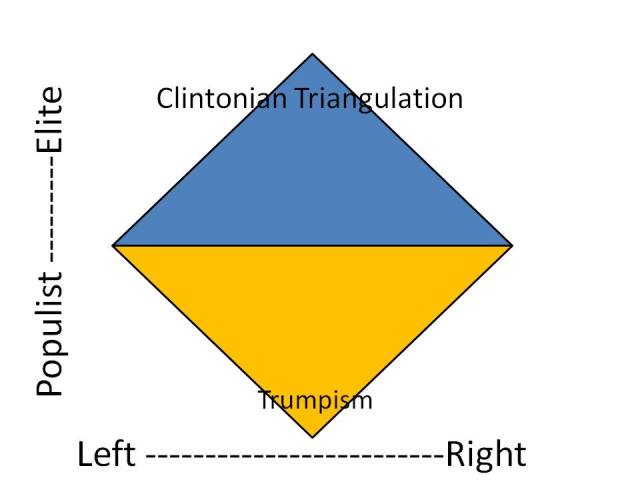
Peggy Noonan today quotes a cabbie shouting from his cab that he supports Trump because he is “neither left not right”. But wait, didn’t Clinton finish this job off in the 90s with his fabled “triangulation”? Yes, Clinton did an excellent job in his own way of difference-splitting for political gain. But in retrospect his accomplishment seems to be more that he created a new elite consensus. Triangulation can be extended to include another corner, creating a rectangle, with Trumpism another form of triangulation in a populist direction.

trumpism

Posted in Politics and Economics, Uncategorized | Tagged , , , , | Leave a comment

Notes on “Drunk Stoned Brilliant Dead”

Fenster writes:

Drunk Stoned Brilliant Dead is a documentary film chronicling the life and death of the highly influential humor magazine National Lampoon.

tombstone (1)

It is worth viewing but don’t expect all that much humor.  It is not a revue or a series of snippets, like, say a film in The Best of Saturday Night Live series.  It is for the most part a straightforward documentary chronicling the life and times of this interesting publication, and the many influences it has had on American culture since its founding in 1970.

It makes sense that it would not be a series of sketches highlighting the humor.  After all, National Lampoon was (at least in its first incarnation) a magazine.  Film can show a graphic, like a cartoon or photo, but the humor in National Lampoon was at its heart pretty dense stuff.   A lot of writing.  A lot of detail.  You had to pay attention.  You had to read.  The film gives this density some glancing blows but for the most part it just marches on, chronologically, moving from year to year to year and commenting on the flow of characters and styles.

For me it was a lot of fun to watch the story unfold.  I read a lot of National Lampoon in the 1970s, and knew roughly of the narrative arc: brainy Harvard duo Kenney and Beard morph from the Harvard Lampoon to a national magazine almost by chance; immediate success because of the no-holds-barred approach to humor; the magazine spawning related media like the revue Lemmings, radio shows and eventually films.  And the eventual draining away of its energy, a combined result of exhaustion, drugs, changing attitudes, genre depletion and the collision with Hollywood.  The latter problem is well-explained here–how are you going to keep them down on the farm, at an odd little print magazine, when Big Media and Big Money and Big Fame come calling?

Some of the film plays a little too much like inside baseball.  It will mostly be completists who will care what the effect on design was when Peter Kleinman replaced Michale Gross as art director.  But small issues like this aside, the film is fun as nostalgia for those who know something of the subject from experience, and it ought to be informative to a younger demographic which is less familiar.

My son, for instance.  When he saw I had the movie he remarked that sure he knew National Lampoon.  “They did those movies.”  Drunk Stoned Brilliant Dead demonstrates nicely how much more they did than “those movies”.

Moreover, a glance at the current humor scene will demonstrate quite clearly how much of National Lampoon we still have with us.  This is a mixed blessing of course.  The Lampoon’s ultra-ironic approach to all subjects was and is tremendously appealing, especially to youth and especially to smarty-pants types that figure they are better than everyone else.  That’s the Harvard influence–Kenney and Beard may have been brilliant but they were also awful snobs.  If you have ever yearned for some escape from–even for a brief respite from–a diet overly rich in irony you have the Lampoon very much to blame for your condition.

And here’s another irony: while the influence of the Lampoon remains very pronounced in American humor today, much of its material would be absolutely verboten today.  The goofy sex stuff may live on in diluted form in Judd Apatow films, but a good deal of the sexual, racial and political humor that was embraced by the smart set back then falls into the category of what Blowhard Esq. calls “couldn’t do it today.”  It is pretty shocking in retrospect to see just how outrageous a good deal of the material actually was.  It causes you to reflect on how our current era has magically managed to combine anything goes with a new Puritanism.

Posted in Humor, Movies, Uncategorized | Tagged , | 10 Comments