
Sir Barken writes:
Lately at Casa Barken, where the coyotes don’t just howl at the moon, we’ve had the platters spinning like UFOs at Area 51. Here’s a sampling of some of the aural delights.
Astrud Gilberto / The Shadow of Your Smile 1965
 Produced by Creed Taylor, engineered by Phil Ramone and Rudy Van Gelder, this is one supremely sensual audio experience. All of the Verve recordings I have from this era are stunning in quality, from the performances, to the production, to the pressing. These records fire on all cylinders.
Most striking to the early 21st century ear is the contrast with today’s pop music. It’s hard to believe something as unabashedly beautiful was ever in the Top 50. How far we’ve fallen. And of course today Astrud’s vibrato free vocals would get shoved into an Autotune straightjacket. Probably her singing sounds out of key to anyone under 25.
This record is a delight. These songs float by on breezy contrails of violins over deep black pools of bass, glittery with swarms of percussion. And then they die in smokey orchestral sunsets of the strangest modulated chords.
This is as much a “put it on an float away” album as any by Pink Floyd.
Kevin Godley & Lol Creme / Freeze Frame 1979

This is pop of an entirely different kind, indeed pop that was never popular. Godley & Creme were refugees from the mid 70’s pop group 10CC, and managed to parley that success into a run of bizarre albums that were destined for the cut out bins. They went on to be big players in the 80s video world (Herbie Hancock’s “Rockit” and The Police’s Syncronicity videos among others) before disappearing.
Godley & Creme were geniuses behind the mixing board, a quality they first showed on 10cc’s “I’m Not in Love”, with it’s hundreds of tracks of back ground vocals. With Freeze Frame they’ve taken that spirit to it’s extremes, so much so that the songs almost disappear under a frayed and fractured surface of bizarre sound textures. Almost nothing runs straight and true or stands upright; it’s like a Broadway musical staged in Dr Caligari’s world. This oddness extends to the lyrical subject matter. “Random Brainwave”, about an errant radio station going rogue; “I Pity Inanimate Objects”, what it says, but in more detail; “Freeze Frame”, a child’s meditation on a murderous parent, and best of all, “Brazilia”, which I’d wager is the only pop music critique of the International Style of architecture ever recorded.
Its not a question of liking this album, you pretty much just stand back and gawk at it.
Mike Oldfield / Incantations 1977

This is the best minimalist record by a non-minimalist composer. Oldfield is a great melodist, not the conceptual type, but he’s long had an interest in Philip Glass. The Exorcist theme pulled from Tubular Bells makes that clear.
Where Glass would take a phrase and break into fractals to structure his music, Oldfield instead obsesses over a spine of rising musical fifths, something more potent than Glass’s primary harmony arpeggios. Oldfield builds on this spine, leaving lots of opportunity for music geekery spotting the recurring themes and relationships over 4 sides, culminating in this austere lattice of vibes and bass guitar, slashed over by Oldfield’s Dionysian guitar.
From here Oldfield moved to greener more commercial pastures and never again touched such highs. Incantations remains the one musical work that reminds me of The Goldberg Variations in the sheer depth of it’s weaving.
Joni Mitchell / Don Juan’s Reckless Daughter 1977

I can just imagine Joni’s A&R man crying into his coke stash upon hearing this album for the first time. Don Juan’s Reckless Daughter slammed the door on mega fame for Mitchell for good, though she has regained some elder statesman glamour lately. And it’s quite clear that was just fine with her. There are a few examples of artists turning their back on the big time because they just weren’t into it, not more. She’s at the top of my list, and she didn’t just walk away she flipped fame the bird on the way out.
Sonically this has my vote for her most interesting album. It’s virtually a trio between Joni’s vocals, her guitar (here a shimmery 12 string acoustic), and Jaco Pastorius’ unruly fretless bass. During mixing there was a battle of wills between Mitchell and Pastorius; he kept turning the bass up, she kept turning it down. Jaco won, and thank god!
I had always regarded him as only a pyrotechnician on bass, but here he’s Mr Musicality all the way, and such an usual texture emerges that at it’s best DWRL really isn’t comparable to any other record. It’s a genre unique to itself, a trailblazing folk, jazz, experimental and world fusion melange, but always 100% Joni Mitchell.
And at its worse, there are some misfires, some awkwardness, but why not? She’s a bit drunk on this album, drunk on freedom, willfully asserted. We’ll take the good with the bad when the good is this good.
Boards of Canada /Music Has the Right to Children + Tomorrow’s Harvest 1998/2013
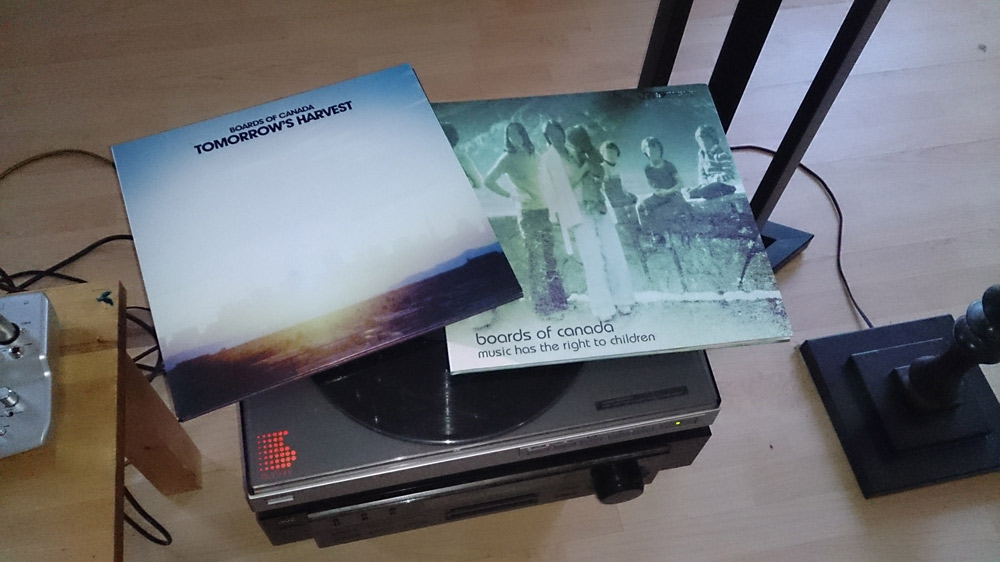
In my day, electronic music was synonymous with the future, it was sci-fi music. Boards of Canada, a Scottish duo, somehow turned that around completely and have made faded remembrance the signature of their electronic music. They’ve staged this obsessive theme across 4 albums. Music Has the Right to Children, their first full length, was an instant sensation in the electronic underground hothouse of late 90s Europe, being often compared to the Beatles for their time. Built from shards of hip hop, old documentary soundtracks, errant machines, My Bloody Valentine-like lathed-down distortion beds, and some really nice tunes, the result was still nothing like all that. Instead there’s a haze of dim childhood memories, some fearful, some pleasant but all now painfully inaccessible, irretrievably lost.
Tomorrow’s Harvest, new this year, isn’t remembering childhood. It’s remembering now, this world, our world, from a time when there isn’t much of it left. This is both sci-fi futurist electronic music, and a faded memory of an impossibly lost past, a place of ghosts and ruins. The whole album is infused with that feeling I think many of us are feeling these days, an uneasy sense of “where the hell is all this going to end up?”
This is Boards of Canada’s dark Sgt. Pepper‘s, a perfect summation in music of what millions are now feeling, a moment in time, crystallized, ready for memory.
(I recommend full screen for this video.)

 Blowhard, Esq.
 Callowman
 Sherbrooke
 Eddie Pensier
 Enzo Nakamura
 Epaminondas
 Fabrizio del Wrongo
 Fenster
 Brundle Guy
 Glynn Marshes
 Paleo Retiree
 Atypical Neurotic
 Question Lady
 Sax von Stroheim
 Sir Barken Hyena
 The Mistaken
 Uncouth Reflections
Creed Taylor is the man. Not only do those Verve records sound amazing, but I’m also a huge fan of his later A&M and CTI work, which share similar production values and superior sound. Much of this stuff was written off as schmaltzy elevator music by the jazz crowd, but for me the good outweighs the bad by a large amount. You can still find beautiful CTI gatefolds for only a few dollars.
LikeLike
Thanks for the tip, I’ll keep my eyes peeled.
LikeLike
Thanks for the recommendations. I’m listening to the Astrud Gilberto right now and it’s great. Just wanted to note that all of these albums, except Freeze Frame, are streaming on Spotify.
LikeLike
Spotify is a great way to discover new music, I use it all the time for that
LikeLike
Pingback: Vinyl Record Reviews
Pingback: Bargain Bin Vinyl Du Jour | Uncouth Reflections