(Mostly) Clothed Ladies Of The Week: The Getty Museum

Eddie Pensier writes:

Earlier this year I accompanied Blowhard Esq, brother of Blowhard (hereafter referred to as BOB) and occasional commenter Tex for a visit to the Getty Museum in Los Angeles. Despite being the sort of modernist architecture we normally abhor here at UR, I found the Getty to be a delightful place, well-organized inside and with charming, restful gardens outside.

Here I give you some feminine highlights from our trip. Personal favorites include Ter Brugghen’s bawdy Bacchante with an opportunistic little monkey; Godward’s Mischief and Repose, whose title fills in whatever blanks you might still have after seeing the languid poses, blissful expressions and translucent dresses; Pippi’s infant Bacchus getting what appears to be a handjob from Semele; and a ringer– Hals’ John the Evangelist, who looks so beautiful I had to include him here.

Mild neoclassical nudity after the break. Continue reading

Posted in Art, Travel | 1 Comment

Cocktails Du Jour

Eddie Pensier writes:

WP_20150729_005

“Cherry Coconut Blazer” (coconut-infused whiskey, cherry-infused cognac, chocolate liqueur and chocolate bitters, flambéed in situ and garnished with nutmeg before serving, still warm) and “Ryan Gosling Flip” (Gosling’s rum, sherry, chocolate liqueur, banana bread syrup, black walnut bitters, and whole egg) at Hippo Co.

The Blazer packed an unholy initial punch from the alcohol vapor, and continued to delightfully sear the throat on the way down. It tasted like a Cherry Ripe but in liquid intoxicating form.

The Flip was quite simply the milkshake of the gods, rich and unctuously palate-coating from the egg. That and the banana-bread syrup provided rich bakery notes to accentuate the inherent sweetness of the rum and sherry. No complexity here, no contrasts, just pure sweet indulgence.

Related

Posted in Food and health, The Good Life | Tagged , , | 2 Comments

Guest Post: The Woman in the Window

Blowhard, Esq. writes:

Sometimes things don’t happen the way we anticipate and we find a piece of art that helps us make sense of things. In this special guest post, an academic finds himself in an online relationship that takes a depressing turn yet he finds solace in Lang picture.

joanbennett

Joan Bennett and Joan Bennett in The Woman in the Window

“Love is like luck. You have to go all the way to find it.” — Robert Mitchum in Out of the Past

By Richard Armstrong

For a year, from December 2013 to December 2014, I had an online relationship with a woman we will call ‘S’. It began innocuously enough with daily chats about work and our mutual interests in culture and art, books and cinema, and eventually expanded into personal and private matters. Through the power of email (sometimes three or four a day) and Skype (two or three times a week), we reached an emotional intimacy and exhibitionism which led us to believe that we had indeed fallen in love with one another. True, there was distance to consider: S lived in Omaha, Nebraska, while I’m in Cambridge in the U.K. But the bond had been formed and plans were made to get together in the flesh.

During the course of all this, S sold her house and moved into an apartment which she transformed into a cozy little love nest for when I’d come and live with her. We spoke about the blissful mornings we’d spend making love, showering together, of gazing into each other’s eyes over breakfast. We believed we had met our match and shared our dreams as well as our misgivings. We talked of pooling our incomes and being there for one another — always. I called her ‘honey,’ she called her bed ‘our bed.’ She longed to introduce me to her parents and her brother. In her off-moments as a part-time waitress, S would write me long letters on the backs of menus which she’d mail to me, along with postcards, books, and even a tee-shirt she’d worn — which I gently mashed under my nose, hoping to draw out her fragrance. Her day job as a kindergarten teacher caused me great worry in the wake of some highly-publicized school shootings in the States. I felt the need to be with her, for her.

When December 2014 rolled around I was able to arrange an extended holiday and flew off for the States. Our hearts and minds were brimming with joyful scenarios. What happened after I arrived, however, was most certainly not part of the plan. There are times when life imitates art, but here life intruded upon art. That our rapport failed to live up to its promise, that our relationship ended a few days after we met, was a wake-up call filled with mutual disappointment and pain. For we discovered ours was a visual relationship far more ‘real’ than the sexual and amorous one we believed we had. As S told me to my face, “it worked online, but not in person…”

Stunned and feeling uneasy and out of place, my mind constantly replayed any number of scenarios with S in a feeble attempt to sort things out, a handful of rose-colored memories of what we once had clashing with sour reality. We both decided to cut the visit short, and I flew home. Staring out the window of the plane, searching for something (anything) to occupy my thoughts, thoughts of The Woman in the Window, the 1944 thriller directed by Fritz Lang, passed through my mind. I remembered an early scene in which the middle-aged academic (played by Edward G. Robinson) gazes through the window of a small gallery at a painting of a woman. As he arbitrarily studies the subject’s face and body, he becomes aware of a presence standing beside him, a mirrored reflection in the window of the woman in the portrait. It was the woman in the window in the flesh (played by Joan Bennett). The similarity between the love-struck professor’s gaze and my online gazing at S, wanting and needing her, was telling. That the professor first ‘meets’ the woman as an image through a glass screen just as I first saw S, and then meets her for real, seemed to mimic the various stages of my relationship with S. That our relationship failed in real life seemed to emulate the disastrous outcome of the professor’s involvement with the woman. But it also echoed, metaphorically at least, the fact that, for the professor, the whole episode turns out to have been a dream from which he’ll awaken feeling uneasy and confused. Just as I was feeling now.

Rifling through these moments in The Woman in the Window, I began to wonder why I so often turned to the movies for answers to real questions, for points of reference to points of my life, and speculated if the cold and abrupt demise of our love somehow had something to do with years of watching movies and the involvement S and I shared on the internet. Was ours merely a ‘looking relationship?’

Back home I made an effort to find out. I tracked down an article by Laura Mulvey in Screen magazine from 1975, a well-known polemical piece entitled Visual Pleasure and Narrative Cinema, in which she wrote: “The magic of the Hollywood style at its best (and of all the cinema which fell within its sphere of influence) arose, not exclusively, but in one important aspect, from its skilled and satisfying manipulation of visual pleasure.” Born respectively in 1967 and 1959, albeit thousands of miles apart, S and I were there to witness and absorb the postwar revival of classic Hollywood films flooding the airwaves on both American and U.K. television, a trend which peaked around the time Mulvey’s article was published.

Mulvey argues that the visual pleasure derived from classical Hollywood cinema and its imitators is informed by the (male) spectator’s scopophilic desire to look and that this looking is organized around a gendered relation in which the spectator admires, and eventually desires, the female love interest via identification with the male protagonist’s desire, a look which is facilitated by the look of the camera, itself driven by the film’s narrative of heterosexual closure. With a little cross referencing, I found this by Susan Hayward in her book, Cinema Studies: The Key Concepts: “In psychoanalytic film theory (in the 1970s) scopophilia was adapted to elucidate the unconscious processes at work when the spectator views the screen.” Originally used by Freud to characterize the infant child’s libidinal drive to pleasurable viewing, scopophilia is described in modern psychiatry as: “the obtaining of sexual pleasure by looking at nude bodies, erotic photography etc.” Meanwhile, Mulvey: “The cinema offers a number of possible pleasures. One is scopophilia. There are circumstances in which looking itself is a source of pleasure, just as, in the reverse formation, there is pleasure in being looked at.” In a very different historical and technological context, this cinematic model of looking relations significantly informs my rapport with S. Acculturated by years of watching Hollywood films, my looking at S conformed to the model’s satisfaction of my deep-seated desire to look, and to see. Meanwhile, S derived pleasure from being seen. Often she would wear make-up; sometimes she would dress especially to ‘meet’ me.

“The conventions of mainstream film focus attention on the human form,” wrote Mulvey. “Scale, space, stories are all anthropomorphic. Here, curiosity and the wish to look intermingle with a fascination with likeness and recognition: the human face, the human body, the relationship between the human form and its surroundings, the visible presence of the person in the world.” Echoing Mulvey, S “so manifestly” wished to show herself. Our Skype sessions rapidly assumed a pattern. We talked — and talked, she glanced down at herself, she moved the camera so that I could see her cleavage, her breasts, hands, fingers… Finally, she’d bring herself to orgasm as I watched. Even the movement of her Skype camera seemed to mimic the camera movement of a film, facilitating my ability to follow the ‘narrative’, to ‘have’ the woman, to realize the heterosexual narrative of desire. As Mulvey observes: “she knows her part is to perform” (my italics).

“In their traditional exhibitionist role,” Mulvey continues: “women are simultaneously looked at and displayed, with their appearance coded for strong visual and erotic impact so that they can be said to connote to-be-looked-at-ness.” Concerning the aesthetic organized around the dichotomy between male activity and female passivity, Mary Ann Doane wrote in her essay, Film and the Masquerade: Theorizing the Female Spectator: “The woman’s beauty, her very desirability, becomes a function of certain practices of imaging — framing, lighting, camera movement, angle.” Taking my ‘direction’, S would lower the camera so that I could see her, the technological medium being manipulated to cater to my desire. For her, just being seen in this way was arousing. Registering my yearning to look at and see her, it simultaneously fuelled her desire to be looked at. In accordance with the relationship between the female spectator and the cinema screen, for S the pleasure came from ‘being’ the image, a form of narcissism driven by her perception of herself as: “that which is there to be seen.” Doane mobilizes the work of French feminist theorist Luce Irigaray to discuss the nature of this close female identification of self with herself: “an autoeroticism based on the embrace of the two lips which allow the woman to touch herself without mediation.” In this regard, it is wholly appropriate that S should have pleasured herself as we talked.

In the orgasms that S experienced which were, importantly, the climax of our Skype pattern, there was also an undeniable echo of the modern film industry’s ‘money shot’. As Jane Mills explains in her book, The Money Shot — Cinema, Sin and Censorship: “Originally mainstream filmmaker’s slang for the image that cost the most money to produce, the phrase was subsequently appropriated by the pornography industry for the male ejaculatory climax, ‘come shot’ or ‘cum shot’, because porno producers paid their male performers extra for it. It’s the shot the punters pay to see.” Given the technological nature of our liaison, was S’s orgasm our own ‘come shot’, the scene S came to experience and I came to see?

“The viewer must not sit either too close or too far from the screen,” Doane says of the proximity between the spectator and what he’s watching. “The result of both would be the same — he would lose the image of his desire.” (Notice the viewer is a he). When I sat at such a distance from my computer monitor to see S opposite me, that is, her head and shoulders, my pose echoed that of the male spectator in the cinema gazing at a classical mid-shot of the heroine on-screen. But if I moved my face closer, her image became fragmented, disparate, unsatisfying, as it would if I moved into too close proximity with the cinema or television screen while watching a film.

As at the cinema, we both desired somebody who was not actually there, an absence which was only exacerbated by the fact that I was in Cambridge and S was thousands of miles away in Omaha. And, as so often at the cinema, even the time on-screen and the time of watching differed owing to the time difference between us. If like the cinema, there was “so much to see,” S was not actually there.

Posted in Movies, Sex | Tagged , , , , | Leave a comment

Architecture and Color, Once Again

Paleo Retiree writes:

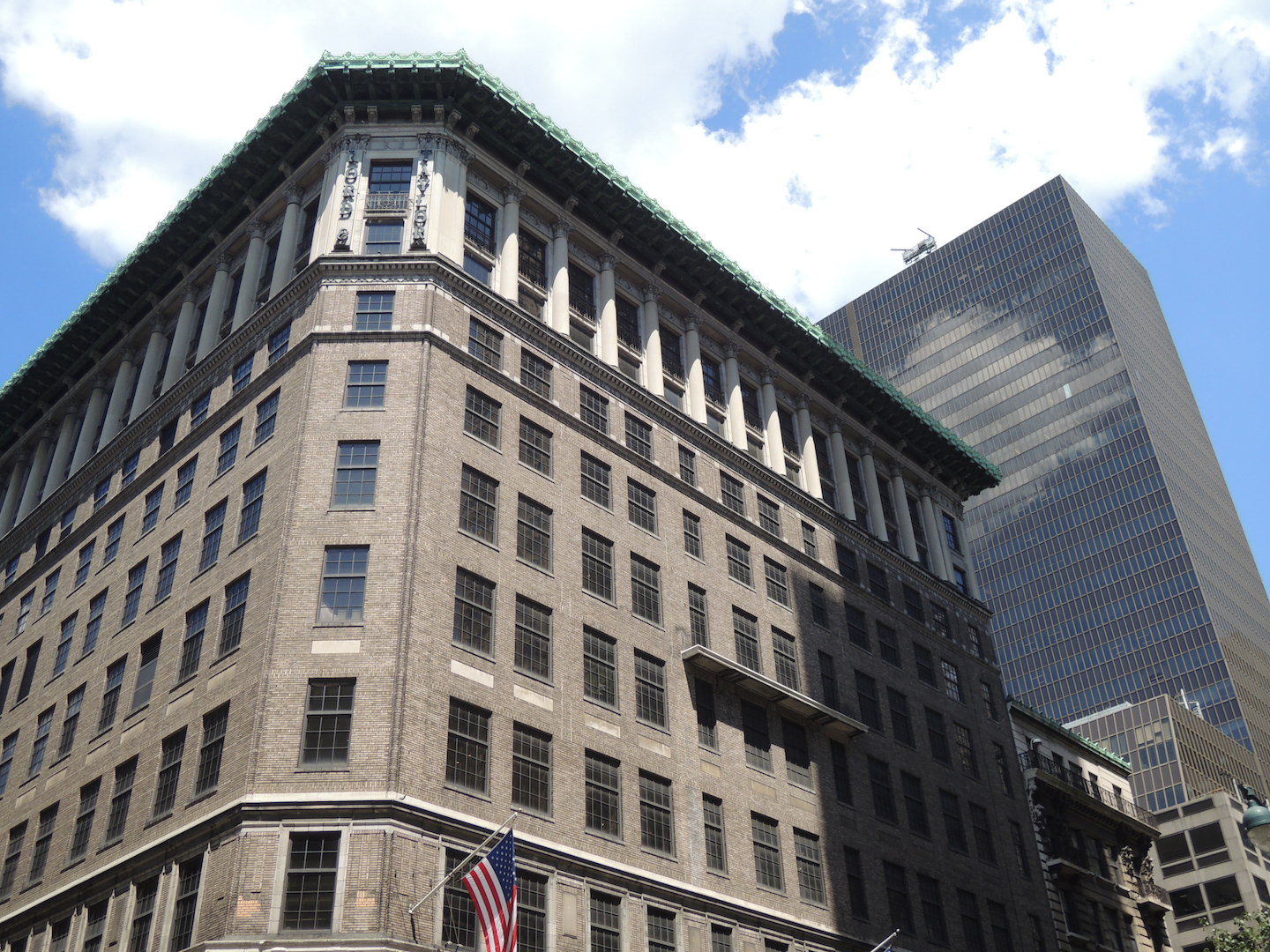
Blowhard, Esq.’s recent posting about architecture and color prompted me to pull out the iPhone a lot during my daily walks around downtown NYC. For the sake of this posting, please ignore the dramatic differences in shapes, designs, depth and materials in these collages. Let’s focus only on the question of color.

Trad buildings:

downtown_color_collage

That’s quite a range, and quite a bouquet, of colors: olive, gold, raspberry, copper, oxblood, mint …

Now, a collage of very recent buildings:

downtown_non-color

I’m hard put to discern any colors at all in that collection of snaps. If it weren’t for the blue-green of certain kinds of glass and the blue of the sky, the collage wouldn’t lose a thing by being reproduced in black and white.

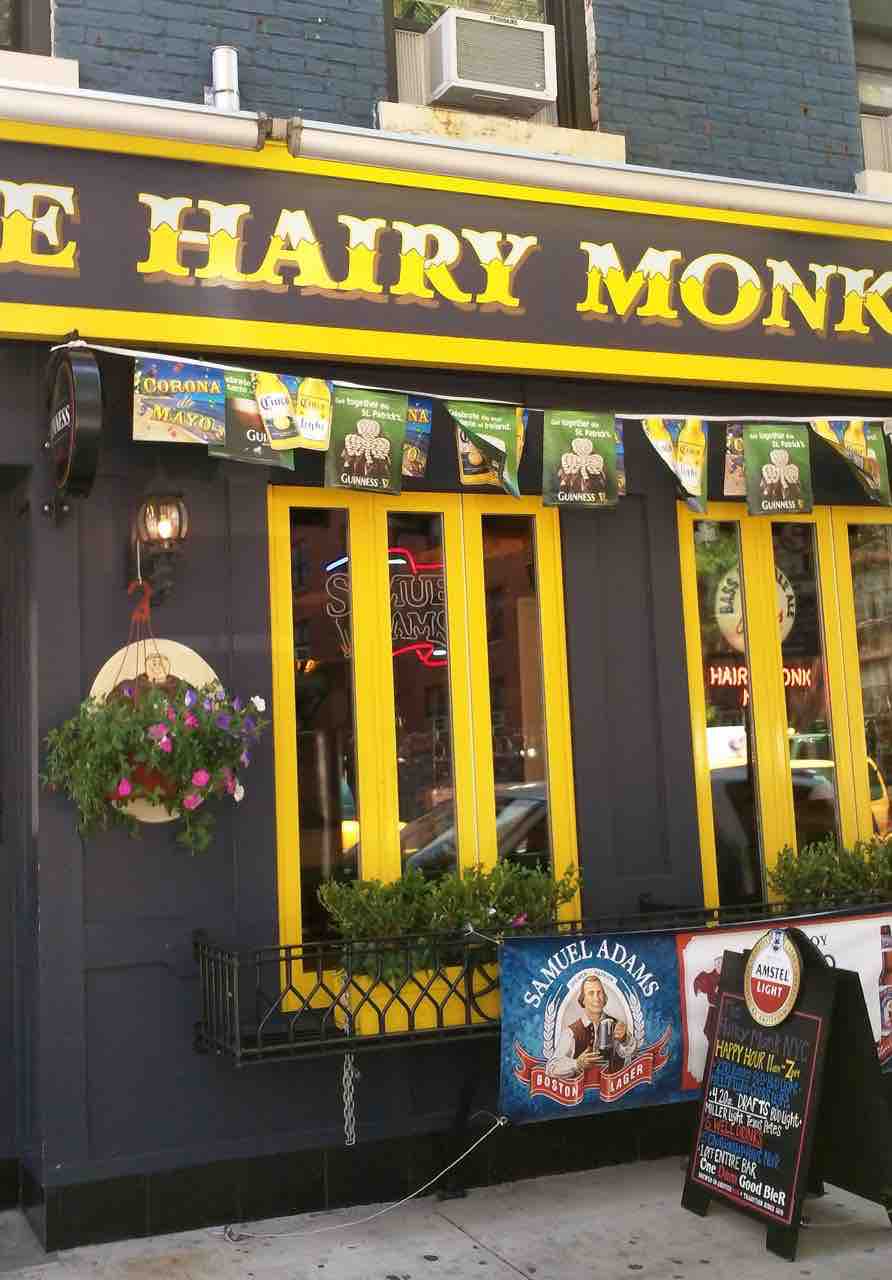
Happy to admit that this isn’t a completely fair comparison. I certainly ran across a few newer buildings that featured touches or color, and the number of older buildings that are ivory, tan or gray isn’t insignificant. Oddly, it’s rare that one runs across black in traditional buildings. The one genre of trad building/space that is reliably black is this:

Irish bars. It’s a convention that I don’t understand. Does anyone know where it comes from? And what is it about the Irish and black generally? They like their black leather jackets too. I’ve always assumed it has to do with the weather — the gray skies, the damp and the chill, the peat and the coal. But what do I know?

Anyhoo: while I was certainly trying to play up the contrast between trad architecture and contempo buildings, I think the comparison is totally fair as a general rule. When your eyes are open to the question of the color of the buildings around you, it’s incredibly striking how warm and various trad buildings are and how monochromatic and neutral contempo buildings are. If anyone should be tempted to point out that, while many of the trad buildings I’ve shown have coats of paint on them, most of the contempo buildings are of glass and metal — well, sure. But doesn’t that help make the point that trad buildings give us the freedom to do as we please with ’em (including applying colors of our choice) while contempo architects and developers are forever locking us into rigid, top-down, cold concepts?

Color, as anyone who has taken Painting or Design 101 knows, means vibration and festiveness. It means life. Why do our current masters want to starve us of all that? And what kind of desolate, if chic, cemetaries are they trying to turn our cities into?

Related

Posted in Architecture | Tagged | 6 Comments

Architecture Du Jour

Blowhard, Esq. writes:

Of each pair, which do you prefer? Which would you rather look at every day? Which do you think has the more inviting and comfortable interior?

chinatown midtown

Click on the images to enlarge.

Posted in Architecture | Tagged , , | 9 Comments

Obvious Things

Blowhard, Esq. writes:

ChestertonIn the red circle of the desert, in the dark and secret place, the prophet discovers the obvious things. I do not say it merely as a sneer, for obvious things are very easily forgotten; and indeed every high civilisation decays by forgetting obvious things.

— G.K. Chesterton, “The New Jerusalem”

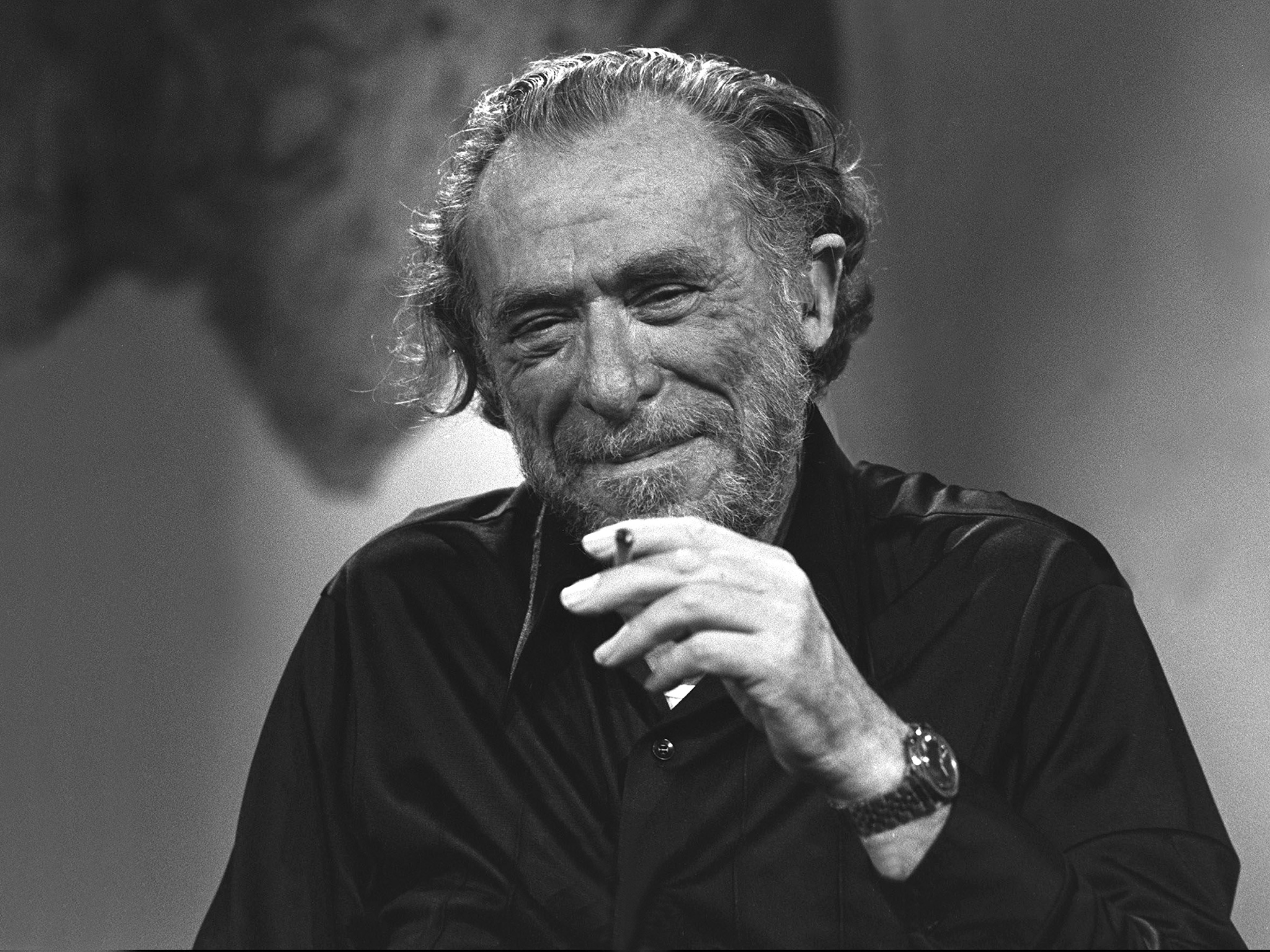
charles-bukowski-hulton-gettythe important
thing
is
the obvious
thing
that
nobody
is
saying

— Charles Bukowski, “Always”

Posted in Books Publishing and Writing | Tagged , , | 1 Comment

Haven’t You an Adventurous Soul, Mr. Bayliss?

Fabrizio del Wrongo writes:

cruise_ship_deck

He had scarcely seen her to speak to since the beginning of the voyage. When she was not walking with Rolly or playing shuffle-board with Twombley, she was down below ministering to the comfort of a chronically sea-sick aunt, referred to in conversation as “poor aunt Nesta”. Sometimes Jimmy saw the little man–presumably her uncle–in the smoking-room, and once he came upon the stout boy recovering from the effects of a cigar in a quiet corner of the boat-deck: but apart from these meetings the family was as distant from him as if he had never seen Ann at all–let alone saved her life.

And now she had dropped down on him from heaven. They were alone together with the good clean wind and the bracing scud. Rollo, Clarence, Dwight, and Twombley, not to mention Edgar or possibly Teddy, were down below–he hoped, dying. They had the world to themselves.

“I love rough weather,” said Ann, lifting her face to the wind. Her eyes were very bright. She was beyond any doubt or question the only girl on earth. “Poor aunt Nesta doesn’t. She was bad enough when it was quite calm, but this storm has finished her. I’ve just been down below, trying to cheer her up.”

Jimmy thrilled at the picture. Always fascinating, Ann seemed to him at her best in the role of ministering angel. He longed to tell her so, but found no words. They reached the end of the deck, and turned. Ann looked up at him.

“I’ve hardly seen anything of you since we sailed,” she said. She spoke almost reproachfully. “Tell me all about yourself, Mr. Bayliss. Why are you going to America?”

Jimmy had had an impassioned indictment of the Rollos on his tongue, but she had closed the opening for it as quickly as she had made it. In face of her direct demand for information he could not hark back to it now. After all, what did the Rollos matter? They had no part in this little wind-swept world: they were where they belonged, in some nether hell on the C. or D. deck, moaning for death.

“To make a fortune, I hope,” he said.

Ann was pleased at this confirmation of her diagnosis. She had deduced this from the evidence at Paddington Station.

“How pleased your father will be if you do!”

The slight complexity of Jimmy’s affairs caused him to pause for a moment to sort out his fathers, but an instant’s reflection told him that she must be referring to Bayliss the butler.

“Yes.”

“He’s a dear old man,” said Ann. “I suppose he’s very proud of you?”

“I hope so.”

“You must do tremendously well in America, so as not to disappoint him. What are you thinking of doing?”

Jimmy considered for a moment.

“Newspaper work, I think.”

“Oh? Why, have you had any experience?”

“A little.”

Ann seemed to grow a little aloof, as if her enthusiasm had been damped.

“Oh, well, I suppose it’s a good enough profession. I’m not very fond of it myself. I’ve only met one newspaper man in my life, and I dislike him very much, so I suppose that has prejudiced me.”

“Who was that?”

“You wouldn’t have met him. He was on an American paper. A man named Crocker.”

A sudden gust of wind drove them back a step, rendering talk impossible. It covered a gap when Jimmy could not have spoken. The shock of the information that Ann had met him before made him dumb. This thing was beyond him. It baffled him.

Her next words supplied a solution. They were under shelter of one of the boats now and she could make herself heard.

“It was five years ago, and I only met him for a very short while, but the prejudice has lasted.”

Jimmy began to understand. Five years ago! It was not so strange, then, that they should not recognise each other now. He stirred up his memory. Nothing came to the surface. Not a gleam of recollection of that early meeting rewarded him. And yet something of importance must have happened then, for her to remember it. Surely his mere personality could not have been so unpleasant as to have made such a lasting impression on her!

“I wish you could do something better than newspaper work,” said Ann. “I always think the splendid part about America is that it is such a land of adventure. There are such millions of chances. It’s a place where anything may happen. Haven’t you an adventurous soul, Mr. Bayliss?”

No man lightly submits to a charge, even a hinted charge, of being deficient in the capacity for adventure.

“Of course I have,” said Jimmy indignantly. “I’m game to tackle anything that comes along.”

“I’m glad of that.”

Her feeling of comradeship towards this young man deepened. She loved adventure and based her estimate of any member of the opposite sex largely on his capacity for it. She moved in a set, when at home, which was more polite than adventurous, and had frequently found the atmosphere enervating.

“Adventure,” said Jimmy, “is everything.”

He paused. “Or a good deal,” he concluded weakly.

“Why qualify it like that? It sounds so tame. Adventure is the biggest thing in life.”

It seemed to Jimmy that he had received an excuse for a remark of a kind that had been waiting for utterance ever since he had met her. Often and often in the watches of the night, smoking endless pipes and thinking of her, he had conjured up just such a vision as this–they two walking the deserted deck alone, and she innocently giving him an opening for some low-voiced, tender speech, at which she would start, look at him quickly, and then ask him haltingly if the words had any particular application. And after that–oh, well, all sorts of things might happen. And now the moment had come. It was true that he had always pictured the scene as taking place by moonlight and at present there was a half-gale blowing, out of an inky sky; also on the present occasion anything in the nature of a low-voiced speech was absolutely out of the question owing to the uproar of the elements. Still, taking these drawbacks into consideration, the chance was far too good to miss. Such an opening might never happen again. He waited till the ship had steadied herself after an apparently suicidal dive into an enormous roller, then, staggering back to her side, spoke.

“Love is the biggest thing in life!” he roared.

“What is?” shrieked Ann.

“Love!” bellowed Jimmy.

He wished a moment later that he had postponed this statement of faith, for their next steps took them into a haven of comparative calm, where some dimly seen portion of the vessel’s anatomy jutted out and formed a kind of nook where it was possible to hear the ordinary tones of the human voice. He halted here, and Ann did the same, though unwillingly. She was conscious of a feeling of disappointment and of a modification of her mood of comradeship towards her companion. She held strong views, which she believed to be unalterable, on the subject under discussion.

“Love!” she said. It was too dark to see her face, but her voice sounded unpleasantly scornful. “I shouldn’t have thought that you would have been so conventional as that. You seemed different.”

“Eh?” said Jimmy blankly.

“I hate all this talk about Love, as if it were something wonderful that was worth everything else in life put together. Every book you read and every song that you see in the shop-windows is all about Love. It’s as if the whole world were in a conspiracy to persuade themselves that there’s a wonderful something just round the corner which they can get if they try hard enough. And they hypnotise themselves into thinking of nothing else and miss all the splendid things of life.”

“That’s Shaw, isn’t it?” said Jimmy.

“What is Shaw?”

“What you were saying. It’s out of one of Bernard Shaw’s things, isn’t it?”

“It is not.” A note of acidity had crept into Ann’s voice. “It is perfectly original.”

“I’m certain I’ve heard it before somewhere.”

“If you have, that simply means that you must have associated with some sensible person.”

Jimmy was puzzled.

“But why the grouch?” he asked.

“I don’t understand you.”

“I mean, why do you feel that way about it?”

Ann was quite certain now that she did not like this young man nearly as well as she had supposed. It is trying for a strong-minded, clear-thinking girl to have her philosophy described as a grouch.

“Because I’ve had the courage to think about it for myself, and not let myself be blinded by popular superstition. The whole world has united in making itself imagine that there is something called love which is the most wonderful happening in life. The poets and novelists have simply hounded them on to believe it. It’s a gigantic swindle.”

A wave of tender compassion swept over Jimmy. He understood it all now. Naturally a girl who had associated all her life with the Rollos, Clarences, Dwights, and Twombleys would come to despair of the possibility of falling in love with any one.

“You haven’t met the right man,” he said. She had, of course, but only recently: and, anyway, he could point that out later.

“There is no such thing as the right man,” said Ann resolutely, “if you are suggesting that there is a type of man in existence who is capable of inspiring what is called romantic love. I believe in marriage. . . .”

“Good work!” said Jimmy, well satisfied.

” . . . But not as the result of a sort of delirium. I believe in it as a sensible partnership between two friends who know each other well and trust each other. The right way of looking at marriage is to realise, first of all, that there are no thrills, no romances, and then to pick out some one who is nice and kind and amusing and full of life and willing to do things to make you happy.”

“Ah!” said Jimmy, straightening his tie, “Well, that’s something.”

“How do you mean–that’s something? Are you shocked at my views?”

“I don’t believe they are your views. You’ve been reading one of these stern, soured fellows who analyse things.”

Ann stamped. The sound was inaudible, but Jimmy noticed the movement.

“Cold?” he said. “Let’s walk on.”

Ann’s sense of humour reasserted itself. It was not often that it remained dormant for so long. She laughed.

“I know exactly what you are thinking,” she said. “You believe that I am posing, that those aren’t my real opinions.”

“They can’t be. But I don’t think you are posing. It’s getting on for dinner-time, and you’ve got that wan, sinking feeling that makes you look upon the world and find it a hollow fraud. The bugle will be blowing in a few minutes, and half an hour after that you will be yourself again.”

“I’m myself now. I suppose you can’t realise that a pretty girl can hold such views.”

Jimmy took her arm.

“Let me help you,” he said. “There’s a knothole in the deck. Watch your step. Now, listen to me. I’m glad you’ve brought up this subject–I mean the subject of your being the prettiest girl in the known world–”

“I never said that.”

“Your modesty prevented you. But it’s a fact, nevertheless. I’m glad, I say, because I have been thinking a lot along those lines myself, and I have been anxious to discuss the point with you. You have the most glorious hair I have ever seen!”

“Do you like red hair?”

“Red-gold.”

“It is nice of you to put it like that. When I was a child all except a few of the other children called me Carrots.”

“They have undoubtedly come to a bad end by this time. If bears were sent to attend to the children who criticised Elijah, your little friends were in line for a troupe of tigers. But there were some of a finer fibre? There were a few who didn’t call you Carrots?”

“One or two. They called me Brick-Top.”

“They have probably been electrocuted since. Your eyes are perfectly wonderful!”

Ann withdrew her arm. An extensive acquaintance of young men told her that the topic of conversation was now due to be changed.

“You will like America,” she said.

“We are not discussing America.”

— P.G. Wodehouse

Posted in Books Publishing and Writing | Tagged , | 6 Comments

(Semi) Naked Ladies of the Week: Girls of Zishy

Fabrizio del Wrongo writes:

z-cover

I don’t know about you, but I like looking at real (if beautiful) girls; Photoshopped-smooth simulacrums of pulchritude aren’t what get me going. Internet nudity used to offer a ton of funky naturalness — it’s what first attracted me to it. But now that internet porn is mainstream, much of what you find out there looks a lot like the digital-era version of “Playboy.” That is, drained of personality. And it can be so over-explicit, sometimes in a way that’s almost clinical. Zishy and its proprietor Zach Venice have provided a corrective to that. Zishy is an erotica site that doesn’t skimp on natural textures and funkiness. The avoidance of beaver shots, special effects, and post-production tinkering hasn’t resulted in boring pictures. Just the opposite — the photos on Zishy are enjoyable largely because you can sense the photographer and the models improvising as they try come up with interesting poses, looks, and attitudes. There’s a sense of fun and play in them. They have personality.

There’s not much outright nudity on Zishy. Venice has a keen sense for tease. He understands that part of what makes cheesecake so enjoyable is its tantalizing intimation of more: you keep looking because you haven’t seen everything.  The “about” page on Zishy makes this clear:

This site is about photography, fun, tease, and of course, attractive young women. The aim is to excite and entertain through an innocent and playful means. For all those bored (and possibly overwhelmed) by porn and nudity on the Web, but still interested in seeing beautiful girls in photos, Zishy is for you.

I believe the below models are Lilly Gardner, Anastasia Black, Rachel Snowflake, Alice Wonder, Anya Amsel, Ashlee Hills, Blake Crawford, Bree Abernathy, Debbie Vogel, and Natalie Moore. Cheesecake-style naughtiness below the jump. Have a great weekend.

Continue reading

Posted in Photography, Sex, The Good Life | Tagged , , , | 2 Comments

Crap Space 1

Paleo Retiree writes:

For no doubt perverse and disgraceful reasons I enjoy snapping photos of architectural goofs. One of the mistakes I’m most drawn to noticing and documenting is what I think of as “crap space” — pockets of in-betweenness (or out-in-frontness, or just plain overlooked-ness) that might have had some life had they been conceived of and created with care and respect, but which in reality weren’t and so just don’t.

Modernism, you’ll be stunned to learn, has been spectacularly successful in the generation of crap spaces — plazas no one lingers in, parks the public avoids, indentations that collect windy swirls of garbage, etc. This particular tendency of modernism — its disastrously bad record where the spaces in between its art-thing buildings go — used to be openly  acknowledged even by modernists themselves. But that was back in a more lively, open and rowdy era. As the architectural establishment has reasserted its dominance over the public discussion of buildings and urbanism, that simple and self-evident fact — apparent to anyone with eyes and instincts — seems to have vanished down the memory hole. It’s time to pull it out and proclaim it loud, sez I. So today I kick off a new series: crap spaces. Let’s acknowledge that they exist; let’s talk about what may have gone wrong.

Today’s example strikes me as a primo example of something all too common: a new, or newish, park that simply isn’t working. I passed by and snapped it on a beautiful summer day. Why is almost no one using it? Despite the fact that it’s a handy shortcut between two streets, no one’s even walking through it. Why?

My own hunch is a very general one: it’s because nothing about this park really says “park.” Instead, despite the efforts that have been made to humanize it with furniture and greenery, this crap space declares itself to be pretty much what it almost certainly is: empty space that’s been inserted between two buildings for the sake of earning a developer a tax break. You can pretty much see the proposal’s checklist laid out in front of you: X number of square feet, X amount of vegetation, X number of benches, X touches of liveliness and playfulness, X pieces of movable furniture … According to current academic/urbanistic theory, the above list should, when translated into actual fact, all come together to equal “an inviting and user-friendly park.” Yet for some reason it doesn’t. The recipe remains a recipe, and never turns itself into a dish. A park is something more — something more traditional and more organic — than an empty space that has been filled up with a checklist of items that committees associate with parks.

Curious to hear what others’ hunches are about the failure of this crap space.

Related

  • To my mind, Christopher Alexander and Leon Krier explain better than anyone else why some buildings and spaces have life and some don’t. (As far as I’m concerned, in fact, Alexander and Krier both qualify as Major Geniuses of Our Era.) The best Alexander book to start with is this one. This is the Krier to start with. Both books are easy to read; they’re also complete mind-blowers with implications for all the arts, not just architecture. Read and be amazed. I reviewed the Krier book for Salon.
  • Back at my old blog, I did several interviews with the mathematician and architectural theorist Nikos Salingaros, an associate of Christopher Alexander’s. He’s very brilliant and clear. Start with this interview: Part One, Part Two, Part Three, Part Four, Part Five.
  • David Sucher’s “City Comforts” is a down-to-earth distillation of a lot of wisdom about how to create better towns and cities. Buy a dozen copies and give them to whoever it is who’s in charge of development in your town, county or city. I interviewed David at my old blog: Part One, Part Two.
  • It’s a mystery why the architecture-and urbanism-world doesn’t spend more time revisiting its creations and evaluating how well they work or don’t work. (Imagine a chef who takes no note of whether people enjoy his food …) William Whyte was an urbanist who did exactly that. His book “City” (which he co-wrote with Paco Underhill) was the result of his studies, and it’s full of fascinating looks at things like parks and street corners.
  • The Project for Public Spaces is a “placemaking” organization inspired by Whyte’s work.
Posted in Architecture | Tagged , , , , , , , | 11 Comments

Roller Girls, ’30s-Style

Blowhard, Esq. writes:

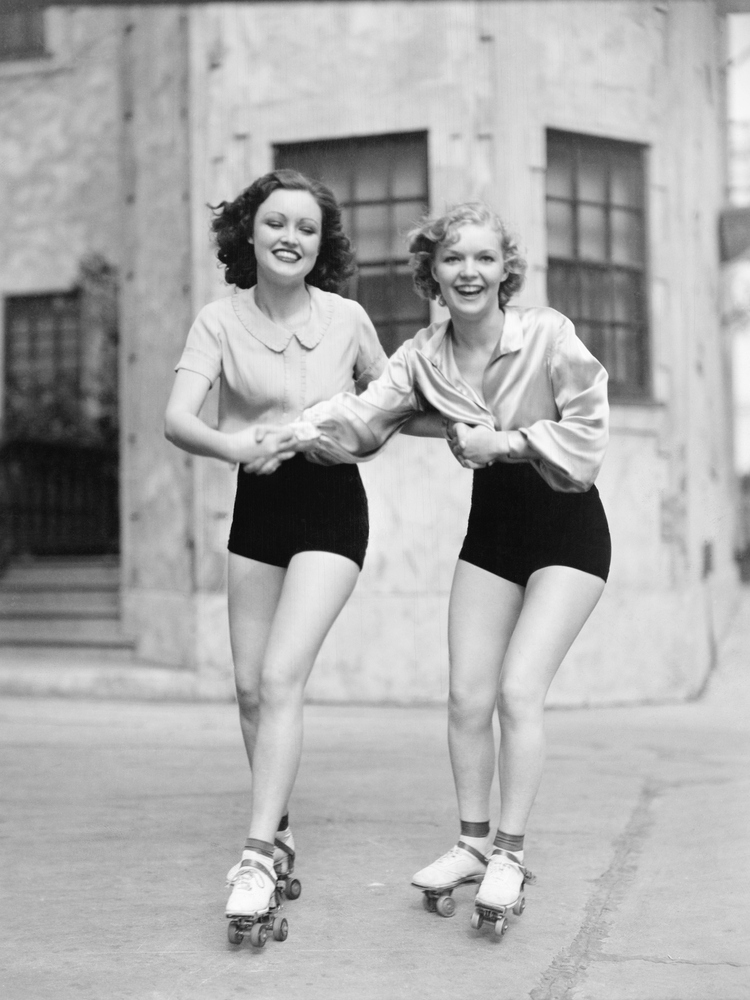
rollerskating1930s

Click on the image to enlarge.

Posted in Sex, Women men and fashion | Tagged , | 5 Comments