
Blowhard, Esq. writes:
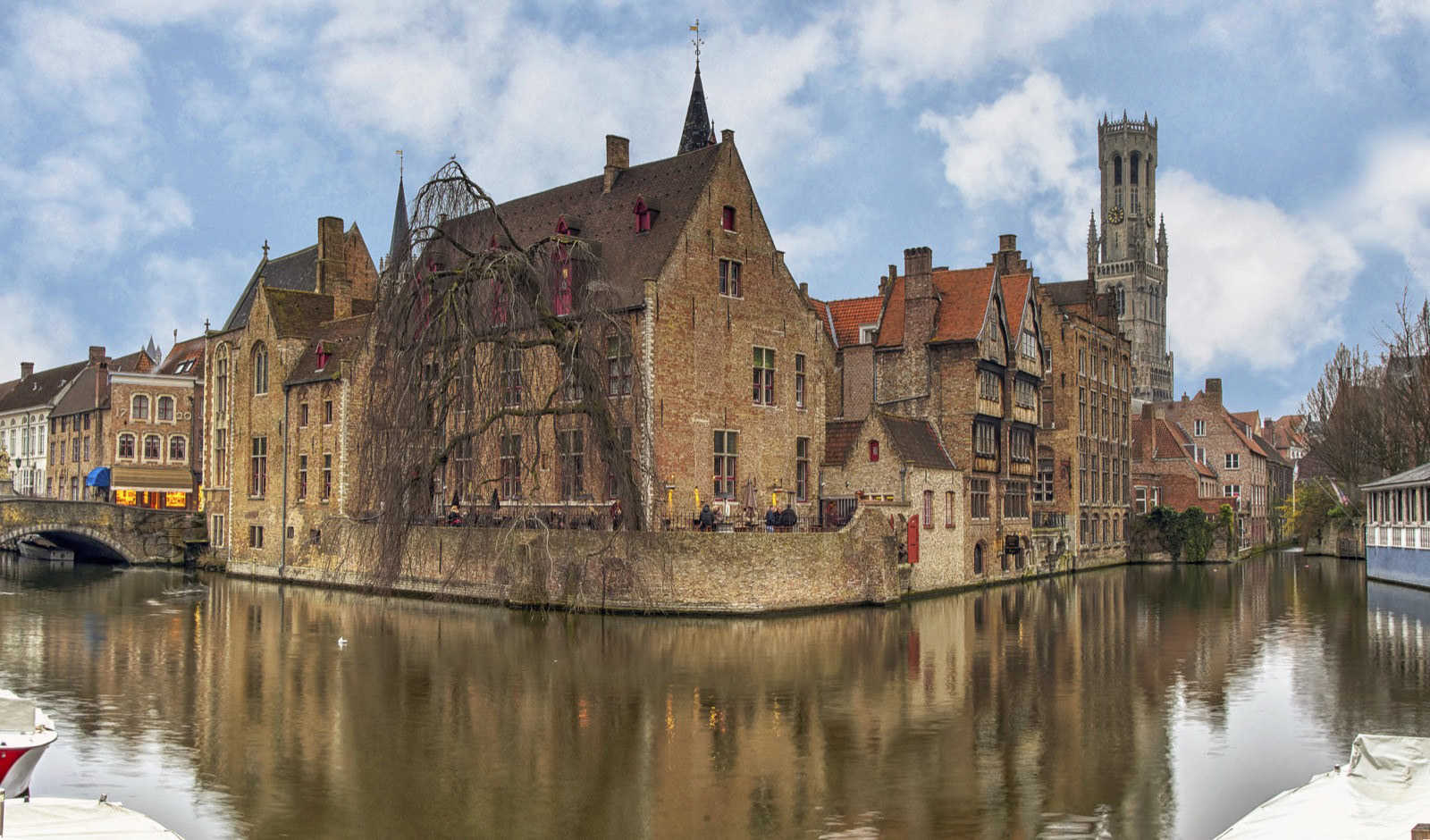
Bruges, Belgium.
Click on the image to enlarge.
Blowhard, Esq. writes:
Bruges, Belgium.
Click on the image to enlarge.
Blowhard, Esq. writes:
Lots of people are disappointed with this episode, but I enjoyed it. What’s wrong with an action-packed installment filled with hook-ups, rebuffs, and comic interruptions? Does every episode have to be slow and ponderous?
1. Betty is going back to school for a masters in psych. Anyone else surprised she and Henry are still together?
2. “This is what they do.” — Don on lawyers
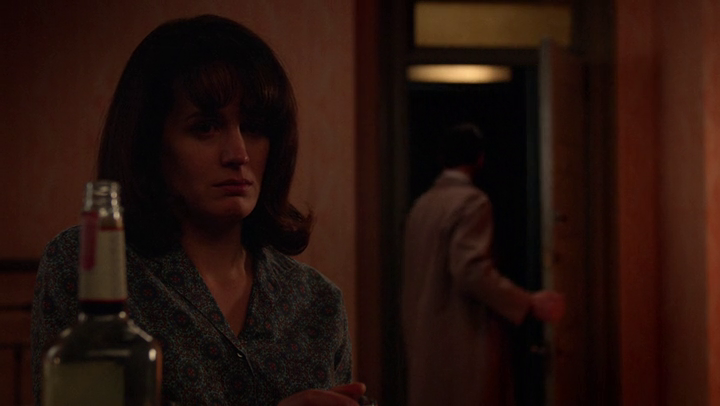
4. The episode was Diana centered, but Betty, Megan, and Lindsay Weir were all prominently featured. The nagging question is: What does Don see in Diana? Another lost soul keeping a secret pain who like Don is also from the Midwest. We learn that Diana has abandoned one of her children, an echo of Don’s real mother abandoning him when she died in childbirth. The most striking visual note was the shot of Don walking out of Diana’s flophouse apartment, a tableaux that references a thousand pulp fiction covers.

5. Last week I said that Colonel Sanders was Roger’s style icon, but maybe it’s actually Marlin Perkins, whom Roger references specifically.
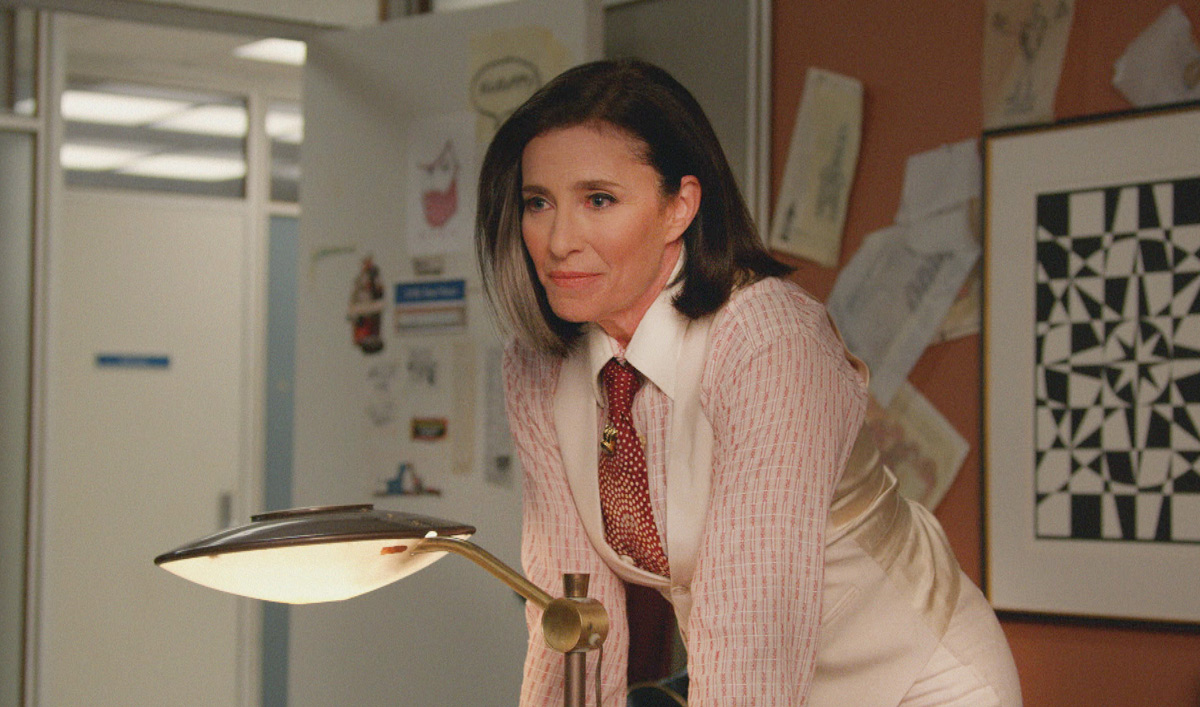
6. Happy to see Mimi Rogers pop up playing a fashion photographer who is half Annie Liebovitz, half Susan Sontag.
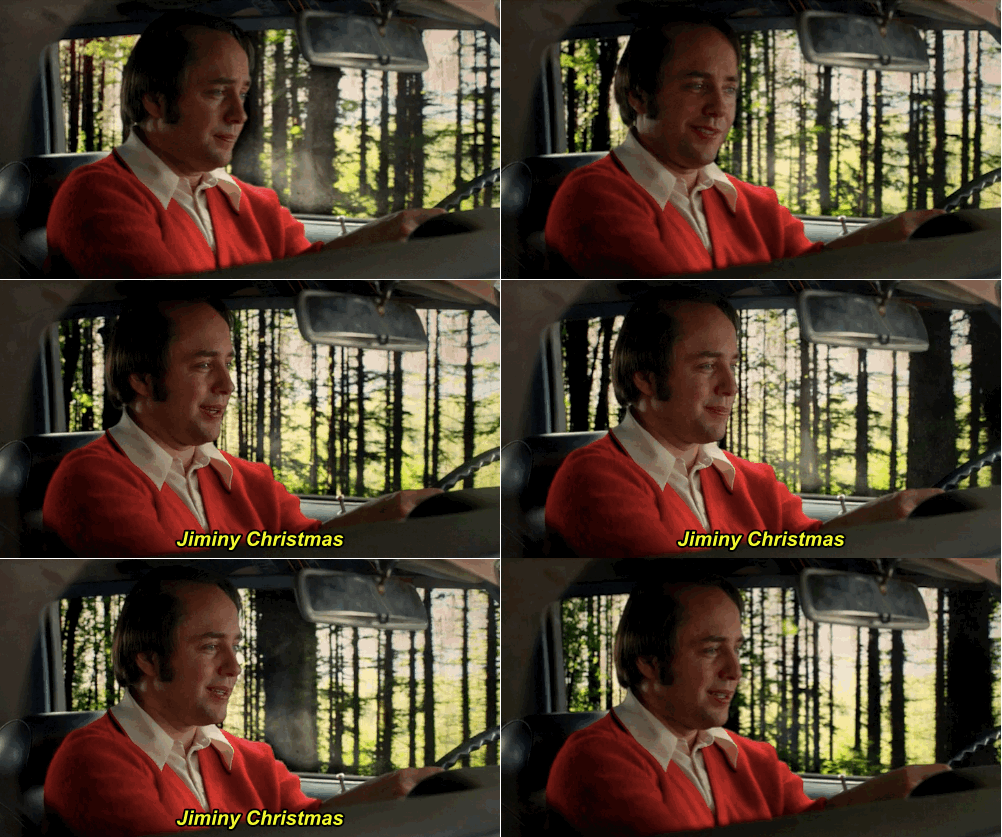
7. Can Pete please say “Jiminy Christmas!” more?
8. Harry finally puts the moves on Megan, something he’s been dying to do for a long time. Actually, everyone seems to hook up in this episode: Don and Diana, Stan and Pima, and Roger and Marie.

9. In case you were curious, $1 million 1971 dollars would be $5.8 million in 2015. A friend wonders if there’s any connection between Don’s $1m alimony check and the $5,000 check he wrote for Midge, the artist strung out on heroin, from season 1. Hmmm, not much that I can see. After he handed the check to Midge she told him she couldn’t cash it, so Don gave her some cash he had on him. But recall that Don did give Adam Whitman, his brother, a $5,000 check to get out of his life permanently.
Fabrizio del Wrongo writes:
 The 1959 “The Great War” is appropriately titled: it may be one of the great war films. Certainly it’s a thoroughly Italian one: a war film in which no one is sure who’s in charge or what’s being fought for, in which everyone wants to take off their uniforms, go home, and eat. (There’s a funny moment when the Italians are captured by stern-looking Austrians. They look at each other as if to ask, “Are these guys really serious about this war stuff?”)
The sardonic storyline, in which a pair of shirkers — they’re played by Alberto Soldi and Vittorio Gassman — repeatedly try to distance themselves from the fighting, anticipates “M*A*S*H,” and there are a couple of scenes that are as graceful as anything in “Grand Illusion.” (Well, okay, almost as graceful as anything in “Grand Illusion.”) Director Mario Monicelli has a painter’s eye for space and composition, yet nothing in his work feels static or posed. Many of the movie’s big events play out on the periphery of your awareness; they’re finished almost before you can admire them.
I particularly enjoyed Monicelli’s take on that sine qua non of WWI filmmaking, the over-the-barricades charge through No Man’s Land. After a series of stunning tracking shots showing Italian troops flooding the battlefield, Monicelli sabotages his big scene by diverting its action into a comedic bit involving the stringing of a phone line. By the time that’s resolved the attack has accomplished its goal of blowing a bridge — yet no one is sure how. Monicelli doesn’t even give you the sound of the explosion, just a miraculous shot of the smoldering structure and the soldiers’ astonished looks of relief. There’s a sort of heroism here, but it’s not expressed through violence or feats of great derring-do; it’s the simple, all-too-human heroism of perseverance, self-preservation, and good luck.
Like may war films, “The Great War” is a picaresque — one assembled around the unique personalities of Soldi and Gassman. The two men stand for the variegated character of Italian society. Soldi, the quintessential Roman, specialized in playing weaklings and cowards. Here he’s a low-to-the-ground milksop with the instincts of a sharpie. Gassman, from Genoa, is tall, matinee-handsome, with an aristocratic carriage that makes his buffoonery all the funnier. In tandem they suggest Don Quixote and Sancho Panza. (The resemblance wasn’t lost on Monicelli: he later cast Gassman as a Quixotic knight in his memorable “For Love and Gold.”) These two clowns, both icons of the Italian popular cinema, deserve to be considered among the great movie actors of the middle of the twentieth century.
Blowhard, Esq. writes:
Someone once said that TV recaps are the lowest form of writing — which is probably true — but why should that stop me? Therefore, I’ll be spouting random opinions and observations about the last half season of MAD MEN. A true superfan would’ve gone back and watched the previous 6.5 seasons in preparation for the endgame, but screw that, there are only so many hours in a day. So I’ll leave it up to y’all out there in BlogLand to fill in any gaps, allusions, and callbacks that I’ve missed.

1. OK, there’s at least one callback I picked up. The opening scene, with various models trying on furs while Don and the team evaluate them, is a reference to Don’s first job writing ad copy for a furrier. The hot model pictured above was played by Andie McDowell’s daughter Rainey Qualley, who belongs in the Movie Star Offspring Hall of Fame alongside Eva Amurri.
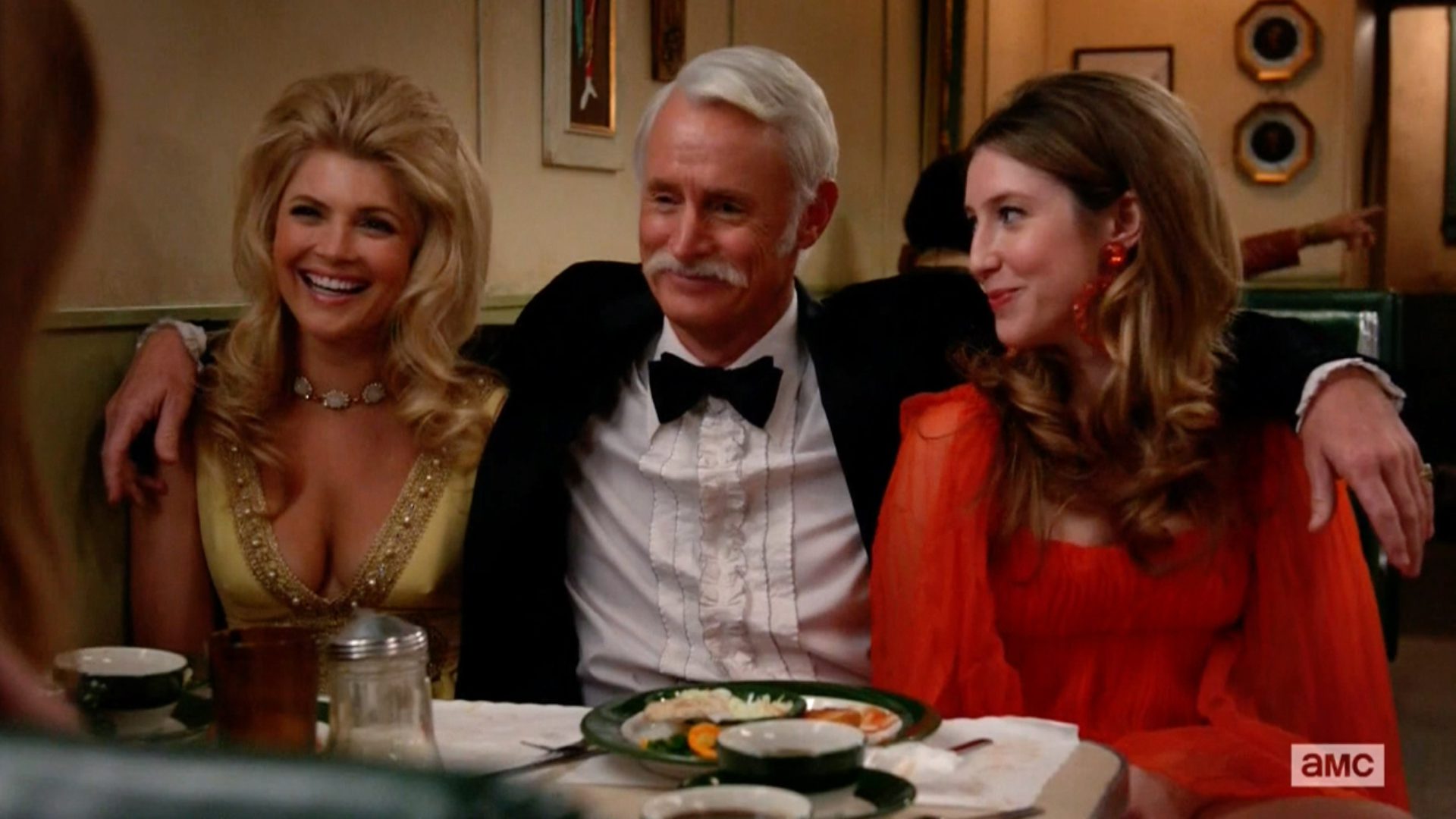

2. Roger’s 70s style icon is apparently Colonel Sanders.

3. Literary references include shout-outs to James M. Cain’s Mildred Pierce and John Dos Passos’s U.S.A. Trilogy. Dos Passos is one of those literary greats who largely goes unread now, no? Paleo Retiree wrote about Cain’s Mildred Pierce here.
4. “Apparently hemlines are going up.”

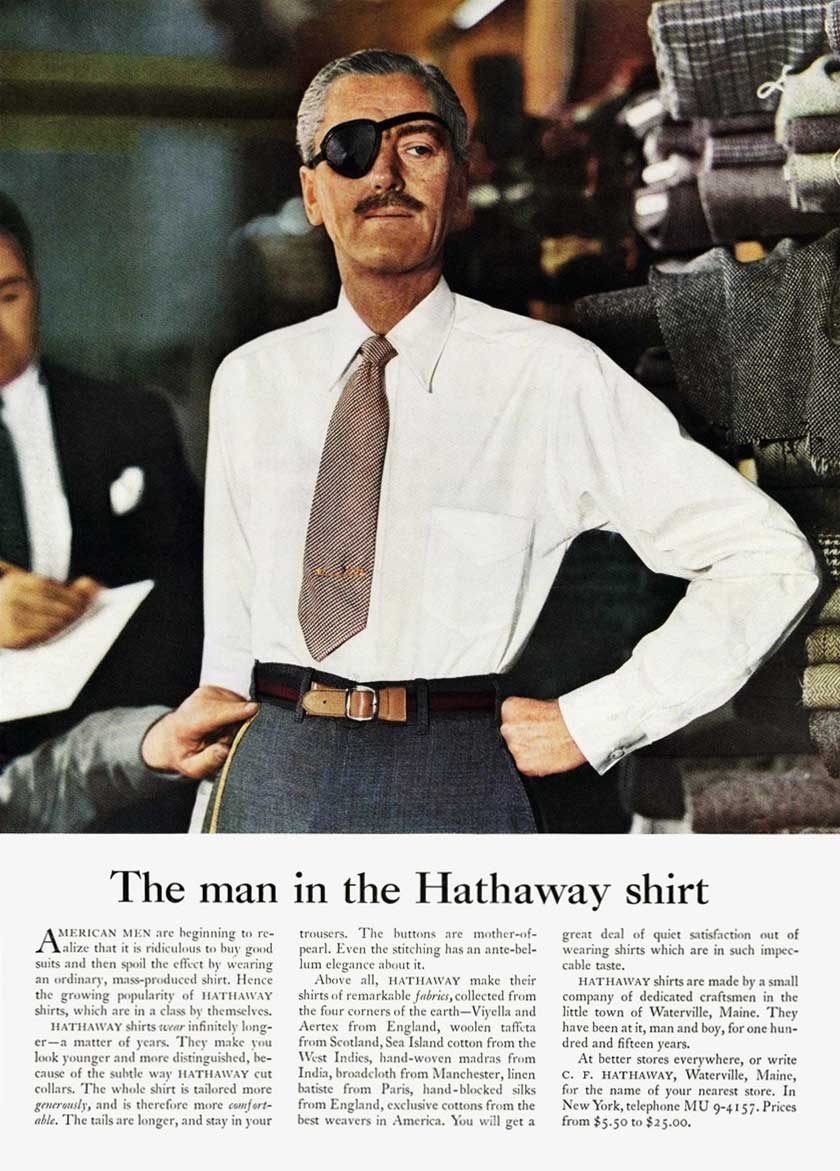
5. I’m late in putting two and two together, but Ken’s eyepatch look was surely inspired by David Ogilvy’s famous advertising campaign.
 6. The theme of the episode was death and the life not lived. On his way to Divorce #2, Don is living it up with a bevy of young beauties, but Rachel’s death and Ken’s near firing both give him pause. The big question among fans seems to be: will Don end up dying and how? Suicide? Liver failure? Will he realize what a dissolute life he’s lived? What has Weiner learned from the aftermath of David Chase’s controversial SOPRANOS ending? My prediction is the series will go out not with a bang, but a whimper.
Fabrizio del Wrongo writes:

Gawping at “science” evangelists has developed into one of my favorite pastimes. I use the scare quotes because, more often than not, the people who are celebrated as science evangelists (typically at places like Reddit) seem to be living out some kind of fantasy — one based more on wild flights of fancy than on what we traditionally think of as science.
Elon Musk, for instance, appears to have fashioned himself as a real-life Tony Stark, the billionaire inventor who is the alter-ego of Marvel’s Iron Man. (Or maybe Stark is based on Musk? It’s hard to tell sometimes.) From what I can tell, Musk made his fortune with PayPal, an internet money-transferring operation, and he cemented it through his involvement in Tesla Motors, an electric car company funded by a massive loan of taxpayer money. (Musk: he’s big on money transferring.) He’s also a mover and shaker in the realm of privately funded space shuttling, an industry that seems poised for growth now that NASA has shifted its focus to multiculturalism and climate change. Oh, and he talks a lot about traveling to Mars. No one can figure out what the point of going to Mars is. But, then, why not? If and when the time comes, Musk will presumably be there to transfer someone’s money all the way to the Red Planet.
Undoubtedly, Musk is a brilliant and ballsy guy. He’s also the kind of idiosyncratic tycoon that people root for. He excites the imagination. Certainly, I enjoy Musk and his brand of techno-adventuring a helluva lot more than Bill Gates and his dreary foundations.
Still, I can’t help but giggle at the seriousness with which many seem to take the guy. He’s widely seen as a symbol of enlightened courageousness. Take, for instance, this article’s calm proclamation that “with Elon Musk, nothing is impossible.” Let’s see, so far Musk has helped found PayPal, helped refine the electric car, and raised a lot of money for vague space adventures. Maybe I’m being overly jerky in my analysis, but none of these admittedly impressive achievements strikes me as being anything close to impossible.
To my way of seeing things Musk is a smart, ambitious dude who has found ways to make lots of dough while burnishing his image and cozying up to the Powers That Be. And now he’s using his money and influence to live out a nerd fantasy. More power to him. But why would I take his public gesticulations as anything more than entertainment?
Lately Musk and other science evangelists have been assuring us that computers will soon take over the world. There’s a sort of wishfulness to their warnings, a sense that they’d be more comfortable if things were run by robots rather than by, you know, people who shop at Walmart. This article even has physicist and television host Neil deGrasse Tyson predicting that our robot overlords will engineer a more docile race of humans. Presumably, computers being as smart and as rational as Tyson, they will inevitably breed the sort of people who watch “Nova.”
Like Musk, Tyson often seems to be inhabiting an image based on pop culture and fantasy. In his recent redo of the “Cosmos” series, Tyson pads across the deck of a CGI spacecraft as he calmly tells us about black holes, supernovas, and the dangers of anti-science bigotry. He doesn’t seem to realize how silly he looks. And it’s sometimes hard to tell whose footsteps he’s treading in, Carl Sagan’s or Captain Kirk’s.
As to the general idea of A.I. taking over . . . let’s just say I’m skeptical. It sure is fun to think about, and I don’t have a problem accepting Stephen Hawking’s opinion that it’s possible. But, ultimately, I can’t take it any more seriously than Musk’s fantasies of colonizing space. I’m no scientist, and I haven’t founded PayPal, so my opinion is probably invalid. Still, my guess is that robots taking over the world is about as likely from a 2015 perspective as the ideas in Mary Shelley’s “Frankenstein” were in 1818. That is, not very.
To me, all this wild imagining looks an awful lot like what we used to call “science fiction.” And while there is, of course, a degree of science in science fiction, the “fiction” is there for a reason. I’d even argue that it’s the more important word in the term.
Look, I’m not trying to denigrate sci-fi. I love sci-fi. I’ve read most of Asimov’s “Foundation” novels. Their sciencyness is felt mostly in their tone and the way in which they present themselves — that is, as escapism for rational-minded dudes who are bad at sports. The storylines, which involve people zipping around the galaxy, conversing with humanoid robots, and controlling things with their minds, is pure fantasy. Asimov’s making Hari Seldon a mathematician doesn’t make the character’s ability to predict the future a whole lot more science-based than it was when the Greeks had Cassandra do it 3,000 years ago. Seldon’s (and Asimov’s) sciencyness is a trapping.
Someone will probably pop into the comments to inform me that, technically speaking, it is possible to predict the future using math — just like Hari Seldon! Maybe. But by the time Elon Musk builds the computers necessary to run the equations, the human race will likely have died out or been replaced by incredibly well-behaved animatronic versions of Neil deGrasse Tyson. In other words, don’t hold your breath, nerdlingers.
I mean, lots of things are possible, right? Given enough time donkeys might evolve sentience and cure AIDS.
Here’s what I find amusing: 40 years ago the people fawning over Musk and Tyson would’ve been wearing ill-fitting Star Trek shirts and going to sci-fi conventions to argue about dilithium crystals. Now they wear ironic facial hair and go to TED Talks to argue about worm holes and sustainability. I wasn’t expected to take the former activity seriously; the latter activity I’m almost required to take seriously. Why?
Related
Paleo Retiree writes:

Could be wrong, but I’m pretty sure that this is the first time I’ve run across the adjective “trendy” being used (non-ironically, anyway) as an enticement. Is calling something “trendy” and meaning it as praise becoming a trend?
Fabrizio del Wrongo writes:

Are you a fan of freckles on girls? I’m a real freckles advocate — a devotee. Aimee Sweet has some nice ones. Not that that’s all that’s nice, of course. There’s the auburn hair, the legs, the . . . well, take your pick.
She started modeling in the ’90s, first with the great Suze Randall, then with a host of other outfits. According to Wikipedia, she’s acted in a few music videos, has done some TV work, has even spent time as a fashion model for the Elite agency. I think she’s retired now.
Freckled nudity below the jump. Have a good weekend.
Paleo Retiree writes:
I’ve been an avid follower of the U.Va “gang-rape at a frat house” imbroglio since Sabrina Rubin Erdely’s article first appeared in Rolling Stone’s Dec. 2014 issue. When I gave the story a read it took only a couple of paragraphs before I found myself thinking, “Hooo-eee, I’ll be curious to see how this one stands up under real scrutiny.” FWIW: I’ve worked as a reporter, a researcher and a fact-checker, and I’ve spent many hours going over stories with editors and lawyers. Working my way through Erdely’s article, all my professional alarm bells were clanging. (For one big thing, it read more like a movie — or a pornographic hallucination — than it did like a description of a real event.) My shrewd and intuitive wife was even quicker to react than I was. I’d read her only a couple of sentences when she interrupted me, saying, “It’s a hoax.” So I’ve been following reactions to the Columbia J School’s recent critique of the debacle avidly too. Here are a few of the — IMHO, of course — more interesting ones, plus some fun bonus links.
Curious to hear about any and all other good articles and postings about the episode.
Fabrizio del Wrongo writes:
Japanese:

Italian:

Cuban:

Fabrizio del Wrongo writes:

Blonde, architecturally proportioned Delilah — she also goes by Amanda, Danica, and a few other names — is from Russia, the world capital of hot naked chicks. She’s a lively model, one who seems to enjoy mugging and goofing off for the camera. I enjoy how her magazine-spread varnish is dinged here and there by a certain lived-in-ness; the laugh lines that appear on her face when she smiles are, I think, especially appealing.
These photos come from Amour Angels, MPL Studios, and Stunning 18. The MPL photos are, to my eyes, too digitally worked-over.
Nudity below. Happy weekend.
 Blowhard, Esq.
 Callowman
 Sherbrooke
 Eddie Pensier
 Enzo Nakamura
 Epaminondas
 Fabrizio del Wrongo
 Fenster
 Brundle Guy
 Glynn Marshes
 Paleo Retiree
 Atypical Neurotic
 Question Lady
 Sax von Stroheim
 Sir Barken Hyena
 The Mistaken
 Uncouth Reflections