
Blowhard, Esq. writes:
Blowhard, Esq. writes:
Blowhard, Esq. writes:

Aldwych Quarter, London.
Click on the image to enlarge.
Fabrizio del Wrongo writes:
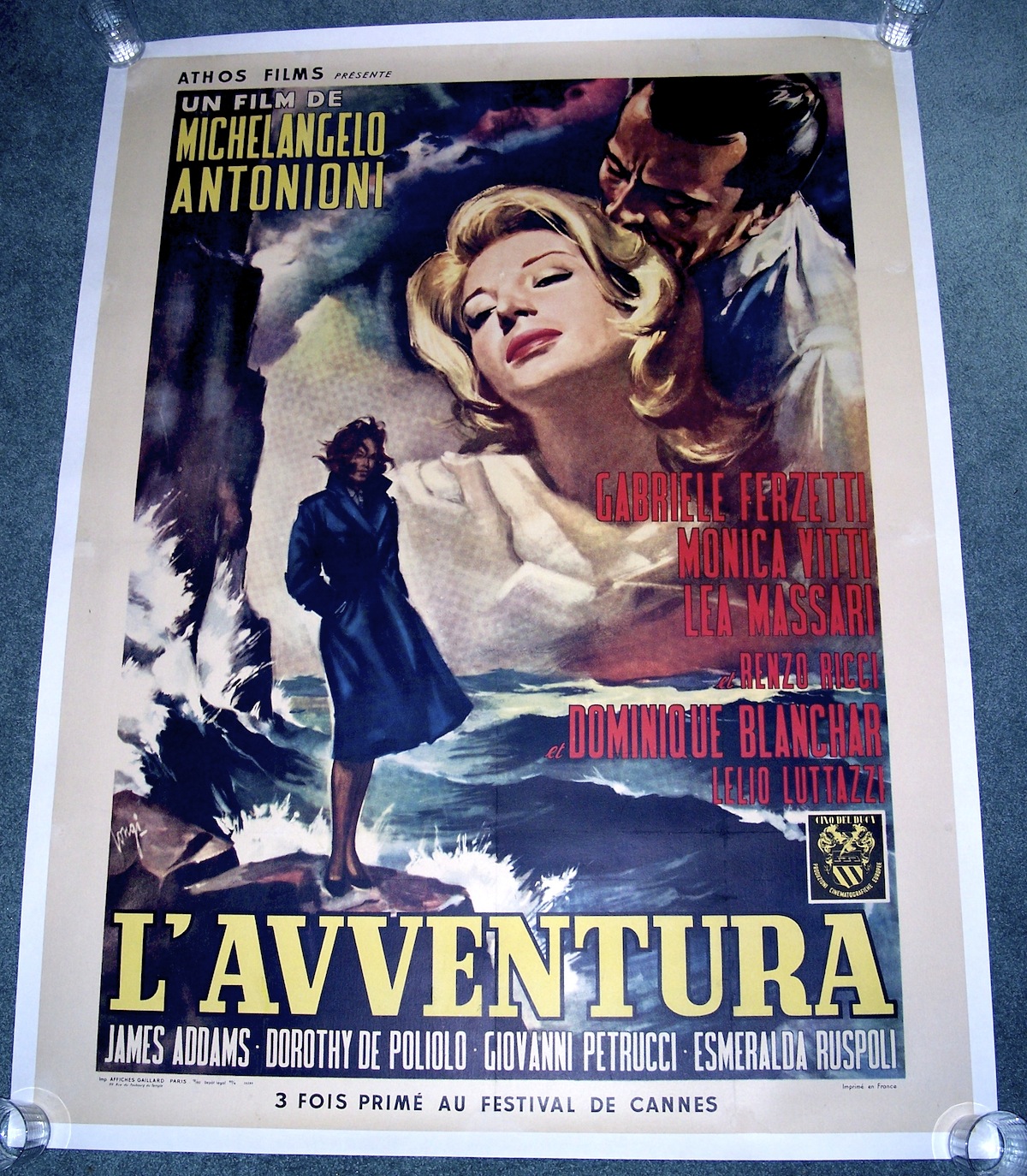
The French poster utilizes the art from the Italian poster, by the great Carlantonio Longi.
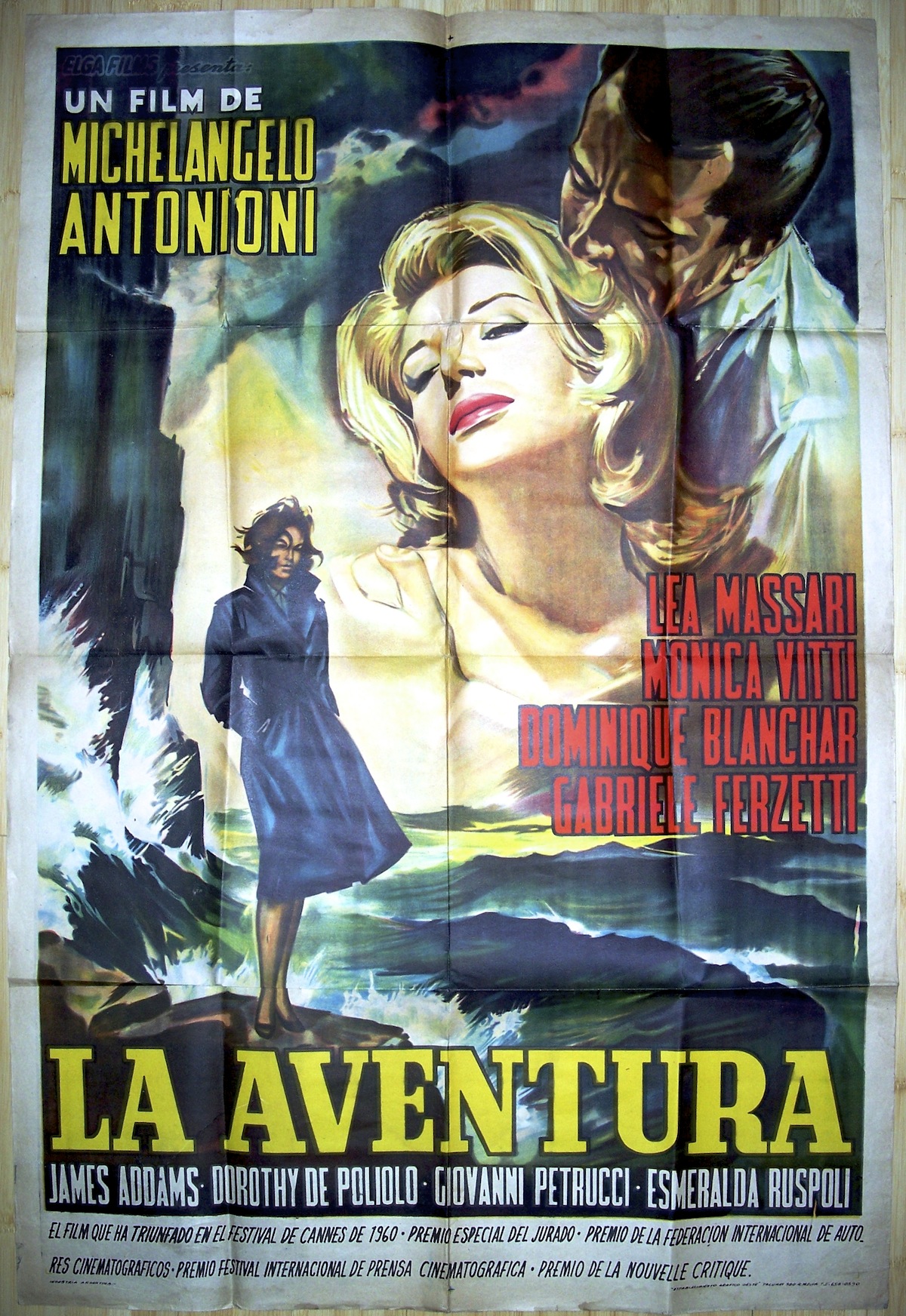
This Argentine poster features the same basic design, though it’s been reinterpreted somewhat. The acid-y coloration is typical of Argentine movie posters of the period.
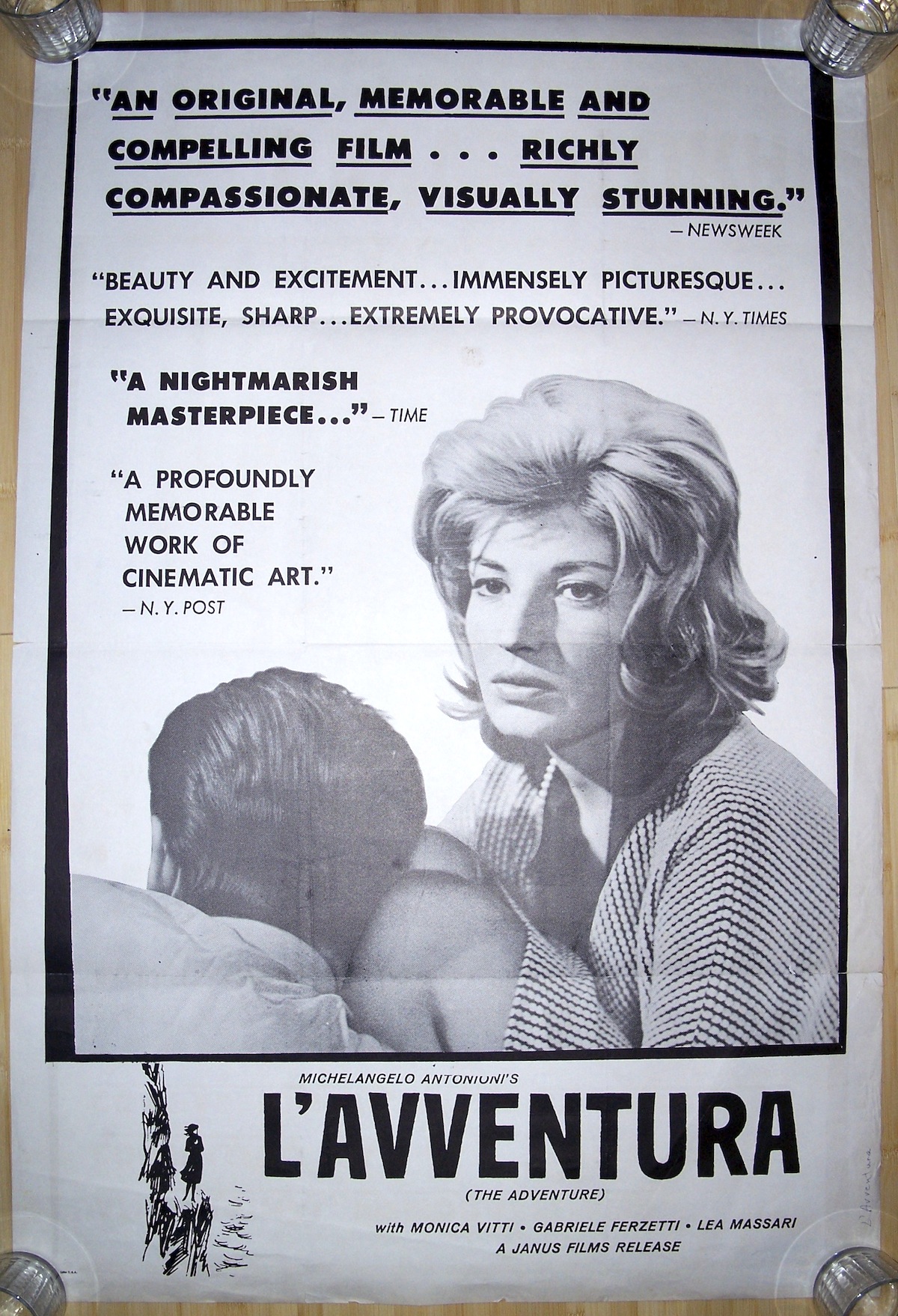
Compared to the other two, this U.S. effort is pretty weak, though it might do a better job of expressing the tone of the movie. Note that it uses Longi’s image of Lea Massari standing on the rocks, though it’s been relegated to the margin.
“L’avventura” was recently released on Blu-ray by Criterion. I think it’s fair to say that the transfer, which derives from a 4k scan of original elements, is among the most beautiful ever to make its way to home video.
Fabrizio del Wrongo writes:
(Sorry about the wonky aspect ratio.)
Fabrizio del Wrongo writes:

The sturdily built Ashley is German and looks it: she has the face of a good, solid mädchen. Not that you’d want to limit your stares to her face, of course.
Over at the ever-helpful TheNUDE.eu, a commenter going by the handle of Pendragon wrote a sonnet in her honor. Here it is in full:
SONNET FOR ASHLEY
Prologue
“AMONG ALL THE ACCOMPLISHMENTS OF LIFE NONE ARE SO IMPORTANT AS REFINEMENT, IT IS NOT, LIKE BEAUTY, A GIFT OF NATURE, AND CAN ONLY BE ACQUIRED BY CULTIVATION AND PRACTICE.”
– James EllisSTANZA ONE: REFINEMENT/VORNEHMHEIT
A young woman of twenty five Summers
Elegant, smooth and cultured in semblance
Gentleness as fine-spun as gossamer
Having the mark of balanced temperanceSTANZA TWO: DESIRABILITY/ERWUENSCHTHEIT
Of engaging and attractive bearing
‘Dear as a remembered kiss after death’
Her poise assuring in its outpouring
Rising mind to mind like a telepathSTANZA THREE: COMELINESS/ANMUT
Fair and enticing in form and physique
As Swift said, ‘comeliness in the female’
Her frame and limbs bespeaking her mystique
A womanly visage in each detailCONCLUDING COUPLET: WARMTH/INNIGKEIT
Impassioned kindliness and tenderness
Traits upheld by her graceful slendernessEpilogue
“SIE IST WIRKLICH CHARMANT.”
“SHE IS TRULY CHARMING.”
– Romantic German Saying
Laugh if you must. When’s the last time someone wrote a sonnet about you?
Most of these images appear to derive from Body In Mind and Femjoy. She’s a regular at the latter venue.
Nudity below. Have a good one.
Blowhard, Esq. writes:

Downtown Vegas ca. 1948-1950.
Click on the image to enlarge.
Paleo Retiree writes:
Blowhard, Esq. writes:
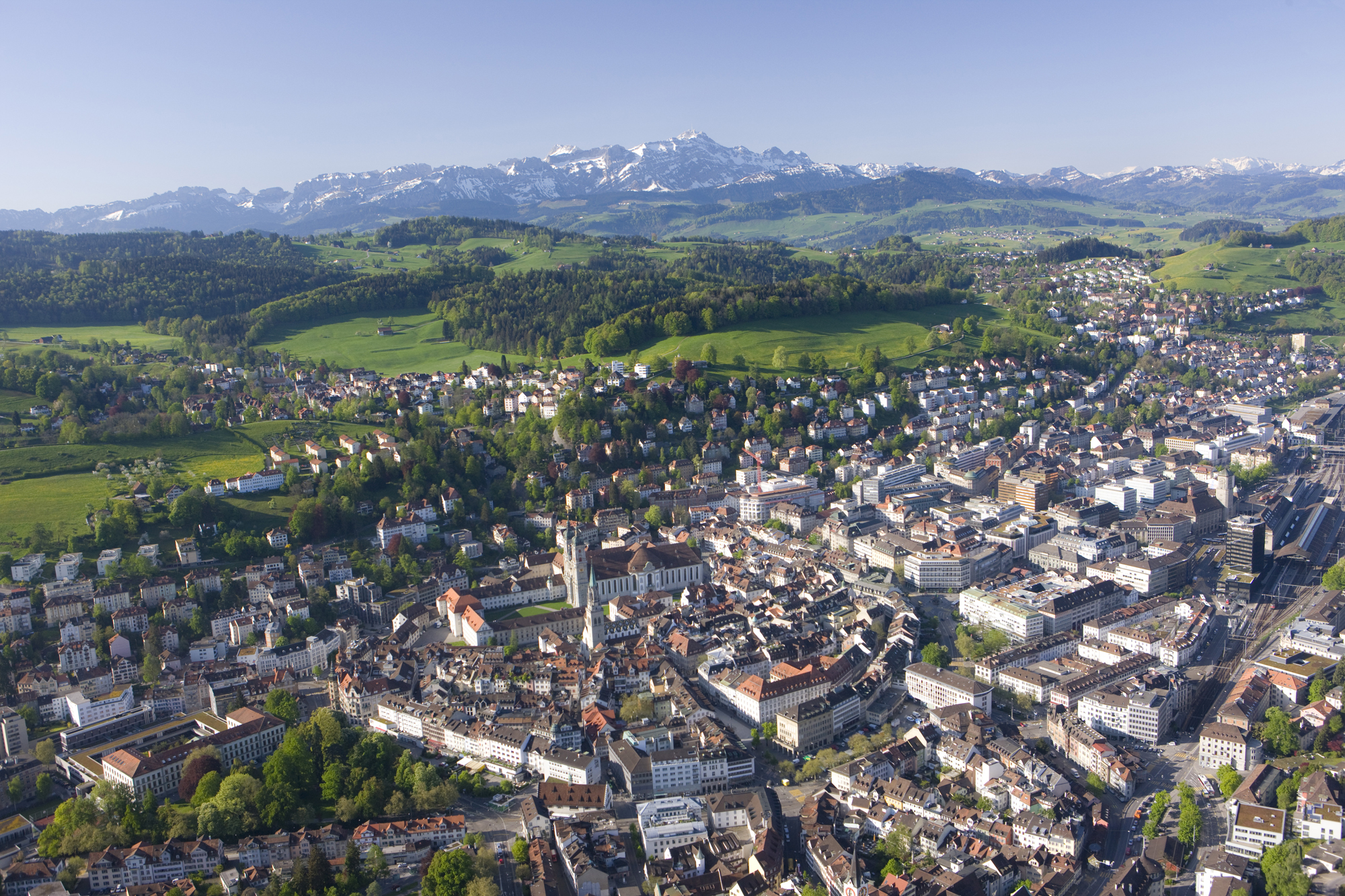
St. Gallen, Switzerland. H/T Callowman.
Click on the image to enlarge.
Blowhard, Esq. writes:

A description of Wichita would be incomplete without a notice of the notorious dance house on the west side of the river, kept by that singular personage ROWDY JOE, or Joseph Lowe, his real name.
Joe has been a frontiersman for many years, and has experienced about as much roughness as any other man. His dance house is patronized mainly by cattle herders, though all classes visit it; the respectable mostly from curiosity. I understand that the receipts over his bar average over one hundred dollars per night for months. The receipts are for drinks. No tax is levied for dancing, but it is expected that the males will purchase drinks for themselves and female partners at the conclusion of each dance.
Joe is his own policeman, and maintains the best of order. No one is disposed to pick a quarrel with him, or infringe upon the rules of his house. A dancing party at this place is unique, as well as interesting. The Texan, with mammoth spurs on his boots, which are all exposed, and a broad brimmed sombrero on his head, is seen dancing by the side of a well dressed, gentlemanly-appearing stranger from some eastern city; both having painted and jeweled courtezans for partners. In the corner of the hall are seen gamblers playing at their favorite game of poker. Jests and conversation suitable to the place and occasion are heard.
I would not recommend the establishment as one adapted for the schooling of the rising generation, but to those of mature years, who should become acquainted with all phases of society, Rowdy Joe’s is a good place to get familiarized with one peculiar phase. While I would not recommend Rowdy Joe as a model for Sunday school scholars, yet I am constrained to say that there are many men passing in society as gentlemen whose hearts are black in comparison with his.
— A correspondent from the Topeka Daily Kansas Commonwealth, October 15, 1872, as quoted in Why The West Was Wild
Fabrizio del Wrongo writes:

As John Wick, the titular assassin of the 2014 action film, Keanu Reeves has a grave physicality. He moves like he has weights in his shoes, and his face, always beautiful, has a hardness, like it’s been chiseled from crystal. (In a sense, Reeves’ mien is the character.) Reeves has always been a physical actor, less a deliverer of lines and more of a dancer, serene and gracefully there. Presumably it’s this quality that encouraged Bertolucci to cast him as Siddhartha: he recognized the calmness underlying the surfer-dude persona.
In first-time director Chad Stahelski, Reeves has found another filmmaker who understands him. A martial artist and longtime stunt guru, Stahelski doubled Reeves in the 1999 “The Matrix,” and, like the Wachowskis, he approaches action in the Hong Kong manner, treating it as a kind of ballet. The kung-fu set pieces are shot full-body, the camera held steady to emphasize the coordinated movements — the calligraphy of arms and legs — that makes this kind of thing worth looking at.
Stahelski and his team may have approached “John Wick” with reformative intent: contrary to prevailing trends, the action is quicksilvery rather than bruising (sometimes it’s too quicksilvery — nothing has much weight), and Jonathan Sela’s precise cinematography is blissfully free of shakiness. It’s possible to enjoy “John Wick” for its look and design alone. The lighting and color grading have been carefully tied into the picture’s moods (Nicolas Winding Refn may have been an inspiration), and the art direction, by Dan Leigh, is always creeping into the fringes of your consciousness. (“Hey,” I kept thinking, “where can I get a lamp like that?”) All of this helps to cement the impression of a fantasy, neon-dipped Manhattan, one as eerily devoid of normal human occupation as Feuillade’s Paris.
Where the movie goes wrong, I think, is its screenplay, which complicates the plot’s through-line in a way that betrays the vivifying simplicity of the hardboiled premise. Writer Derek Kolstad has a decent idea — to combine the dice-hard cool of Hodges and Melville with comic-book flair and exaggeration. But he can’t prevent the narrative from going limp when, about halfway into the picture, Wick locates the man who killed his dog — the act that set this rudimentary revenge story into motion. From that point on you can sense Kolstad sweating as he throws new elements into the plot, trying desperately to keep the movie going. A female assassin character feels like one of the picture’s few concessions to trendiness (predictably, she gives Wick more trouble than his male foes); Willem Dafoe blips into and out of the movie in a way that’s more frustrating than surprising; and there’s a dreadful scene in which Wick ragingly explains his motivations, as if to remind us that, yes, there’s a point to all of this. (Did the filmmakers really think we’d forget that the bad guys killed his pooch, or fail to realize what that meant to him?) By the time the screenplay has Dafoe get tortured in order to provide Wick with a second layer of motivation (and the movie with a second big ending), my interest level had flat-lined. It was about as dead as John Wick’s dog.
 Blowhard, Esq.
 Callowman
 Sherbrooke
 Eddie Pensier
 Enzo Nakamura
 Epaminondas
 Fabrizio del Wrongo
 Fenster
 Brundle Guy
 Glynn Marshes
 Paleo Retiree
 Atypical Neurotic
 Question Lady
 Sax von Stroheim
 Sir Barken Hyena
 The Mistaken
 Uncouth Reflections