
Blowhard, Esq. writes:
Related
- BARCELONA is one of my favorite movies from the ’90s. Fabrizio listed his favorite ’90s movies here.
Blowhard, Esq. writes:

…Rita Hayworth
Click on the image to enlarge.
Fenster writes:
Time for perfesser Fenster

to grade Frank Bruni for his essay on higher education in the NYT.

I’ll grant him an A in the effective writing department, as always. No typos. No misspellings. Good structure.
I’ll give him a B+ for ambition. It takes a certain amount of chutzpah in today’s climate to mount a really, really old-fashioned defense of the classical virtues of higher education, and he deserves a certain amount of credit for that. Forward into the past!
Persuasiveness? Well, that depends on what he is trying to say. For sure he says that for him college was transformative in the old-school way, courtesy of a course in Shakespeare’s tragedies at the University of North Carolina. Yes, Shakespeare can do that. And if his little essay is intended simply as a personal testimonial, I find it persuasive and will give it a B+.
Is it just that? Pundits can dabble in the memoir form but one suspects there is a larger point to be made. Bruni (perhaps intentionally, perhaps prudently) does not explicitly look to link his personal experience with a sense of policy, of what to actually do. But what to do, what not to do . . . that is the question, no?
Here we have to go mostly by inference. Bruni takes aim at a couple of easy (Republican) straw men, moving his argument toward politics if not policy. He chides Scott Walker, who recently suggested (and then wisely withdrew) a change in the statutorily-defined mission of the University of Wisconsin. According to the Washington Post:
Wisconsin Gov. Scott Walker submitted a budget proposal that included language that would have changed the century-old mission of the University of Wisconsin system — known as the Wisconsin Idea and embedded in the state code — by removing words that commanded the university to “search for truth” and “improve the human condition” and replacing them with “meet the state’s workforce needs.”to drop the phrase “search for truth” and insert “meeting the state’s workforce needs”
I am enough of a purist to find this stupid as well as politically ham-handed, and Walker withdrew the proposal. But to criticize an extreme instance of dumbing-down is not a compelling defense of the ideal university, which has its own problems in the real world.
Bruni also chides Reagan, natch, whose 1967 pronouncement as Governor of California that taxpayers should not “subsidize intellectual curiosity” has been seen by some as a pivotal moment in the turn towards utility as the primary goal of higher education.
I am happy to concede this may have been a pivotal moment, as Bruni puts it. But most pivotal moments have a turning point quality, meaning that they represent the moment at which a series of forces cause a meaningful turn. So with Reagan. Bruni might like to flirt with the idea that the utility meme is the Gipper’s fault, but it is a lot more complicated than that. What he wants us to believe, it seems, is that some bad political ideas somehow somehow got traction–who knows how?–and that we are now all the poorer for them. I don’t buy that.
More importantly, having luxuriated in his moment of conservative bashing, he lets himself off the hook in terms of offering anything up other than pabulum to fix things.
Here’s the quote that gives the game away:
But it’s impossible to put a dollar value on a nimble, adaptable intellect, which isn’t the fruit of any specific course of study and may be the best tool for an economy and a job market that change unpredictably.
Two problems here. The first is the notion that you can’t put a dollar value on something like this. That’s just bad rhetoric. Too many college educations cost a king’s ransom and trotting out the hoary old notion of “no price tag possible” just doesn’t work anymore.
So then you come to the second problem with the quote–the notion that the liberal arts are arguably the best possible training for a fast-changing job market. There is actually some truth to this notion, I will concede. There is a good argument that in theory that the liberal arts can do a better job at prompting critical thinking, building good communications skills and instilling problem-solving ability than can, say, a plain old business degree. But that is an argument in theory. In practice, as Arum and Roksa pointed out in their well-regarded book from couple of years ago, too many colleges do a poor job of just these things.
So Bruni accomplishes two sleights of hand in this sentence. First, he disparages the idea that costs have to be taken account of at all, and this at a time when costs are out of control. Second, by ignoring costs, he also is able to ignore the important concept of cost-benefit, an idea that would require a reckoning on the benefit side in addition to an accounting on the cost side. That’s where the action is, and Bruni’s feel-good rhetoric doesn’t help with an answer.
Overall persuasiveness: C-.
Fabrizio del Wrongo writes:
The French poster, by Chica, is a classic.
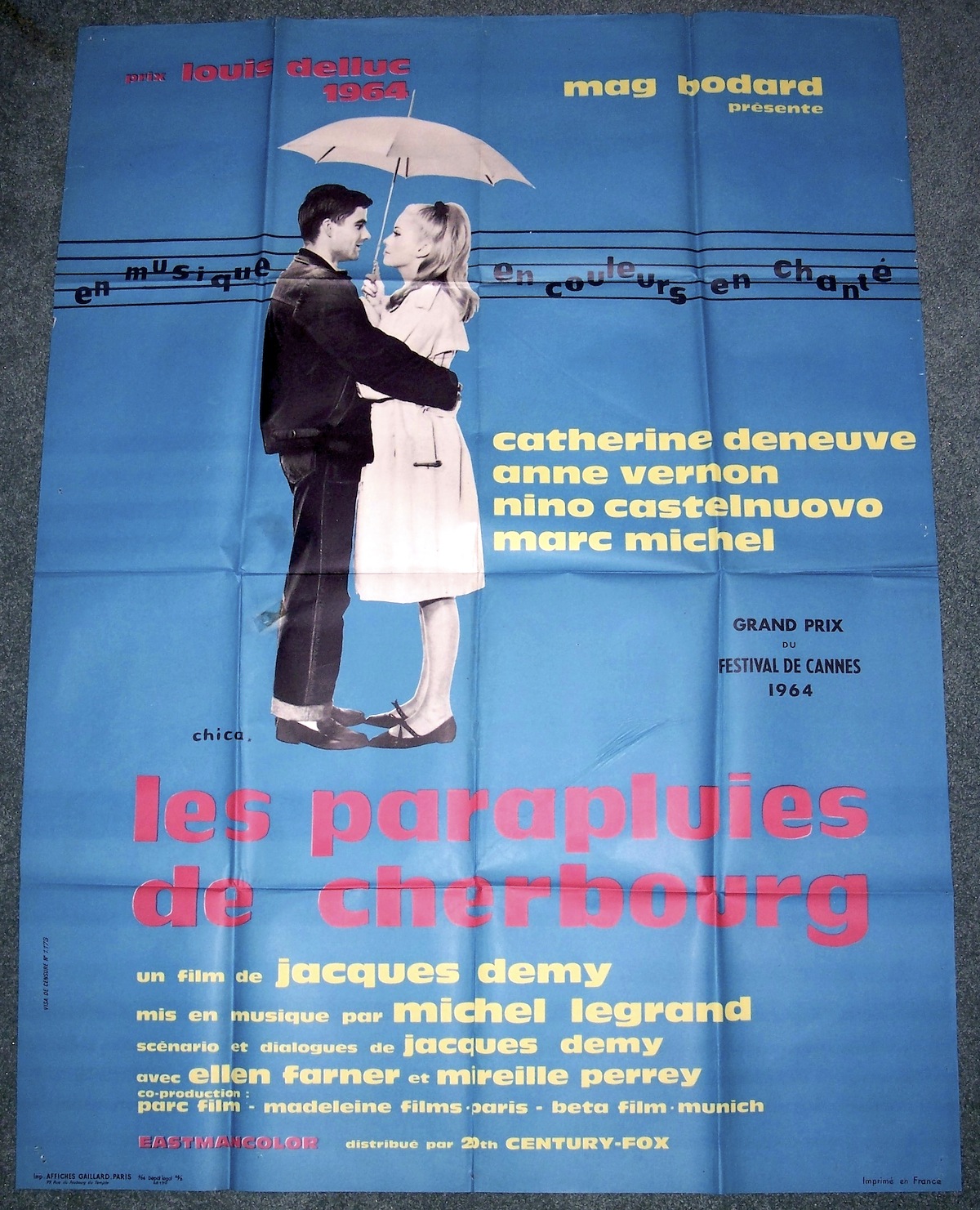
Echoed, somewhat ineptly, in this Argentine design.

The U.S. poster utilizes a couple sketch that appeared in a lot of international advertising for the movie. The American posters for arthouse releases tended to be pretty simplistic and limited as to color. See here.

The sketch turns up again in this British treatment. Clearly, the Brits thought it important to emphasize the all-singing nature of the movie.

There’s that sketch again, this time treated as a silhouette. The poster is from Finland.

The Danish poster references the couple sketch, though the viewpoint is flipped and the treatment is naturalistic. It also adds a big, two-shot-style image of the film’s stars; it looks like one of those pastel portraits offered by street artists on summer afternoons.

Related
Blowhard, Esq. writes:

Because tomorrow is Valentine’s Day, I thought Karina Hart’s name and cherubic figure made her an appropriate choice this week. Like her fellow compatriots Veronika Zemanova, Jana Defi, and Karin Spolnikova, Ms. Hart hails from the Czech Republic or as I like to think of it, The Land of the Busty Brunette. (Yeah yeah, it’s wildly inaccurate generalization. Don’t spoil my fantasy, bro.) Most of these pictures came from her official site, DDF Busty, and Scoreland. Check out the tube sites for some softcore videos.
Bountiful boobage after the jump. Happy Friday.
Sir Barken Hyena writes:
Representing the vast Griot tradition West African of epic poetry, we have this master (“Jali”) of the 21 string Kora. From Wikipedia:
“The West African griot is a troubadour, the counterpart of the medieval European minstrel… The griot knows everything that is going on… He is a living archive of the people’s traditions… The virtuoso talents of the griots command universal admiration. This virtuosity is the culmination of long years of study and hard work under the tuition of a teacher who is often a father or uncle.”
It’s not apparent at first, but as you listen you can hear the influence on Delta blues, both musically and in the persona of the artist, as a chronicler of truth.
Blowhard, Esq. writes:
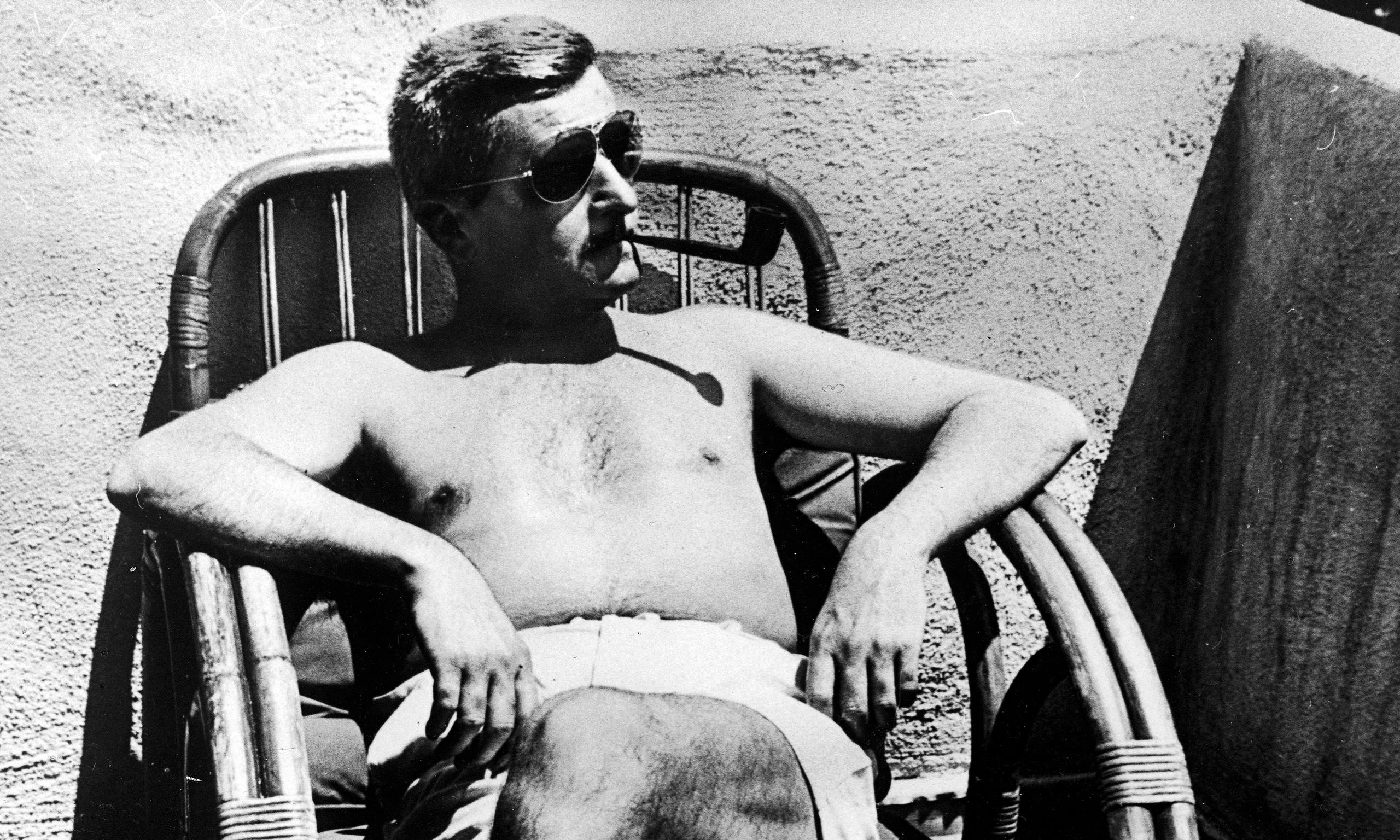
INTERVIEWER
What were the kinds of work you were doing to earn that “little money now and then”?
FAULKNER
Whatever came up. I could do a little of almost anything—run boats, paint houses, fly airplanes. I never needed much money because living was cheap in New Orleans then, and all I wanted was a place to sleep, a little food, tobacco, and whiskey. There were many things I could do for two or three days and earn enough money to live on for the rest of the month. By temperament I’m a vagabond and a tramp. I don’t want money badly enough to work for it. In my opinion it’s a shame that there is so much work in the world. One of the saddest things is that the only thing a man can do for eight hours a day, day after day, is work. You can’t eat eight hours a day nor drink for eight hours a day nor make love for eight hours—all you can do for eight hours is work. Which is the reason why man makes himself and everybody else so miserable and unhappy.
Blowhard, Esq. writes:

“Daughters of Lusting Torment” is my nominee for Title of the Year. Published February 1939.
Click on the image to enlarge.
Blowhard, Esq. writes:

In discussions of literature and architecture, I still come across would-be intellectuals who invoke art critic Clement Greenberg’s distinction between the avant-garde and kitsch. Of course, for such people avant-garde is doubleplusgood, while kitsch is one small step above Nazism. If you’ve never read Greenberg’s original essay, it’s worth checking out, if only for examples of the art Greenberg dismisses:
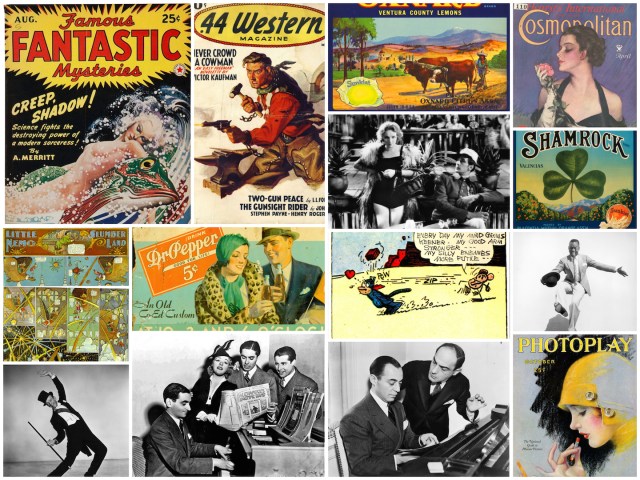
Where there is an avant-garde, generally we also find a rear-guard. True enough — simultaneously with the entrance of the avant-garde, a second new cultural phenomenon appeared in the industrial West: that thing to which the Germans give the wonderful name of Kitsch: popular, commercial art and literature with their chromeotypes, magazine covers, illustrations, ads, slick and pulp fiction, comics, Tin Pan Alley music, tap dancing, Hollywood movies, etc., etc.
That’s a pretty good list of the most popular and beloved American art ever created, not to mention hugely influential on world culture. Question du Jour: Why do people insist on generalizing and theorizing from their own preferences about what is “good” or “the best”? More importantly, why are others so apt to take such pronunciations seriously?
Related
 Blowhard, Esq.
 Callowman
 Sherbrooke
 Eddie Pensier
 Enzo Nakamura
 Epaminondas
 Fabrizio del Wrongo
 Fenster
 Brundle Guy
 Glynn Marshes
 Paleo Retiree
 Atypical Neurotic
 Question Lady
 Sax von Stroheim
 Sir Barken Hyena
 The Mistaken
 Uncouth Reflections