Showtune Saturday: “Moses Supposes”

Eddie Pensier writes:

Not really a showtune, you protest. In fact, “Moses Supposes” was the only song from Singin’ In The Rain that hadn’t been previously used in other MGM musicals. The lyrics, such as they are, are by musical theater Olympians Betty Comden and Adoph Green, which therefore makes this a showtune.

Even if you disagree, it’s four of the most deliriously marvelous minutes Hollywood has ever produced. Plus Gene Kelly and Donald O’Connor.

Posted in Movies, Music, Performers | Tagged , , , , | 3 Comments

Notes on “The Working Man”

Fabrizio del Wrongo writes:

working_man_lc_thumbThis 1933 George Arliss vehicle focuses on a getting-ready-to-retire shoe magnate. His vitality is so reliant on competition that he covertly goes to work for his rivals when their fortunes begin to fail. The company, launched by his onetime buddy and romantic adversary, has foundered under his spendthrift progeny, and Arliss just can’t bear to see it sink below the waves. By reviving it he’s reviving his youth, his relevance. Arliss’ performance is a lot of fun: Doddering a little, uncertain as to how to secure his legacy, he suggests a fuzzier and much shrewder Lear. And he’s an apt foil for the young Bette Davis, who has some nice moments in a role that’s like an inversion of those familiar from screwball comedy. (She’s an heiress who runs towards home rather than away from it.) In fact, the whole movie seems consciously poised against the screwball attitudes then emerging in Hollywood comedy: It stands up for the squareness of the suburbs, the WASP work ethic, and the inherent wisdom of the elderly. Plot-wise, everything ties up neatly, and director John Adolfi has a clean, efficient way with interior dialog scenes. The movie could be sexier, but then its target seems to be older viewers who like to complain about the irresponsibility of spoiled young whippersnappers. Old people go to movies too, you know. It’s on Warner Instant.

Related

  • Arliss was a big deal at the time. He had his own production unit at Warner, hand-picked Adolfi as his director, and was an early booster of Bette Davis. Along with Marie Dressler, one of MGM’s biggest draws of the early ’30s, Arliss represents a bygone class of movie star: those famous because of their advanced age not in spite of it.
Posted in Uncategorized | 1 Comment

Unexpected Celebrity Perfumes, Five Ways

Eddie Pensier writes:

Every celebrity has their own fragrance nowadays. And frankly, those of us who appreciate the art of perfumery generally don’t think much of star-hyped scents: the lion’s share of their budget tends to go toward packaging and marketing, while the juice in the bottle is generally done on the super-cheap, and smells like it. (There are exceptions.) And who outside their teens would admit to wearing Justin Bieber or Britney Spears?

But for those who don’t mind their celebrity scents a bit outside the mainstream, here are some unusual selections.

Klaus Kinski

kinski

For your next trip into the Peruvian Amazon jungle, try this scent licenced by the late actor’s estate. Contains notes of vetiver, juniper and (uh-oh) marijuana.

Pope Pius IX

“Just a little behind the ears…”

Hey, everyone wants to smell like a movie star or a musician or an athlete or a billionaire. But it takes a serious hardcore history geek to admit to wanting to bathe in the aura of a 19th-century Vicar of Christ. It is claimed to be an eau de cologne with notes of violet and citrus. People might kiss your hands for altogether different reasons if you wear it.

Continue reading →

Posted in Humor, Performers, Shopping, The Good Life, Women men and fashion | Tagged , , , , , , , | 3 Comments

Naked Lady of the Week: Sofi A

Blowhard, Esq. writes:

sofiaheader

When the shit goes down, the world economy collapses, and we all have to choose which nomadic desert band to join, it’s a safe bet that at least a few of us here at UR will be high-tailing it for the Ukraine. Like Fabrizio’s choice last week, this week’s cutie hails from the Putin-contested land of chicken Kiev. (Please accept my apologies for that sentence, but I’m a dumb American and I’ve just exhausted everything I know about the country without resorting to Wikipedia.)

A leggy, free-spirited, dark-haired beauty with eyes bluer than the Sea of Azov at sunrise (thanks, Wikipedia), like Chloe A there is precious little information online about this other Ms. A. (Hold on, gimme a sec, I’m making a note to look up all the As in the phonebook when I move to Europe’s third-largest grain exporter.) But unlike Chloe, Sofi continues to be active in the nude modeling world, which is surprising given that she could no doubt find gainful employment in Ukraine’s booming metallurgical refining industry. Ahhh, well, their loss is our gain.

The pictures below are lo-res versions from Met-Art and Femjoy. Unless your boss lets you fap at work, I wouldn’t click on the jump. Happy Friday.

Continue reading →

Posted in Photography, Sex | Tagged , , , , , , | 6 Comments

Docs About Movies 1: “Free Radicals”

Paleo Retiree writes:

Sick and housebound with a cold/flu/something-or-other, I’ve been passing the time with a lot of doc-watching via Netflix Instant. Weird the way that illness makes me lose my appetite for fiction films. Why should that be? Is it as simple as the fact that projecting into fiction (the whole effort of making believe, caring about made-up characters and situations, etc.) takes more energy than watching films about real people and real events? In any event, docs have been suiting my low-energy state just fine.

And what an amazing era in docs we’re living through. Film era-style greatness may be in short supply but there’s such an abundance of perfectly-fine-to-pretty-darned-good docs out there, and on such a range of subjects, that someone with a taste for facts presented in movie form can feel like he’s died and gone to heaven.

For no particular reason I’ve wound up watching not just a bunch of docs, but a bunch of docs about movies. Docs about movies, in fact, have seemed to me to be one of the liveliest of movie genres since the 1990s. But I’m suspicious of my hunch; it corresponds a little too closely to the fact that the ’90s were when I began losing interest in new movies. So I won’t try to make too much of it, although I’d be interested in hearing from visitors if they think it’s true too. Anyway, I’ll riff through these films in separate postings. First up:

radicals

Free Radicals

Personal-essay style doc from 2011 about the avant-garde film years, though mostly focusing on the ’50s through the ’70s and mostly covering American artists. The names of the artists really bring back a couple of eras: Stan Brakhage, Hans Richter, Robert Breer, Jonas Mekas, Ken Jacobs, Peter Kubelka, Stan Vanderbeek … Though it makes no attempt to be comprehensive, the film still manages to sketch in some of the movement’s outlines, its in-person visits are enjoyably informal, and it provides numerous samples of footage that are fun to watch. Pip Chodorov, the film’s director, is a second-generation filmmaker himself; his dad, who provides guidance and yarns, is Stephan Chodorov. Pip is a light-voiced hippie type, and he brings an insider’s perspective as well as a lot of boyish admiration and enthusiasm to his picture. It’s all presented with a lot of familiar “this is an avant-garde film” quirks — super-8 style scratchiness, multiple exposures, end-of-the-roll color-flashes … Are these mannerisms annoying or nostalgic? At this point they seem harmless to me. They constitute their own peculiar language — why quarrel with it?

The Question Lady loved avant-garde films back in the ’70s; she took them as the ultimate in personal filmmaking. I enjoyed some of the movies at the time but I was mainly into feature films and I disliked the strident claims that were made on behalf of avant-garde work. So revisiting the artists and their work now was a nice experience for me. The artists have all mellowed with time; I have too, of course. They’re mostly in a looking-back-ruefully stage of life. Motivated by passion and heedless of practical concerns, they spent their creative years doing crazy experimental things. They achieved some of the effects they were aiming for, and even if they’re still alive and active they now qualify as survivors, like it or not. They recall — with a lot of melancholy/bittersweet smiles and shrugs — how they dreamed of changing the world, how impossible their material lives were, how difficult it was for them to pay the bills, and how small their audiences were. It’s good to see that the passions that drove them still burn, if a little less frenziedly. For myself, I now watch their work and find myself thinking, “Bless ’em, they were up to crazy shit, and why the hell not?” It’s just a different game they were playing, not a better or a worse one. Plus: More of us should pursue a few of our passions heedless of practical concerns, you know? If maybe not with quite such life-wrecking determination …

My main beef with the movie was that I could have used a few more reflections about the situation today. After all, what with computers, the kinds of things that these people were producing is now not just easily accessible but omnipresent. (This doesn’t hold true for Brakhage, who in a lot of his work was fascinated by the specific physical and optical characteristics of celluloid and emulsion.) The visual world we inhabit today and largely take for granted — our digital media world of whirling graphics, abstract effects, and music videos — is as avant-garde as can be, and was anticipated by the avant-gardists much more than by feature filmmakers. What do they think of that? Do they feel responsible for it? Would it have come about without their pioneering? They really had to kill themselves to create their little works. Do they look at modern computers, which make the same effects relatively easy to achieve, with envy? And what do they make of the fact that so much of our media life these days is avant-garde? Has the revolution many of them were anticipating and rooting for come to pass after all? I’d have loved to hear their reflections and reactions.

All that said, I enjoyed the film thoroughly. Pip Chodorov keeps his picture quick and appreciative, his own style and presence are very likable, and the filmmakers (fwiw: aside from Maya Deren, they’re all guys) are excellent company.

Next I’ll yak about “Big Joy,” a doc about the San Francisco filmmaker and poet James Broughton.

Related

Posted in Movies | Tagged , , , , , | 5 Comments

Cartoon Gangsta

Paleo Retiree writes:

Good lord, the ways some people dress these days.

apersonal_ne_nyc_2014_07_gang_member06

Mr. Gang was so devoted to demonstrating his Badness that he kept flashing a roll:

apersonal_ne_nyc_2014_07_gang_member03

LOL: I just noticed for the first time that his forearm tattoos match the number on his jersey. Well, you can’t accuse him of not having made some efforts to coordinate his look.

When did everyday people start morphing into cartoons? It isn’t just the always-prone-to-overstatement ghetto crowd; working and middle-class people look more and more like comic-book versions of themselves. When I was younger, grown men didn’t routinely walk around the city in baseball uniforms and grown women didn’t routinely project themselves as fashion drawings. My wife and I often find ourselves marveling at the way today’s young people look like anime and manga versions of young people. The old attitude was: Fantasy is out there to be enjoyed and very occasionally indulged in, but real life is real life. These days the distinction between real life and fantasy seems much more blurry. I blame this development on Photoshop, but it wouldn’t surprise me if readers have more persuasive theories.

Related

Posted in Trends | Tagged , , , | 8 Comments

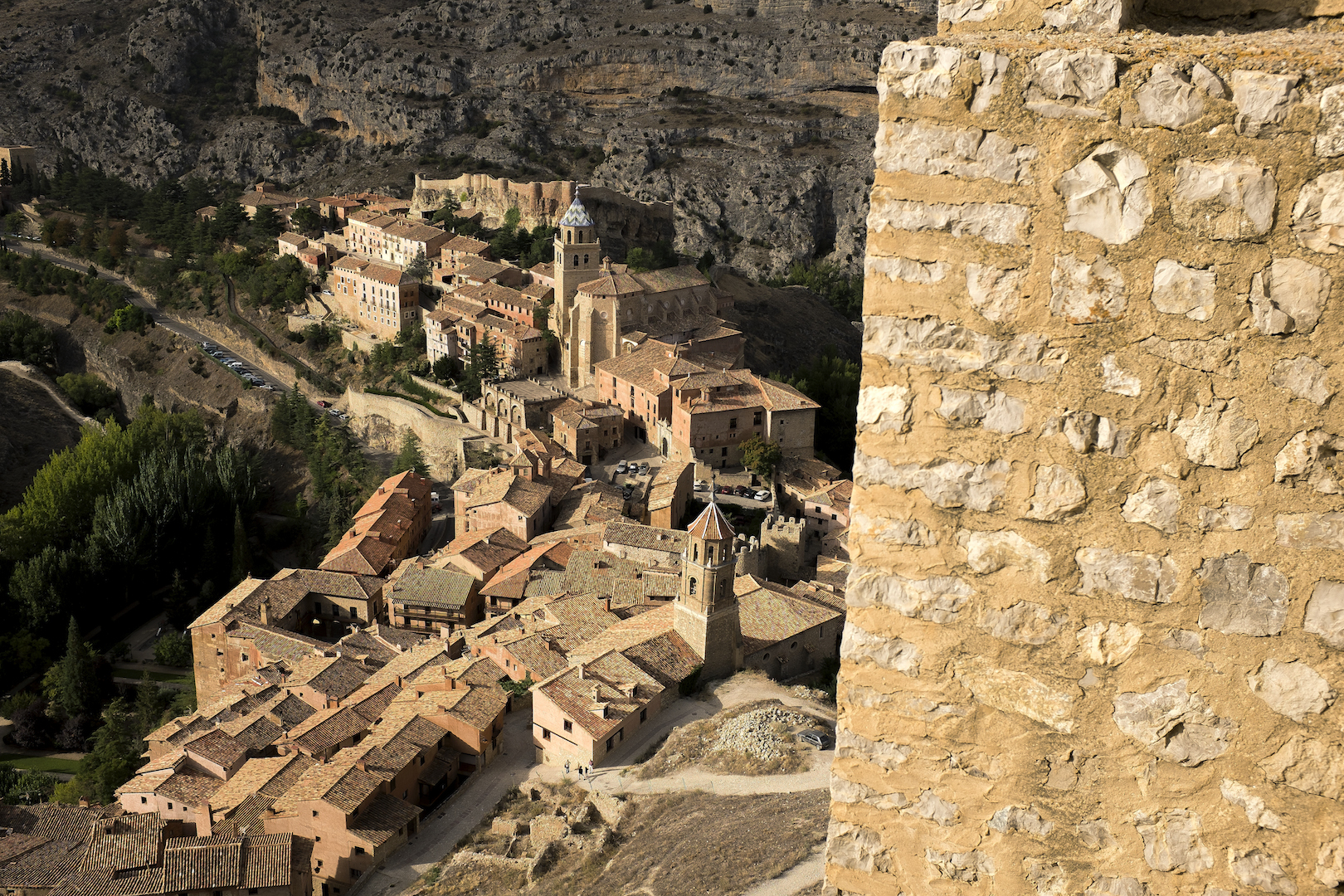
Village Du Jour

Blowhard, Esq. writes:

albarracin

Albarracín, Spain. Source.

Click on the image to enlarge.

Posted in Architecture | Tagged , , , | 5 Comments

Linkage

Blowhard, Esq. writes:

  • Blood Boil Du Jour: since 9/11, police have seized billions from motorists without a single warrant, indictment, or trial.
  • Nanny State Update. Key quote: <<Some say it is all but impossible to make compliant raw-milk cheese consistently, and that the lowered tolerance for nontoxigenic E. coli will do nothing to improve public health. “There was no health risk in all the years we operated at 100 MPN,” says David Gremmels of Oregon’s Rogue Creamery, which produces several raw-milk blues. “We look at this as an arbitrary change.” Cary Bryant, Rogue’s cheese maker, says he worries that the tightened standards may even impair public health. “People need some microbial diversity in their life,” says Bryant, a microbiologist by training. “This is going to create people with immune systems that can never handle anything.”>>
  • U.S. News and World Report thinks that Harvard, Princeton, Yale, et al. are the “best value” in college education. Aside from status-anxious parents, does anyone really believe that bullshit?
  • A Greek literature professor argues colleges should replace “critical thinking” with old fashioned bullshit.
  • Patton Oswalt thinks you shouldn’t look at photos from The Fappening, but remember those private Anthony Weiner dick pics? Hilarious.
  • I’m patiently waiting for all the feminists, sjws, and other progressives to respect this woman’s agency.
  • A former L.A. Times national security reporter, who now writes for AP, used to pre-clear all his stories with the CIA. I’m sure he doesn’t do that anymore.
  • When are people going to get sick of zero tolerance nonsense?
  • Lloyd admires Ron Chernow’s Washington bio.
  • This man is a hero. This one too. (NSFWish)
  • A little jam session between Redding and Booker T & the MGs:

Posted in Linkathons | 9 Comments

Movie Still Du Jour

Blowhard, Esq. writes:

2or3things

Marina Vlady and Anny Duperey in Godard’s 2 OR 3 THINGS I KNOW ABOUT HER. Just two naked French prostitutes mock fighting while wearing travel bags over their heads, nbd.

Click on the image to enlarge.

Posted in Movies, Performers | Tagged , , , , | 4 Comments

Architecture Du Jour: The Yemen Tower House

Blowhard, Esq. writes:

Tower houses are a form of building unique to southern Arabia. They originated in pre-Islamic times in the south of Yemen, where tribal strife was the motivation for developing an effective way of building defensive towers out of local materials…Most tower houses are at least five stories high, and some reach as many as eight or nine. The vertical arrangement follows an upward transition from public to private space…In a rural area, the ground floor, apart from the entrance hall, is for animals and the storage of wood, fruit, and grain; in towns, it is used for shops and stores.

…

The foundations of the tower houses are constructed using stone or earth (sun-dried clay, mud blocks, or fired bricks). In the city, the ground and first floors are made of tufa, and the upper floors of fired bricks. The facades of the houses are typically highly decorated, as are the windows and doors.

— Building Without Architects: A Global Guide to Everyday Architecture

Related

Posted in Architecture | Tagged , , , , | 6 Comments