
Eddie Pensier writes:

From PopSonnet, whose author recasts well-known songs in Shakespearean iambic pentameter. Link via Maggie McNeill.
Eddie Pensier writes:
From PopSonnet, whose author recasts well-known songs in Shakespearean iambic pentameter. Link via Maggie McNeill.
Eddie Pensier writes:
In my more than ten years of critical examination of motion pictures, I have never seen anything quite so unacceptable as the shots of the breasts of the character of Rio. This is the young girl whom Mr Hughes recently picked up and who has never before according to my information appeared on the motion picture screen. Through almost half the picture the girl’s breasts, which are quite large and prominent,* are shockingly emphasized and, in almost every instance, are very substantially uncovered. So far as we know there is no possible way to bring this picture within the provisions of the Production Code except by a large number of re-takes…Many of these breast shots cannot be eliminated without destroying the continuity of the story.
–James Breen, head of the Production Code Administration, in a memo to Will Hays, kvetching about Jane Russell’s deshabille in Howard Hughes’ “The Outlaw”.
Quoted in Obscene, Indecent, Immoral and Offensive**: 100+ Years of Censored, Banned And Controversial Films, by Stephen Tropiano. I’m only about a hundred pages into it, but fascinating so far.

Related
Fabrizio del Wrongo writes:
Blowhard, Esq. writes:
Fenster writes:
Hora Decubitus, Charles Mingus
Eddie Pensier writes:
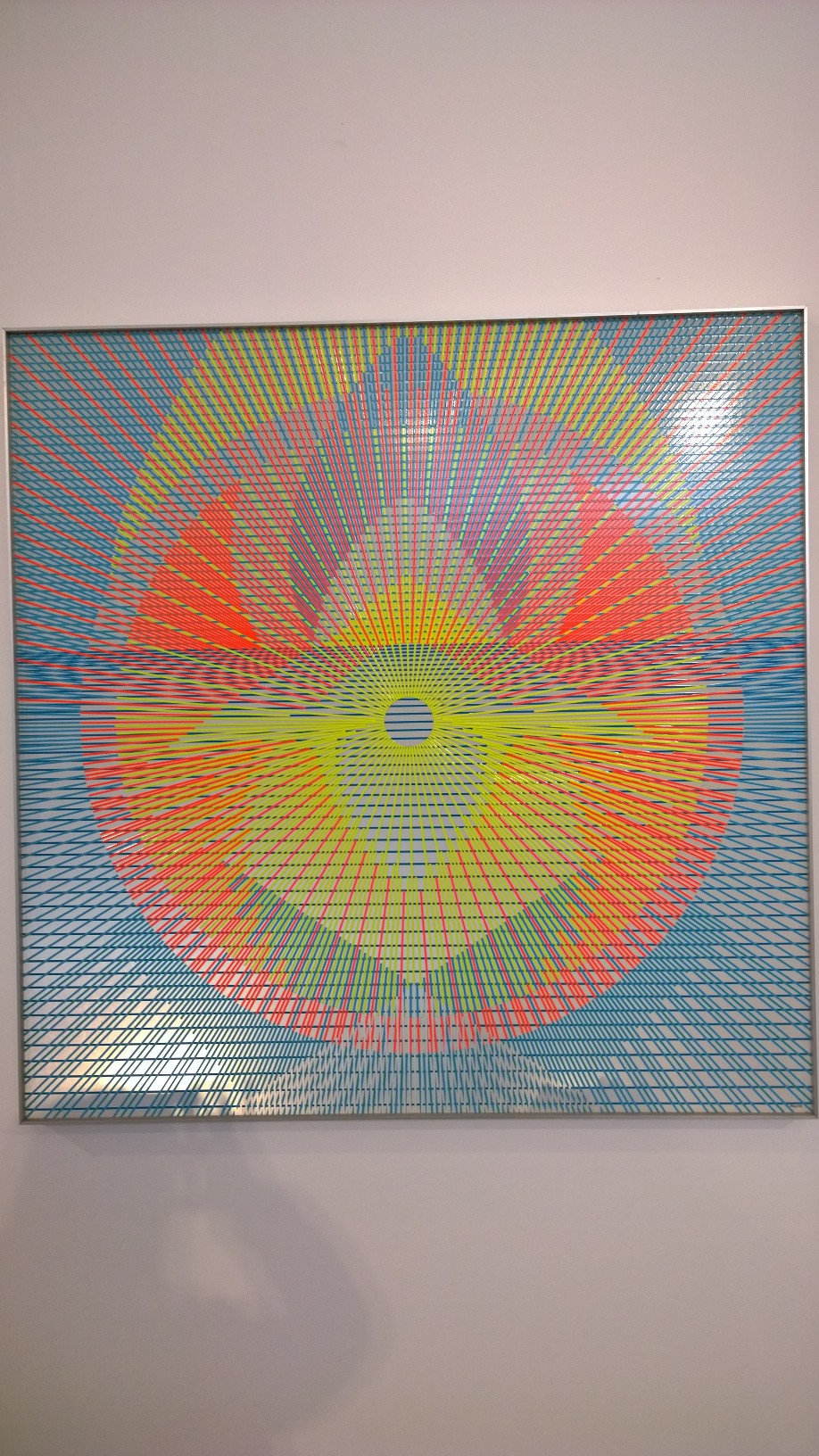
Jozef Stanislaus Ostoja-Kotkowski, Kronos 2 (1979), photographed without flash
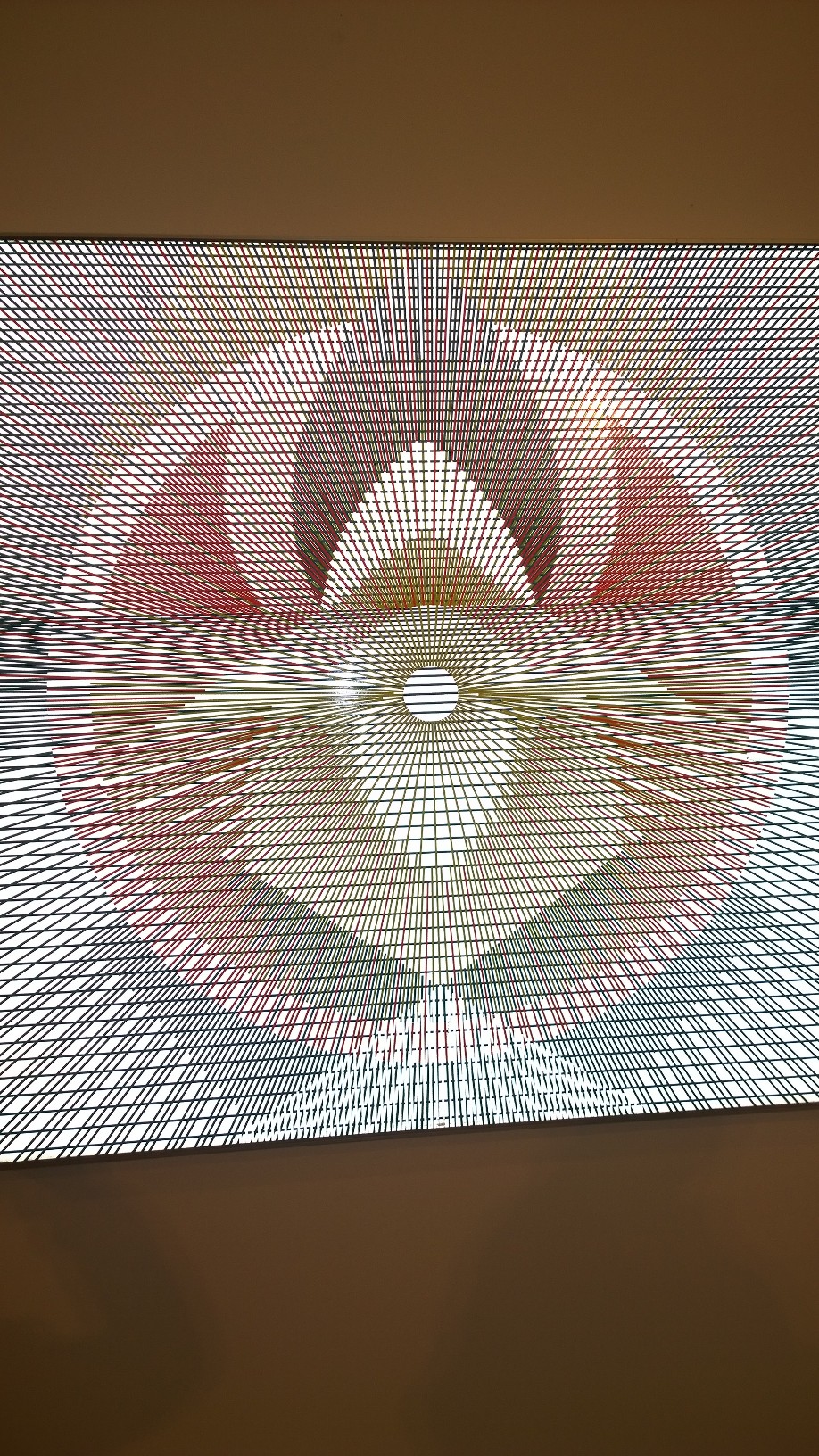
The same artwork, photographed with flash.
From COLOUR MUSIC, an exhibit I attended today at the ANU’s Drill Hall Gallery, which “brings together the work of visual artists who speculate on connections between pictorial form and pitch, harmony, movement and musical notation.” I only glancingly noticed any such connection, and I normally avoid contemporary art like dental surgery, but I found this exhibit surprisingly pleasing for the most part. It wasn’t intellectual, or moving, or technically superior, but my inner five-year-old who giggles at bright colors got a big kick out of it.
More COLOUR MUSIC pictures after the break.
Eddie Pensier writes:
Hermann Prey, the great Austrian baritone known best for his German lieder interpretations, gives a heartfelt rendition of the standard from Cole Porter’s Kiss Me, Kate. Yes, perhaps his English could be better, but can you doubt the sincerity and true emotion evident in every measure? He treats the words like poetry and gives them no less weight than the music…one of the marks of a great singer.
Correction: An earlier version of this post had the wrong video, of Prey singing “On The Street Where You Live” from Lerner & Loewe’s My Fair Lady. I’d been debating which one to share with y’all and got the video URL incorrect. So what the heck, for today’s ShoSat you get not one but TWO classic tunez sung by Prey. Lucky you!
Paleo Retiree writes:

Half-interesting, half-annoying CBC-produced doc, directed and hosted by Neil Diamond, a Canadian Cree, about Hollywood’s treatment of Native Americans; the Question Lady and I caught it recently on Netflix Instant. It’s in the “this topic means a lot to me, and I’m on a journey to discover the truth about it …” format that’s around a lot these days. (The other day I watched a doc about eels — eels! — that took this quest-for-the-truth, road-trip form.) Diamond gets in his clunky, rusty old rez car and drives off to visit everyday Indians on reservations, to talk with actors and directors, not all of them Native, and to check in with critics and academics. He shares a lot of movie clips as he’s on the road.
Seeing the clips and learning a little about movie history that I hadn’t been aware of before was fun; so was meeting some of the Indians, learning some real-life Indian lore, and getting glimpses of their lives. How Native Americans experience movies, especially Westerns, is pretty much an automatically fascinating topic. Most of the time Diamond is an affable presence and interlocutor, and the Indians who respond to his questions with an appreciation of the subject’s many ironies are a delight. I was pleasantly surprised when Sacheen Littlefeather, famous for being sent by Marlon Brando to accept his Oscar for “The Godfather,” showed up; I was puzzled that Sherman Alexie didn’t make an appearance.
Not so much fun was the hyper-earnest, militant-activism side of the movie, which is mostly ‘60s radical/academic and is beyond predictable. Diamond starts the film with a broad range of guests, many of whom are quirky, odd and fresh. But as the film goes by he comes back, over and over again, to activist John Trudell and critic Jesse Wente, and they’re both humorless, self-righteous, Professional-Victim-Group-Member sorts. The film’s case of advanced political tunnel vision isn’t just boring; it results in some odd judgements where the movies go, especially a spectacularly off-base interpretation of John Ford’s “The Searchers.” Does Diamond buy into Trudell and Wente’s vision completely? Or did his easygoingness (and possibly his willingness to please his CBC masters) make him vulnerable to being steamrollered into letting Trudell and Wente dictate his movie’s point of view?
The film also left me thinking: Man oh man, do some people take media portrayals a lot more seriously than I do. (The film’s basic idea is to equate movie portrayals with political realities.) Do these academic and geek warriors really believe that protesting stereotypes in the movies and on TV is the same thing as getting something significant done in life? I suppose they do. My additional hunch, though, is that they’re also people who like watching a lot of movies and TV, complaining about what they see, and imagining themselves to be doing something politically important.
To dramatize my point here: how does arguing that Shakespeare was sexist compare as a worthwhile political act to planting some trees, getting rid of a lousy school superintendent, saving a wetlands or preventing Wal-Mart from ruining your local downtown? If you were to accept “Reel Injuns” on its own terms, you’d be agreeing that casting non-Natives as Indian chiefs in corny Westerns was as significant an insult and a tragedy as, say, pushing Indians off their lands and forcing them onto reservations was. I’ve been a huge film buff and I certainly think the arts have their importance, but: Get a little perspective, for god’s sake.
Now, I’ve got precisely zero against protesting cliche’d portrayals in the media, and I think it’s great that some Native Americans have begun making their own movies. Let’s have more of that. (A small recognition that it’s thanks to the efforts of white and Asian technologists and businesspeople that the rest of us can now make our own movies would be nice, but that may be asking for too much.) It’s the idea that these showbiz preoccupations are somehow more important than real-life problems, and are perhaps even the cause of them, that strikes me as bizarre. It can definitely be nice to run across people like yourself in books or onscreen; god knows I’ve enjoyed the handful of movies (“Breaking Away,” “Hoosiers,” a few others) that have done a good job of portraying something like the world I grew up in. But it’s not like enjoying these movies solved any of my real-life vexations, you know?
Sigh: I guess we really are living in a self-esteem-obsessed era. Many people really do seem to 1) think that the most important thing in life is to feel good about themselves, 2) believe that feeling good about themselves is dependent on how the media portray them, and 3) to be deeply convinced that positive action isn’t possible until the media have made you feel good about yourself. I can’t convey how strange I find these notions, and how self-defeating too. What fool would allow his/her ability to conduct and maybe improve his/her life to be dependent on what moviemakers are up to?
We stuck it out all the way through the doc, though, noting down the titles of some movies we want to catch up with. And when he drops the politics, Diamond can be droll and shrewd about topics like Iron Eyes Cody, a Sicilian-American who made a life for himself playing Indians on screen and who apparently came to believe in his personal myth. (A famous series of “Keep America Beautiful” ads from the early ’70s featured Cody as a weeping Indian chief.) A visit with Cody’s half-Native son, who reveres his father as a great Indian, is fascinating; Werner Herzog would have made a full-length movie about this guy alone. It was interesting to learn (on some webpage I’m unable to find again) that Neil Diamond’s original plan was to make a 30 minute doc about non-Native actors who’d portrayed Indians on TV. Now that’s a show I might really have enjoyed.
Related
Fabrizio del Wrongo writes:

Art by Franciszek Starowieyski.
Related
Fabrizio del Wrongo writes:

How to describe a young guy’s impression of Veronika Zemanova upon first running across the Bohemian beauty in the 1990s? The word “wow” will probably suffice.
Looks-wise, she was like a combo of Geena Davis and Brigitte Bardot, but with boobs that comprised their own archetype. In her earliest shoots she seemed impossibly lush, exuding a sensuality that was almost fragrant.
Unfortunately, in the early 2000s Veronika’s bloom began to fade. She lost her babyfat, and the boobs became a bit pancake-y. As I lamented back here, she got a boobjob around 2001, and — for me at least — she was never quite the same. I think a reasonable case can be made that Veronika Z’s boobjob is one of those moments, like the birth of Christ or David Lee Roth leaving Van Halen, by which one can define epochs.
With that idea in mind, I give you the below images. They all date from the BVB (Before Veronika’s Boobjob) period, a more innocent and less troubled age.
NSFWage below. Have a nice weekend.
 Blowhard, Esq.
 Callowman
 Sherbrooke
 Eddie Pensier
 Enzo Nakamura
 Epaminondas
 Fabrizio del Wrongo
 Fenster
 Brundle Guy
 Glynn Marshes
 Paleo Retiree
 Atypical Neurotic
 Question Lady
 Sax von Stroheim
 Sir Barken Hyena
 The Mistaken
 Uncouth Reflections