
Fabrizio del Wrongo writes:
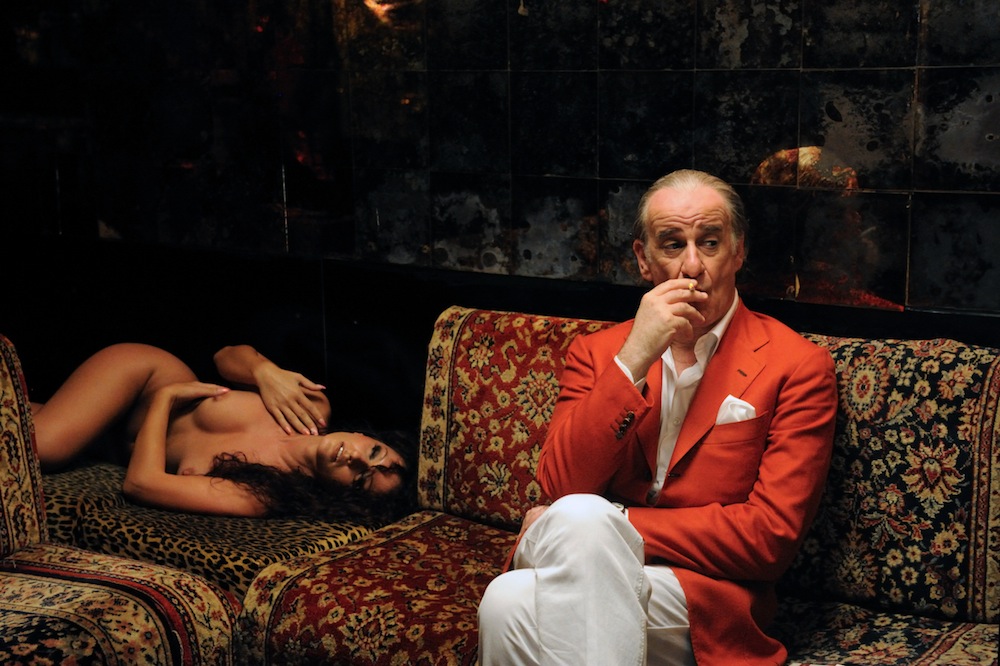 A fanciful jaunt through modern-day Rome seen through the eyes of a nearing-the-end-of-the-road libertine, “The Great Beauty” consciously evokes Fellini, though it’s free of Fellini’s attenuation and his lordly high-handedness. Writer-director Paolo Sorrentino has the advertising-soaked sensibility of an up-market vulgarian. Rather than fussily poke at decadence, as Fellini often did, Sorrentino revels in it; he has a love for polished surfaces and fever-dream exaggeration that rivals that of Paul Verhoeven or Brian De Palma. Sorrentino’s hero, Jep (the gallantly hangdog Toni Servillo), is a well-known writer. As a young man he wrote a novel that even he now considers pretentious. But rather than devote himself to his talent, he’s spent life in pursuit of leisure and sensual pleasure. (In his happier moments, Jep is proud to be Rome’s most beloved gadfly.) Though the movie offers scant explanation for his lavish lifestyle, he maintains his notoriety by puttering on the occasional magazine piece. This he takes only half-seriously. After interviewing a vapid performance artist — her act involves painting the Soviet flag on her pubis, then running face-first into a stone wall — he casually, bemusedly eviscerates her. Perhaps because Jep has so little time remaining (he’s just turned 65), he has little patience for moral or artistic preening.
The success of “The Great Beauty” is, I think, inseparable from its cynicism. It’s a cynicism that derives from Jep’s predisposition, his outlook. In its best moments the movie has a wry, observational quality that is reminiscent of the Italian social comedies of the ’60s, movies like “Divorce, Italian Style” and “Seduced and Abandoned.” And it’s often pleasingly, genially caustic. When Sorrentino tries to make points — about lost love, the death of high culture, the irrelevancy of the Church — he stumbles, as he does when he allows the movie to slip into the gloop of magic realism. Still, Sorrentino’s visuospatial sense is so keen, and Cristiano Travaglioli’s editing so quicksilvery, that you cruise right over the flaws. Watching it I felt as I do when a particularly mellifluous talker whisks away my better judgement in a gale of flimflammery. I hesitate to praise Sorrentino for what amounts to tricking me. But that trick is so much a part of the movie’s fabric that it hardly seems fair to complain. It’s part of Sorrentino’s (and Jep’s) Pirandellian put-on.
The Rome of “The Great Beauty” is a city shorn of its cultural heritage. Even its nobles have been reduced to sullen theme park attractions. When they’re not furtively visiting the public museums that were once their homes, they’re renting themselves out for parties thrown by the nouveau glitterati. While it’s tempting to compare the movie’s bustling, life-as-a-big-buffet vibe to the films of Robert Altman, “The Great Beauty” is perhaps too tightly wound to support the analogy. Structurally as well as metaphorically, it’s a death spiral. When we’re shown revelers engaged in a nightmare-lit conga, the face of each frozen in a rictus of semi-voluntary pleasure, it’s hard not to think of the danse macabre, or to wonder at Sorrentino’s ability to invest corrosiveness with a melancholy joie de vivre. (More than once I flashed on the work of that great contemporary nihilist, Gaspar Noé.) Sorrentino’s central conceit — that life is a phantasmagoria, a stream of highly personal sensations that abruptly ends when you die — isn’t much. But when a movie is this consistently fun to watch, I guess it’ll do.



 Blowhard, Esq.
 Callowman
 Sherbrooke
 Eddie Pensier
 Enzo Nakamura
 Epaminondas
 Fabrizio del Wrongo
 Fenster
 Brundle Guy
 Glynn Marshes
 Paleo Retiree
 Atypical Neurotic
 Question Lady
 Sax von Stroheim
 Sir Barken Hyena
 The Mistaken
 Uncouth Reflections