
Blowhard, Esq. writes:
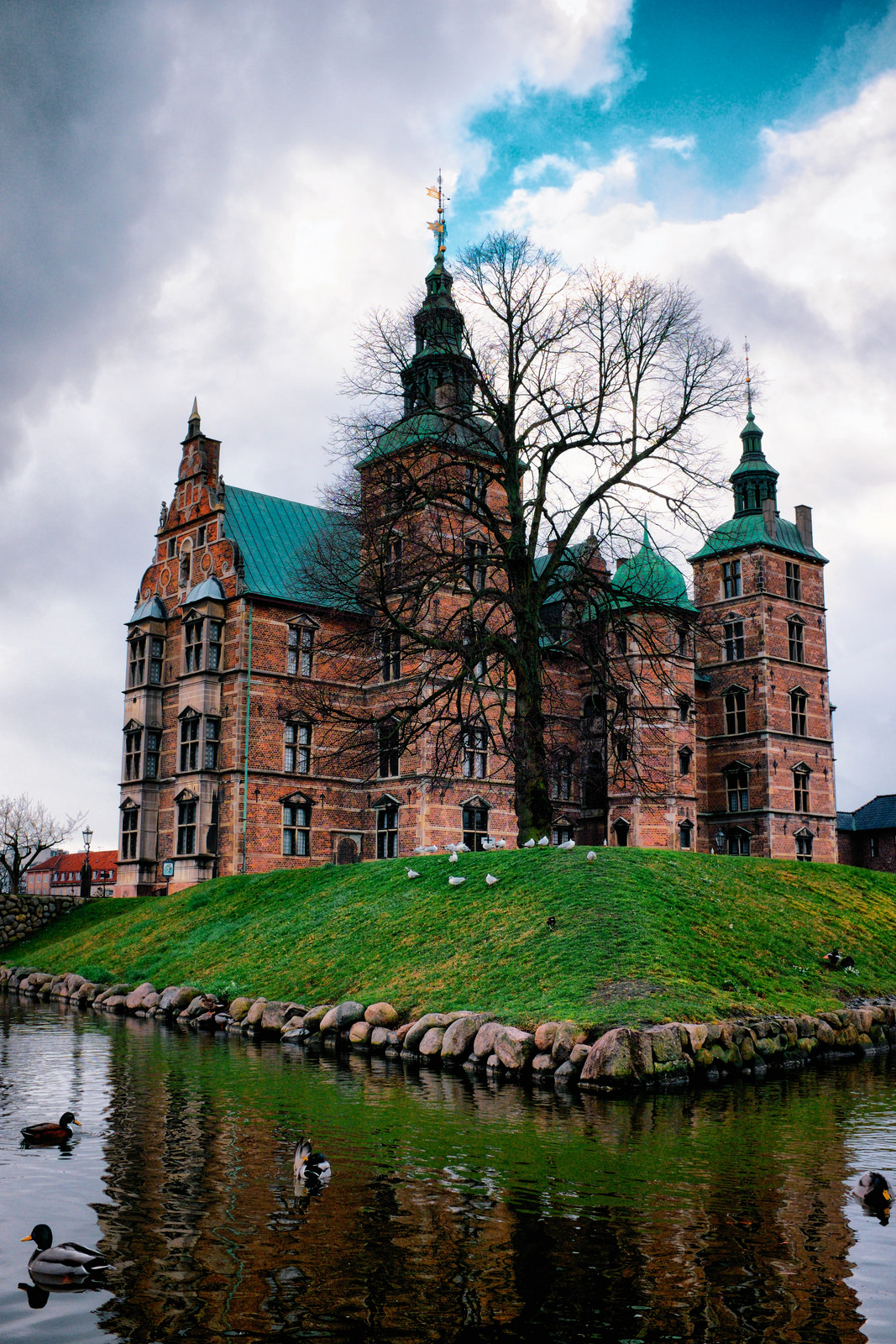 Rosenborg Castle in Copenhagen, Denmark.
Click on the image to enlarge.
Fabrizio del Wrongo writes:
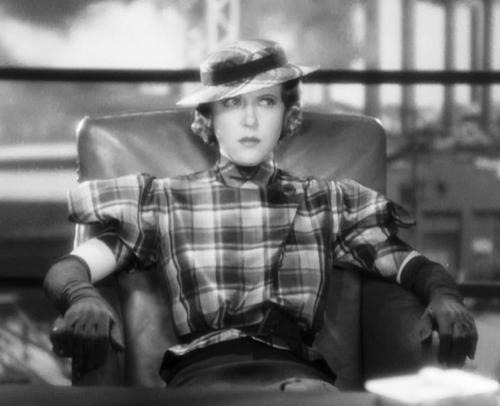
In the 1933 “Female,” Ruth Chatteron plays a successful industrialist who goes through men with the efficiency of a Catherine the Great. When she fancies a secretary (they’re all male), she invites them to her manse for dinner, plies them with vodka, and beds them without fuss or ceremony. Then she ignores them the next day — she can’t abide their fawning servility. Economically empowered but amorously aggrieved, she visits an amusement park hoping to meet a regular guy, the kind not afraid to stand up to her. (“I need someone to accept me as a plain woman,” she says.) She finds what she’s looking for in George Brent, who nonchalantly bests her in a flirtatious rifle contest — a meet-shoot moment that might have inspired the similar scene in “Gun Crazy.” Brent, it turns out, is an engineer contracted to Chatterton. She’s disappointed — another employee! — but she invites him for dinner anyway. He rebuffs her. Rebuffs even the vodka.
There’s rarely any flab on these early ’30s films: even the star vehicles tend to be admirably no-nonsense. “Female” runs a trim 60 minutes, and all the main players register without making a big deal of it. Chatterton’s get-ups aside, the sets are the only extravagant detail. The factory is pierced by enormous windows that look out on rear-projected industrial scenes. And Chatterton’s home is in the gargantuan style of ’30s musicals: it’s a gleaming deco cavern with exteriors pinched from Wright’s fussy Mayan temples. There’s a touch of Jacques Tati techno-ludicrousness to it as well, particularly in the way the place is wired so that Chatterton can tell her houseboys which room will require extra booze and pillows.
Chatterton, who sometimes looks a bit like Nancy Allen, locates the sweet spot between imperiousness and petulance; she perfects the art of looking bothered while standing with her hands on her hips and screwing up her brow. While it’s fun at first to watch her and Brent go at it, eating little hamburgers and making jokes about horse meat, the movie doesn’t capitalize on its set-up. Brent doesn’t have enough good lines, and all the sex goes out of the picture once he’s lodged in the heroine’s affections. I fear we’re supposed to celebrate the couple’s newfound staidness, their drudging respectability — but it’s hard to feel good about a picture that begins as a flight of fancy and ends in the kitchen sink. The resolution, in which Chatterton turns her back on her career as well as her appetites, is like a bucket of cold water; it’s a betrayal of both the characters and the romantic comedy ethos. William Wellman, William Dieterle, and Michael Curtiz all worked on the picture, though it’s credited to Curtiz alone. You can pick out Wellman’s work.
“Female” can be streamed via Warner Archive Instant.
Related
Eddie Pensier writes:
 “Restaurant De Lujo” (Luxury Restaurant) by Argentine humorist and editorial cartoonist Lino Palacio (1903-1984)
Fenster writes:
I like that Keep Calm font a lot. Can we use it here maybe?

Fenster writes:
Have you noticed the font style for previews of coming attractions has changed?
The old:

The new:

This article notes the difference.
The article quotes a font person who said it looked like Gotham, but that’s not right.

The MPAA itself said the font is Myriad-Pro, and if they say so I guess I believe them but that also seems off. The “O” in Myriad-Pro is not perfectly circular, the way the new preview sign has it.

It reads to me like the echt-Brit font Johnston, the London Underground font.


Also reminiscent of the “Keep Calm and . . . ” messages seen everywhere nowadays, a font which looks like another echt-Brit font called Gill but which was apparently hand drawn in WW2 for the original poster.



Obviously a cheap American knock-off
Do you suppose the ubiquity and popularity of the “Keep Calm” series has caused the MPAA to jump the pond?
Paleo Retiree writes:
Our Cocktail Du Jour series is mainly intended as a way to celebrate the pleasures of leisure, class, elegance, funkiness and getting a little high, as well as an ongoing tip of the hat to the cocktail renaissance we Americans are fortunate enough to be experiencing. (It’s not like you get to choose which artistic/cultural golden eras you live through — nothing you can do about when and where you were born. So why not take note of, explore and enjoy the ones that do come your way?) Man oh man, are there ever a lot of good bartenders out there, from solid traditionalists to flashy innovators and inventors.
Sad to say, though, that not all the news from the “craft cocktail” world is good. The other night, the Question Lady and I were out and about in Tucson and settled on a stylish-seeming, upscale place for dinner. I proceeded to be served the two worst “signature cocktails” I’ve ever had.
The first abomination — sadly, I was too stunned by its clueless awfulness to remember to take a snapshot of it — was the place’s variant on a Sazerac. The first bad idea was infusing the rye with apple and cinnamon — two flavors which are not meant to play nice with Pernod. The second bad idea was to hang an orange wedge on the edge of the glass. It turns out that there are good reasons why you’re never served a glass of orange/apple/licorice juice. The welcome harshness of the rye wasn’t nearly sufficient to mask the mixture’s really epic badness.
Hoping that a return to basics would redeem the drinks dimension of the evening, I ordered an Old Fashioned. What I was served was the place’s variant. By now I was on the alert and morbidly curious. Here’s a shot of the thing:

The color in the shot is accurate — the drink was more pink-red than amber. It had struck the place’s barmaster as a good idea to, essentially, fill the glass with as much cherry liquid as booze. Drinking it reminded me of nothing so much as going through one of those cans of Hawaiian Punch that many Boomers will remember from childhood. Hard for me to imagine that the words “Old Fashioned” would occur to anyone making their way through this cocktail.
But, given that the food was as fancy-yet-clueless as the drinks, maybe these concoctions please the place’s clientele. Despite the place’s chic appearance and chic-seeming menu, the crowd was far more caught up in the U of A basketball game on the TVs than in the food. So maybe this is the sort of thing people with no tastebuds but reasonably full wallets and a desire to feel up to date really enjoy. Hard to know — and I certainly won’t be asking the place’s bartender for insights.
Fenster writes:
There’s been an open moderated thread running at Andrew Sullivan’s blog on various approaches to atheism and their overall relation to belief. It was kicked off via a link to an article by Thomas Wells on why he is not an atheist. Wells is not a believer but he doesn’t want to call himself an atheist because he sees no reason to define himself in opposition to something he finds non-relevant to his life.
There are many supernatural things that some people believe in that I don’t, including Santa Claus, UFOs, crop circles, witches, ghosts, homeopathy, gods, fairies, and astrology. I see no particular reason to select out my non-belief in gods from that list of non-beliefs for special attention and justification. I see no no more reason to describe myself as an atheist, than as an afairieist, ahomeopathist, etc. To put it another way, my non-belief is apathetic: the nonexistence of God/Gods is a matter of great insignificance to me. And isn’t that how it should be?
That stance got a lot of pushback, including from more aggressive atheists who argue for more pro-active Dawkins-style assertiveness. In the pushback to the pushback, these folks got termed “dickhead atheists”–people who have nothing better to do than rain on the parade of believers when they ought not to care.
I agree raining on parades is dickhead behavior. I have too much respect for most believers–and too little fuel for any fire on my own account–for anything more than a general policy of live and let live.
I will note, though, that most of those folks arguing for greater voice did not argue for dickhead disruption just to make believers’ lives miserable, or to convert them to non-belief. Rather, most arguing for assertiveness based their arguments on politics–i.e., atheists ought to be willing to stand up and be counted, lest the assumption that we are all similarly religious produce outcomes, both cultural and in terms of public policy, that are not to our liking.
I suspect these points of view can be reconciled. As I see it Wells is making somewhat more of an aesthetic or psychological argument. He is indifferent, and thinks those making too much of a stink reveal themselves as caring too much about something they profess not to care about. But one can have the generally indifferent attitude Wells advocates to belief per se yet still be mindful of the tension between belief and non-belief in the public square, and to take action, including using one’s voice, in that square as needed.
Fenster writes:
In the news:
TOPEKA, Kan. — The Rev. Fred Phelps Sr., who founded a Kansas church widely known for its protests at military funerals and antigay sentiments, is in a health care facility, a church spokesman said.
Phelps, 84, is being cared for in a Shawnee County health center, Westboro Baptist Church spokesman Steve Drain said Sunday. Drain would not identify the facility.
I can see why the facility remains unidentified. It would be awfully tempting for people to show up with signs thanking God for the development.
Fabrizio del Wrongo writes:

We curved through the bright mile or two of the Strip, past the antique shops with famous screen names on them, past the windows full of point lace and ancient pewter, past the gleaming new nightclubs with famous chefs and equally famous gambling rooms, run by polished graduates of the Purple Gang, past the Georgian-Colonial vogue, now old hat, past the handsome modernistic buildings in which the Hollywood flesh-peddlers never stop talking money, past a drive-in lunch which somehow didn’t belong, even though the girls wore white silk blouses and drum majorettes’ shakos and nothing below the hips but glazed kid Hessian boots. Past all this and down a wide smooth curve to the bridle path of Beverly Hills and lights to the south, all colors of the spectrum and crystal clear in an evening without fog, past the shadowed mansions up on the hills to the north, past Beverly Hills altogether and up into the twisting foothill boulevard and the sudden cool dusk and the drift of wind from the sea.
It had been a warm afternoon, but the heat was gone. We whipped past a distant cluster of lighted buildings and an endless series of lighted mansions, not too close to the road. We dipped down to skirt a huge green polo field with another equally huge practice field beside it, soared again to the top of a hill and swung mountainward up a steep hillroad of clean concrete that passed orange groves, some rich man’s pet because this is not orange country, and then little by little the lighted windows of the millionaires’ homes were gone and the road narrowed and this was Stillwood Heights.
The smell of sage drifted up from a canyon and made me think of a dead man and a moonless sky. Straggly stucco houses were molded flat to the side of the hill, like bas-reliefs. Then there were no more houses, just the still dark foothills with an early star or two above them, and the concrete ribbon of road and a sheer drop on one side into a tangle of scrub oak and manzanita where sometimes you can hear the call of the quails if you stop and keep still and wait. On the other side of the road was a raw clay bank at the edge of which a few unbeatable wild flowers hung on like naughty children that won’t go to bed.
Then the road twisted into a hairpin and the big tires scratched over loose stones, and the car tore less soundlessly up a long driveway lined with the wild geraniums. At the top of this, faintly lighted, lonely as a lighthouse, stood an eyrie, an eagle’s nest, an angular building of stucco and glass brick, raw and modernistic and yet not ugly and altogether a swell place for a psychic consultant to hang out his shingle. Nobody would be able to hear any screams.
— Raymond Chandler
Related
Blowhard, Esq. writes:
 Chantal Goya and Jean-Pierre Léaud in Jean-Luc Godard’s MASCULIN FÉMININ (1966)
Click on the image to enlarge.
Related
 Blowhard, Esq.
 Callowman
 Sherbrooke
 Eddie Pensier
 Enzo Nakamura
 Epaminondas
 Fabrizio del Wrongo
 Fenster
 Brundle Guy
 Glynn Marshes
 Paleo Retiree
 Atypical Neurotic
 Question Lady
 Sax von Stroheim
 Sir Barken Hyena
 The Mistaken
 Uncouth Reflections