R. Emmet Sweeney picks the best DVDs of the year, including a set containing two of my favorite Japanese films of the ’30s, Yamanaka’s “Humanity and Paper Balloons” and “The Pot Worth a Million Ryo.”
In the 1979 “Superman: The Movie,” Supes foils a real estate scheme involving the destruction of California’s coastline. Granted, this entails causing the earth to spin backwards for a little while, but it was a fairly modest plot by contemporary standards. Now, if you ain’t saving the world, you ain’t nuthin’.
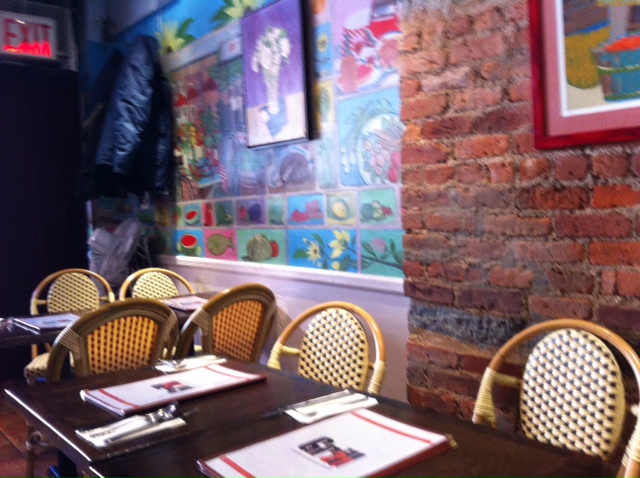
Fenster tries to be a trend setter of the likes of Paleo Retiree and The Question Lady but it’s always a day late and a dollar short. Since the two of them recently found an interesting Filipino restaurant in New York City, Fenster’s idea of cutting edge was to slavishly follow their example. Herewith a few snaps of Grill 21, an appealing little hole-in-the-wall on 21st Street near the corner of 1st.
My tosilog, thin sliced pork roast marinated in a sweet and salty sauce and fried.
The neighboring table’s pata (crispy pork knuckles) and sininang na baboy (pork chunks in a tamarind broth). Next time.
Gian Carlo Menotti’s Amahl and the Night Visitors was the first opera composed especially for television. It was commissioned by NBC for a Hallmark Hall of Fame presentation in 1951, and became a holiday standard not long afterwards. It is still a staple of community theaters for both its inspirational story and its (uncharacteristic for 20th-century opera) straightforwardly tonal melodic style.
Hieronymous Bosch, Adoration of the Magi. The painting that inspired Menotti to write Amahl. (click to enlarge)
The original NBC production, originally aired live, was shown annually throughout the 50s and 60s but went out of vogue. In 1978, a new production was filmed, starring Canadian soprano Teresa Stratas, American bass-baritone Giorgio Tozzi, and Anglo-Jamaican bass Willard White, conducted by Spaniard Jesús López-Cobos. The interior scenes were shot at London’s Pinewood Studios, while the exteriors were filmed on location in Israel.
Ignore if you can the poor sound quality, which desperately needs remastering, and focus on the gorgeous music which owes debts to Ravel and Barber (Menotti’s real-life partner), and the stunning vocal performances. The subsequent five parts are also on YouTube. Fans of the Bosch pictured above will be tickled to note that the Magi in the movie are dressed exactly as they are in the painting.
In one of the great epic fails in moviemaking history, the BBC filmed and edited a completely new version of Amahl in 2002. It was awaiting broadcast before it occurred to someone to ask if the copyright had been secured before shooting started. It hadn’t, as it turned out. So there is a multi-million-dollar film of this opera that won’t see the light of day for another 50 years or so.
I often marvel at the way certain situations, characters and setups establish themselves so thoroughly that they become part of our shared cultural landscape. Think of how often we’ve watched shiny new cars zooming across the Great Salt Desert or winding their way down California’s Highway One, for instance. How weird that these particular images have become as familiar to all of us as they have.
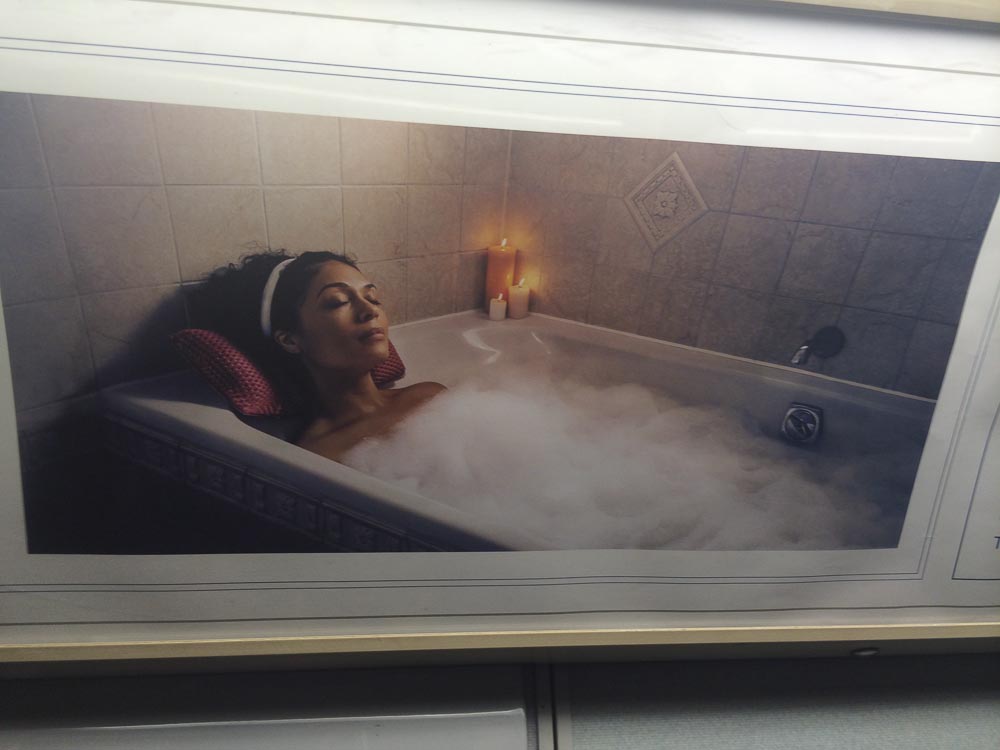
From a poster that caught my eye on the subway the other day, here’s another example:
The woman-in-a-bubblebath-with-candles-by-her-side trope: Once you start noticing it, it’s everywhere — in ads, in TV shows, in chickflicks … Apparently this image has resonance of some kind. But why? Does it reflect anything in the way of reality? Or is it just an appealing fantasy? What’s the history of “the woman who relaxes in a bubbly bathtub with candles by her side” image anyway? Has it gained in popularity as more and more women have entered the workplace? (In other words: as women grow more overextended and more tired, do they dwell ever more on fantasies of relaxing?) Does the trope exist in other cultures? Guesses, speculations, insights and experiences will be enjoyed and appreciated.












 Blowhard, Esq.
 Callowman
 Sherbrooke
 Eddie Pensier
 Enzo Nakamura
 Epaminondas
 Fabrizio del Wrongo
 Fenster
 Brundle Guy
 Glynn Marshes
 Paleo Retiree
 Atypical Neurotic
 Question Lady
 Sax von Stroheim
 Sir Barken Hyena
 The Mistaken
 Uncouth Reflections