Fabrizio del Wrongo writes:
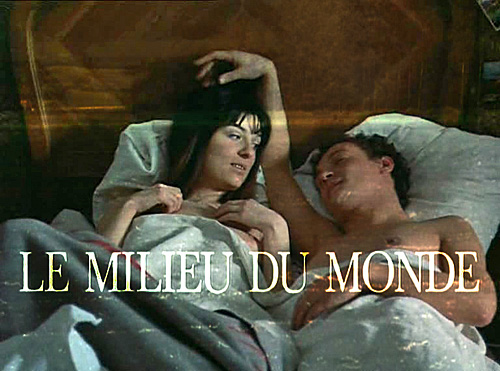
 Alain Tanner’s “The Middle of the World,” released in 1974, is a movie about cultures clashing in the most subtle of ways. Maybe it’s more appropriate to say it’s about cultures slipping past each other in the night — it’s the class struggle staged as a sleepy pas de deux. Philippe Leotard plays Paul, a Swiss engineer who’s recently been persuaded to run for office. Paul is a man of the middle class: during a strategy huddle the leaders of his party stress stability and normality, values characteristic of middle classes the world over. These men are also characterized by their benign self-centeredness: Content with their community, they have no need to look outside of it. They’re comfortably normal. The idea of normalization weighs heavily on the movie. Following the opening credits a voice-over explains that transitional forces in Europe have thus far failed to alter the status quo. The movie intends to get at this tug-of-war between change and conventionality.
As is his wont, Tanner emphasizes the cultural fuzziness of Switzerland, that politely unassuming country that on maps is tucked neatly among the larger blots of Italy, France, and Germany. Perhaps he over-emphasizes it: the screenplay, by Tanner and the writer-intellectual John Berger, makes repeated reference to the town’s location on Europe’s continental divide, the point at which water can run into either the Mediterranean or the Atlantic. Further stressing the geographical metaphor, Paul proudly refers to the area as “the middle of the world,” a title we’re meant to take semi-ironically. It’s the middle of his world, anyway.
That world is knocked a bit off center when Paul begins a relationship with Adriana, a northern Italian woman who has come to Switzerland for reasons that are never made clear. Tanner introduces her on a train, one of his favorite symbols of transition. When she arrives in Paul’s area she takes a job at a local pub, whereupon her new boss warns her against getting involved in her patrons’ political discussions. (“Beer,” she says, “has no party.”) Adriana’s becoming sexually involved with an aspiring politician, thereby becoming the subject of everyone’s political discussion, is one of the movie’s several low-key ironies. Olimpia Carlisi, the actress who plays Adriana, is both cool and earthy. Though the character is intended as an avatar of the industrial working class (she comes from a family of factory workers), Carlisi gives her the limpid air of an odalisque — she’s a creature you want to contemplate. (“I could look at you all day,” Paul tells her.) Paul’s intentions are always very clear. He’s smitten, and as he grows closer to Adriana his attachments to his wife and career begin to weaken. Adriana, however, remains remote. It’s possible this dislodged woman is drawn to Paul’s unreflective confidence regarding his place within the community. But we don’t know for sure: she’s as sphinx-like as Paul is garrulous.
Though Paul is married, he vows to see Adriana every day. In a sense “The Middle of the World” is a record of their meetings. These Tanner presents in chunks, mostly composed of unhurried long takes, each prefaced by a title card providing the date. This formalizes their encounters, encourages us to see them as independent bits occurring outside the spooling-film flow of regular life. Possibly, Tanner wants us to experience the relationship as the lovers experience it in their memories: as a series of semi-connected scenes, each with its own set of parameters. There are several references to the shift in frequency that sound waves undergo as objects approach and then recede into the distance. I think we’re meant to understand this relationship in similar terms: as a distortion that has occurred as the trajectory of Adriana has intersected with the fixed point of Paul.
The film is rife with showy, clever-awkward gimmicks of this kind — it’s affected by what my co-blogger Paleo Retiree calls the “Euro-novelist approach to big themes and metaphors.” Your receptiveness to this tactic will inevitably vary, but I think it’s unquestionable that some of this stuff — this arty-intellectual scaffolding — distracts from what’s best in the movie, namely the muted, non-actorly performances and Tanner’s unpushy way with the material, which always feels true to the look and rhythms of an out-of-the-way, semi-rural locale. In particular there are some lovely winter landscapes, some of which have the timeless, standing-for-everything clarity of a miniature by the Limbourg Brothers. Occasionally Tanner will follow one such image with a shot of the same location in summer, a juxtaposition that forces a consideration of the land as a constant — as a bolster against the impermanence of people, weather, and feelings.
The relationship ends when Paul loses an election and Adriana loses her job. Afterwards she moves to the German-speaking part of Switzerland, where she finds employment in a factory. (Pointedly, it looks similar to the one overseen by Paul.) Prior to that we see their meetings grow contentious: more often than not they end in arguments, which Adriana tends to neutralize by offering sex. (She seems to enjoy fucking just as much as he does.) We also see that Adriana is resistant to Paul’s repeated proffers of marriage. She claims that he will never be able to “see” her, to know her.
Here the movie’s refusal to provide us with a sense of Adriana’s motivations is problematic. We know only that she doesn’t want a middle-class life. What she does want remains a mystery, probably even to her. (We’re told as much by the movie’s narrator.) In his contemporaneous review of the film Roger Ebert writes that Adriana can be taken as a symbol of feminism. If so it’s a feminism of a frustratingly aimless sort. Adriana seems destined to roam the back roads of Europe until she finds . . . what? A commune of like-minded undecideds? Ebert blames Paul for Adriana’s vagueness, claiming that his lack of interest in her motives is what keeps her so remote. But since the movie refuses to explain Adriana it seems wrong to blame Paul for failing to figure her out. Besides: If she’s so liberated, why does she need Paul to act as her confessor? It’s possible Adriana is intended to represent an inchoate and wayward leftism. Yet I think it’s equally likely that Tanner and Berger succumb here to the kind of male self-absorption that Ebert ascribes to Paul: they’re so keen for Adriana to stand for something that they don’t bother to make her stand up.
Released nearly ten years later, Tanner’s “In the White City” takes what is best in “The Middle of the World” — the rumpled eroticism, the feel for transience, the unfussy visual poetry — and dispenses with most of the political-conceptual baggage. Where “World” sometimes feels like a treatise, “City” comes off as a memoir — the kind that lingers in your memory long after its overt meanings have faded. I think it’s the better picture.
Related
- I wrote about “In the White City” back here.
- An old “Movietone” interview with Tanner in which “The Middle of the World” is discussed. It’s amusing that such a big deal is made of the movie’s use of long takes.





 Blowhard, Esq.
 Callowman
 Sherbrooke
 Eddie Pensier
 Enzo Nakamura
 Epaminondas
 Fabrizio del Wrongo
 Fenster
 Brundle Guy
 Glynn Marshes
 Paleo Retiree
 Atypical Neurotic
 Question Lady
 Sax von Stroheim
 Sir Barken Hyena
 The Mistaken
 Uncouth Reflections