Atypical Neurotic writes:
On the way to work, I noticed this “breakfast special”, a submarine sandwich for NOK 29, around USD 5. I’m fasting today, so I gave it a pass.

Atypical Neurotic writes:
On the way to work, I noticed this “breakfast special”, a submarine sandwich for NOK 29, around USD 5. I’m fasting today, so I gave it a pass.
Paleo Retiree writes:
Atypical Neurotic writes:
The first time I visited the “other” Georgia, called Sakartvelo in the Georgian language (which in turn is written საქართველო in the Georgian alphabet), was at Christmastime 2004. My next visit was in November 2006, and I have been back once or twice ever since. The pics in this series are all from 2011 or later, as I did not have a decent digital camera until I got one for Christmas in 2010. They are not in chronological order. I hope that my blog readers with OCD issues will bear with me here. If it isn’t a problem for me, it shouldn’t be one for you.
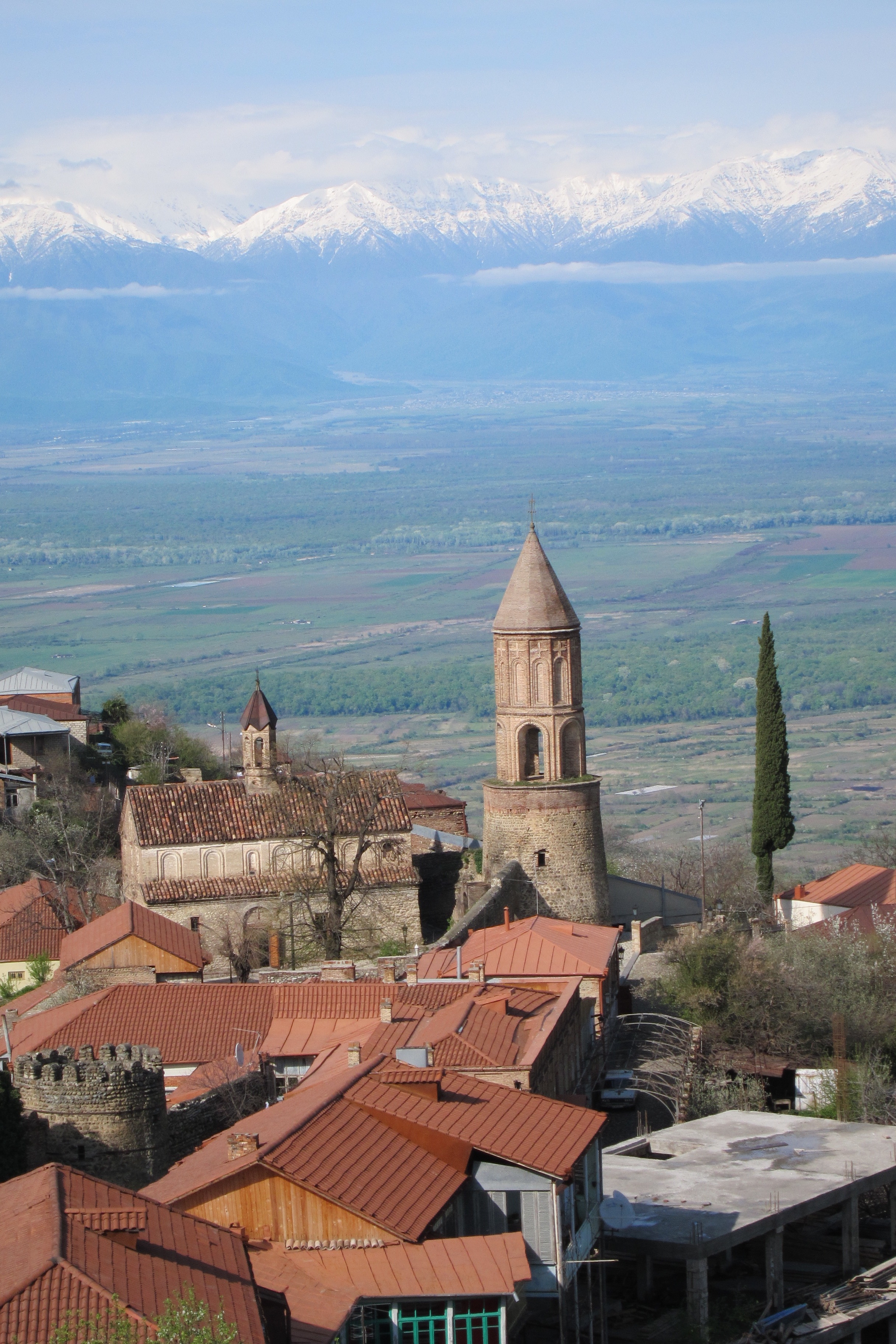
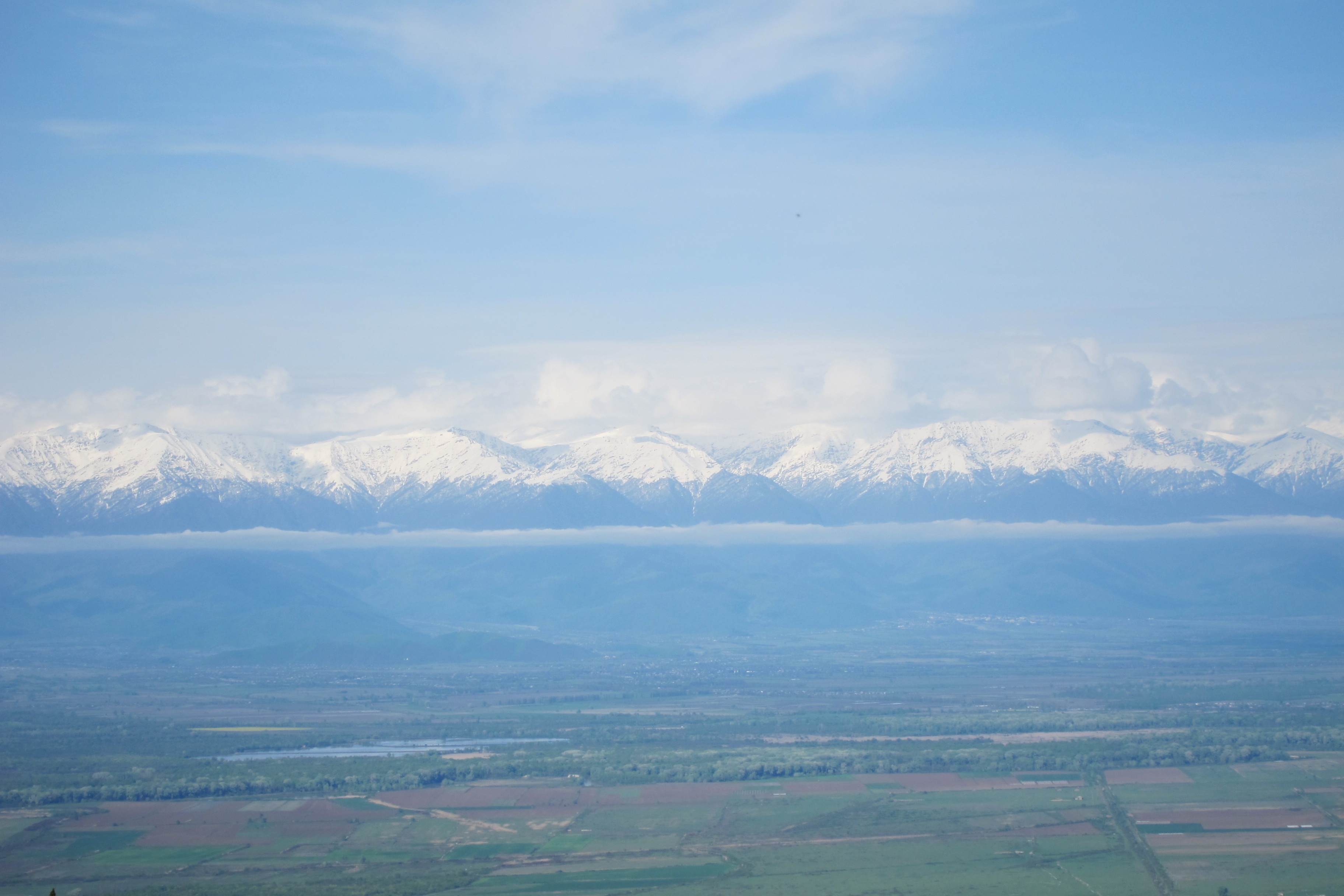
This is a shot of the Greater Caucasus Range from the village of Sighnaghi, overlooking the Alazani Valley. Beyond the mountains is Daghestan, which is why Sighnaghi is surrounded by a wall. In Soviet times, Sighnaghi was a popular tourist destination, but after the collapse of the Soviet Union, Lithuanians, Estonians and Uzbeks could – at least in theory – now travel to Florence or Cape Town. In the meantime, Sighnaghi has been spruced up, and looks more lived-in these days, not so much like a movie set.

This is a shot of Metekhi Church and Narikala Fortress taken from Kopala Restaurant. Pretty good food and a great view.

A shot of the Gombori Pass region, which separates Kakheti (eastern Georgia) from the central region surrounding Tbilisi.
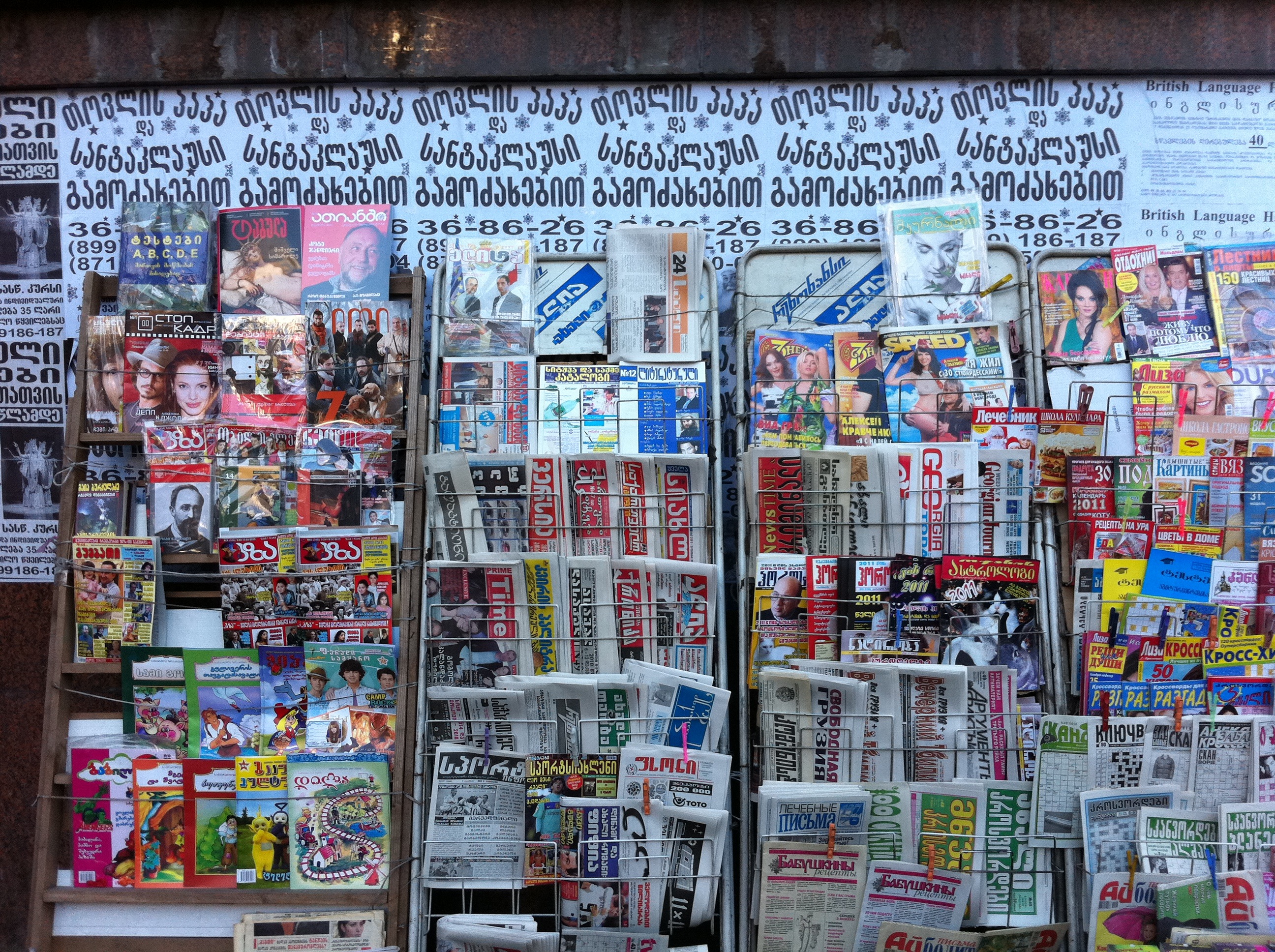
When I first visited Georgia in 2004, there were almost no advertising-supported periodicals for sale. Now they are everywhere. People need to have celebrity mags in their own language.
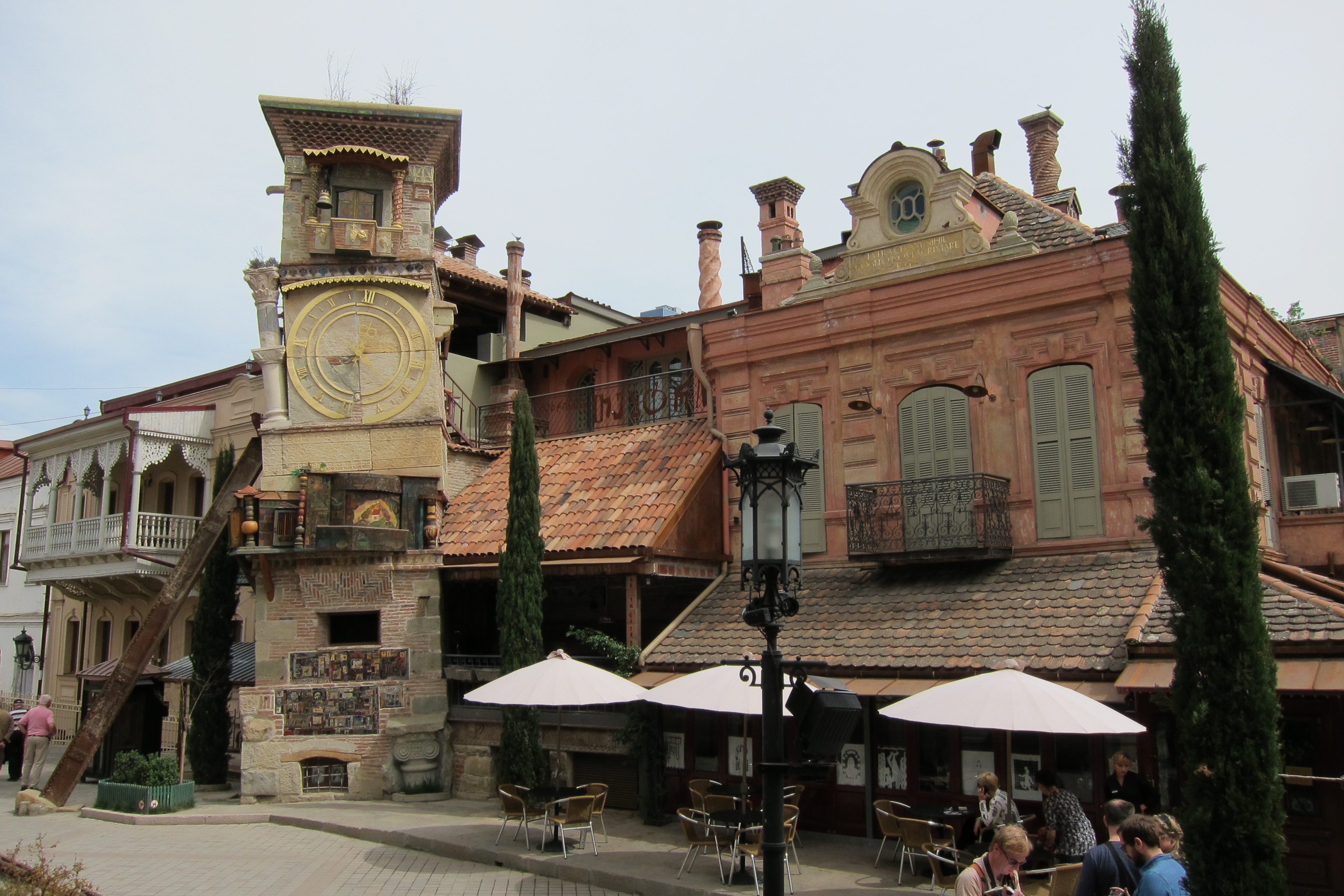
There was a gallery/beanery at the edge of the Old Town called Sans Souci, founded by a returning ex-pat in the late 1990s or early 2000s, I am guessing. It wasn’t originally a restaurant until two German tourists came in, sat down at a table, and asked for a menu. The artist/proprietor dished up some lobio, a brown bean stew seasoned with cilantro and fenugreek (which are in just about everything, by the way) and the rest was history. Unfortunately, the building had to be torn down because it was structurally unsound, and this is what replaced it. The food is still good.
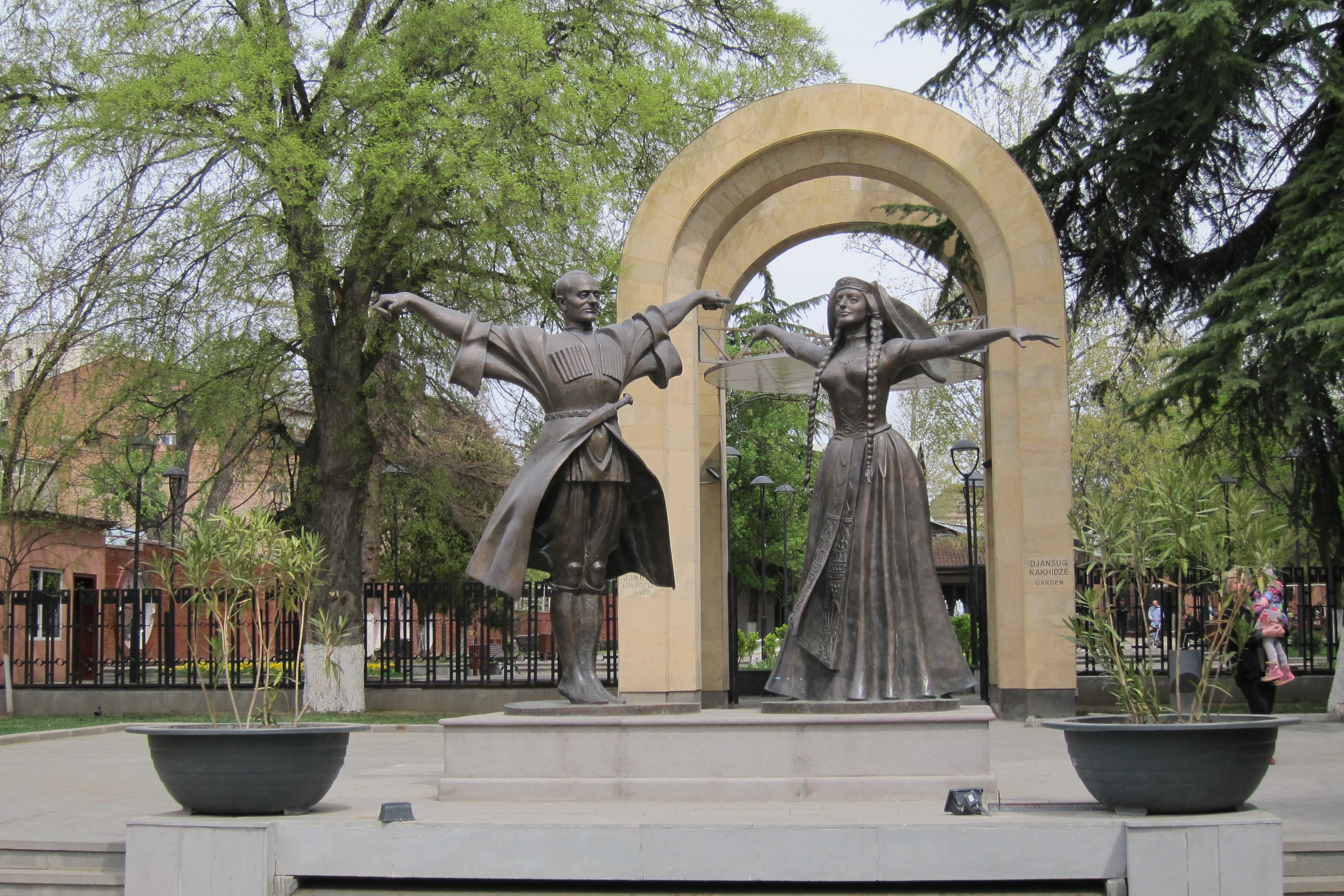
I took this picture in spring 2012 on a stroll along Davit Aghmashenebulis gamziri (David the Rebuilder Boulevard) on the north bank of the Mtkvari, the muddy, swift-moving river that runs through Tbilisi and flows into the Caspian through Azerbaijan, where it is called the Kura. My FB comment at the time was “All the Lenin statues have been resmelted, but the remaining Soviet-era art gets to stay, as it is pétit-bougeois in taste”.
A park bench in Tbilisi, and we know this because that is what it is written in the ironwork.

From my most recent visit. A campaign poster for one of the presidential candidates (the election is today). Nino Burjanadze was a supporter of Mikheil Saakashvili during the Rose Revolution in 2003, and for a period afterward, but is now a critic. Her motto is “Fairness – everywhere and for everyone”. A Georgian friend said that people refer to her as Tootsie…

A greengrocer selling real food. Those pendulous thingies hanging from the lintel are called churchkhela, a confection made from grape pulp and walnuts.

For once, a decent place to eat…

Finally, another shot of Sighnaghi, from the approach from the south/west, with the Greater Caucasus shrouded in clouds…
Atypical Neurotic writes:
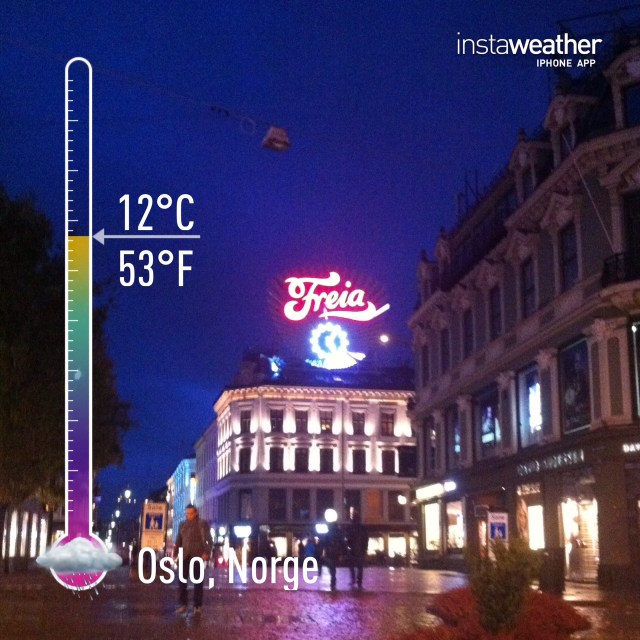
A rainy, yet mild late October evening on the first full day back on standard time. Note that according to the clock on the Freia Chocolate sign, it is five past five…
epiminondas writes:
If you’re looking for bad poetry, you came to the right place: McGonagall is your man. This stuff is so excruciatingly bad, it’s funny. Don’t say you weren’t warned.
Fabrizio del Wrongo writes:

If the selfie is the premier photographic genre of our age, then I name Shu Qi as its queen.
Are you all familiar with Shu Qi? She’s a Taiwanese model and actress best known in the West for her appearance opposite Jason Statham in the first “Transporter” film. But she’s also served as the muse for renowned arthouse director Hou Hsaio-hsien. In Hou’s 2001 “Millennium Mambo” Qi is framed as the embodiment of youth and freedom. The movie’s melancholy stems from Hou’s contemplation of the much younger actress; his camera often seems to be trying to reconcile his eroticized fascination with the shallow reality of her character’s day-to-day life. (It’s reminiscent of the way Godard looked at Anna Karina in the ’60s.)
But enough of that: The point of this post is to celebrate Qi’s talents as a selfie artiste. Below is a gallery of some of the selfies she’s posted on her public Facebook page, which you can “like” by clicking here. They run the gamut of common snapshot moods, from consumer-y self-satisfaction to semi-canned tourist excitement to the burnished ennui familiar from upscale architecture mags and old Antonioni movies. As you’ll no doubt notice, she’s also a master of the second most important photographic genre of our age — the look-at-what-I’m-about-to-eat food shot.
Which is your favorite?


Related
Paleo Retiree writes:
Have you run into the Frenchman Jean Raspail? Back in 1973 he published a notorious book called “Camp of the Saints,” a dystopian/apocalyptic novel about Western Civ getting overrun by 3rd worlders. He was much-mocked and derided, naturally; all right-thinking people — the ones who paid attention to it at all — knew, just knew, that he was a racist/fascist/whatever. Time magazine’s Paul Gray put the word “Gestapo” into the very first line of his review of the book — awesome work, dude. The book’s power to enrage mainstream opinion hasn’t waned; when “Camp of the Saints” returned to French bestseller lists in 2011, the word “raciste” was prominent in the headline of the article L’Express published about the event. An evil nature can be the only possible explanation for Raspail’s views, after all.
But, well, maybe we’re discovering that Raspail was right all along. I read the novel myself some years back — when a book starts getting talked about as something so hideous as to be outrageous, I tend to be one those people who’ll go out and pick up a copy. I remember being amazed at the number of people who had strong opinions about “The Bell Curve” without having read it, for instance. I promptly bought a copy and gave it a read; danged if it didn’t turn out to be far more interesting than the public caricature of it made it out to be. Besides, I’d been fascinated by the immigration issue ever since I was struck by it during a school year I spent in France in the early ’70s.
Verdict: I didn’t love “Camp of the Saints” as a reading experience — I found it gloomy, slow-going, grueling and abstract. “I get it, I get it,” I kept muttering. But “Camp of the Saints” is also clearly one of those strikingly prescient books — like “1984,” “Brave New World” and much of Philip K. Dick — that may deserve a category (something like “not great in a strictly literary sense, but, hey, they accurately predicted the future and that’s really something”) of their own. I may have found the novel hard going … but who could dispute that it has proved to be major in its own way? Funny how it isn’t better-known in the U.S. I wonder why that could be.
For all my reservations about Western Civ — and especially my horrors at what our imperial elites get up to — I do regularly marvel at how willing we seem to be to throw our civilization away and/or hand it over to strangers. If I’m going to bother with civilization at all, I’d like it to deliver what ours sometimes does: clean drinking water, a certain amount of freedom, movies, air conditioning … And maybe that takes a little vigilance. It’s a practical question so far as I’m concerned. Put aside ideals and altruistic feelings: How many strangers can you really make room for in your family home before it ceases being “your family home”?
Raspail is an old man of 88 now. Here’s the latest interview with him, and here’s a nice passage from it:
At the point where we are now, the measures we would have to take would necessarily be very coercive. I don’t believe it will happen and I don’t see anyone who has the courage to do it. They would need to put their soul in the balance, but who is ready for that? That said, I don’t believe for an instant that the supporters of immigration are more charitable than me: there probably isn’t a single one of them who intends to welcome one of these unfortunates into his home… all of that’s just an emotional pretence, an irresponsible maelstrom that will engulf us.
Weird, the way that for mainstream opinion you’re either pro-immigration — and thus a decent person — or you’re anti-immigration, and thus deserve censure as a Nazi. Why is “I wish the world at large well, but I also think it’s important to respect and look after our own good fortune” not considered something a decent person is allowed to assert? Forgive me for suspecting that the people who run the public debate want that particular option to be ignored.
Related
Sir Barken writes:
Lately at Casa Barken, where the coyotes don’t just howl at the moon, we’ve had the platters spinning like UFOs at Area 51. Here’s a sampling of some of the aural delights.
Astrud Gilberto / The Shadow of Your Smile 1965
 Produced by Creed Taylor, engineered by Phil Ramone and Rudy Van Gelder, this is one supremely sensual audio experience. All of the Verve recordings I have from this era are stunning in quality, from the performances, to the production, to the pressing. These records fire on all cylinders.
Most striking to the early 21st century ear is the contrast with today’s pop music. It’s hard to believe something as unabashedly beautiful was ever in the Top 50. How far we’ve fallen. And of course today Astrud’s vibrato free vocals would get shoved into an Autotune straightjacket. Probably her singing sounds out of key to anyone under 25.
This record is a delight. These songs float by on breezy contrails of violins over deep black pools of bass, glittery with swarms of percussion. And then they die in smokey orchestral sunsets of the strangest modulated chords.
This is as much a “put it on an float away” album as any by Pink Floyd.
Kevin Godley & Lol Creme / Freeze Frame 1979

This is pop of an entirely different kind, indeed pop that was never popular. Godley & Creme were refugees from the mid 70’s pop group 10CC, and managed to parley that success into a run of bizarre albums that were destined for the cut out bins. They went on to be big players in the 80s video world (Herbie Hancock’s “Rockit” and The Police’s Syncronicity videos among others) before disappearing.
Godley & Creme were geniuses behind the mixing board, a quality they first showed on 10cc’s “I’m Not in Love”, with it’s hundreds of tracks of back ground vocals. With Freeze Frame they’ve taken that spirit to it’s extremes, so much so that the songs almost disappear under a frayed and fractured surface of bizarre sound textures. Almost nothing runs straight and true or stands upright; it’s like a Broadway musical staged in Dr Caligari’s world. This oddness extends to the lyrical subject matter. “Random Brainwave”, about an errant radio station going rogue; “I Pity Inanimate Objects”, what it says, but in more detail; “Freeze Frame”, a child’s meditation on a murderous parent, and best of all, “Brazilia”, which I’d wager is the only pop music critique of the International Style of architecture ever recorded.
Its not a question of liking this album, you pretty much just stand back and gawk at it.
Mike Oldfield / Incantations 1977

This is the best minimalist record by a non-minimalist composer. Oldfield is a great melodist, not the conceptual type, but he’s long had an interest in Philip Glass. The Exorcist theme pulled from Tubular Bells makes that clear.
Where Glass would take a phrase and break into fractals to structure his music, Oldfield instead obsesses over a spine of rising musical fifths, something more potent than Glass’s primary harmony arpeggios. Oldfield builds on this spine, leaving lots of opportunity for music geekery spotting the recurring themes and relationships over 4 sides, culminating in this austere lattice of vibes and bass guitar, slashed over by Oldfield’s Dionysian guitar.
From here Oldfield moved to greener more commercial pastures and never again touched such highs. Incantations remains the one musical work that reminds me of The Goldberg Variations in the sheer depth of it’s weaving.
Joni Mitchell / Don Juan’s Reckless Daughter 1977

I can just imagine Joni’s A&R man crying into his coke stash upon hearing this album for the first time. Don Juan’s Reckless Daughter slammed the door on mega fame for Mitchell for good, though she has regained some elder statesman glamour lately. And it’s quite clear that was just fine with her. There are a few examples of artists turning their back on the big time because they just weren’t into it, not more. She’s at the top of my list, and she didn’t just walk away she flipped fame the bird on the way out.
Sonically this has my vote for her most interesting album. It’s virtually a trio between Joni’s vocals, her guitar (here a shimmery 12 string acoustic), and Jaco Pastorius’ unruly fretless bass. During mixing there was a battle of wills between Mitchell and Pastorius; he kept turning the bass up, she kept turning it down. Jaco won, and thank god!
I had always regarded him as only a pyrotechnician on bass, but here he’s Mr Musicality all the way, and such an usual texture emerges that at it’s best DWRL really isn’t comparable to any other record. It’s a genre unique to itself, a trailblazing folk, jazz, experimental and world fusion melange, but always 100% Joni Mitchell.
And at its worse, there are some misfires, some awkwardness, but why not? She’s a bit drunk on this album, drunk on freedom, willfully asserted. We’ll take the good with the bad when the good is this good.
Boards of Canada /Music Has the Right to Children + Tomorrow’s Harvest 1998/2013
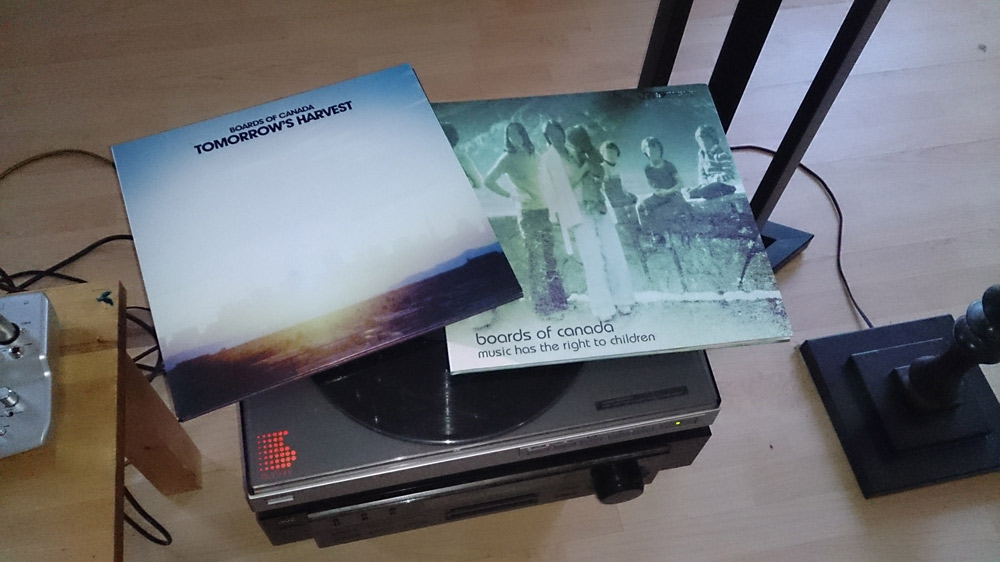
In my day, electronic music was synonymous with the future, it was sci-fi music. Boards of Canada, a Scottish duo, somehow turned that around completely and have made faded remembrance the signature of their electronic music. They’ve staged this obsessive theme across 4 albums. Music Has the Right to Children, their first full length, was an instant sensation in the electronic underground hothouse of late 90s Europe, being often compared to the Beatles for their time. Built from shards of hip hop, old documentary soundtracks, errant machines, My Bloody Valentine-like lathed-down distortion beds, and some really nice tunes, the result was still nothing like all that. Instead there’s a haze of dim childhood memories, some fearful, some pleasant but all now painfully inaccessible, irretrievably lost.
Tomorrow’s Harvest, new this year, isn’t remembering childhood. It’s remembering now, this world, our world, from a time when there isn’t much of it left. This is both sci-fi futurist electronic music, and a faded memory of an impossibly lost past, a place of ghosts and ruins. The whole album is infused with that feeling I think many of us are feeling these days, an uneasy sense of “where the hell is all this going to end up?”
This is Boards of Canada’s dark Sgt. Pepper‘s, a perfect summation in music of what millions are now feeling, a moment in time, crystallized, ready for memory.
(I recommend full screen for this video.)
Blowhard, Esq. writes:
 Dorothy Malone and Bogie in Hawks’ THE BIG SLEEP

 Blowhard, Esq.
 Callowman
 Sherbrooke
 Eddie Pensier
 Enzo Nakamura
 Epaminondas
 Fabrizio del Wrongo
 Fenster
 Brundle Guy
 Glynn Marshes
 Paleo Retiree
 Atypical Neurotic
 Question Lady
 Sax von Stroheim
 Sir Barken Hyena
 The Mistaken
 Uncouth Reflections