In-Charge Women and Slumping Men

Paleo Retiree writes:

Here’s a little scene I witnessed the other day at an airport:

Woman superior

There’s much to be remarked on in this photo where current relations between the sexes go. As for the woman: her attitude of wide-awake in-chargeness: her broadly-spread, crossed legs, as aggressive as a pro baseball player’s, taking up space purely for the pleasure of establishing a territorial claim; the CEO-in-the-making zigzag of her spine; the combo of intensity and aloofness in her facial expression, pressing her point home coldly and firmly. She’s all cockiness, assertiveness, impatience, guidance, and command. As for the b.f.: slumped-over, exhausted, submissive, soft and collapsed. What’s more to be said about him?

But what I found myself  focusing on was the placement of the woman’s right hand. Was she really rubbing and scratching the back of her man-boy’s head and neck? Yup, she really was. Here’s my reading of her gesture: She was stroking her b.f. as though calming, placating, soothing and controlling either a very young boy or a small, temperamental, and not very bright pet. She’s showing her man no more respect than she would a new purse. Maybe less, in fact: Hubby/b.f. as a lifestyle accessory.

In recent years I’ve witnessed many, many young women treating their men this way; and I’ve seen many, many young men accepting this kind of treatment — and, for all I know, even welcoming it.

It’s hard to convey how repulsive this looks to an old-timer, and by “old timer” I mean something like “any guy who did a little growing up before ’70s feminism.” I can assure readers that almost no man of my generation would allow himself to be treated like this by his woman. It can be mega-lovely to accept touching, stroking and attention from a lady-mate, god knows. But soothing is something that should happen in private, not public. And even when you do choose to accept some womanly warmth, affection and sympathy  — and if you aren’t going to get that from your woman, why are you bothering with her at all? — it’s something that you should never do submissively.

Were today’s young men never taught the meaning of the word “self-respect”?

Related

Posted in Photography, Sex, Trends, Women men and fashion | Tagged , , , , , , | 48 Comments

The Monopoly is Over

epiminondas writes:

The barriers to entry just got dynamited.  And the tremors are going to be felt everywhere.

Posted in Education | 6 Comments

Liberals in Hell

epiminondas writes:

You have to admire the sheer chutzpah of Bay Area liberals who continue to parade their PC credentials in the face of overwhelming reality. I have no doubt these brave fools would raise a huge stink if it were suggested they arm themselves.

Posted in Politics and Economics | 10 Comments

“Starship Troopers 3: Marauder”

Paleo Retiree writes:

StarshipTroopers3Maruaders (45)

Scrappy sequel to the brilliant Paul Verhoeven picture, directed this time by the first film’s screenwriter, Ed Neumeier. The movie was made on one-tenth the budget of the original and was shot in only 28 days, and the lack of physical resources shows — the film often looks like an episode of a TV series. And Neumeier’s inexperience (this was his first film as a director) shows in a tone that sometimes gets overly-knowing and jokey. All that said, I had a very good time. Much of the film’s satire is darned funny (and god bless satire generally); the cast (which includes Caspar Van Dien from the first movie, Jolene Blalock as an ultra-serious ship’s commander, and the ever beyond-fabulous Amanda Donohoe) digs in and delivers; the production design and effects are inventive in hilariously overambitious ways; and many of the film’s ideas are daringly berserk and demented.

Related

Posted in Movies | Tagged , , , , | 2 Comments

“Jane Eyre”

Blowhard, Esq. writes:

janeeyrecover

When was the last time you read a romance novel? Yeah, I can’t say it’s a genre I sample much either. But I was talking to Paleo Retiree once at our weekly cultural salons (comparing and contrasting the oeuvres of Katie Sunshine and Remy LaCroix, if I remember correctly) when he said that all men should be required to read at least six romances so as to better understand women. I think he was talking about the dimestore Harlequin type, but I figured, what the heck, I’ll start off with a classic. Two friends are big fans of Jane Eyre, so that’s the first volume I chose for my informal Women’s Studies course. (The book is almost 170 years old so this is probably unnecessary but lots of SPOILERS AHEAD.)

I think it’s a wonderful book, probably one of my top 10 novels. To begin with, even though it’s over 500 pages, it has a plot that moves. The story is a pretty wild mix of fairy tale, romance, mystery, horror, suspense, and coming-of-age story. To give you a brief idea of her tale of woe, through the course of the story Jane has to deal with an evil stepmother, being shipped off to a dreary boarding school, the death of her best friend from tuberculosis, a co-worker who appears to be trying to murder her boss, competing with the beautiful girl across town for the affections of her beloved boss, finding herself destitute and homeless, the discovery of relatives she never knew she had, multiple marriage proposals, and being the heiress to a sizeable fortune. To say nothing of the Big Twist which has made the book infamous. Hey, what’s this I hear about people dismissing stories for being too soapy? Next time I hear that criticism, I’m pointing to this Undisputed Classic.

Another thing that makes the novel so fascinating is Brontë’s deft balancing of the external action with Jane’s internal thoughts. As events swirl around her, outwardly Jane appears calm and determined, the very model of the Victorian English governess, but all the while she’s letting us in on her innermost feelings. Doesn’t it seem like so many novels, particularly contemporary ones, forget how to strike this balance? The Wikipedia entry for the book says that Brontë “has been called the ‘first historian of private consciousness’ and the literary ancestor of writers like Joyce and Proust.” Yes, but while contemporary novelists seemed more concerned with novelistic depictions of thinking and feeling, Brontë never forgets that she’s a storyteller too. As soon as Jane reaches some kind of stasis, Brontë knocks her for a loop, thereby testing her heroine and surprising and engaging us as readers.

A word about the prose. It’s accomplished but never show-offy. Being a pillar of gothic fiction, all the scenes and elements are there: the foggy moors, the wind-swept countryside, the dark English manor. Even when she’s not describing them, you can see those ancient gnarled trees and handmade stone walls, all of which seem to contain a deep history of secrets. Yet none of this is ever dwelled upon, there are no self-conscious sentence pyrotechnics. This excerpt, where Jane has just run away from her employer, is typical of Brontë’s descriptive passages:

I touched the heath: it was dry, and yet warm with the heat of the summer day. I looked at the sky; it was pure: a kindly star twinkled just above the chasm ridge. The dew fell, but with propitious softness; no breeze whispered. Nature seemed to me benign and good; I thought she loved me, outcast as I was; and I, who from man could anticipate only mistrust, rejection, insult, clung to her with filial fondness. To-night, at least, I would be her guest, as I was her child: my mother would lodge me without money and without price. I had one morsel of bread yet: the remnant of a roll I had bought in a town we passed through at noon with a stray penny — my last coin. I saw ripe bilberries gleaming here and there, like jet beads in the heath: I gathered a handful and ate them with the bread. My hunger, sharp before, was, if not satisfied, appeased by this hermit’s meal. I said my evening prayers at its conclusion, and then chose my couch.

A few other observations:

  • During the main action of the story, Jane is 20 years-old and her love interest, Rochester, is 40. Not only is Rochester twice her age, he’s rich where she is poor, worldly where she is provincial, AND he’s her employer, so Jane frequently refers to him as “my master.” Hey, uneven power relations are hot hot hot, aren’t they?
  • When Rochester’s insane wife, Bertha Mason, is finally revealed, she’s depicted as a carnal, snarling demon. While that might have horrified the novel’s original Victorian audience, it’s the kind of thing that probably strikes modern readers (well, me at least) as an outdated, over-the-top anachronism. Could it be that vestiges of a more Medieval consciousness account for the disparity in reactions? Johan Huizinga, author of The Autumn of the Middle Ages, writes:

“When the world was half a thousand years younger all events had much sharper outlines than now. The distance between sadness and joy, between good and bad fortune, seemed to be much greater than for us; every experience had that degree of directness and absoluteness that joy and sadness still have in the mind of a child. …

There was less relief available for misfortune and for sickness; they came in a more fearful and more painful way. Sickness contrasted more strongly with health. The cutting cold and the dreaded darkness of winter were more concrete evils. Honor and wealth were enjoyed more fervently and greedily because they contrasted still more than now with lamentable poverty. A fur-lined robe of office, a bright fire in the oven, drink and jest, and a soft bed still possessed that high value for enjoyment that perhaps the English novel, in describing the joy of life, has affirmed over the longest period of time. In short, all things in life had about them something glitteringly and cruelly public.”

In his lectures, Prof. Daileader argues the Middle Ages didn’t end until the period of 1750 to 1850. It feels as if Brontë’s depiction of Bertha Mason still tapped into these starker Medieval emotions.

  • A friend once dismissed Jane Austen’s novels as not “real” literature because they deal with such mundane matters as relationships, marriage, and money, while the “true” great books grappled with life, death, good, evil, fate, etc. Have you encountered this attitude? Is that perhaps why women’s fiction, chick-lit, and erotica still don’t have the same intellectual standing of, say, mystery and crime novels? Given that, for the vast majority of us, marriage, money, and family are the most dramatic and significant elements in our lives, why shouldn’t those topics be fodder for art?
  • Hang around enough English lit dorks for a while and one of them is bound to say something like, “Oh, I always prefer novels to movies because I prefer my imagination to whatever’s on the screen.” OK, I guess if someone feels that way, I’m not about to persuade them otherwise. Although I think my imagination is just fine, I dunno, I’d rather see the Sistine Chapel ceiling than read a great literary description of it. So as soon as I finished reading the book I watched the 2011 adaptation directed by Cary Fukunaga.

jemovie

The movie is a high-class production that’s worth it for the photography and production design alone. At least when it comes to English costume dramas, I’ll take the work of dedicated artists and craftsmen over my vague notions.

As for the overall film, I enjoyed it a lot and thought the actors did a great job, but I’m not sure if those unfamiliar with the story would think much of it. The movie felt more like Jane Eyre’s Greatest Hits than a complete story. Two hours just isn’t enough time to adapt a 500-page book, thus events are overly compressed and the pacing is off. One of the joys of the novel is Jane’s slow realization that she’s in love with Rochester. It’s fun watching her being taken by surprise, but that isn’t conveyed well in the film. Also, although Lloyd disagrees, I felt the movie’s portrayal of Jane’s Christian faith, which is the wellspring of her independence, was muted.

So what’s your experience with the romance genre? You a Jane Eyre fan or are you someone who resents having it foisted on you in school? Will Wuthering Heights blow my mind too?

Related

  • Paleo Retiree reviewed Kirsten Mortensen’s When Libby Met the Fairies and Her Whole Life Went Fae back here. Fabrizio reviewed Mortensen’s Can Job here.
  • Jane Eyre reminded me of Ray Sawhill’s and Polly Frost’s The Bannings, another tale about an independent woman deceived by family secrets. You can buy The Bannings here.
Posted in Books Publishing and Writing, Movies | Tagged , , , | 11 Comments

The Hundred Years’ War, Taxes, and the Modern State

Blowhard, Esq. writes:

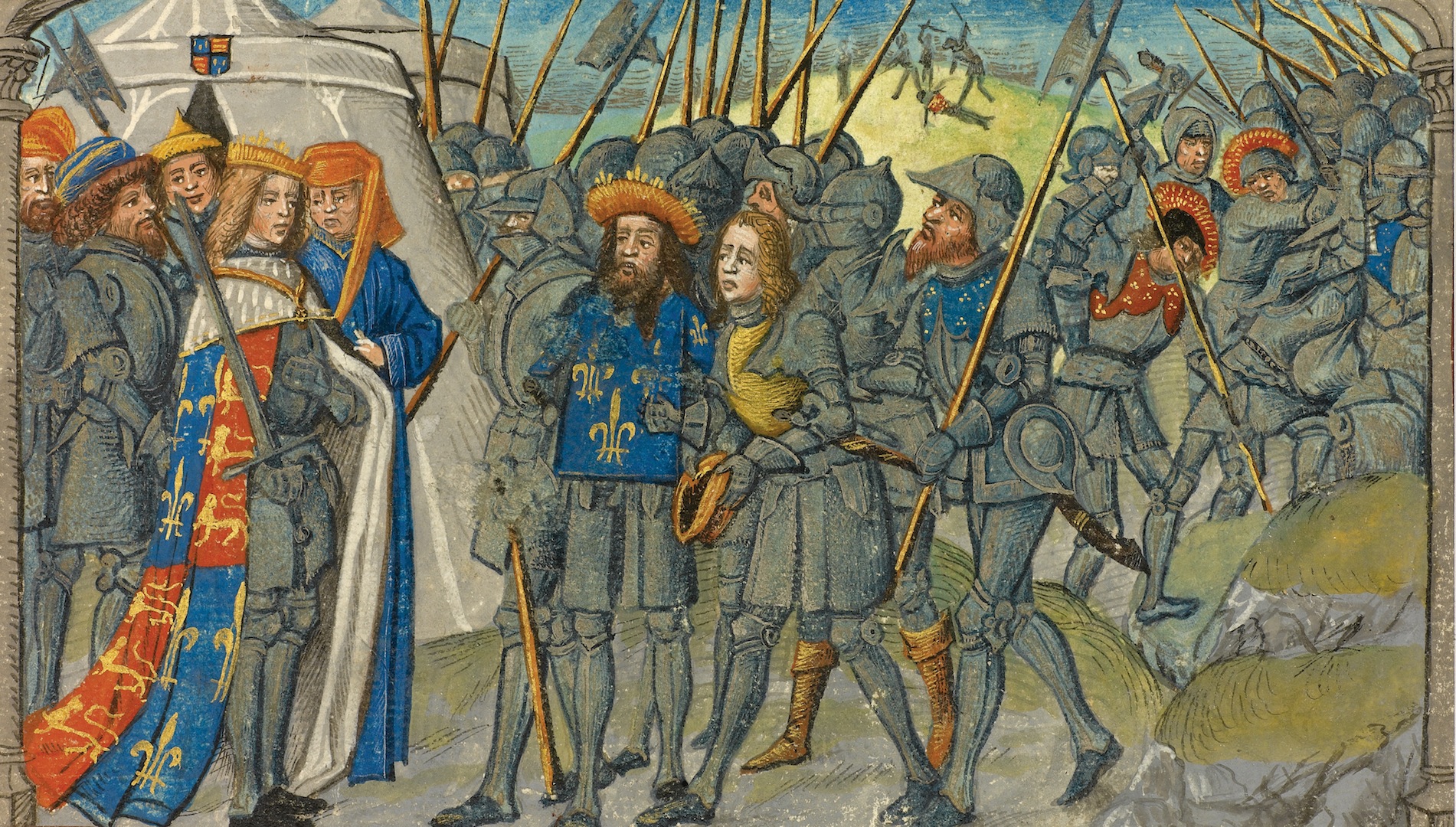
The King of England receiving a herald from the King of France, France of Southern Netherlands, c. 1485

The King of England receiving a herald from the King of France, France or Southern Netherlands, c. 1485

The Hundred Years’ War (waged from 1337 to 1453, so it was actually 116 years long) was a series of conflicts between England and France over control of the French monarchy. The war actually had roots that went back to the Norman invasion of 1066. When William the Conqueror, who you’ll remember was the French Duke of Normandy, took the English throne, he also retained his French landholdings. Thus, William and all subsequent English kings were technically vassals of the French king. What did this mean? Could the French king summon the English king to the French court, make the English monarch kneel, pledge fealty, and pay homage to France? If the English king was next in line for the French throne, could he take it? The Hundred Years’ War was fought to settle these questions. (SPOILER ALERT: France won.)

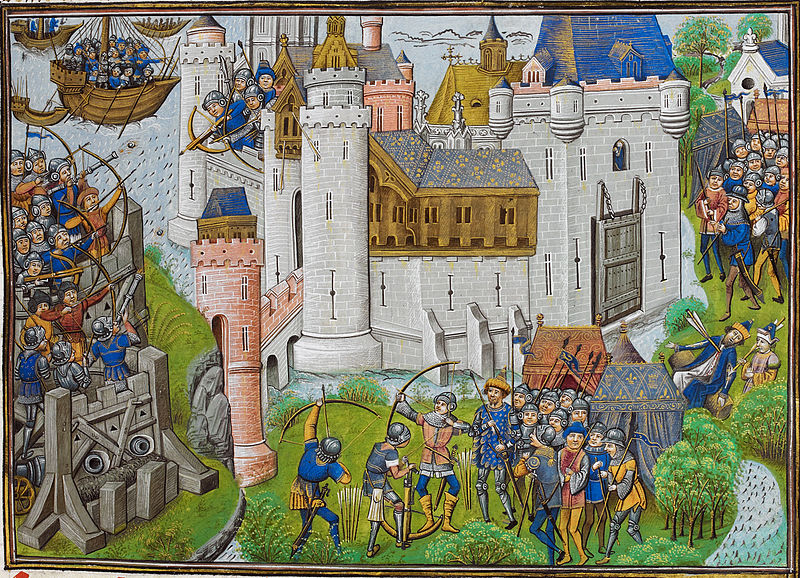
While war was not waged continuously over that 116 years, while there were periods of truce and relative peace, it was nevertheless a fierce conflict. English armies ravaged the French countryside — killing peasants, burning towns and farms, and generally making things miserable for the French. Not to mention the war coincided with the first outbreak of the Black Death from 1348 to 1350. Good Lord, was there anything worse than being a mid-14th century French peasant?

The Siege of Mortagne, near Bordeaux, in 1377

The Siege of Mortagne, near Bordeaux, in 1377

Besides giving us the Battle of Agincourt and Joan of Arc, the war introduced an innovation on which states have relied ever since: permanent and regular taxation of the citizenry.

Prior to the Hundred Years’ War, it was expected that monarchs would finance their governments out of their own pockets, specifically, from money generated from their extensive landholdings. Imagine that the Bushes had to fund the federal government with money produced by their compound in Kennebunkport and Crawford ranch. Yes, monarchs could supplement their income with indirect taxes by tapping into the funds of all royal subjects, but this was rare and done only in exceptional, emergency circumstances. There was a medieval legal maxim that prevented permanent taxation (one that should be tattooed on the foreheads of all politicians): “With the cause having ended, the consequence must end.” That is, once the emergency was over, the tax must end too.

But that legal rule would be consigned to the dustbin of history with the Hundred Years’ War. As you might imagine, financing a war over generations is quite expensive. Paying for armies to pillage and rape for decades doesn’t come cheap. Thus, given the duration and intensity of the conflict, direct taxes became a routine part of life. It was as if governments now existed in a state of permanent emergency. To give you an example of the change, during the reign of Henry III of England, which lasted almost 50 years from 1216 to 1272, direct taxes were levied only 5 times, an average of once a decade. However, during the reign of Edward III of England, which also lasted 50 years from 1327 to 1377, direct taxes were levied 27 times, more than every 2 years.

So the next time you make out that check to the IRS, you can thank a war fought for the French crown 560 years ago.

Related

Posted in Politics and Economics | Tagged , , , , | 12 Comments

My Twitter with Andre

Fenster writes:

I am getting old so I still go to the theater from time to time.  What do I find when I get there, in the audience?  Season ticket holders way older than I am, a sea of gray hair and no hair.

It’s too bad the kids don’t go.  Some think this can be rectified via more current topics.  I dunno, gay themes are nothing if not current but if the kids are anything like me they probably find theater’s interminable coming out party to be wearing kind of thin.  Nah, it’s all about attention span.

So why not twitterize the theater?  We all know Twitter has radically transformed 21st century communications by proving that content does not have to be sacrificed when brevity is enforced.  Indeed, we are living in a veritable renaissance age, courtesy of Twitter’s 140 character limit.  Or so some say.

Anyway, I figured to do my bit to bring kids back to the theater by condensing Wallace Shawn and Andre Gregory’s two person film, My Dinner with Andre, into a tweetstorm version for the stage.  The film version is way too wordy.  This version has the benefit of brevity–the entire play takes a matter of minutes.  And it is economical, too.  It can be done multiple times in a night. And though it could be staged in different ways, the preferred approach is to just use one actor, the Shawn character, since in this version he finds himself alone at Cafe des Artistes, and tweets Andre to find sup.

Of course, it could be staged with two, or even three characters (a silent waiter wouldn’t hurt).  Or it could be done with no characters.  But since Wallace Shawn himself volunteered to play the part he made famous in the film, the first staged version, set to open next week, will be a one man show.  The part of Andre will be played by text messages flashing across a large, simulated iPhone to one side of the stage.

My Twitter with Andre will open at the Oily Muscle Theater on Broome Street next Tuesday, August 13.  It will be a limited engagement, running for 20 performances and closing the next night, August 14.

And now . . . . (pause) . . .

Without further ado . . . . (pause, and short pause, too–we don’t have time for fucking Pinter) . . . .

My Twitter with Andre

Image

W (to all followers): Writer’s life hard.  Raised rich now poor chasing gigs.  Money, money, money.

W: Deb not at home poor me caged into din with crazy Andre Gregory.  Heading into C d Artistes.

W: Not looking forward.  Used to be close but he lost it somewhere.  Not sure if I can do this here goes.

W: Sitting at bar.  A not here yet.

W: Still not here–sitting here almost an hour.  Maybe just sneak out?

W: Hell, I’ll DM the guy.

(now in direct message mode).

W: u there?

A: Sup.

W: Where u?

A: Following u! fun read.

W: r u coming?

A: stuck at book signing.  out of limelight at moment but must return.

W: well r u coming A?

A: prob not.  sorry.

A: but don’t let that stop you.  caille aux raisins xcellent at cda.

W: don’t like sitting by myself.

A: i will chat this way.  kk?

W: why not.  deb not home don’t want to cook.  caille aux raisins?

A: Yes

W: OK, just ordered.  What’s new?

A: everything.  I am depleted in a way, used up

W: how so

A: i have had many many wild experiences. so much so may have actually lost mind

W: um

A: by that you maybe mean you know that.  i know people have been talking and they should. i mean things have just been wild.

W: um

A: and by that you mean tell me more, right, like a kind of twitter shrink?  ok i will.

W: um

A: first growtowski.  you know him?  off to polish forest w jerzy along with a troupe of nubiles.  ran around, danced, trances, etc.  wild.  beehives and teddy bears–really.

A: put one hand in candle flame no burn,  the other burn.  why?  wild.

A: birds flying out of mouth.  not really.  well maybe really, in car mirror anyway.  who knows?

A: improvisation on a character but what if you are the character!?  ha  ha improv on own life!  rich!

A: but when all is performance no one bothers to observe any more.  world collapsing as a result.

A: guy named kozan and i out in desert.  Thought it was about little prince staging but not sure that’s why there.  wandered, ate sand.  Why?  Very close to the edge by now.  Bleak.

A: scary connected to all since then also connected to death. right?

W: um

A: and findhorn.  mystic destination far north.  how do they keep that roof on in all that wind?  a total mystery.

A: heading toward a new dark  age, right around corner.  but i think we will stagger thru somehow.  meanwhile me spent, spent spent.

W: are u interested in my actual response?

A: of course

W: just trying to get by, me.  pay the bills, track errands in my notebook

W: read some plays, write some plays, finish heston’s autobiography

W: love that cold coffee on counter in a.m.

W: don’t need more than this.

W: besides which you can’t believe just anything.  some things just true.  that roof held down by scientific laws.

W: the past is the past and it cannot give clues about the future, which hasn’t happened.

A: um

W: and why do you want to strip life of purpose, anyway?

A: staying busy is a way to avoid, no?

W: well maybe sometimes yes.  true i do fear the silence.

A: um

W: like i can do things but am uncomfortable just to be.

A: face to face.  hard.

W: yes.  why?

A: alone means must confront death.

A: people hold on to images to avoid death.  a father, a mother, a husband, a wife.  seem to provide ground.  but don’t.

W: um

A: no wife there. baby holds your hands then huge man lifts you off ground, then he’s gone.  where’s that son?  you know?

W: yeah

A: gotta go back to signing. cul.

W: cul.

(drops DM mode)

W: I rode home through the city streets.  There wasn’t a street–there wasn’t a building–that wasn’t connected to some memory in my mind.  There, I was buying a suit with my f

Posted in Books Publishing and Writing, Movies | Tagged , , , | 3 Comments

Crusader Follies: Peter Bartholomew and the Holy Lance

Blowhard, Esq. writes:

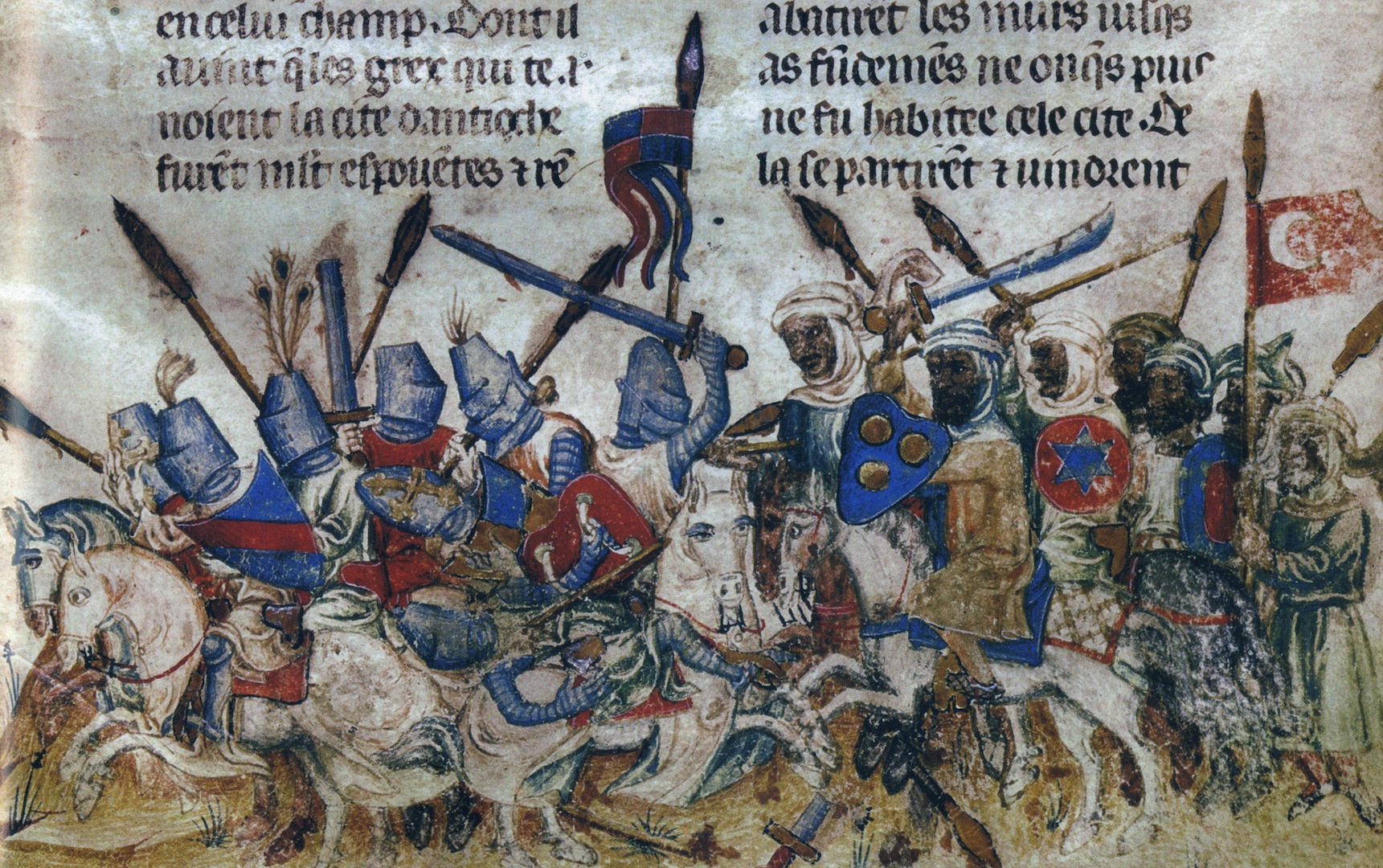
Detail of battle scene outside Antioch, c. 1098 from Estoire d'Outremer by William of Tyre, the British Library

Detail of battle scene outside Antioch, c. 1098 from Estoire d’Outremer by William of Tyre, the British Library

One of the first major victories for the Europeans of the First Crusade was the capture of Antioch. After eight months of laying siege to the city, the Christian knights captured it in May 1098. However, their victory was short-lived because the Muslim armies regrouped and, in a matter of days, the former besiegers became the besieged. Trapped in a city they had spent months starving out, there was little food or supplies to sustain the Crusaders.

But a monk named Peter Bartholomew had good news. Bartholomew claimed that St. Andrew had appeared to him in visions and told him that the Holy Lance that had pierced Christ’s side during the Crucifixion was located in Antioch and, if the knights found the Holy Lance, they would survive the siege.

Saint Andrew the Apostle by Yoan from Gabrovo, 19th century

Saint Andrew the Apostle by Yoan from Gabrovo, 19th century

Bohemond, an Italian noble and one of the most respected knights of the Crusade, thought Bartholomew’s story was ludicrous. Others pointed out that the Holy Lance was already in Constantinople, so what the hell was this nutty cleric talking about? But Raymond of St. Gilles, an influential French noble, believed Bartholomew and convinced the other knights that they should search Antioch for the Holy Lance. So, the Crusaders searched. They found nothing.

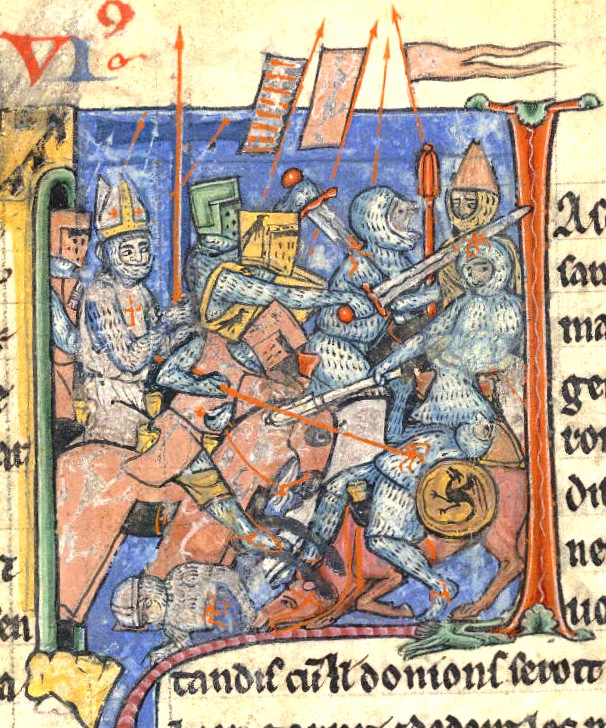
Peter Bartholomew searched too and — surprise! surprise! — he found the Holy Lance, telling everyone that it was exactly where St. Andrew said it would be. Bohemond didn’t believe any of this bullshit, but the rest of the knights, perhaps looking for the slightest shred of hope to motivate them, hailed it as a sign. The knights decided to break out of Antioch and on June 28, 1098, they did so. The Muslims were waiting for them but, due to their inability to coordinate their forces, the Christians routed them. Praise be to God, the Europeans got their much-needed supplies while still holding on to Antioch.

European Crusaders battle Muslim troops, from a French manuscript, c. 1200

European Crusaders battle Muslim troops, from a French manuscript, c. 1200

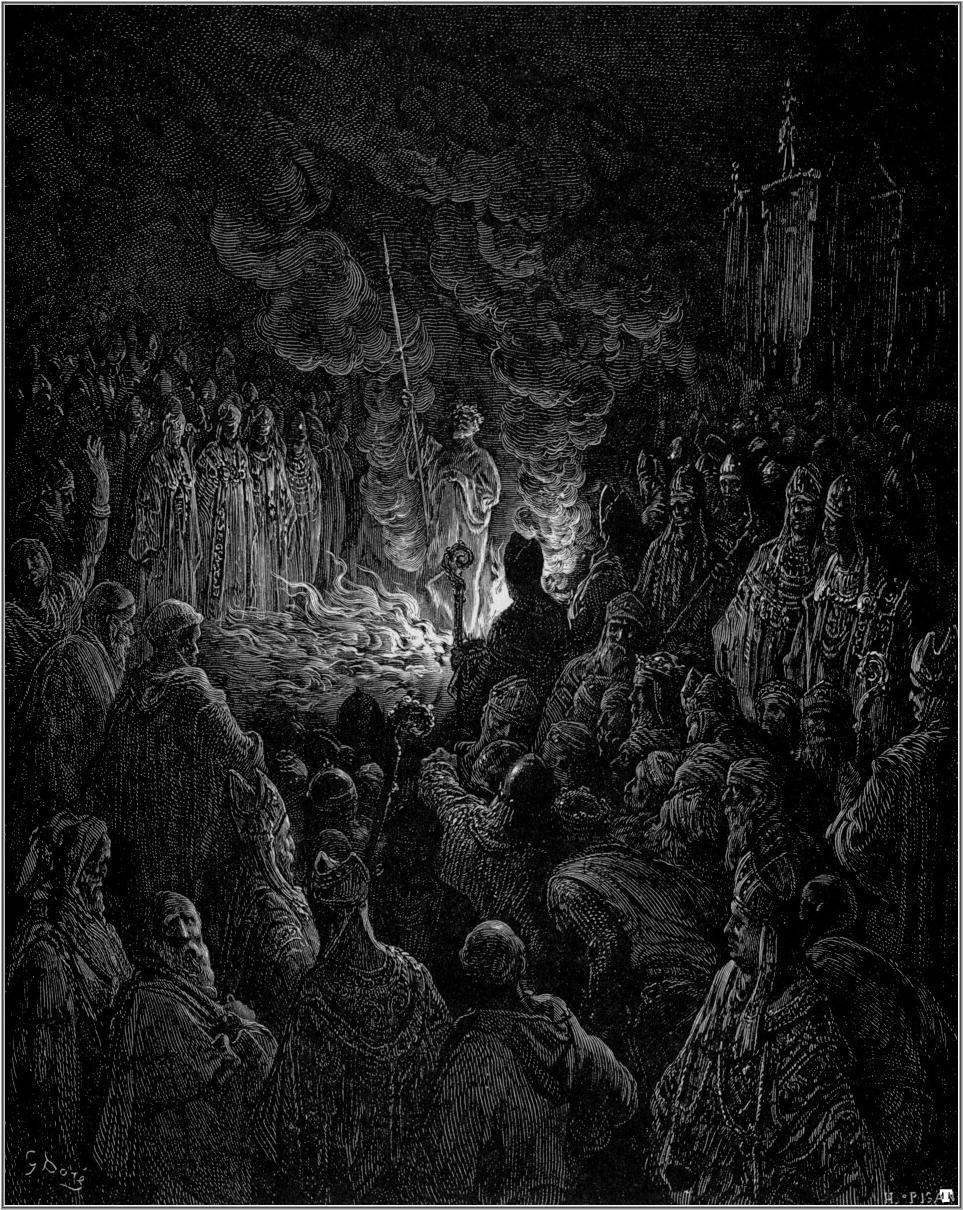
Even after all of this, Bohemond refused to believe any of the Holy Lance nonsense. Bartholomew, who wasn’t about to back down, insisted the Holy Lance was legitimate and that he didn’t plant anything. In the spring of 1099, Bartholomew decided he was going to prove once and for all that the lance was genuine by undergoing the ordeal by fire. Clad only in normal clothing and carrying the Holy Lance for divine protection, Bartholomew walked through a hallway, at a moderate pace, filled with burning logs stacked on either side. Before the ordeal began, he predicted that he would come out unscathed.

Barthelemi Undergoing the Ordeal of Fire, by Gustave Doré.

Barthelemi Undergoing the Ordeal of Fire, by Gustave Doré.

NOPE. When Bartholomew emerged at the other end, he was a walking cinder. After days of intense agony, he died. “I told you so, morons!” said Bohemond. (I’m paraphrasing here, my Latin is a little rusty.)

Raymond of St. Gilles kept the Holy Lance anyway, because hey, you never know.

Posted in Philosophy and Religion | Tagged , , | 10 Comments

Picture of the Day

Blowhard, Esq. writes:

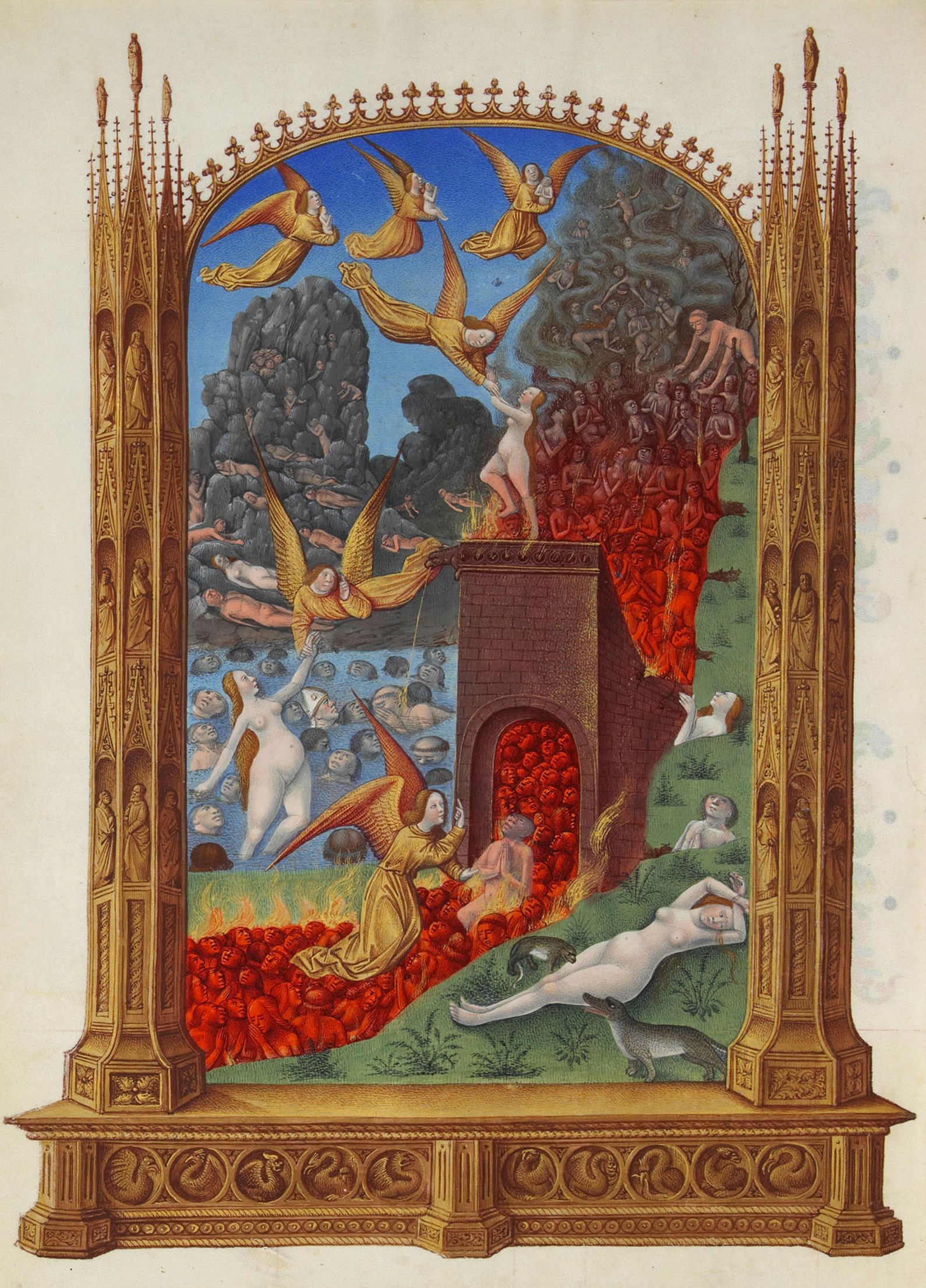
purgatoryThe purified souls in Purgatory, from the Très Riches Heures du Duc de Berry, c. 1412-1416

Related

  • I’ve been enjoying The Great Courses’ lecture on the High Middle Ages. TGC also has a course on the Late Middle Ages, the period during which the above work was produced.
Posted in Art, Philosophy and Religion | Tagged , , | Leave a comment

Urbanism: It Ain’t Rocket Science

Blowhard, Esq. writes:

The City of Los Angeles has been holding listening sessions the past few weeks on the revision of its zoning code. I haven’t been able to attend any of them, but if I did it would be to remind The Powers That Be of this:

threerules

To put it even more simply:

urbanism

Go here to download the chapter on The Three Rules from David Sucher’s City Comforts.

Posted in Architecture | Tagged , , | 5 Comments