Linkathon

Paleo Retiree writes:

Posted in Linkathons, Music, Politics and Economics, Sex, Technology | Tagged , , , , , , , , , , | Leave a comment

City Sights: Downtown L.A.’s Grand Park

Blowhard, Esq. writes:

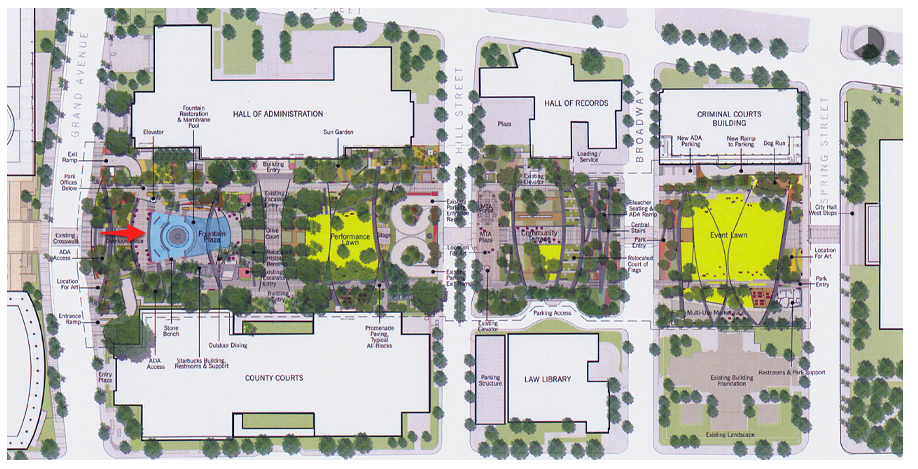
When the guys at the office don’t care if we win or lose, I’m sent downtown to make court appearances. One of the perks of going — besides getting out of the office — is the chance to see L.A.’s new Grand Park.

Here’s a map of the project, with the arrow showing the location where this picture was taken.

Last time I was there I didn’t have enough time to take many pics, but when I get a chance I’ll put together a montage to give you a better sense of the area.

Posted in Architecture, Photography | Tagged , | 3 Comments

Architecture We Love 2

Blowhard, Esq. writes:

As a follow-up to Paleo Retiree’s post, I put together my own montage of multistage entryways from my neighborhood. As you can see, some are more charming and inviting than others.


A quote from A Pattern Language:

While people are on the street, they adopt a style of “street behavior.” When they come into a house they naturally want to get rid of this street behavior and settle down completely into the more intimate spirit appropriate to the home. But it seems likely that they cannot do this unless there is a transition from one to the other which help them to lose the street behavior. The transition must, in the effect, destroy the momentum of closedness, tension and “distance” which are appropriate to street behavior, before people can relax completely.

Posted in Architecture, Photography, The Good Life | Tagged , , , | 3 Comments

Let Us Pause to Recognize Our International Audience

Blowhard, Esq. writes:

Looking at the site stats, I couldn’t help but be pleased that we’re getting hits (albeit very, very modest ones) from such far-flung and exotic locals as France, Malaysia, Israel, Belgium, and Denmark. Even more impressive, our Danish readers were nice enough to send along a picture of them waiting in eager anticipation for another of our posts:

Image

UR: Doing our best to foster friendly international relations.

Posted in Personal reflections, Sex | Tagged | 3 Comments

Question Lady Question

The Question Lady writes:

Is there an athlete you identify with? If so, who and why?

Posted in Personal reflections | Tagged , | 10 Comments

Why are economists so retarded?

Sir Barken Hyena writes:

This is a post that could go on forever, but I just want to highlight a certain trend I’m seeing: economists arguing like complete retards. I’m talking to you, Bryan Caplan, but you’ve got lots of company.

Case in point.

The argument is over why Americans give so little as charity to the Federal government. Theories are proposed: they’re selfish, or they think it’ll be wasted. It’s all very theoretical and technical. But this point is never made:

Because the government already forcibly takes a third of our incomes. Duh.

There, see how easy that is? It’s called thinking like a normal human who lives in the actual world, instead of being an autistic stuck in an aquarium of your own making.

To be fair, Caplan does have some interesting things to say, but jeez man, get a grip already.

Posted in Politics and Economics | Tagged , , | 6 Comments

Genre Movie Themes, Adult Fantasies

Fabrizio del Wrongo writes:

Have you ever noticed how many genre movies of the late ’50s, ’60s, and early ’70s featured specially-composed pop songs? It’s one of my fave aspects of that era in movies. I’m not sure exactly where the trend began, but it’s worth pointing out that many westerns in the ’50s had theme songs. (Here’s one of my favorite examples.) Maybe it derives from that. Or maybe it developed out of the use of theme songs in conjunction with television series. In any event, the Bond series really took it to the next level, each of them opening with a lush pop song played over a decadent montage seemingly geared to mimic the all-too-infrequently-had experience of flipping through a high-end men’s magazine while tripping on peyote.

One of the things I like about the examples I’ve featured below is how unashamedly cheesy they are. They’re loungey, trashy, silly, sexy, fun — like Xavier Cugat tunes set to images. They cue the listener to put aside his rationality for 90 minutes and enjoy some far-out sights and ideas, to indulge in a corny pop fantasy, to not take himself too seriously.

Hey, doesn’t judicious indulgence of this kind seem like a key quality of that whole era? It was a time when adults were still adults, when men often wore suits whenever they left the house, but it was also an era in which the culture provided a variety of rituals and outlets specifically designed to cater to adult fantasy. Tiki bars, “Playboy,” cocktail parties, Bond movies — all fantasy outlets of a very adult (if self-consciously silly) kind. Unfortunately, that sort of sexy-silly sophistication seems to have been drained out of the culture. These days we can’t even appreciate the Bond films as fantasy — as a comic book escape geared towards grown-ups — without wringing our hands and worrying about the sociopolitical implications of Bond’s actions. (The new Bond films aren’t bad, exactly, just sort of joyless. Judi Dench is in them. Need I say more?)

We still have adult fantasies, of course. They often seem patterned on either frat house crassness or quasi-political empowerment schemes. Men seem to partake more frequently of the former, women of the latter. Oh, and there’s the superhero thing too. But let’s not even get into that. I’m in a bad enough mood as it is.

Anyhoo, I’m way off track. Here are some of my fave silly movie themes. If anyone is aware of additional examples, please post ’em in the comments.

The theme song to the 1958 “The Blob” was composed by the great Burt Bacharach, who was a master of the silly-sophisticated thing.

This Danish production was based on the same source as Tarkovsky’s arthouse snoozeathon “Solaris.” Talk about strange bedfellows! I have no idea who that is singing, but the song was composed by the wonderfully named Teepee Mitchell.

This isn’t a theme song, but I’m including it anyway because Arch Hall, Jr. is my hero. “There’s coyotes around the camp!”

Bruno Nicolai composed and Nancy Cuomo performed this Bondesque number from 1966. The title surely comes from “Mr. Kiss Kiss Bang Bang,” a John Barry tune that was intended for “Thunderball,” released in 1965, but then never used. Of course, Pauline Kael later used it as the title of her second collection of movie reviews.

One of my fave title sequences. The rest of the movie doesn’t quite live up to it. The song is by Bob Crewe and Charles Fox.

The greatest man-returns-home-after-a-hard-day’s-work sequence ever put on film. Song composed by The Man himself, Ennio Morricone.

“You’ll believe it when you find…something screaming ‘cross your mind!” This acid rock gem was composed by Richard Delvy.

Posted in Movies, Music, Personal reflections, Sex, The Good Life | Tagged , , , , , , , , , , , , , | 8 Comments

Bicycles and Berlin

Paleo Retiree writes:

Where most things go, I’m a pluralist. As Vedanta maintains: one goal, many paths. And my pluralism extends to transportation policy. Let’s not let any one or two forms of transport dominate, let’s have them all: trams, cars, blimps, planes, bicycles, trains, scooters, mini-buses …

America gives itself over to cars and planes ‘way too completely, IMHO. In my preferred version of the country, whenever do-able and sensible we’d always and everywhere enjoy walkways, bicycle lanes, center medians given over to trolleycars, etc — and our places and roadways would be designed from the outset to take all these forms of getting-around into account. As it is, we prioritize the car while — every now and then, and always reluctantly — remembering to make a few concessions to pedestrians and bicyclists.

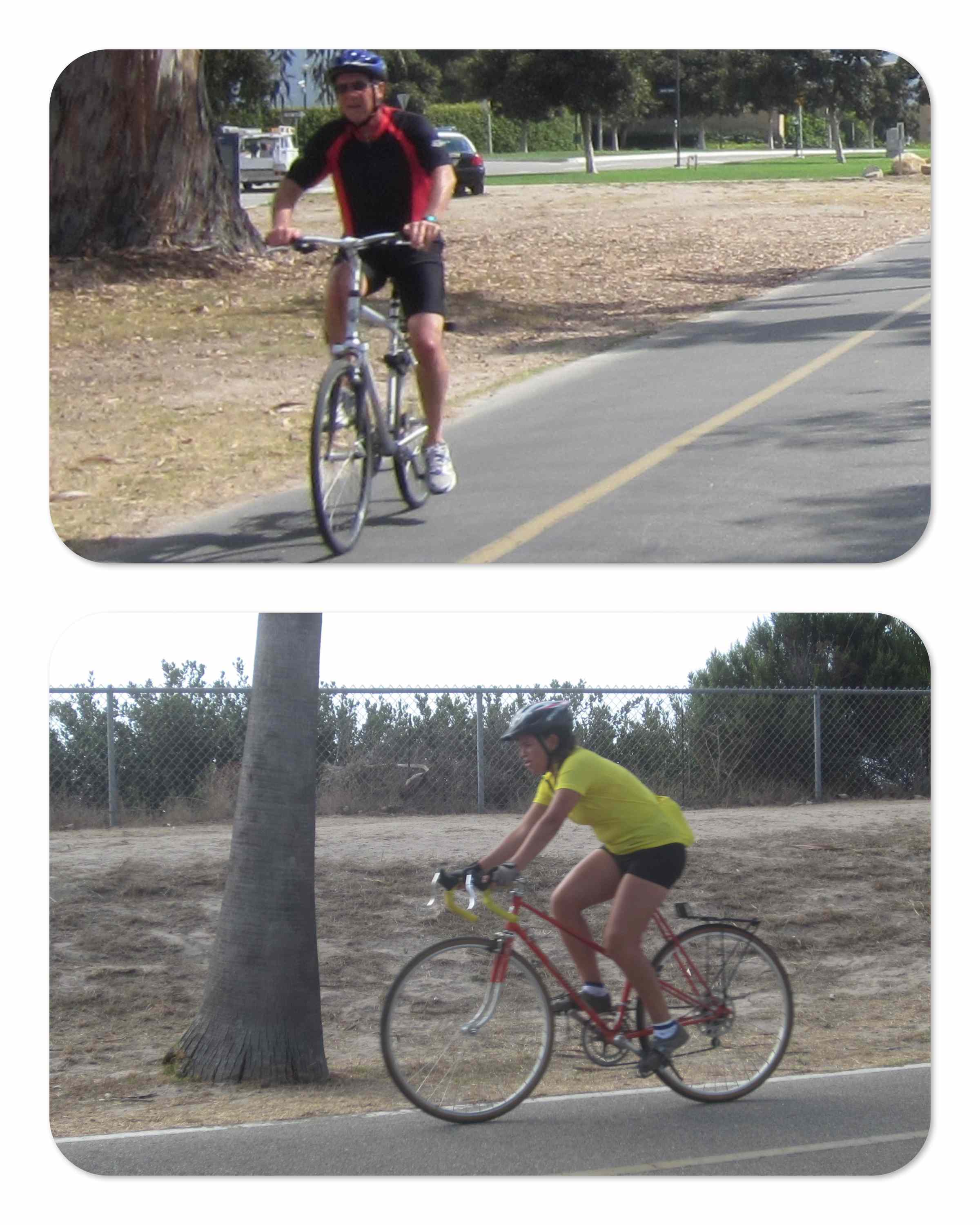
That said, man-o-man do I often dislike the way American bicyclists carry on. (Can it be said that there’s an American culture of bicycling? If there is, I don’t like it very much.) They race around at top speed. They charge the wrong way down one-way streets. They ignore stoplights and stop signs. They’re reckless and uncooperative in completely unnecessary ways.

Outta my way, pedestrian.

This isn’t a trivial matter. I know a couple of people who got knocked over by bikes traveling at speed. In one case, the bicyclist ran a red light right into a pedestrian crosswalk and hit a 68 year-old woman. In the other, the bicyclist was going the wrong way on a one-way street and slammed into an unsuspecting younger woman. These were gruesome and painful accidents involving trips to the emergency room and weeks of tedious and painful recovery. A man on a metal device traveling at 20 mph makes quite an impact — and can wreak a lot of havoc — on an unsuspecting body that’s looking the other way.

Reckless and thoughtless bikers are a threat even to automobile drivers. I’m the world’s most unhurried, considerate and careful driver, yet the other day I found myself swearing amidst a small mess of screeching and honking cars. It turned out that the tangle had been caused by a couple of bicyclists who’d run a red light. As you might expect, the two women bicyclists emerged from the mess, smiled at the rest of us, and waved sweetly, as though expecting us to find them oh-so-eco and oh-so-retro-charming.

And don’t get me started about how ridiculous most people look dressed up in bike-racing gear. I’m OK with the fact that there are a few dead-serious biker-athletes out there. But most people in bicycling outfits are offenses against any conceivable kind of good taste. Americans, eh? Always racing around, always looking for a reason to dress up like superheroes and sports stars. BTW, when did grownup Americans start dressing up like sports heroes anyway? Men didn’t generally do that when I was a kid.

I can semi-understand why American bicyclists carry on like hotshots, militants, badboys and protestors. We’ve so over-emphasized getting around by car that people who prefer biking feel persecuted. Isn’t one person on a bike as valuable as one person in a car? Why aren’t bikers’ needs being attended-to as lavishly as those of drivers? Besides, if most automobile drivers are inconsiderate towards bicyclists, why shouldn’t most bicyclists act inconsiderately towards automobile drivers? (Me, I’d argue that most drivers hardly give bicyclists any thought at all.) It’s clear where the power is, and it isn’t with the bicyclists. And of course I’m sympathetic to the general argument that America ought to treat its bicycles and bicyclists more thoughtfully and generously.

All that said, the situation isn’t pleasing. There’s too much asshole behavior coming from our bicycling culture.

It doesn’t have to be that way. When my wife and I visited Berlin a year ago, we were delighted by the way the city incorporates multiple forms of transportation into its fabric. Berlin — a big, spread-out city made up of numerous smaller city-centers — is heaven for walkers. Buses and trams/subways are well-run; cabs are easy to hail … And there are bike lanes everywhere. Drivers and pedestrians both know to expect bicyclists, and they know how to take them into account too. Granted, my wife and I nearly got knocked over a couple of times during our first days in Berlin. But it was entirely our fault — we hadn’t grasped the rules yet. We learned quickly, though. We adapted, and we soon came to relish the dancing interplay in the city between bikes, walkers and cars.
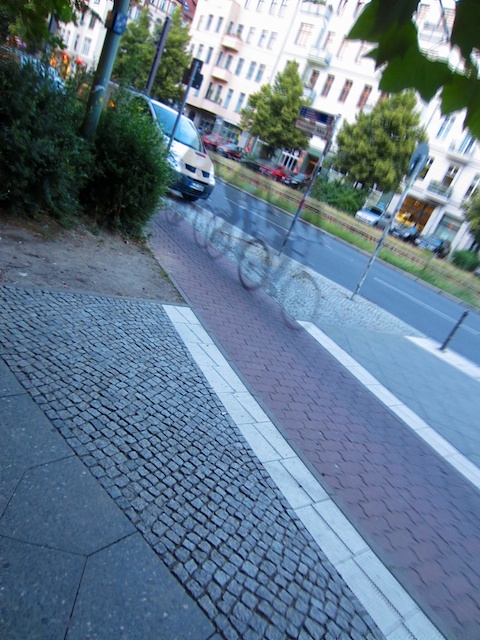
A Berlin bike lane at twlight.

One nice and striking thing about bicyclists in Berlin: the modest and sensible way most of them go about their bicycling. In ten days there, we didn’t spot more than a half a dozen bicyclists doing hotshot things, let alone wearing absurd stretch clothes. Few of them were racing around; they seemed to favor eccentric old bikes; and they weren’t about to change from their everyday attire into flashy training clothes just to get on their bikes and pedal a distance. 99% of the bikers we saw, in other words, were everyday people using sensible bikes to get someplace-or-other. They waited at stoplights, they respected pedestrians when it was appropriate. You might almost mistake them for grownups.

A typical Berlin bicycle

Were they able to do this — to play a confident yet modest part in the to-and-fro-ing of city life — at least partly because they themselves are treated with respect? In NYC it’s quite common for drivers and pedestrians to swear at bicycles, as though they really shouldn’t be allowed. Given the way some of the bikers conduct themselves, some of the swearing-at-’em strikes me as totally understandable. If bicyclists want to be part of the transportation-system of the city, then they should be held accountable to the rules everyone has to follow. Still: Many people are just really antagonistic to bikes. The bicyclists return the warmth, of course. In Berlin, by contrast, the presence of tons of people on bicycles is just an accepted fact of daily life. And taking bikes into account is just a part of life-as-it-is.

I suppose that it’s also possible that Berlin bicyclists conduct themselves as they do largely because they’re Berliners — ie., German, ie., orderly. But for the purposes of this blogposting I’m not going to go there. I prefer to think that Berlin and its bicyclists are showing the rest of us something of what a city can be like if its planners take a many-layered approach to transportation. Yay, pluralism.

FWIW: I like bikes myself, and if I lived in something like a college town I’d probably be out on one almost every day. As it is, I split most of my time these days between a huge city where biking strikes me as suicidal and a ‘burb where biking is kind of pointless — it’s not as though you can bike out to do the day’s shopping — except as exercise. And for exercise I’d rather walk, or do yoga or qigong.

Are y’all out there on bikes very often? If so, what’s it like? If not, why not?

Posted in Personal reflections, Politics and Economics, The Good Life, Travel | Tagged , , | 14 Comments

A Fauxdoc Called “Lake Mungo”

Image

Fabrizio del Wrongo writes:

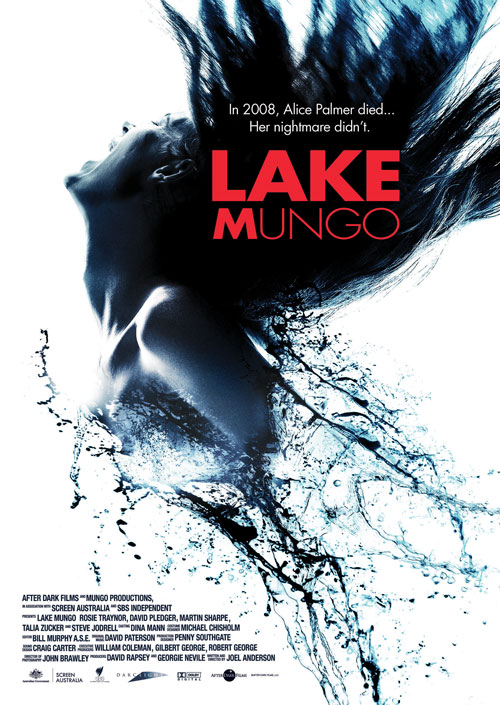
A few days ago I blogged about the Norwegian film “Troll Hunter,” a combo of faux documentary and horror spoof that I thought was pretty amusing. I enjoy the faux documentary format in general; I think it speaks to the mercurial, recursive qualities of contemporary culture, and it seems that many young filmmakers are interested in playing around with its possibilities. (They take to it as naturally as they do irony or jittery handheld camerawork.) The format is especially common on television, where outfits like History and Animal Planet routinely air programs which strain wild ideas, stories, and theories through carefully-constructed sieves of objectivity. Sometimes the sciency feel of these shows is so persuasive, their employment of computer-generated imagery so precise, that audiences are happy to buy into the reality of what they’re watching. (Here’s one extreme example.) Hey, maybe this trend has something interesting to tell us about how we’ve come to view our relationship to the truth, to media, and to entertainment. But as much as I love to speculate about such things, that’s probably a blog post in and of itself. Here I want to focus on one fauxdoc in particular, an Australian one called “Lake Mungo,” which struck me as especially sharp and well-composed.

Written and directed by Joel Anderson, “Lake Mungo” is a ghost story that uses the faux documentary framework to explore how the contemporary mediascape informs our relationship with the past. The narrative concerns a family that has recently lost a daughter, Alice, in a drowning incident. While on its surface the event does not seem mysterious, the tone of the film preps us for something ominous, and since a documentary is supposedly being made about the incident we know there’s a kicker lurking somewhere in the story. (It’s a good example of a movie’s format being employed to satisfy genre expectations: our familiarity with the conventions of documentary helps to generate the movie’s atmosphere of dread.)

A mystery does gradually emerge, but it’s centered on Alice the person rather than on her death. First evoked in words by interviewees, then in still photos, audio tape, and finally in grainy home video, Alice’s presence informs the movie in the way that Laura Palmer’s did “Twin Peaks.” (It was only after writing this piece, while looking at IMDb, that I learned that Alice’s last name is Palmer. So the reference is explicit.) Like the townspeople in the David Lynch series, the characters in “Lake Mungo” are attempting to cope with the void left by a loved one’s disappearance. But they’re also attempting to reconcile their personal and mechanical images of Alice with the fact of her existence, to resolve (and quarantine) the idea of her in their minds. The faux documentary format is here once again vital in that it highlights the gulf between reality and fiction by adding a layer of supposed objectivity. The interviewees are assumed to have known Alice as a genuine corporeal presence, whereas for those in the movie audience she’s approachable only through the rabbit hole of media. For us, she remains as grainy and unprovable as the dead body in “Blow Up,” a movie Anderson references liberally.

Throughout “Lake Mungo” Anderson mixes tones, styles, and chunks of narrative with the skill of a collagist. The sitcom banality of the documentary family contrasts perfectly with the nudginess of the digital “found” footage, and each seemingly disparate piece of the puzzle neatly informs the others. It’s an admirably fluid piece of work, and it gives full expression to the movie’s themes of experience, image, and memory. By the time we finally see and hear Alice speak, in a video recorded, fittingly, by a professional psychic, it’s as though a specter has materialized — and it’s doubly revelatory because we suddenly recognize the deftness of Anderson’s technique. (The trick recalls the moment in Chris Marker’s “La Jetee” when the wakening girl is brought to “life,” Galatea-like, by the gradual quickening of still images.)

It’s terribly trite to call “Lake Mungo” a ghost story for the twenty-first century, but I think that’s what Anderson has achieved here. Aren’t we all haunted by the hodgepodge of media left in our wakes? People walk out, even die out, of our lives, but then there they are five years later, staring out at us from Facebook or Youtube or Flickr. How do we manage to live in the present when our past is all around us, when the natural process of forgetting — of organically reformatting our brains — has been rendered impossible by ghosts in the form of recorded sound and images? Like no other movie I can think of “Lake Mungo” gets at this dilemma, and it does so from a variety of angles, with Anderson continually tweaking the material to generate new shades of meaning.

Near the end of the movie Alice’s mother begins to realize that her inability to comprehend her daughter’s ghost is a proxy for her failure to understand the girl while she was living. And at that point you realize the movie’s a sort of tragedy — that it’s about the impossibility of ever really knowing another person; that it’s saying that all of our perceptions are mere representations. The final shot shows the truncated family smiling happily in a photograph. They’ve just moved out of their old house, which is visible in the background. The camera zooms in on a window; it’s seeking something. It’s debatable whether the face of Alice is recognizable, but there’s a version of her back there somewhere, and it’s unreachable.

Posted in Movies | Tagged , , , , , , | 5 Comments

Please, let’s end the political French kissing – the children are watching!

Sir Barken Hyena writes:

Sorry if you’ve just eaten, but here’s the latest sign of encroaching political dementia from America’s finest heartland city, Chicago. It’s a plaque commemorating the first kiss between our Leader and his Lady. If this shines a light into the minds of the clerisy these days, and the defense of this utter shite on the intertubes leads me to think it does, then we can only admire the glee with which they are throwing themselves over the cliff into total silliness.

What next? A plaque to mark the spot where they buried Malia’s placenta?

.

http://news.investors.com/article/622556/201208170904/barack-and-michelle-obama-first-date-was-eating-ice-cream.htm?ven=rss

Posted in Architecture, Art, Humor, Personal reflections, Politics and Economics | Tagged , | 3 Comments