Sic Transit Gloria Mundi, OR Simiae est Insanissimae Populos

Fenster writes:

Fame is fleeting.

You remember newsreels, like actually remember them?  Mebbe mebbe not.  Depends on age mostly.

They were really the only way to disseminate the news visually in a pre-internet and pre-TV era.  TV in fact pretty much put an end to them, starting with how that medium woke up to its news possibilities at the time of the Kennedy assassination.  I myself vaguely remember newsreels, and the stentorian tones of Lowell Thomas, growing up.  Vanished now.

Vanished, too, are some of the people from that world, down the memory hole at the same time.

How many people know Lew Lehr nowadays? (Bonus points for Uncouthers who do–surely there are some in our small but idiosyncratic crowd who do).

Lehr was best known for humorous commentaries inserted into the harder news in the newsreels of the day.  You see him pictured with a monkey because of one of his trademarked lines, which you may recall even if you do not recall Lehr: “monkeys is the cwaziest peoples!”

According to a long New Yorker profile from 1939 (excerpt and link for subscribers here), other stock phrases included “Look who’s shpoking!” and “Sometimes your eyes can’t believe your pupils.” “Dribble Puss” is another, and his humorous inserts into Movietown newsreels were known as the Dribble Puss (or Dribblepuss) Parade.

By the way, be careful Google Imaging “Dribble Puss” with safe search off.

According to the 1939 New Yorker profile, Lehr figured he had about 57,000,000 listeners; 45,000,00 movie and 12,000,000 radio fans–quite an accomplishment considering the population of the nation was a little over 130,000,000.

Yet it is kind of hard to find much on the guy nowadays.  YouTube has a short video showcasing his inspired silliness–or just plain silliness if you don’t find it amusing.

His fans at the time seemed to have found it inspired.  According to The New Yorker, “some of his more ardent devotees are moved to hysteria by the mere sight of his face.”  It is quite a face.

An interesting accent, too.  It’s exaggerated German, not the more common exaggerated Yiddish done for fun. You hear German accents still in the current day media, but it is usually mouthed by a German character, not an  ostensible American.  And it typically denotes bad things, and is not played for laughs (Arte Johnson a more recent exception).

To some extent the dying out of the accent in America is a function of the integration of the very large German immigrant population (as with the dying out of of the German restaurant in America).  It is probably related, too, the the progressive de-Germanification and suspicion of Germans that started during World War I and continued through World War II.

Anyway, it is hard to find much about Lehr online.  I finally found one video of him using monkeys line here.

48050266_1200.do?keywords=lehr%2Cmonkeys

It is sad that fame is fleeting, and that in another few decades not that many will even recall Uncouth Reflections.

Posted in Humor, Movies, Performers | 6 Comments

Not a Letter from China

Fenster writes:

I was going to write about urbanism and bikes in Beijing but it’s been done before.

The New Urbanism Blog has a short piece, and a nice picture, of group dancing in front of St. Joseph’s Wangfujing Church, in downtown Beijing quite near the Forbidden City.

That was exactly the scene as I walked by last week, so it is a regular thing.  And, as the blog points out, it’s a nice urban thing, too. Check it out.

Meanwhile, I was also going to write about bikes and e-bikes, but it turns out that this guy Eric Osnos at The New Yorker has done so, and done it quite well.

The nerve of that guy Osnos, though.  He obviously copied me by entitling his series of articles “Letter from China”, and to make things worse, he got them into print before
I got mine online.  Sheesh.

But take a look at his e-bike piece.  This article and the blog piece suggest that, despite China’s overall seeming indifference to urban values in its headlong development spree, such values continue to have a place there, at least in Beijing.  Hutongs, bike lanes, a busy streetside retail scene and density that does not allow for hiding out.

So this will not be a letter from China.

But let’s consider the e-bike phenomenon while we are on the subject.

E-bikes have exploded in popularity in the past few years in China.  In 2009 China had 25 million cars but four times as many e-bikes.  That proportion has probably grown further in favor of e-bikes.

A Goggling of the topic reveals that just in the past several years there has been a similar explosion in Europe, Canada, Australia and other parts of the world.  The explosion is not as big as China’s–how could it be otherwise?–but it has been remarkable nonetheless.  Further, Googling also reveals scads of links dealing with e-bikes in other parts of the world but almost none dealing with e-bikes in the US.  That’s because, in effect, no one is interested in buying them stateside, though they are available.

Much is made of the car culture being the reason for this.  I buy that, but it can hardly be the only factor.  It is probably also the case that the bike culture resists as well.

I am myself much in favor of promoting cycling in the US and for a while commuted about 15 miles each way to work in Boston and Providence.  But bike culture, while a lot more than an affectation, is still an upper-middle class thing, and a statement about values as much as a means to keep fit and save money.  Looked at from that perspective, e-bikes are a fairly reprobate phenomenon.  A schlub in Beijing looking for a cheap and easy way to get to work is likely to have no such reservations.  So while I suspect e-bikes will take off here at some point in the not-distant future, they still has something of an image problem for being neither fish nor fowl.

Here’s one on the way from Germany.

Would you consider one?

Posted in Travel | 7 Comments

Jazz: Dead or Alive?

Fenster writes:

Here’s a link to an article by Benjamin Schwartz in The Atlantic on whether jazz remains a vital art form or not.  It takes the form of a review of the book The Jazz Standards, by Ted Gioia.

Schwartz admires a lot about Gioia’s book.  And along the way he makes some interesting points.  He quotes approvingly of one reviewer on Billy Strayhorn’s masterpiece that “it’s hard to think of another piece of music that has anything at all in common with ‘Lush Life‘”.  Nicely put.

But that’s not the main point of Schwartz’s book review.  His main game is to take issue with Gioia’s contention–after Gioia’s own acknowledgement that his book mostly enshrines old classics–that jazz remains a “vibrant present day endeavor”.  Schwartz riffs it the other way, arguing that jazz is a relic.

His argument is based on the nature of the relationship between jazz and the Great American Songbook, “a body of refined, complex work that stands at the apogee of this country’s civilization, mostly written for the musical theater from roughly the 1920s to the 1950s by such composers and lyricists as Porter, Rodgers and Hart, Jerome Kern and Dorothy Fields, Irving Berlin, George and Ira Gershwin, Harold Arlen and Yip Harburg, Vincent Youmans, and Arthur Schwartz and Howard Dietz.”

Jazz’s high point in Gioia’s account is roughly coterminous with the Songbook.  What does this mean?  According the Schwartz, Gioia steps back from drawing from this overlap the correct conclusion: that the relationship between jazz and the Songbook goes beyond the fact that many of the jazz greats improvised on Songbook material, and that the relationship between the two genres was fundamentally symbiotic.  Put in the words of Cahn and van Heusen:

You can’t have one,

you can’t have none,

you can’t have one without the other!

And along with the drying up of the Songbook comes the inevitable atrophying of the jazz that was intertwined with it.

Schwartz’s argument is to me persuasive.  He doesn’t just toss the idea out but makes a good effort to back it up with specifics about artist attitudes and song structure.  And the argument resonates with me since I often find current jazz wanting and have not been sure why.  Artists who continue to mine the Songbook seem like they have overstayed their welcome.  And works that riff on more modern material end up unsatisfying in their own way.  As much as I love the Beatles, hearing their work done by Blue Note artists or Brad Mehldau only serves to underscore the fundamental difference between the pop song structure in the Songbook and more recent pop-rock song structure.  The former for some reason seems to fit jazz like a glove.  The latter not so much.

Any thoughts?  Do you find current jazz wanting?  Has jazz inevitably reached the canon stage?  And can you have one without the other?

N.B.  None of this applies to Thelonius Monk.  He’s not joined at the hip to the Songbook as much as he is to Stravinsky.

Posted in Music | 10 Comments

Those Nameless Naked Girls

Fabrizio del Wrongo writes:

Who do you think is the most photographed nude model of all time? I’ve often heard it claimed that Bettie Page holds that title. As much as I love Bettie, I’m not so sure that’s accurate. It seems to me the most photographed nude model of all time pretty much has to be a lass of more recent vintage. After all, in the internet age, photographs are everywhere — or at least the digital descendents of photographs are. I mean, think about it: the average young girl is photographed nearly every single day; sometimes she even has her clothes on. And then there’s the ease with which digital technology allows for thousands of images to be captured, processed, and instaneously shotgunned throughout the matrix. It’s a far cry from the old days when you had to trap the images on film and then develop ’em on paper. Given of all this, isn’t it safe to assume that the “most photographed model” is actually someone still very much alive? I’m guessing that a model from the ’50s has little chance of competing against the women of the age of duckface, cell phones, and internet porn.

Which leads me to my next musing: is it fair to assume that, someday, perhaps not too far in the future, some internet model will be regarded with the same degree of fondness that we today reserve for Bettie Page?

Continue reading

Posted in Commercial art, Personal reflections, Photography, Sex | Tagged , , , , , , , , , , , , , , , , , , , , , , , , , | 23 Comments

Quiz o’ th’ Day

Fenster writes:

What is it?

Hubble image?

Detail of painting by Redon?

Chimpanzee art?

Painting by a schizophrenic?

Fan mail from a Flounder?

None of the above?

Posted in Art, Travel | 6 Comments

Letter from China: All Chinese Animals Numerous; Some More Numerous Than Others

Fenster writes:

1. “So  Many People”

I am at a meeting with a senior official of the provincial education department.  We are discussing the state role in higher education.  Today, I am more reliant than ever on my translator since the official, though clearly worldly and well-educated, knows no English at all. Also, my translator is a bit out of his depth on matters of policy and finance.

I am asking a series of questions in which I hope to draw out from the official his own account of the problems the state faces in terms of policy, and that he faces personally as a policy-maker.  It is tricky ground for me relative to my questions.  I am new to the country and have not yet gauged what is appropriate and what is out of bounds.  And my translator is struggling a bit with his task.  The picture that emerges is that of a competent but overworked senior bureaucrat struggling to hold it together.  That’s common in governments around the world.

If you’ve been involved in a discussion which is being simultaneously translated in real time, you will know how it can be difficult to get the full meaning on the fly.  The back-and-forth of just a one language conversation takes for granted a remarkable amount relative to nuance, word meanings and meta-language.   When you get to the squishy terrain of a translated discussion, you worry that you may suddenly find yourself having jumped the tracks, with the conversation now rolling along on a discarded rail line to Manchuria.

I ask a question and I get what amounts to a hard-to-fathom snippet back from the translator: “so many people.”  Like I am supposed to know what that means.  A few questions later the translator seems to be struggling and once again brings back that concept: “as you know from the Commissioner . . . so many people”.  The same phrase then arises yet a third time, a few minutes later.

How to understand this?  It could be my translator got a bit lost in the woods himself, and fell back on a phrase he’d used before.  But he is a pretty competent guy.  I prefer the more poetic interpretation: my interlocutor as a kind of Colonel Kurtz.  When asked about his mounting concerns, he can only repeat “so many people . . . so many people . . . so many people.”

2. But So Few Kids in the Park

Knowing that cultures differ, I was expecting a lack of dogs in China.  And sure enough, other than a few petite and pampered Pekinese out for walks and scrawny runty mutts wandering the streets, dogs are scarce.  No big and meaty ones to be seen at all in fact.

Oddly enough, since I know there is a one child policy, it took me a little longer for it to sink in that kids are almost as scarce as dogs.  And while seeing two dogs together out for a walk is not all that uncommon, seeing two little kids playing is quite rare.

Whereas in American family of five its three kids fighting for two parents, in the modern Chinese family it is one kid being doted on by four or even six: parents plus grandparents.  And sure enough, a walk through the park revealed few kids–singletons when they were visible-as well as doting parents and grandparents.

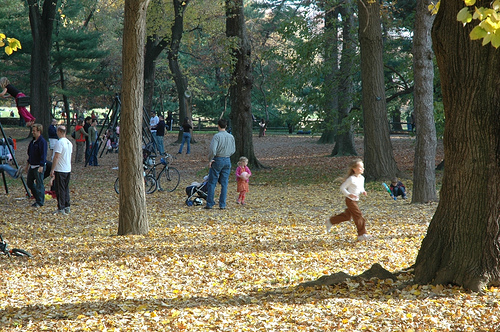
Here is a snap of Central Park.

By contrast here is a snap of a lovely park in Jinan, a meandering set of springs in the center of the city.

Can you find the kid at all?  Ah, there he is, in the center of the picture, one little one being carried, and surrounded by a sea of adults.

I found myself taking pictures of little kids.  Well, for one they are just so damn cute at that age.  But I think I was also subconsciously reacting to their scarcity value as photographic subjects.  Look!  A cute kid! Snap ‘em up fast since you don’t know when you’ll see the next.

Posted in Personal reflections, Travel | 2 Comments

Question Lady Question

The Question Lady writes:

As Sandy approaches, I wonder: What’s the worst weather you’ve ever been in?

Posted in Personal reflections | 14 Comments

Letter from China

Fenster writes:

When I had not yet begun to study Zen thirty years ago, I thought that mountains are mountains and waters are waters. Later when I studied personally with my master, I entered realization and understood that mountains are not mountains, waters are not waters. Now that I abide in the way of no-seeking, I see as before that mountains are just mountains, waters are just waters.

Heavy-duty Sixties retreads like me may recall this quote, from the Tang Dynasty Buddhist monk Qingyuan Weixin.  More will likely recall its Western popularization:  the folksinger Donovan’s refrain “first there is a mountain, then there is no mountain, then there is.”

Nice sentiments but what mean?  I don’t know for Zen, but I have made my own Western adaptation to the quote appropriate for my own experience.   That is, while the Buddhist monk sees in the quote the move to enlightenment, my take is much more pedestrian.  For me, the quote sums up nicely how learning, and all change, happens.   Learning is not primarily a matter of accreting new facts on top of the old.  It’s more a process of disruption, in which a former settled view becomes unsettled, then becomes settled again in a new way.  First you know you know.  Then you are made unstable by knowing that what you know may not be true.  Then you once again know you know.  That’s called learning–the disruptive accretion of falsehoods providing useful new perspectives.

But enough Buddhist talk of illusions—on to the brass tacks, in American fashion.

——————————————————————————————

It is now a week since I arrived in China.  An interesting amount of time—long enough to begin to dispel  erroneous first impressions but too short to give confidence that you know anything yet, really.   I am, I suppose, in the “no mountain” stage.  That’s my caveat, my disclaimer, as I write the letter.

I was asked to come to China at the invitation of a Chinese university.  I’d come to know, and to like, the senior administrators of the university when I served as the lead trainer for them on a visit to the United States in the summer.  They’d come to take a closer look at American higher education, a topic with which I am familiar from many years of work.  We agreed that I would visit them later to teach and to do research.  A two week visit was arranged.

I first spent a few days in Beijing visiting with the parents of a Chinese exchange student now living with my family at home.  Then it was on to several destinations in Shandong province.  My host university manages three campuses in Shandong: a main campus in the ocean side city of Qingdao and two smaller campuses in Jinan and Ti’ian.

So my experience here is not only severely constrained by time but also locale. I have seen a small sliver of a small slice for a split second.  Yet it is hard to square that reality with my experience of the past week, experience in which the new came at me so hard and fast that time seemed to stretch out, like a kid’s experience of an endless summer by the Fourth of July.

For sure, some of the intoxication came from being by myself as an American.  For most of the time here I have been totally and completely with the Chinese.  I have had the pleasure of being accompanied from two skilled translators from the university assigned to me.  But the level of English among older Chinese, even at a university, is not high, and so I have had to go native—or at least as native as the hospitable Chinese permit a foreign guest to be.

Other factors contributed to an almost surrealistic feeling in the first days here.

First, there’s the jet lag.  That’ll get you.

Then there’s the juxtaposition of old and new in peculiar ways. The bright red banners with Chinese slogans, redolent of an earlier Communist era, mirrored by the strikingly similar use of bright reds and yellows in the ultra-sophisticated product advertisements all around.


And then there’s a freakily robust popular culture.  We know our popular culture is freaky but we take that as a sign of our freedom, and China is hardly free.  It’s enough to make you want to revisit Marcuse’s concept of repressive tolerance, and not just for China.  Some things come across as not only Westernized but echt-so, as though I had somehow fallen into Minority Report by way of Brazil.  Is this the future?  No, just the present.

Club LA in Beijing

Adding to the surrealism is that odd haze that hangs on in Beijing and its environs, prompting cognitive confusion  as to whether it is a sunny day or a cloudy one, with the buildings fading off in the distance like in an old Chinese painting of the far mountains.

This not a proper and complete letter, I know.  I will add more as I go along, episodically and intermittently.

Posted in Travel | 6 Comments

Question Lady Question

The Question Lady writes:

When you’re tired but have something you really need/want to do, what’s the best strategy you’ve hit on to revive your energy?

Posted in Personal reflections | 7 Comments

“Juliette”

Fabrizio del Wrongo writes:

In the 1951 “Juliette” Marcel Carne attempts to evoke Cocteau but mostly succeeds in calling attention to his unCocteauness. The movie is gauche where it needs to be lyrical, deliberate where it needs to be suggestive. The narrative concerns a condemned man, Michel, played by the flame-coiffed Gerard Philippe, whose dreams of a one-time crush named Juliette serve as a temporary reprieve from imprisonment. While sleeping he visits a dreamworld known as the the Land of Lost Memories. Aware of nothing but the present, its residents wander about in an idiot fog, often amusing themselves by speculating about the wild adventures they might have experienced and then promptly forgotten. It’s a world of rampant self-delusion (the palm readers peer into the past rather than the future), but one in which nearly everyone seems content. Michel is the sole exception: his pained longing for Juliette makes him something of a Debbie Downer. So it’s odd when the object of his obsession turns out to be so boring. Played by the saucer-eyed Suzanne Cloutier (she would later serve as Welles’ Desdemona), she has a gaga blandness that undercuts the movie’s motivational design. Why, you wonder, is Michel so enchanted by her? Probably, her dullness is intentional; it’s Carne’s way of suggesting that our aspirations are little more than mirages, as illusory in their way as the invented pasts of the amnesiac townsfolk. This theory is borne out by the paradoxical visual strategy employed by cinematographer Henri Alekan. He bathes the fantasy sequences in a hard, all-over light and reserves the suggestiveness of Poetic Realism for the “straight” scenes which bookend the movie. It’s clever all right, but by the time it registers the plot has become something of a botch, especially in its clumsy incorporation of a subplot which draws equally from the Blue Beard fable and Lang’s “Secret Beyond the Door.” (There’s a metaphor for the Occupation tucked in there too — is there a French film from this period that doesn’t have one?) In the end, Michel lacks the imagination to win the dream girl and the material wealth to keep the real one. He fails to deliver on both levels. So does the movie.

(The device of a man whose erotic obsession gives him passage to alternate realties may have given Chris Marker an idea or two, and the hounds kept by the Blue Beard character seem like antecedents of the much more evocative dogs featured in Franju’s “Eyes Without a Face.”)

Posted in Movies | Tagged , , , , , | 2 Comments