Paleo Retiree writes:
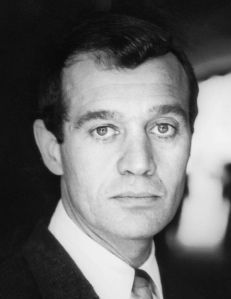
Anatole Broyard, 1920-1990
Steve Sailer has been writing (and leading discussions) about the topic of “passing” — the way some black people “pass” as white. (See here, here, here and here.) One of his examples has been the late writer Anatole Broyard, who was best-known as a book reviewer for The New York Times, and whose blackness wasn’t publicly acknowledged until after his death. I had this little bit to add to the yakfest:
Many, many years ago, while Broyard was still in his prime, a book critic I knew told me that Broyard was black/Creole; another friend, who’d hung around the NYC lit-intellectual world in the ’50s and ’60s, confirmed it to me; and the black intellectual Albert Murray told me about it too. Murray told the tale with great amusement: he thought Broyard’s adventures were pretty funny.
Albert Murray is great, btw: shrewd and smart about race and racial differences, yet in a very appreciative way; and wise about many things, including writing, books, jazz, art, and life more generally. I only met Mr. Murray (and one does refer to him as Mr. Murray) three times, but I’ve read much of what he’s published, and he’s a thinker who’s had a big impact on me. I’d be very eager to read/hear Steve Sailer’s reactions to him.
In any case … Despite the big fuss at the time the info about Broyard’s blackness went public, I suspect that it had been an open secret in some fancy NYC circles for decades. I mean, even I knew about it. (Never met Broyard myself.)
All of my sources told me that there were two reasons Broyard didn’t want to identify as black: 1) he didn’t want the racial thing to be a big issue in his life (it wasn’t a topic that interested him much), and 2) as a Creole, he genuinely didn’t think of himself as black. (My acquaintances all told me that Broyard was a successful ladies’ man too.) Needless to say, once Broyard died and the fact that he’d been black became more widely known, most commentators turned the discussion into one “about race” — something that struck me as wildly unfair given that Broyard wanted his life and his work to be about different subjects entirely.
America’s one-drop rule — whereby anyone with even a bit of African blood in him/her gets classified as “black” — is nuts, right? As is our tendency to boil 90% of all serious political discussions down into one “about race.” (The same one, over and over and over …) Not that race and racial things aren’t enormously fascinating — but, good lord, could the shape most discussions about the topics take be more predictable and boring? If I never hear the word “identity” again I’ll die a much happier man.
- Here’s Wikipedia’s entry on Broyard.
- I love Broyard’s slim books: a memoir about life as a Greenwich Village bohemian, and a collection of reflections and musings noted down as he was dying of prostate cancer. He was one brainy and elegant writer.
- I wrote a little something about my own battle with prostate cancer.
- Broyard’s daughter Bliss, who was raised as an upper-middle-class white girl in Connecticut, has published a book about discovering that her dad was part black. Perhaps inevitably, PBS got fascinated by Bliss’ story.
- Here’s some fun I once had at the expense of PBS’s dragginess and earnestness.
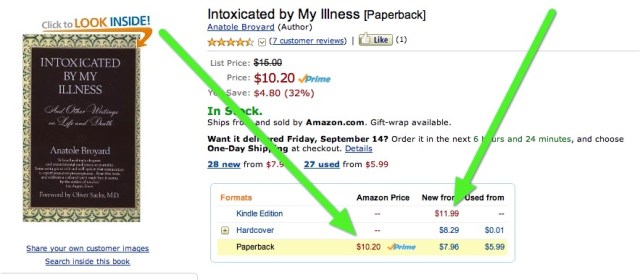
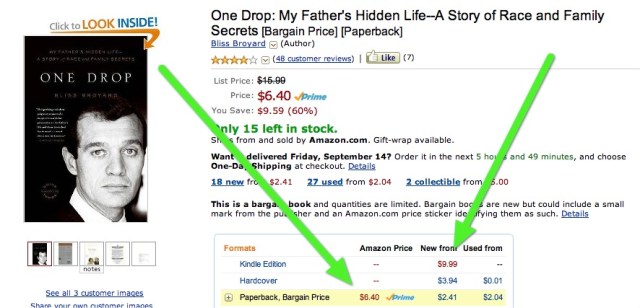
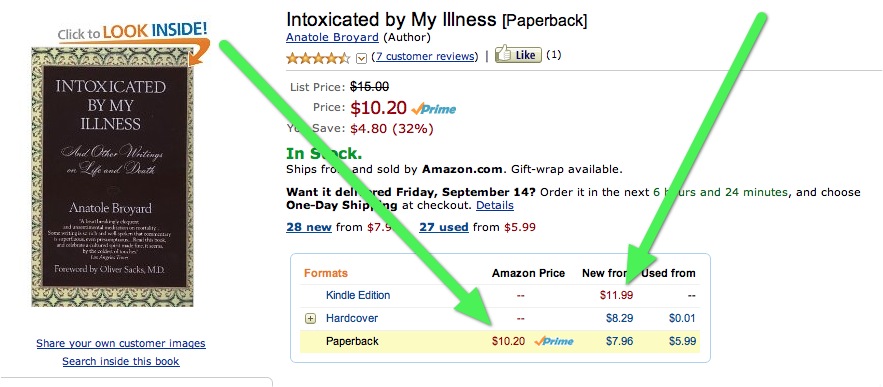
Because we here at Uncouth Reflections are seriously irked by book publishers’ idiotic current pricing policies, let me express my annoyance with the fact that, in the case of both of Broyard’s books and his daughter’s book, the Kindle versions are currently more expensive than the paperback editions. Proof:

 There are times when I wonder if the New York City trade publishing wants to die …



 Blowhard, Esq.
 Callowman
 Sherbrooke
 Eddie Pensier
 Enzo Nakamura
 Epaminondas
 Fabrizio del Wrongo
 Fenster
 Brundle Guy
 Glynn Marshes
 Paleo Retiree
 Atypical Neurotic
 Question Lady
 Sax von Stroheim
 Sir Barken Hyena
 The Mistaken
 Uncouth Reflections