Sounds like Celebration, Florida, the Disney-inspired small town, is not immune from the problems of the real world: a murder at the end of 2010, followed shortly thereafter by a suicide. And now this article about murder’s dark backstory.
Makes one wonder about the possibility of manufacturing innocence. I know that’s not the goal of new urbanism, but it did seem to be the goal of this Disney iteration.
If you have a choice where you want to live, and you want to live under new urbanist principles, there’s always the prospect of existing places!
One of my favorites, and a place I called home for almost five years: lovely Hopewell, New Jersey. Compact, walkable, self-contained, surrounded by open land (a lot of it recently conserved), filled with older homes with charm and character, and nice people, too.
His work is worth knowing, and he is accessible to boot, the very model of the engaged scholar of the internet era: interested in both relevant research and the clear communication of results to a wide audience in an enjoyable manner.
He has a blog, too, in which he does some semi-public ruminating about his research ideas. Here’s today’s post, in which he pulls a possible research idea from literature:
Not only do I find examples of behavioral economics in literature, sometimes I get research ideas from it. This passage from Wallace Stegner’s Angle of Repose was one such instance:
“Touch. It is touch that is the deadliest enemy of chastity, loyalty, monogamy, gentility with its codes and conventions and restraints. By touch we are betrayed and betray others… an accidental brushing of shoulders or touching of hands… hands laid on shoulders in a gesture of comfort that lies like a thief, that takes, not gives, that wants, not offers, that awakes, not pacifies. When one flesh is waiting, there is electricity in the merest contact.”
We already know that touch can change our behavior, for instance, holding something for a few seconds makes us much more likely to buy it. But what about how touch, as slight as described here, changes interpersonal dynamics? How exactly might I test this idea? What might an experiment look like? And could I possibly get approval for it from the Institutional Review Board? More on this soon, I hope…
I subscribe to his blog and am interested to see if and how he formulates a research design for this, and how he gets it by an Institutional Review Board, which can be a persnickety creature.
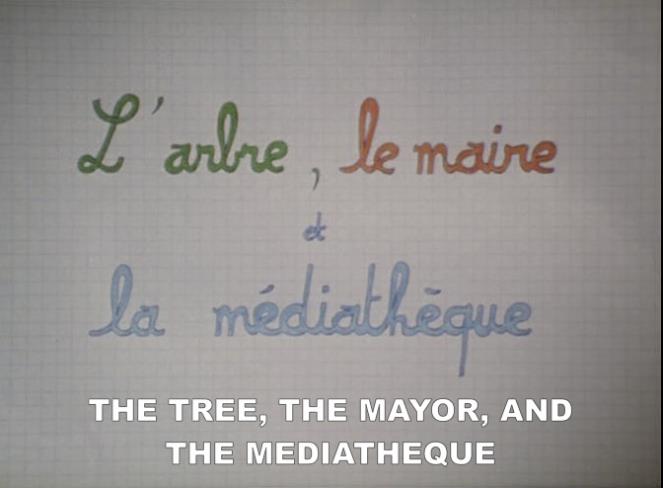
When you think of New Wave filmmakers who’ve delved into politics Eric Rohmer probably isn’t the first guy to spring to mind. And for good reason: he was always the group’s miniaturist-philosopher, a guy who was more interested in plumbing the potentialities of a young girl’s knee than in scrutinizing the big isms and schisms of his day. Maybe that’s why his 1993 “The Tree, the Mayor and the Mediatheque” feels less like a political film than a conversation about politics — like the meandering sort of chitchat you might engage in on your Facebook wall. In fact — and this is typical for Rohmer — the movie is structured as a series of dialogs, each a low-key face-off between contrasting points of view: urban vs. rural, action vs. reaction, male vs. female, adult vs. child, and so on. Rohmer uses these oppositions to scrutinize the ways in which our viewpoints intersect, overlap, and butt up against each other, and he comes up with a pretty interesting movie in the process.
I have just returned to reality after spending four days in the bizarre, whacked-out, sublime, insane, trashy, sacred, profane, dreamy place known as Las Vegas. After this my 5th trip there, I left convinced it is truly one of the great American cities/creations/institutions/whatever-you-wanna-call-it. I took over 300 pictures on my trip using my trusty iPhone4 and Canon PowerShot, so expect a number of photo montages and essays over the next week or so. To whet your appetite, here’s a little sampling of the city’s wonderful signage.
“It’s a real uphill challenge to battle the white-guyness,” Mr. Gibbons said of himself. “White people get nervous and speed things up.” But, he suggested, “you don’t have to be in a hurry because you ain’t got nothing to gain and you ain’t got nothin’ to lose. And that’s where the groove lies. Consider that as a mental concept for a second!”
I found this 1968 spaghetti western from action legend Sergio Corbucci pretty entertaining, if in a relentlessly hyperbolic, showboating way. It’s an amusing mix of the buffoonish, the witty, the visually spectacular and the stirring. A group of Mexican miners revolts against their decadent overlords; their leader (Tomas Milian) enlists the help of a blond-haired mercenary (Franco Nero) known as, so help me, “The Polack,” to help turn them into a revolutionary army. Meanwhile, government forces collaborate with ultra-bad sadist Curly (Jack Palance, smoking reefers and wearing a hilarious wig) to squelch the rebellion.
All that said, it’s mainly a buddy film, and the main focus of the movie is on the relationship between the Milian character and the Nero one: the clueless but shrewd dark brute vs. the suave blue-eyed cynic — they bicker, they bond, they feud, they stab each other in the back …
The plot delivers a few well-engineered twists, but its main purpose is to serve as an excuse for picturesque, macho overacting; brilliantly staged action; awe-inspiring scenery and glorious horses; and a lot of over-the-top Ennio Morricone music. Like all the good spaghetti westerns, it’s so off in its own cartoonish, make-believe world that it might as well be a sci-fi movie.
Here’s a review of the film from 10K Bullets. Like “Django,” another Corbucci-directed spaghetti western, “The Mercenary” has had its influence on Quentin Tarantino.
I’ve been going through some of the lesser-known MGM musicals of late. There’s a lot of dreck hiding out in that celebrated body of work. But one of the things you quickly realize is that even the turds tend to encompass a tasty morsel. (Yes, I just mixed a shit metaphor with a food metaphor.) The 1948 “The Kissing Bandit” is one such turd. It’s like a banalized version of the studio’s MacDonald-Eddy operettas, themselves banalized versions of the operettas made by Ernst Lubitsch at Paramount during the early ’30s. (Lubitsch made a great one for MGM, the 1934 “The Merry Widow,” but it was mostly in the Paramount mode.) Here, the young, marionette-like Frank Sinatra plays a Yankee just arrived in Spanish California; he’s hoping to inherit his dead father’s hotel business. But it turns out the old man had moonlighted as a thieving Lothario, and Frank’s less enthusiastic about assuming that particular mantle. (Where women are concerned, he’s hapless.)
Playing a naif doesn’t come naturally to Sinatra. Worse, the screenplay denies you the pleasure of witnessing the materialization of the magnetic, tough-guy Frank; he’s a nebbish right ’til the last scene, when he finally succeeds in putting the lip to lead mannequin Kathryn Grayson. Prior to that the movie is a concatenation of scenes in which Grayson and Sinatra clumsily attempt to work up some heat. They also occasionally sing, though not memorably. It’s like watching cardboard woo tagboard.
But towards the end of the movie something wonderful happens. Right in the middle of all that tepid wooing, the tempo picks up, the lighting becomes more expressive, and the staging suddenly becomes energized. The camera dollies in on a group of dancers, there’s a cut, and then the head of Ricardo Montalban rises into frame. He directs a leer to the right of the camera, gives his hand a little jiggle, as if to shake off the banality of the proceedings, and then slowly begins to turn his body while dancing in place. And as he turns women appear from beneath his cape, first below his left shoulder, then below his right, each of them falling in with the turning as the camera dollies back out. The dancers now in full frame, Montalban briefly sets the women free with a flourish, then catches them by the arms and swings them around with abandon. They’re like satellites in thrall to Planet Montalban.
This bit, fittingly known as “The Dance of Fury,” was choreographed by Stanley Donen, still one year away from making his directorial debut with “On the Town.” One presumes Donen directed the sequence too, as it puts everything else in the movie to shame. (The bulk of the film was helmed by the prosaic Laslo Benedek.) It’s either a great argument for the Auteur Theory or evidence that MGM, aware that it had a turd on its hands, pulled out all the stops in giving the audience at least one moment to thrill to.
Here’s the clip:
How about Montalban? His performance has all the masculine bravado and raciness that’s missing in Sinatra’s. He’s sexy. He’s suave. He even manages to make his befuddlement in the face of female over-attention seem like an outgrowth of his affability, his confidence. Of course, it doesn’t hurt that the gals fighting for him happen to be Ann Miller and Cyd Charisse, two of MGM’s most vivacious (and leggiest) female commodities. Lord knows it’s hard to look impotent when those two are after you. (In comparison, Grayson is like a tarted-up Pekingese.) Can you imagine how Frank felt while watching this? You can almost see him sitting there at the premier, mentally comparing his starring role with Montalban’s cameo (a cameo!), and scrunching down low in his seat. How emasculating.
Watching Montalban here (and he seems to be having a lot of fun, doesn’t he?), I can’t help but recall Pauline Kael’s terrific review of “Star Trek II: The Wrath of Khan,” in which she framed Montalban’s performance as the triumphant validation of a too-long-overlooked bit player. Of course, as a performer Kael was every bit as flamboyant as Montalban. Maybe she saw a little of herself in his performance?
Here’s the best part:
Montalban is unquestionably a star in “The Wrath of Khan” (and his grand manner seems to send a little electric charge through Shatner). As a graying superman who, when foiled, cries out to Kirk, “From Hell’s heart I stab at thee!,” Montalban may be the most romantic smoothie of all sci-fi villains. Khan’s penchant for quoting Melville, and Milton (which goes back to “Space Seed”), doesn’t hurt. And that great chest of Montalban’s is reassuring — he looks like an Inca priest — and he’s still champing at the bit, eager to act: he plays his villany to the hilt, smiling grimly as he does the dirty. (He and his blond-barbarian followers are dressed like pirates or a sixties motorcycle gang.) Montalban’s performance doesn’t show a trace of “Fantasy Island.” It’s all panache; if he isn’t wearing feathers in his hair you see them there anyway. You know how you always want to laugh at the flourishes that punctuate the end of a flamenco dance and the dancers don’t let you? Montalban does. His bravado is grandly comic.
“If he isn’t wearing feathers in his hair you see them there anyway.” Not a bad epitaph, if you ask me.





 Blowhard, Esq.
 Callowman
 Sherbrooke
 Eddie Pensier
 Enzo Nakamura
 Epaminondas
 Fabrizio del Wrongo
 Fenster
 Brundle Guy
 Glynn Marshes
 Paleo Retiree
 Atypical Neurotic
 Question Lady
 Sax von Stroheim
 Sir Barken Hyena
 The Mistaken
 Uncouth Reflections