Question Lady Question

The Question Lady writes:

Why do people think that breakfast is an essential meal? When I was a kid everyone said I had to eat breakfast or I’d 1) get fat, 2) be under-nourished, and 3) my sugar levels would go haywire and I’d be cranky and disruptive in school. But I learned by my late teens that if I skipped breakfast most days I felt better. I lost weight when I skipped it, I felt healthier and I was way less cranky than when I ate it. As for disruptive — well, I was always disruptive regardless of what I ate. What about you? Is breakfast something you can’t wake up and get through the day without?

Posted in Food and health | 6 Comments

Can “Good Enough” be Good Design?

Fenster writes:

A theme found regularly on this blog (or is it a preoccupation? or an obsession?) concerns the shortcomings of much of contemporary architecture.  Do some of the same issues hold for design, in a broader sense?

Some years back, I was in conversation with the Dean of Design at a high-toned art college.  She had just shown me her etchings–well, no.  Rather it was a spread in a high-toned design publication in which her work was showcased, having won a design award.  I liked her work a great deal but could not escape the impression that a fair amount of what passed for great design in terms of awards smacked of snobbery, elitism, conspicuous consumption and–here comes that word–“theory”.

Now, some of my reaction comes from the fact that at heart I remain solidly middle class.  A great sage once remarked that society would be better off with 90% of the populace bourgeois and the remaining 10% rebels of one or another stripe.  I think that is true of individuals as well as societies: I am happy to be about 10% rebel myself, and am willing to concede the balance to solid bourgeois values.

And so when I see, say, a watch like this winning an award I have to wonder, this is good design?

It is not easy, for me at least, to make out the time from those two small green thingies.  And you have to touch it to activate it, adding effort to what is ordinarily a simple matter of looking.  On what grounds is this “good design”?  Or is it just a fashion accessory for some urban wannabe?

And here’s an $80,000 Tag Heuer.

According to the company, the design “is more shock-resistant and requires less maintenance because of the belts and micro ball bearings.”  Yum!

How good does a watch have to be, really?  Skin divers will want them to work underwater and some folks somewhere I suppose will worry about the errant second or two missing from time to time.  But for me Timex, generically speaking of course, is just fine.  For me, in this instance, good enough is good design.  There is such a thing as design for living.

My friend the Dean took great offense when I used this phrase.  Good enough?  Good design?  Egad man, get a hold of your philistine self!  We debated the issue for a while, long enough for me to realize discretion was the better part of valor, and that I needed to concede the point, set and match.  She seemed to grasp something of my main idea, but it was clear I had strayed into matters intensely theological.

Now, do I believe a lot of what passes for great design is actually great design?  I surely do. Especially when market forces are at work, there is a ton of pressure brought to bear on squaring market appeal, functionality and cost.  The ongoing fight between Amazon, Apple, Microsoft and Google for primacy, especially with mobile devices, will continue to yield great design dividends.

But the high-toned awards aimed at a cognoscenti? Of that I am far less sure.  Perhaps it is just my middle class bias.  Feel free to pass along your opinions, natch.

Posted in Commercial art | 8 Comments

A Cardinal at the Conventions

Fenster writes:

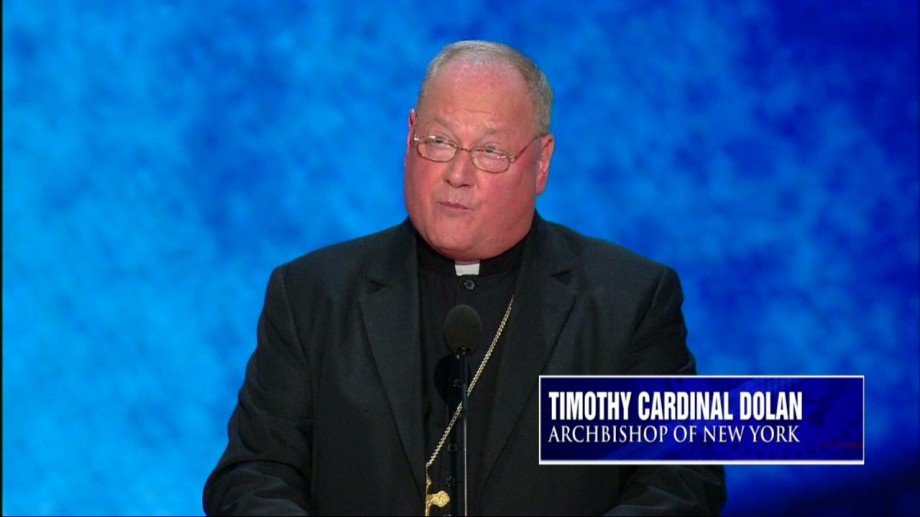
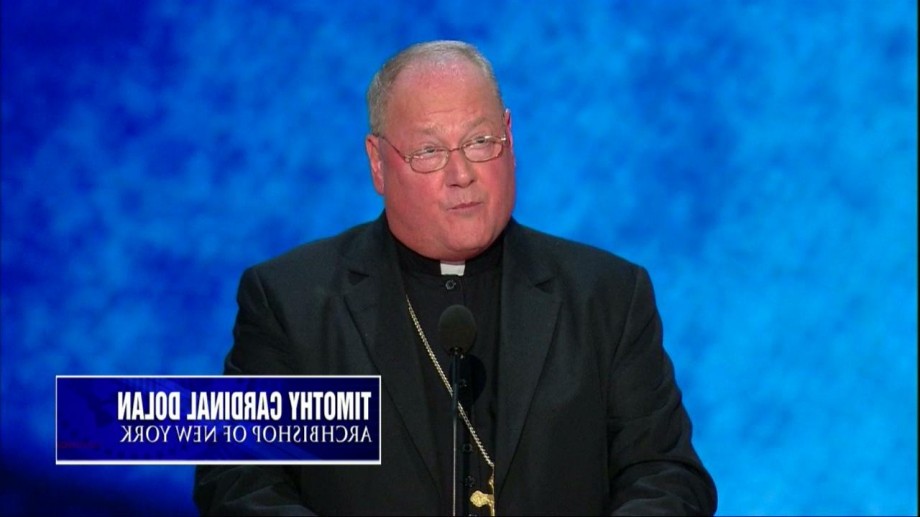
The Archbishop of  New York, Timothy Dolan, finds himself in the unique position of addressing both of the national party conventions, supplying the benedictions to both Democrats and Republicans.

Here is a link on a Catholic political blog to both addresses.

I found them interesting and instructive.  You may too.  The blog owner asked for reactions to the two addresses.  Here are mine.

First, a comment on the practice of benedictions at such events.  While it is tempting to ask how the tradition of benedictions at political events squares with the separation of church and state, I will refrain from that easy hit.  My take is almost the opposite.  IMHO, there really can be no true wall between church and state.  If religion were just a matter of private belief such a wall would be entirely feasible.  No one should hear the knock on the door while privately praying.  But religion is inevitably social and value-laden, and it concerns itself by necessity with matters of practice and behavior.  Accordingly, conflicts will always exist between dominant values in a political collective and dominant values in a religious collective.

To say religious freedom must entail the primacy of the latter cannot be true. You have only to consider the many practices around the world that are offensive to our sensibilities as a political collective–practices that we rightly condemn and limit–to realize that religious practices do not hold a trump card on account of their origins in religious doctrine or belief.  Further, given the inevitability of values overlap, no such thing as a wall can truly be said to exist.

Which is not to say we should do without the idea of a wall.  All social ideas are adaptive more than they are true or false, and the idea of a wall is a helpful one.  Most of the time.  But we should not delude ourselves into thinking there is some sort of objective truth about it.

So as far as I am concerned, let Dolan speak in a political context.

But let’s also see what he has to say.

And that is also interesting.

Given the Church’s position on social issues such as abortion (and given Dolan’s reputation for conservatism in such matters), it is hardly surprising that he should make specific reference to the unborn in both settings.  And that’s fine.  I think it is part of the bargain when you invite a Cardinal to speak.

But he seems to handle questions of social justice and the poor in very different ways.  In his address to Democrats his very first sentence after invoking God is as follows:

Bless all here present, and all across this great land, who work hard for the day when a greater portion of your justice, and a more ample measure of your care for the poor and suffering, may prevail in these United States.  Help us to see that a society’s greatness is found above all in the respect it shows for the weakest and neediest among us.

You have to get to the third paragraph before the unborn make an appearance:

We ask your benediction on those waiting to be born, that they may be welcomed and protected.

When we get to the Republican address, the unborn are in the lede.  The first sentence after invoking God is:

We ask your benediction upon those yet to be born.

But what of social justice?  Here is Dolan’s second paragraph:

We lift up to your loving care those afflicted by the recent storms and drought and fire.  We ask for the grace to stand in solidarity with all those who suffer.  May we strive to include your tired, your poor, your huddled masses yearning to breathe free, in the production and prosperity of a people so richly blessed.

Here, the poor and suffering consist of two kinds of people: those put out by natural calamities (we stand in solidarity with them), and the “huddled masses yearning to breathe free” (i.e., the poor of the rest of the world that look for a better life in this land of opportunity).  What about those who are . . . actually poor and suffering here, in the United  States?  They make a brief appearance at the very end of the benediction, in passing:

We pray for all those who seek honest labor, as we thank you for the spirit of generosity to those in need with which you so richly blessed this nation.

Note as well they only make the back half of the sentence, after praying for those seeking honest work.

Again, I am not sure I can fault Dolan for these rhetorical devices.  The Church does seem to be more concerned with social issues like abortion than social justice.  And so the institution of the Church tilts right, even as the Nuns on the Bus tilt left.  But it is at least revealing of priorities that Dolan would have chosen his words as carefully as he did.

For the record, my own views on abortion-style issues are to the left of Dolan, just as my views on social justice are to the right of progressives and the Nuns on the Bus.  I do find it odd, though, that both progressives and the Church hierarchy seem to think that abortion and gay marriage are the most important issues in play. I don’t.

Posted in Philosophy and Religion, Politics and Economics | 3 Comments

Is Anyone Cool Anymore?

Brundle Guy writes:

A couple of years ago a friend of mine, for the purposes of this article we’ll call him Ryan, was being transferred by his job. He was regaling another friend and I with the story of a meeting he’d had about the office transition. He works, as I do, in the entertainment field, so his office had a very casual vibe. However, the new office they were moving into was a little nicer, a little more corporate, so they were being asked to make a few adjustments.

They were told not to eat lunch at their desks. Some coworkers flew into a tizzy. “We can’t eat in the office?!?!” No, there would be an area for eating, they were just being discouraged from eating at their desks. A barrage of questions followed. “How many eating areas are there?” “Where is there to eat around the office?” “Is snacking at desks OK?” “What about drinks?”

Next was the new dress code. Nothing extreme, just business casual, so no t-shirts, shorts or flip-flops. “What about dresses?” “What if they’re NICE t-shirts?” “Do Crocs count as flip-flops?” “Is what I’m wearing ok?” “Is what I’M wearing ok?” A man leaned over to my friend and grunted, “UNGH, dress codes are total bullshit.” The man, according to my friend, was wearing something unquestionably acceptable by the new, but still fairly lax, dress code standards.

The meeting, which was supposed to be a quick little affair, had stretched on interminably. When hearing this my other friend, we’ll call him Andy, went on to tell us a number of similar experiences he’d had with people who seemed to live to get their panties in a twist. When, he wondered, did it become cool to be so damn uncool? Then he said words that have echoed with me ever since: “Why can’t everyone just be the fucking Fonz?”

It seems to me that there used to be aspirational figures in our cultural that exhibited a sought-after style of cool. John Wayne, James Dean, Cary Grant, Steve McQueen, James Bond, Shaft, The Rat Pack, and yes, The Fonz. They were all COOL, and a big part of being cool was being unflappable. Things didn’t bother them. They kept their head at all times, they never flipped out, ranted, raved or lost their shit. At least not in their public personas, the personas that made them “cool.”

Being “cool” isn’t just about doing your own thing and saying “Damn the man,” either. Remember The Fonz? He may have been a tough guy biker, but he still called Mrs. Cunningham “Mrs. C” and obeyed the Cunningham house rules when he was a guest, not because he was some goody goody. He was cool. He didn’t want to start shit or get in anybody’s face or flaunt cheap rebellion or any of that stuff, because that wasn’t cool. Most of the people mentioned above weren’t just cool for the cool kids, they were cool with EVERYBODY.

Who is “cool” nowadays? Real or fictional, I’ll take either one. It seems like everyone’s got a chip on their shoulders and it’s become the hip new thing to go ballistic over every single slight you can find, and even some that you outright fabricate.

As much as it seems completely antithetical to the very nature of “cool,” the first person who came to mind as I was mulling this over was Obama. I’ve certainly got a number of issues with the guy’s presidency, but in a time where being a whiny, temper-tantrum-throwing baby is the fashion, and no one has perfected that more than politicians, the current POTUS seems to have invested in being the only cool, calm and collected guy out there. When the guy talks he radiates “cool.” He seems to constantly be saying “Don’t worry, I’ve got this,” whether or not you may actually believe he’s got it.

This can’t be true, can it? Is the coolest person in our country not just a politician, but THE politician? That’s like saying the coolest person in school is the principal, right?

Is part of it the much-reported Rise of Narcissism? Is nobody out there even looking for new/current Icons of Cool because most people are so narcissistic they can’t imagine anyone being cooler than they are?

Ever since that conversation with my friends, whenever I’ve gotten into situations of stress or felt the need to lash out, whenever I want to go on Facebook and rant about politics or cultural or what-have-you, I’ve thought to myself, “Be the fucking FONZ,” and I’ve found that it actually helps. But then again, I’d never claim to be cooler than the Fonz.

Not to step on The Question Lady’s territory, but what say you all? Are there other people in the public conscious who are “cool” that I’m forgetting? And who are your Icons of Cool?

Posted in Personal reflections | Tagged , , , , | 14 Comments

Question Lady Question

The Question Lady writes:

How do you handle stress?

Posted in Uncategorized | 7 Comments

Architecture We Love 3: Corrugated Metal

Paleo Retiree writes:

Among the many shortcomings of semi-official discussions of architecture:

  • An overemphasis on architects, and particularly on star architects (aka “starchitects”). What the starchitects create represents less than 1% of the built environment. The rest of  building-and-urbanism is created by no-names — contractors, developers, non-legendary architects, even (gadzooks) everyday people … Why is this work so totally overlooked by those who Lead the Discussion? Since it’s what most of our experience of “architecture” consists of, it’s a terrible oversight. It’s as though the Music Discussion recognized nothing but conservatory-style highbrow music as “real music”; or the Movies Discussion focused only on auteur-type feature films from arthouse directors; or the Food Discussion failed completely to take folk food, fast food, and home cooking into account. (Hard to believe now — what with the omnipresence of good, populist food magazines, blogs and food shows in our lives — but it wasn’t so long ago that the foodie world took note only of “fine dining,” preferably à la française. Thank god that particular snobbery has been overcome! And I say this as someone who enjoys the occasional adventure in fine dining.) But a similar kind of snobbery still prevails where architecture-and-urbanism goes. Architecture journalists and critics ought to be — IMHO, of course — observing, discussing and critiquing/appreciating minimalls, casinos, parking structures, schools, hotels, condo developments, alleyways, two-family-homes, plazas, playgrounds, office campuses, porches, barns, neighborhoods, garages, etc.
  • An underemphasis on minor and sideways pleasures. With its neurotic fetishism of the starchitecture world and its obsessive fixation on genius-creators, the architecture establishment does a massive injustice to the many potential satisfactions and delights a fan has in store if he/she just opens his/her eyes. (If your eyes are open, the entire built world — your house, your daily walk, your place of work — becomes a playground/museum of architecture.) A nicely-placed park bench … A beautifully-recessed window … A parking lot that offers some shade, and that doesn’t wreck the neighborhood it serves … A lobby that’s both welcoming and helpful … A stretch of road that’s a reliable pleasure to drive along … A corner of a park where people enjoy eating lunch on a sunny day … Materials, too. Back at my previous place of blogging, for instance, I offered an appreciation (or two) of the pleasures of traditional brick. Why deny oneself — or fail to take note of — such day-to-day beauties? I can’t imagine an architecture-appreciation life spent waiting around for the next act of earthshaking mischief by the usual handful of certified geniuses. But maybe that’s me.

A long-winded windup to my modest topic today: the pleasures of corrugated iron. I don’t know about you, but I often love walks and drives through industrial areas. In my own case, especially through small-scale industrial areas, and particularly through neighborhoods that mix small-scale industry and residential buildings. (What can I say? I’m a “smaller is usually better,” decentralization-lovin’ kinda guy. Not much I can do about that.) The combo of the chaotic and the structured … The variety of scales and building-types … The complete lack of prissiness … The inventiveness, craftsmanship and resourcefulness on display … Lordy, it can really get my eyes and brain (and, OK, my heart) dancin’.

Something that often stops me in my tracks in these quarters is corrugated iron — whether a wall of it or an entire building made of it.

Eye-pleasing textures … Geometry of a non-fussed-over, unself-conscious kind … Shadows and light of a non-harsh, non-stark kind … A material that wears “time” and “usage” with a lot of eloquence … Space, shelter and usefulness defined in such refreshingly direct ways … Taking note of such a structure can be like experiencing a sonata.

But one might worry: Was anything deliberately “aesthetic” intended? My response: Does it really matter all that much? Like a random YouTube video, or diner food, or street fashions, or a pattern of damp on a plaster wall, the pleasure — and even the style — is there to enjoy once we give ourselves permission to do so.

Not to step on The Question Lady’s toes, but I often find myself wondering: While the music, movies, visual-culture and food worlds have been showing a lot of openness to non-snob work for some time now, the Architecture Discussion remains stuck back in 1950, almost totally under the control of genius-worshipping editors, professors and critics. Why should it be the last of the cultureworlds to open up to the broader world around us? Hunches?

Previously in this series.

Posted in Architecture, Photography, The Good Life | 10 Comments

More Building Fun for Blowhard, Esq.

Fenster writes:

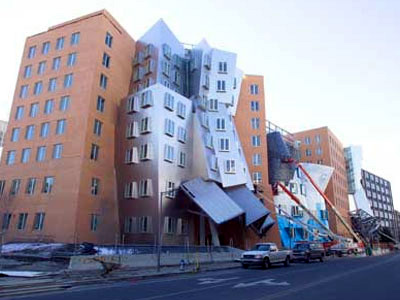
It’s kind of hard to tell the intentional from the accidental.

Posted in Architecture | Tagged | 8 Comments

Are There Any Taboos Today?

Sir Barken Hyena writes:

I know the obvious answer is “yes and they are racial & gender related” but when reading about Victorian England, for example, it’s clear that the taboos of the age were pretty much universal. Nobody anywhere, above the level of the street prostitute, was discussing sex. Or so it seems. Hard to say from this remove of time and space but the vibe I get from that era tells me that even two close old friends sitting around privately chatting would have been very reluctant to broach that subject.

But today? Is there anything even remotely like that? The racial and sexual taboos are a subject of lots of stand up, as Paleo Retiree likes to point out, and much else besides.

So for this post I’d like to encroach on Question Lady’s territory and ask: what are the universal taboos of this age?

Posted in Personal reflections, Philosophy and Religion, Politics and Economics | 16 Comments

Question Lady Question

The Question Lady writes:

The Stanford study on the benefits of organic food has been all over the internet and tv today. What do you think about it?

(Here’s an L. A. Times article about it.)

Posted in Food and health | Tagged , | 5 Comments

Building’s long-lost sibling

Glynn Marshes writes:

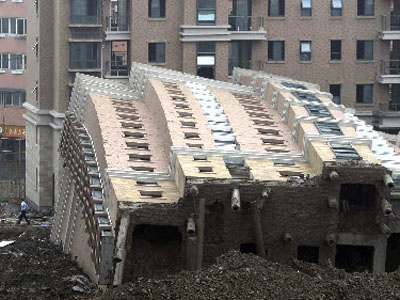
For Blowhard, Esq. The empty building next to the OC Public Defender’s office reminded me of something . . .

Posted in Architecture, Photography | 4 Comments