
The Question Lady writes:
When it comes to people on the internet posting photos of those near and dear to them — are you more susceptible to photos of their animals or their children?
The Question Lady writes:
When it comes to people on the internet posting photos of those near and dear to them — are you more susceptible to photos of their animals or their children?
Blowhard, Esq. writes:
The L.A. Weekly recently ran a feature on the “20 Worst Hipster Bands.” Here’s the entry for No. 20:
 Fifty years after the Rolling Stones and we’re still upset about this? They “lack authenticity,” you see, b/c they aren’t black. Thus, they’re forever barred from using a I-IV-V chord progression and playing a minor pentatonic scale.
By the way, a question: how many young blacks are even drawn to playing guitar? Very few in my admittedly limited, anecdotal experience. It seems like most blacks who pursue music get into DJing, hip-hop, or R&B, all of which put more emphasis on voice or keyboards/programming than guitar. Given the relative dearth of young black blues musicians, shouldn’t we be happy someone is carrying the torch for this essential American art form?
OK, OK, OK — if it sounds like I’m taking this a little personally, it’s b/c I am. First, I think the Black Keys‘ latest album, El Camino, is a great rock ‘n roll record. Freewheeling, raucous, and energetic, it’s packed with dirty hooks and low-down riffs. Eleven tracks and not a single one of ’em is filler. And I used the phrase “rock ‘n roll” intentionally. In his autobiography, Keith Richards laments that fact that a lot of modern rock music puts all the emphasis on rocking and none on rolling. “What happened the groove?” he wonders. (My short answer: blame Johnny Ramone.) The Black Keys didn’t forget the groove. Unlike a lot of the music you find on alternative rock radio, you can dance to it. Here’s the second single off El Camino, “Gold on the Ceiling.”
The second reason this nonsense pisses me off is that I’m kinda, sorta an amateur blues player myself. After messing around on the guitar for years, I recently decided to take formal lessons. My teacher, who is white, was born and raised in Whittier, got his music degree at UC Irvine, and now lives in Aliso Viejo. In other words, cracker as can be. He’s an incredible guitar player whose favorite music is jazz and reggae. At my first lesson, within 15 minutes of meeting him, he taught me the basic blues scale and had me improvising over a rhythm track. It was a blast. Scary and exhilarating at the same time.
But I guess I shouldn’t enjoy myself too much, seeing as I wasn’t born to the right type of people in the Mississippi Delta during the late 19th and early 20th centuries, thus my playing will never be more than ersatz. Nah, fuck that and fuck these pinhead humanities-major music critics who probably couldn’t strum a C-chord if their tickets to Coachella depended on it.
Now, if you’ll excuse me, I need to go practice my scales.
UPDATE: Stuff White People Like weighs in.
Sax von Stroheim writes:
Over the last year or so Mrs. von Stroheim and I have been dipping our toes into the world of vintage pinball, and we finally took the plunge and bought the first (and perhaps only) machine for our collection. It’s a game from 1960 called “World Beauties”, produced by the Gottlieb company, which made the best pinball games up until the 1970s when the older electro- mechanical style that they had mastered was phased out in favor of machines run on circuit boards. We chose the game not only because we prefer the old-fashioned gameplay, but also because it’s a gorgeous machine, featuring the art of Roy Parker, a genuine American Master.
Here’s the backglass for “World Beauties”:

Parker’s specialty
Parker was a commercial artist who worked for Advertising Posters, a printing company in Chicago, which was the center of the pinball manufacturing world. Advertising Posters handled the art for Gottlieb as well as Gottlieb’s major competitor, Williams.
Parker was the artist for 290 Gottlieb machines. From the 1930s until his death in 1966, Parker was the exclusive Gottlieb artist, which gives their machines from this era a very cohesive look. Like all pinball art of the era, Parker’s work put beautiful women front and center, but he also had a great sense of humor. The backglass for “Old Faithful”, from 1949 (his style was a little rougher then) reminds me of Frank Tashlin’s cartoons:

At the time, these games definitely were not for kids…
And I love the “school of fish” in the playfield of “Mermaid” (1951):

The joke at the top of the field is pretty good, too…
He also had a great eye for 50s “atomic age” architecture. Dig the hotel in “Hi-Diver” (1959):

Reminds me of Dan Clowes…
One of the great accomplishments of fandom – whether we’re talking about pinball fans or comic book fans – is to have shined a light on the work of commercial artists which would have otherwise ended up in the dustbin of history along with all the other bits and pieces of culture that don’t have official, institutional support. But thinking about Parker’s work makes it clear just how much luck plays a role in what art gets remembered, preserved, and celebrated. Who knows how many other illustrators could have done what Parker did? And who would have guessed that 70 years later people would be collecting these machines for the artwork? In terms of his legacy, Parker seems to have “lucked out”: working for Gottlieb all those years not only gave him steady work (which is probably all he cared about at the time), but gave his career the kind of shape it wouldn’t have if he was in the position of doing piece work, for a bunch of different employers.
If you ever get a chance to check out some of his machines in person, don’t pass it up!
The Question Lady writes:
How forgiving are you towards yourself?
Glynn Marshes writes:
Oh, those silly Texans! The “top elected official” of Lubbock, County Judge Tom Head, went on local television and spouted a bunch of—oh, read for yourself! As reported by the New York Times:
He said he was expecting civil unrest if President Obama is re-elected, and that the president would send United Nations forces into Lubbock, population 233,740, to stop any uprising.
“He is going to try to hand over the sovereignty of the United States to the U.N.,” Mr. Head said on Fox 34 last week. “O.K., what’s going to happen when that happens? I’m thinking worst-case scenario: civil unrest, civil disobedience, civil war, maybe. And we’re not talking just a few riots here and demonstrations. We’re talking Lexington, Concord, take up arms and get rid of the guy.”
We should all be laughing now, right? We should roll our eyes; we should laugh; and then, contracting back to fear-tinged sobriety, we should lament the terrible danger people “like that” present to us, the rational ones.
But that’s not my reaction at all. On the contrary, I feel something else entirely: fascination, plus a kind of tenderness.
I confess: I don’t think Head is a “kook.”
Before I explain myself, let me offer up a few other details about the kinds of stories that Judge Head’s constituents no doubt share among themselves—offered to give a bigger glimpse of the seas they sail:
The “rational” explanation for these sorts of stories is to dismiss them as conspiracy theories—a phenomenon with its own rational explanation, as summed up by Michael Shermer in this article in Scientific American.
Conspiracy theories connect the dots of random events into meaningful patterns and then infuse those patterns with intentional agency. Add to those propensities the confirmation bias (which seeks and finds confirmatory evidence for what we already believe) and the hindsight bias (which tailors after-the-fact explanations to what we already know happened), and we have the foundation for conspiratorial cognition.
This is certainly all true, as far as it goes, but perhaps there’s an even richer explanation.
In his book Magical Child, Joseph Chilton Pearce relates an experiment by parapsychologist Charles Tart.
Tart was studying the effects of mutual hypnosis.
In a typical experiment, a female graduate student put a male student under hypnosis, then instructed the male student to reciprocate—i.e. to put her under hypnosis. Once she was under, the male student asked the woman to imagine a tunnel; traveling down the tunnel represented a deepening of the hypnotic state. The woman, in turn, used the same imagery, “now quite vivid for her” to induce the man to go deeper into a hypnotic state as well.
It is at this point that the experiment gets interesting. As Pearce relates the story:
[S]uddenly the boy and girl were together in the tunnel.
At the moment the tunnel imagery was mutually shared and given consensus between them, that tunnel took on full-dimensional sensory reality. It smelled, felt, looked, and sounded like a regular tunnel. They could distinguish no difference in the reality of the tunnel and the reality of any ordinary daily event in the actual world . . .
[T]hey began conversing with each other in that created state, rather than using their actual voices there in their ordinary reality.
During another mutual hypnosis session, the same pair “found themselves on a magnificent golden beach, with a champagne ocean, crystal rocks, heavenly choirs singing overhead . . . Every item of their created state had stabilized because it was shared . . . The phenomenon did not shift, as such things do in a dream.”
This is astonishing to me: the minute two people agreed that what would otherwise be considered a fantasy or imaginary projection was objectively “real” it became objectively real to them.
Fine, you say. But this happened under laboratory conditions, using people who were known to be good hypnosis subjects.
It couldn’t possibly happen “in real life.”
But what if it could?
In The Emerald Tablet, Dennis William Hauck relates an experience he had in the early 1970s in Grass Lake, Illinois, which he describes as a small farming community on the Illinois-Wisconsin border.
In July, 1973, three families who lived in the community started reporting “fires” in the sky.
They reported the strange lights to the police.
The authorities responded over a dozen times, and on several occasions officers witnessed the lights, but there was not much they could do . . . After two years, they just stopped responding.
Abandoned by the authorities, the families turned to each other. They reached out to UFO groups and psychics. They began trying to communicate telepathically with the lights.
At that point, “very strange things began to happen in the homes of [the] families.” Phenomena they experienced included:
When Hauck visited one of the families himself, he also experienced a sequence of “paranormal” events, starting when he heard a “large thump” on the exterior wall of one of the families’ homes.
Thinking something had hit the side of the house, I jumped up, ran over to the half-open dining room window, and stuck my head out. Turning my head to the right, I watched in astonishment as an invisible hand made fresh claw marks about three inches long in the faded redwood siding. The claws actually dug in deeper as soon as I started watching, and I could see the pieces fall to the ground as the fresh wood underneath was exposed . . . there is no way anyone could have faked that; there were no trees anywhere, the long driveway was empty, and the pitch of the roof was too steep for anyone to hide there. I did not exactly run screaming from the house, but I quickly excused myself without telling anyone what I saw and headed for my car.
On his drive back to Chicago, Hauck’s car lights began blinking on and off—including, for a while, after he’d pulled over to the side of the road and shut off his engine. The next day a car mechanic could find nothing wrong with the car’s wiring, but the entire left hand side of the vehicle was magnetized—one of mechanic’s screwdrivers stuck to it.
Now, you could dismiss this as a tall tale.
But what if it’s another example of the “mutual hypnosis” phenomenon that Tart documented in his lab?
Cue the Twilight Zone theme! Suddenly we face the possibility that groups of people can splinter away from what we might call “mainstream” consensus reality and become entrained by a different consensus reality—one in which, for example, people are abducted and carried off in UFOs. Or vaccines cause autism. Or the U.S. government is building concentration camps.
Perhaps the only reason “we” don’t experience these splinter realities as the mainstream consensus reality is that they haven’t achieved enough—for lack of a better word—mass. Not enough people believe in them, so they fail to substantiate (literally!) to people luckly enough to dwell outside some perimeter of psychic influence.
We know that the human mind is an organ of projection as well as (or even more than?) perception—quantum physics has proved it.
“Common sense” dictates that the spooky quantum effect works only on the quantum level; that on a macro level, what we perceive as “solid,” objective, material reality is there because it’s there, not because, through some sleight of consciousness, we decided it was there.
But what if “common sense” is itself a product of consensus?
What if the only reason material, “factual” reality exists is that we’ve collectively agreed it exists?
We assume ancient myths are simply stories. If we’re being generous, we grant them status as allegories that primitive people shared to inculcate certain behaviors and values. After all, we see no material evidence for dragons, or centaurs, or fairies.
And then we sit at our desks reading articles in the New York Times and laughing at those silly people who think our government is colluding on a UN takeover of Texas.
But what if it’s actually happening? What if over there in Texas, the Argonauts are sailing forth in ships as real as the keyboard beneath my hands?
There’s another element, by the way, common to the stories related by Pearce and Hauck.
In the case of the two graduate students who participated in Tart’s experiment: one of them eventually dropped out. As Pearce puts in, with scholarly delicacy, “He could no longer grant himself consensus about what was really real.”
In the case of the Grass Lake incident, within three years of Hauck’s visit all three families affected were “split apart” by divorce and “personal breakdowns.”
So there’s the risk: absent a broad-enough consensus, phenomena like this has the potential to tear us apart.
Perhaps the real reason we ridicule the crazy Texans is to protect ourselves.
If we didn’t ridicule them—if, instead, we joined them on their ships—we’d discover that their myths are very, very real—and we suspect our psyches could not withstand the shock—that we would be unable to move from our realities into their living myth without going mad . . .
Blowhard, Esq. writes:
Comedy writer Ken Levine tells about the time he met John and Yoko for 20 seconds. He ends his anecdote with a question worthy of the Question Lady herself: “If you get to meet someone you idolize and you have time to ask him just one thing, what would it be?”
Blowhard, Esq. writes:
My copy of Nassim Taleb’s Fooled by Randomness arrived today to match my copy of The Black Swan. I specifically tracked down the UK editions b/c the covers are so wonderful.
 Bold, colorful, hazy, eye-catching. They have a visually consistent theme and use the same sans serif typeface. Th asymmetrical, close-up profiles give the graphics some life and playfulness.
By contrast, here are the American editions.
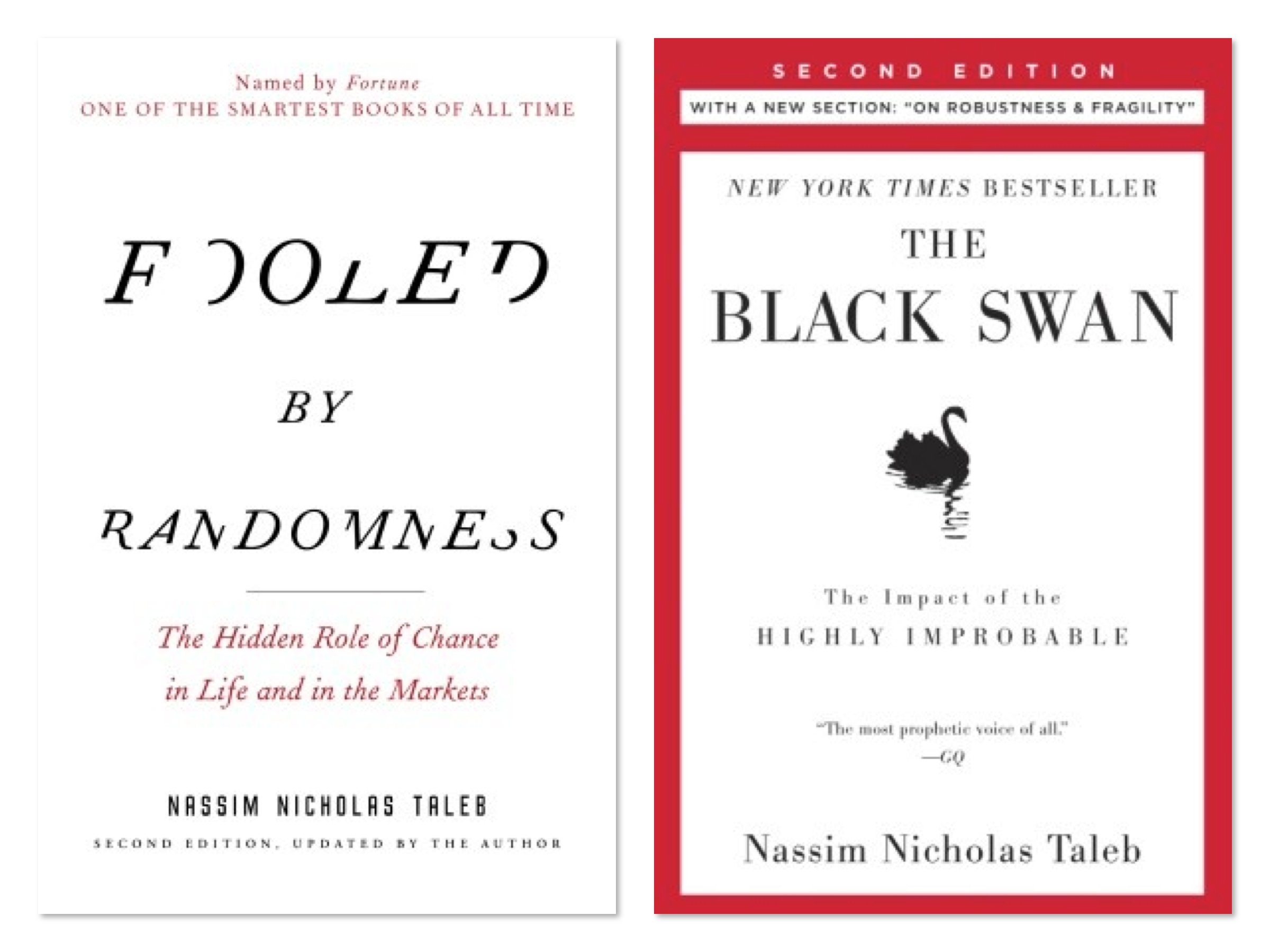 Bland, calm, restrained. There’s a mix serif and sans serif typefaces, the visual elements are centered and static, and they just sorta recede into the background. Maybe Americans like a visual shorthand that lets everyone know they’re reading a serious book? I mean, the UK covers do look like they could be from a children’s series about animals.
When searching for the images I noticed that Taleb’s publisher in the UK is Penguin, while in America it’s Random House. Well there you go. Penguin is known for and prides itself on their beautiful covers. This book by Phil Banes offers a great visual history of Penguin’s output over the past 70 years.
I even have a favorite Penguin designer, Coralie Bickford-Smith. Ms. Bickford-Smith’s website offers a generous sampling of her work. I’m partial her Boys’ Adventure and Sherlock Holmes series.
David Pearson’s work for the Penguin Great Ideas series is not to be missed either.
Paleo Retiree writes:
I ran across this beautiful old Chevrolet muscle car in a grocery-store parking lot:
 If those wheels don’t radiate “Fast” and “Furious,” then I don’t know what does. Click on the image for a more detailed look.
Paleo Retiree writes:
Blowhard, Esq. writes:
It’s quite easy to graduate from law school without learning much legal history. (It’s quite easy to graduate law school without learning how to be a lawyer, too, but that’s a rant for a different time.) OK, you do learn a little bit about the evolution of American law by reading cases, but a straight legal history class is pretty much never required. So questions like, Where does our legal tradition come from?, What makes it different than those of other countries?, How has it changed over time? are given light treatment. Anyone wanting to delve deeper has to do so on their own.
I was one of those people, so I’m happy I stumbled across Harold Berman’s Law and Revolution via the recommendations of Tom Smith and Don Boudreaux. What a wonderful book. Erudite, clear, and eye-opening. Berman’s thesis is that the Western legal tradition began in 1075 when Pope Gregory VII declared the Catholic Church independent from secular control. Previously, emperors and kings controlled the church. While there were many bishops, there was only one emperor or local king. The Church chaffed under the secular yoke — who were these earthly kings to dictate church law and appoint bishops? When he became pope, Gregory VII began a series of events that culminated in law as we know it today. Previously, in Western Europe, law was not seen as distinct body of rules carried on by specially-trained professionals. It was not systemitized. Berman writes:
In the late 11th, the 12th and the early 13th centuries a fundamental change took place in western Europe in the very nature of law both as a political institution and as an intellectual concept. Law became disembedded. Politically, there emerged for the first time strong central authorities, both ecclesiastical and secular, whose control reached down, through delegated officials, from the center to the localities. Partly in connection with that, there emerged a class of professional jurists, including professional judges and practicing lawyers. Intellectually, western Europe experienced at the same time the creation of its first law schools, the writing of its first legal treatises, and conscious ordering of the huge mass of inherited legal materials, and the development of the concept of law as an autonomous, integrated, developing body of legal principles and procedures.
The Papal Revolution was also the beginning of the modern state. It in turn inspired the Protestant Reformation, all the way down to the English, American, French, and Russian Revolutions. (Here’s the Dictatus Papae, Gregory’s “manifesto” or “declaration of independence” from Henry IV, which reads a lot like the list of grievances in our own Declaration.)
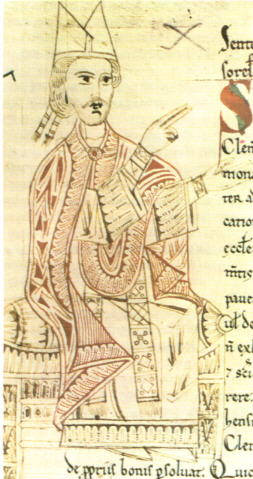
Pope Gregory VII telling Henry IV to ‘eff off.
Even though during this period there was a rise in stronger central authorities, the Western legal tradition was created during a period of political instability as the Catholic Church and secular governments vied for power. As Berman makes clear, our legal tradition did not arise despite this political decentralization, it arose because of it. In the absence of a powerful central government, people spontaneously created and systematized their own laws. The lex mercatoria or “law of merchants,” is a product of this era. It emerged from the everyday actions of merchants.
The merchants created the law largely on their own, spontaneously from the bottom up, a law “not…established by the sovereignty of any prince.” They formed international fairs and markets, merchant courts, and city merchant offices. They created guilds to promulgate standards of honesty in commercial transactions. International treaties mediated commercial disputes between citizens of two treaty partners quickly and, if there was a lack of law on point, according to “good conscience.” They resisted ecclesiastical courts in their attempt to assert jurisdiction over mercantile cases.
As for the mercantile courts themselves, they were staffed by nonprofessional community tribunals. Judges, usually guild representatives, were elected. The judge then usually chose two or three other merchants to sit with him in court. Because businessmen tend to favor efficiency, the courts were noted for their speed and informality. Lawyers were excluded from the proceedings, technical legal arguments were discouraged, and appeals forbidden. (Ahhh, the good ‘ol days.)
Perhaps the most astonishing thing about this period, at least to me, is that many of the legal concepts created in the 11th and 12th centuries still survive today. The modern version of the lex mercatoria is known as the Uniform Commercial Code, the model statute that governs the sale of goods that has been adopted by most states. Among the enduring concepts that were created 900 years ago:
Pretty impressive if you ask me. It shows what powerful ideas and institutions people can create when they’re free of government control and left to their own devices. Is there any reason this can’t be the norm now? Thomas Sowell wonders “[w]hy the transfer of decisions from those with personal experience and a stake in the outcome to those with neither can be expected to lead to better decisions is a question seldom asked, much less answered.”
 Blowhard, Esq.
 Callowman
 Sherbrooke
 Eddie Pensier
 Enzo Nakamura
 Epaminondas
 Fabrizio del Wrongo
 Fenster
 Brundle Guy
 Glynn Marshes
 Paleo Retiree
 Atypical Neurotic
 Question Lady
 Sax von Stroheim
 Sir Barken Hyena
 The Mistaken
 Uncouth Reflections