NY Times Jumps the Shark, or, Trolling Becomes Journalism’s New Standard

Glynn Marshes writes:

So a few days ago, in the comment thread on “What’s wrong with white boys playing the blues,” jr dismissed the LA Weekly article cited as an “exercise in trolling.”

Now comes the New York Times, in a piece titled “Men, Who Needs Them” by Greg Hampikian.

The bait comes in paragraph 5 with the we’re-not-in-Kansas-anymore claim that “women are both necessary and sufficient for reproduction, and men are neither.”

Oh. Hold on! There’s a caveat a little later. It turns out women do need “some very odd tiny cells” that men “shed.” But not to worry. The cells are easy to obtain and store, and we women can impregnate ourselves at our personal discretion and leisure. Using turkey basters. Or straws.

Anyway. Taken together w/ the LA Weekly piece, it makes me wonder: is trolling now an accepted marketing strategy for struggling mainstream papers?

And if so, what are the rules?

“Anything for attention,” maybe?

Or: “If our core readers believe we’re publishing this in good faith, we can pull it off”?

Posted in Books Publishing and Writing | Tagged , , | 8 Comments

City Sights: Claremont, CA

Blowhard, Esq. writes:

A few pics from the city’s lovely downtown.

Posted in Architecture, Photography | Tagged , | 8 Comments

“Black Wings Has My Angel”

Image

Fabrizio del Wrongo writes:

Someone recommended this to me a while back. I took a chance on it when I noticed it was available cheap for the Amazon Kindle. (Maybe it still is.) Written by the terrifically-named Elliott Chaze, and published in 1953 by the legendary Gold Medal outfit, it’s a noirish crime tale about an escaped con named Tim Sunblade who’s torn between practical and impractical impulses. On the one hand, he wants to pull off the ultimate bank heist — to die rich and sated, like a retired congressman. On the other, he’s driven, mostly against his will, to satisfy his deepest erotic longings, which stretch all the way back to his small town upbringing — to sleepy tree-lined streets and furtive kisses on the front porch swing. Both impulses find outlets in the figure of Virginia, a fugitive call girl whom he hires between jobs, uses enthusiastically, and then can’t get clean of. Like any good noir dame, Virginia cares only about money. Loves it so much she’s wont to take off her clothes and roll around in it. Tim recognizes this, of course, but he’s so besotted with her that he keeps inventing new exceptions to his “no attachments” policy. He eventually compromises, working Virginia into his crime plan, and for a while the couple plays at aping suburban normalcy. You can probably guess where that leads.

Hey, isn’t this a sensationalized version of the standard male relationship story? “I dreamed of doing this and this and this, but then I met this leggy blonde thing, and now here I am with a potbelly, floral curtains, and three mewling whelps.”  It seems to me that mid-century crime writing was uniquely suited to that sort of thing. Noir movies too. Today much of this stuff is considered misogynistic, because — gasp! — the female characters are little more than obstacles thrown into the paths of men. But this is pulp we’re talking about, not Chekhov; it’s all about distillation and tanginess. Besides, why shouldn’t dudes have their own private desecration fables? And what asshole determined that all art is required to present an unbiased and “balanced” image of the Way Life Ought To Be?

Anyway, one of the book’s most notable aspects is Chaze’s use of language, which could be described as hardboiled if it weren’t so damn florid. He loves setting off Roman candles of terse-but-vibrant description. These have an impressionistically immersive effect, but they also tease you out of the narrative — because you can sense Chaze leering over every evocative line.

Here are a few extended quotes:

I hadn’t had a hot-water bath in almost four months. The soap was oily and fragrant and it slid down my chest making little zeros of suds, each filled with the milky-green color of the water. I slumped down in the water so that my chin rested just on the surface of it. I soaped my head and scrubbed it with fingertips and fingernails, then ducked beneath the deep hot water, holding my breath, feeling the dirt of months float loose. I always cut my hair short, so short I can use it for a fingernail brush when I wash my head. I credit this trick to Washington and Lee University. It’s about the only thing they taught me there in that splendid woman-starved nest of culture where students address one another as “gentleman,” where freshmen wear nauseatingly cute beanie caps, where no one walks on the hallowed grass, and everyone is so sporting it hurts.

. . .

Thinking back, I remember the stupidest things; the way there was a taut crease just above her hips, in the small of her back. The way she smelled like a baby’s breath, a sweet barely there smell that retreated and retreated, so that no matter how close you got to it you weren’t sure it was there. The brown speckles in the lavender-gray eyes, floating very close to the surface when I kissed her, the eyes wide open and aware. But not caring. The eyes of a gourmet offered a stale chunk of bread, using it of necessity but not tasting it any more than necessary. I remember getting up and coming back to her, and of throwing a shoe at the light bulb, later, when the whisky was gone. I remember the smell of rain-darkness in the room and her telling me I’d cut my feet on the light-bulb glass on the floor. And how she said I was no better than a tramp myself, that I made love to the cadence of the raingusts on the roof, and it was true I was doing just that, but it seemed the natural thing then. And I felt so marvelously clean and soaped and so in tune with the whole damned universe that I had the feeling I could have clouded up and rained and lightninged myself, and blown that cheese-colored room to smithereens.

. . .

You’ve never heard a siren until you’ve heard one looking for you and you alone. Then you really hear it and know what it is and understand that the man who invented it was no man, but a fiend from hell who patched together certain sounds and blends of sounds in a way that would paralyze and sicken. You sit in your living room and hear a siren and it’s a small and lonesome thing and all it means to you is that you have to listen until it goes away. But when it is after you, it is the texture of the whole world. You will hear it until you die. It tears the guts out of you like a drill against a nerve and it moves into you and expands.

Pretty heady stuff, huh? Pretty show-offy too, but I can forgive that in writing as fun and as sexy as this. Truth be told, I’ll take a pulp show-off over a literary show-off any day of the week. I’m looking at you, David Foster Wallace.

FWIW, Chaze himself was hip to this tendency in his writing. When asked about his motivation as a writer, he said: “If there is any discernible, it’s probably ego and fear of mathematics, with overtones of money. Primarily I have a simple desire to shine my ass — to show off a bit in print.” If only more “serious” writers were so candid, not to mention so willing to make their affectations palatable to the commercial audience.

Anybody got some other Gold Medal recommendations?

Related

  • I learned while Googling Chaze that a movie version of “Black Wings Has My Angel” is set to be released in 2013. Here’s hoping it isn’t terrible.
  • Paleo Retiree, né Michael Blowhard, has a go at the Gold Medal phenomenon.
  • An informative write-up on Chaze by Bill Pronzini.
  • Some wonderful examples of Gold Medal cover art.
Posted in Books Publishing and Writing, Commercial art, Movies, Personal reflections, Sex | Tagged , , , , , , | 6 Comments

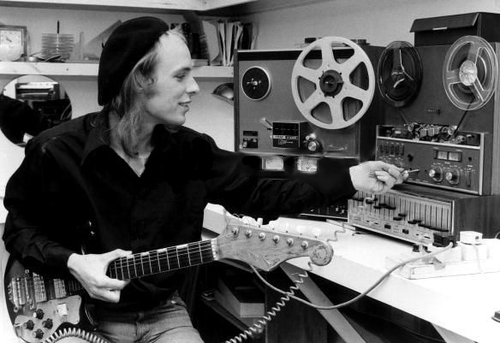
The Brian Eno Disease

Sir Barken Hyena writes:

It pains me to use this title. I adore Eno, he’s been a huge influence on me, both as a teacher of sorts, and as an artist.  Another Green World is practically the founding document for the musical territory I’ve played in, and along with his influence on so many other artists, from Bowie to Jon Hassell, well, you just can’t overestimate his importance. And his curiosity and open mind are to be imitated.

And yet, he has let a disease loose on the world that has to be killed.

It’s not a disease of his own concoction, he picked it up in art school in the 50s and 60s, and passed the contagion along, made more virulent by exposure to the bright lights of pop culture, and fame. And I don’t think he actually completely believes in the disease himself, but that’s how his message has been received. The disease goes something like this:  “You don’t need anything but you’re own inborn resources to create great art.”

Now, what could be wrong with that? It sounds so positive, so confidence building. It’s your oyster baby, run with it! If art is about individuality, and these days it certainly is, then what do you need others for? What do you need skills and knowledge for, it’s about pure imagination, pure creativity and drinking deeply from your inner spaces.

Free at last

The problem is that this is not how Brian Eno actually made his art, nor is it how anyone has ever made art. Artists are born into a cultural scene beyond their making, and their work results from the tensions and attractions between that scene and their own personality. If a style could be simply erected sui generis by the simple expedient of ignoring your surroundings then the whole of art history would have been different.

In fact, what Eno did was not much different from what any creative person, in any time, has done. Leonardo wrote about splattering paint and then looking for familiar things in it to fill out with drawing. He doesn’t seem to have needed to create a fancy term like “aleatoric processes” to get the press excited about it though. Many more examples can be found. Artists have always needed strategies for juicing the creative process. So things like Eno’s Oblique Strategies, though interesting are nothing at all new.

But what’s more is that Eno and his generation drew deeply on the fund of all previous art. In spite of his famous “I am not a musician” pronouncement, I guarantee you that Eno in 1972 knew exactly how to play a C major chord, and could correctly call it that. The musicians he worked with at the time have confirmed this. Really, he was just a producer in the mold of Phil Spector who had his own idiosyncratic methods that got a cool result. Spector never said “I am not a musician” though it would have meant about the same thing if he had.

But all that escapes the tender young mind of a wannabe 16 year old musician. So along with many of my generation I started out thinking “This is what I have to do”. And so I did, and man did I try. But it turns out my inborn resources came up a bit short. I set my sights on Genius and came up with Not Bad. Eventually I tired of this game and just started to do what I really liked doing, which is playing instruments and making quirky little ditties with them. So now in middle age I’m learning to play chords, scales, arpeggios…and I’ve learned some Bach on the piano. This experience of delving into our heritage and making it my own by playing it with my own hands has been the most exciting experience of my artistic life.

And so maybe I can be of some use to the 16 year old wannabes out there who are coming up in a world where the Brian Eno Disease is endemic. By all means be creative and open minded. But be open minded enough to admit that you don’t know anything, and that people before you have done things that you need to know about, to understand, to build on.

Speaking of which, building on the past is the key point. Up until the Disease got the upper hand, art was viewed like a fruit tree. Year after year it gave fruit, and the fruit had it’s own seeds, which hybridized and made the next generation. And so on and on over the centuries a rich orchard grew up.

Then the Disease came along and cut down the trees and used the wood to build things, marvelous things, things we stood around and gaped at. But too late, we found out there weren’t any more seeds, and no more fruit, and all that’s left is to break up the things they built and use the wood for something else, and little by little it’s whittled down to nothing.

We see this with sampling. I’m not getting into the issue of legitimacy, just saying that when an artist uses a loop from a 70s soul record, he’s not leaving anything for the next guy, the way the 70s soul musicians left something for him. What are they going to do, sample his sample, and cut it down further? New stuff has to be injected into the round or it just dries up and blows away.

But the good news is that it’s clear what needs to done now. It’s time to replant the orchard. No need to wait for the complete collapse of civilization to get started.

Posted in Music, Personal reflections | Tagged , | 2 Comments

“Night Flight”

Image

Fabrizio del Wrongo writes:

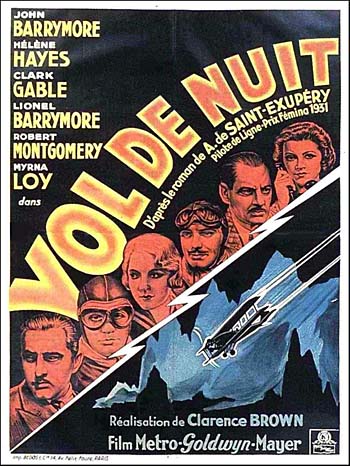
This MGM star vehicle has been out of circulation since its original run in 1933, probably owing to legal issues related to the rights of the source story by Antoine de Saint-Exupéry. (Yeah, THAT Antoine de Saint-Exupéry – the guy responsible for “The Little Prince.”) It deals with a group of flyers in South America who are tasked with undertaking dangerous night missions in order to keep the mail on schedule – they’re a sort of aerial version of the Pony Express. When the pilots land, they go back to their wives and girlfriends, but a part of them remains in the air. They’re spiritually tied to its danger, its space, and its freedom.

It’s a hackneyed idea, and it’s presented with the taxidermied superficiality one expects of MGM. Worse, parts of the movie were cut after a poor preview, dulling some of the plot points considerably. But director Clarence Brown keeps the picture so visually and tonally unified that you glide right over the rough spots. Part of his strategy is to keep the camera moving through space, often craning emphatically to highlight actors and other points of interest. This provides a stylistic corollary to the aerial footage (a dramatic mix of live action and studio fakery), and it effectively underscores the theme of lives dislodged into great open spaces. Brown’s best flourishes come during the flight sequences, some of which take the form of elaborate montages. (The editing is by Hal C. Kern.) Filled with horizontal wipes and high-angle vignettes showing people waving at the planes overhead, these sequences convey the Olympian sense of freedom early flyers must have experienced as they soared above the earth. And in their fractured, space-defeating lyricism they force mental comparisons between aviation and the movies — two technologies which emerged around the same time, each of which went a long way towards splicing together the world.

The scenario lends itself to an ensemble approach, and MGM populated “Night Flight” with some of its best-known players. Clark Gable, Robert Montgomery, and William Gargan play pilots; Helen Hayes and Myrna Loy are their earthbound women; and John and Lionel Barrymore turn up as control station bosses overseeing the flight routes. (John is in full self-caricature mode; his eyebrows seem synced to the flutter of his bizarro tracking instruments.) Loy gives perhaps the best performance, effectively using her entire frame to communicate the complex of feelings that her husband’s flying inspires in her — it’s a mishmash of worry, jealousy, and arousal. I especially enjoyed one of her bedroom scenes with Gargan. Its rumpled, post-coital mood is of a sort one associates with European films.

“Night Flight” is sometimes claimed as an influence on “Only Angels Have Wings,” a not unreasonable charge considering Howard Hawks was serving as chief aid to Irving Thalberg while the movie was being made. But aside from the flying milieu and the South American setting the two films aren’t very similar. With its ensemble cast, its fractured plot, and its race-against-time theatrics, “Night Flight” plays more like a precursor to the disaster epics of the 1970s. It’s like “Airport” or “The Towering Inferno” in miniature.

“Night Flight” is available on DVD through Warner’s burn-on-demand line, The Warner Archive Collection. It also sometimes runs on TCM.

Posted in Movies, Performers | Tagged , , , , , , , , , , , , , , | 3 Comments

House Style at The New Yorker

Paleo Retiree writes:

Take a look at the following first-lines-of-articles-from-The-New-Yorker and tell me if you’re as struck by certain patterns and similarities as I’ve been.

“In 2004, Carolina Izquierdo, an anthropologist at the University of California, Los Angeles, spent several months with the Matsigenka, a tribe of about twelve thousand people who live in the Peruvian Amazon.”
“Spoiled Rotten” by Elizabeth Kolbert

“In 1926, Forrest Ackerman, a nine-year-old misfit in Los Angeles, visited a newsstand and bought a copy of Amazing Stories — a new magazine about aliens, monsters, and other oddities.”
“Show the Monster” by Daniel Zalewski

“On a recent morning in the rain forest of northern Brazil, a wiry man in a faded T-shirt and shorts leaped from a marshy riverbank onto the trunk of a palm tree.”
“Strange Fruit” by John Colapinto

“On Thanksgiving Day, 2008, shoppers began lining up outside the Wal-Mart in Valley Stream, Long Island, at 5:30 p.m., near a small, handwritten sign that read ‘Blitz Line Starts Here’.”
“Crush Point” by John Seabrook

“One midwinter night in 2008, Senator John Ensign, of Nevada, the chairman of the Senate Republican Policy Committee, was roused from bed when six men entered his room and ordered him to get up.”
“Frat House for Jesus” by Peter J. Boyer

“On the evening of May 7, 2008, a twenty-three-year-old woman named Rachel Hoffman got into her silver Volvo sedan, put on calming jam-band music, and headed north to a public park in Tallahassee, Florida.”
“The Throwaways” by Sarah Stillman

House style much?

Here’s my attempt at distilling the art of kicking off a New Yorker article:

“On a date that’s peculiarly specific, and in a sentence that uses more commas than you’re accustomed to, someone you’ve never heard of did something, or had something done to him/her, of puzzlingly little apparent significance.”

Easy-peasy!

If The New Yorker contacts you about offering me a job, you know how to put them in touch with me.

Posted in Books Publishing and Writing | Tagged , | 10 Comments

More on Symbolism

Blowhard, Esq. writes:

Last night I opened my copy of Taleb’s Fooled by Randomness and was greeted with this passage:

At the cost of appearing biased, I have to say that the literary mind can be intentionally prone to the confusion between noise and meaning, that is, between randomly constructed arrangement and a precisely intended message. However, this causes little harm; few claim that art is a tool of investigation of the Truth — rather than an attempt to escape it or make it more palatable. Symbolism is the child of our inability and unwillingness to accept randomness; we give meaning to all manner of shapes; we detect human figures in inkblots. ‘I saw mosques in the clouds’ announced Arthur Rimbaud, the nineteenth-century French symbolic poet. This interpretation took him to ‘poetic’ Abyssinia (in East Africa), where he was brutalized by a Christian Lebanese slave dealer, contracted syphilis, and lost a leg to gangrene. He gave up poetry in disgust at the age of nineteen, and died anonymously in a Marseilles hospital ward while still in his thirties. But it was too late. European intellectual life developed what seems to be an irreversible taste for symbolism — we are still paying its price, with psychoanalysis and other fads.

Regrettably, some people play the game too seriously; they are paid to read too much into things. All my life I have suffered the conflict between my love of literature and poetry and my profound allergy to most teachers of literature and ‘critics.’ The French thinker and poet Paul Valery was surprised to listen to a commentary of his poems that found meanings that had until then escaped him (of course, it was pointed out to him that these were intended by his subconscious).

Previously, here’s Ira Glass on symbolism.

UPDATE:

Posted in Books Publishing and Writing | Tagged , , , , | 1 Comment

Question Lady Question

The Question Lady writes:

What is the best Labor Day meal you ever had?

Posted in Food and health | Tagged | 9 Comments

“Killer Joe”

Paleo Retiree writes:

McConaughey and Gershon have a little something they need to work out

A white-trash/noir, doublecrossin’, absurdist melodrama, directed by William Friedkin from a Tracy Letts play that The Question Lady and I also loved. Friedkin may be in his 70s but he has made an energized and outrageous film — juicy, horrifying, shocking, and funny in a downtown-theater/youthful-cult-movie kind of way.

Small tonal note: “Killer Joe” is darker, more intense and less campy than many of the cult-type movies we’ve grown accustomed to in recent years. Friedkin’s a true man of his era. He doesn’t have the modern guy’s instinct to resort to distance, cool and amusement. His instinct is to go for the jugular: When in doubt, don’t back off; instead, push things even further. The goal here is to upset people, and in a way that’s both good and evil. Tracy Letts is one of the best writers-for-actors around, in a class (IMHO, of course) with Mamet and Shepard. He knows what performers need and he gives them a lot of it to go wild on. (His instinct for what the audience needs is pretty darned good too.) Chicago theater, baby. Caleb Deschanel’s tender/harsh cinematography is attentive to atmosphere and psychology in a way that shows the values of the project off beautifully.

In the way it combines absurdism, humor and intensity, and in the way the original stage play has been opened up, “Killer Joe” demands comparison not just to “Bug,” another Friedkin/Letts collaboration that I adored, but also to the less-successful Robert Altman film of Sam Shepard’s “Fool for Love.” (Hey, the DVD of “Bug” is currently only $6.95!) Some of it’s like an effective film adaptation of a stage play but much of it is an interesting hybrid, defining and inhabiting its own satisfying limbo between the theatrical and the cinematic. Friedkin and Letts seem to have decided to move the play’s action around while at the same time cutting the film’s microuniverse off from the larger world around it. It’s a shrewd and successful choice, delivering the visual stimulation and scene-changes of a movie without losing the supercharged, screwed-down focus of stage space.

You watch projects like these (whether on film or on stage) mainly for the crazy moments, the intensity of the scenes and the situations, and for the actors and their performances. In all this, the film really comes through. Great cast, great casting. In the central, youthful-patsy role, Emile Hirsch gives the film’s least interesting character — he thinks he’s savvy, hot stuff, and he isn’t — a lot of convincing desperation, ego, and sweat. As the cool and scary Killer Joe, Matthew McConaughey dispenses with the heartthrob baloney of his recent rom-com career and shows off a charismatic, balls-to the-wall, freakazoid side. Gina Gershon goes to town with the scheming, slatternly and bitchy notes (although, needless to say, she’s seductive and sexy too) — it’s a seriously wildass performance that, like her perf in “Showgirls,” deserves instant canonization. Thomas Hayden Church shows that he isn’t just a masterly deadpan comedian, he’s also capable of delivering pathos and brooding depths. And as the film’s center-of-real-human-values, young Juno Temple (the daughter of film director Julien Temple) makes her character’s mixture of fragile angel, “Baby Doll”-style sexpot, and terrifying banshee seem to cohere and make sense.

Juno Temple: Turn-on — or terror?

‘70s-movie-style bliss — and to be avoided at all costs if you dislike shocks, four-letter words delivered with zing and gusto, gratuitous nudity, cranked-up-to-11 emotionality, and/or convincing bloodshed. There’s plenty of all the above. Since this movie goes out of its way to violate personal boundaries in all kinds of thrilling ways, politically-correct lovers of mutually-respectful relationships are especially discouraged from attending.

Bonus links:

  • An interview with William Friedkin. Great bit: “The important thing is not ‘Does it go too far?’ but ‘Is it effective?'”
  • An interview with Juno Temple and Gina Gershon.
Posted in Movies | Tagged , , , , , | 9 Comments

Can you secede while still being in charge?

Brundle Guy writes:

Mike Lofgren wrote this article for The American Conservative asking if the wealthy elites in America have, for all intents and purposes, seceded from the union and created their own world while still governing and controlling the rest of us.

What think you, fellow Uncouthers? I’m particularly interested in Paleo Retiree’s thoughts, as I know he’s got an interest in the theories and culture of American Secessionism, and Glynn Marsh, as this made me think of her post on conspiracy theorists and “creating realities.”

There’s also some pretty feisty comments in the article’s talkback section that are worth taking a look at, if you’ve got the disposition for that kind of thing. It’s a fun little shitkicker of an article, so I figured I’d throw it to you fine folks and see what turns up! Let your voices be heard, Uncoutherites!

Posted in Philosophy and Religion, Politics and Economics | Tagged , , , , , | 5 Comments