Movie Update

Blowhard, Esq. writes:

Having seen most of the major movies of 2017, my current top 10 is:

1. FRANTZ
2. MARJORIE PRIME
3. INGRID GOES WEST
4. GOOD TIME
5. I LOVE YOU, DADDY
6. “Finding Frances” episode of NATHAN FOR YOU
7. WONDER WHEEL
8. THE TRIP TO SPAIN
9. BRIGHT
10. SPIDER-MAN: HOMECOMING

Still haven’t seen THE FLORIDA PROJECT, THE POST, DOWNSIZING, or TRANSFORMERS: THE LAST KNIGHT. I’ve seen all the other Oscar contenders.

Posted in Movies | Tagged , | 4 Comments

Naked Lady of the Week: Yuliya

Fabrizio del Wrongo writes:

y-cover

Is the brown-eyed Ukrainian Yuliya a sweetheart? It would be a shame if she wasn’t. She certainly looks like a sweetheart.

The photos of her featured below date from the period during which high-class European nude modeling was all about unaffected outdoorsiness. Many of them derive from the great (and now-under-new-management) Domai. The style is a good match for Yuliya’s guileless charms.

Nudity below. Have a great weekend.

Continue reading

Posted in Photography, Sex, The Good Life | Tagged , , , , | Leave a comment

Louis Malle’s “Phantom India”

Sir Barken Hyena writes:

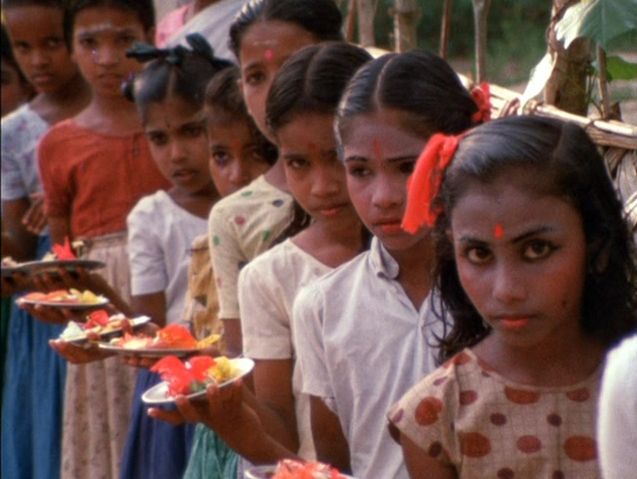
I watched this series from French director Louis Malle back-to-back the other day, it’s that good. In the late 60’s, Malle spent 5 months motoring around the vast backwaters of India in search of what spontaneous cinema verite gold he could find. India obliged, with it’s usual extravagance. The film overflows with unforgettable, yet wholly mundane images. Compiled into seven themed episodes, Phantom India is a worthy addition to the literature on fraught relations between East and West, from Kipling through Conrad, to Bowles, Chris Marker and Rushdie.

PhantomIndia-4-6

Malle was the usual muddle-headed Marxist of his era, and the narration provides far too many forehead slapping moments. Yet, because he’s also a true artist of vision, this only adds to the film’s value. Malle himself is quite aware that he can’t grasp what he is seeing, and has no choice but to take it all in as a Westerner, and an intellectual. He makes this struggle a recurring theme.

Time and again, the visuals subtly belie his analysis. Speaking of economic misery, the images are of villagers riotously celebrating a festival, or singing and smiling while toiling in their fields. While miserable statistics on malnutrition stream by, young men with physiques a metrosexual would die for wrestle in a dirt field. They look better than he does! Sure they are old at 40 but they leave good looking corpses. Too bad they burn them up.

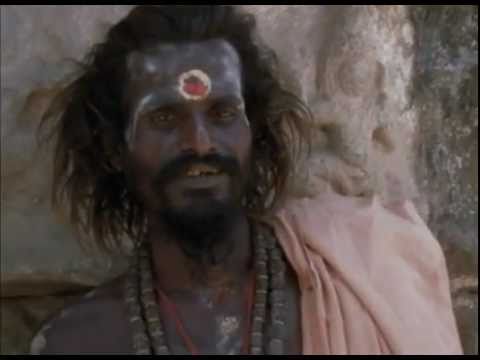
Thankfully this sort of thing is not the whole show. Many fine moments are wisely left to speak for themselves. It’s the faces that amaze the most, and the camera lingers and stares while they stare back. We see the gulf that separates, but the humanity that connects. And, the crew being French, they are adept at finding what’s most beautiful to film.

PhantomIndia-0-1

Malle isn’t insensitive to the consolations religion brings them, though he can’t help seeing it as exploitation. In fact, he sees just about everything in those terms, with the usual Commie blindness and platitudes. In one scene, a caste of fishermen bargain with a city slicker on a bike who buys their catch to sell in town. An epic battle ensues, with one feisty crone clearly loving getting in his face. But in the end, the cash changes hands and he peddles off with his baskets of fish, and no doubt the same scene will play out the next day, and forever. This is the “exploitation of man by his fellow man”, yet it never crosses his mind that the fishers could pool their money, get their own damn bike and send Mr Middleman packing. Doubtless it never occurred to them either.

I am simplifying as much as Malle. Perhaps the fishers couldn’t sell in the market due to caste restrictions; I don’t know. A touching interview with a pair of fresh faced hippies gives one possible answer: the Indians don’t care about having more, just enough. When they get it, they stop working. That’s a kind of exploitation some Westerners I know might like.

And here is the heart of the paradox: they themselves accept quite easily their position in life. It’s we who can’t allow it. They themselves have resisted change at every turn. They know what they like, it’s what they already are. It’s an automatic assumption of Westerners that all humanity is our business, when all through our colonial imperialist adventures nothing has been wanted from the world except for us to butt out. The “false consciousness”, is our own. Maybe one day world peace will come, when we let it.

hqdefault

Posted in Movies | Tagged , | 5 Comments

Couldn’t Do It Today

Fabrizio del Wrongo writes:

Posted in Sex, Television | Tagged , , , | 1 Comment

Mueller? . . . . Mueller? . . .

Fenster writes:

Most of my friends are liberal, which in the current era is to say progressive, which in the current moment is to say increasingly illiberal about a lot of things.  A closed mind seems to many to be the epitome of virtue.

We butt heads regularly on Trump, which is to say in the current moment Russiagate versus its doppelganger the FBI probe.  There’s no proof yet of either argument but I find much more actual evidence is present with respect to the latter.  In turn, the arguments created when people connect the dots of actual evidence seem much stronger, and of more import, with respect to the FBI probe (and related matters) than it does with Russiagate.

My so-called liberal friends don’t much bother to look at the evidence on the emerging case about FBI misdeeds. I have my biases but since I consume mainstream news I can’t miss the pro-Russiagate arguments. And I will sometimes go out of my way to read what are purportedly serious attempts to make the anti-Trump case, just in order to see if I am missing anything substantive.

When I do that most of the time I still don’t find any real beef. Case in point: Jeffrey Toobin’s recent article in The New Yorker. His argument: the attempt to fire Mueller reveals that “the case for obstruction is clear”.

Lawyers often get a free pass to traffic in the counterintuitive because the law is not always logical. But even after I try to adjust for the fact that I am not an attorney and that I may not be able to follow the law’s counterintuitive nuances I honestly don’t find his argument persuasive in the least.

He starts by saying that most white collar crime turns on motivation and uses that to suggest that the search for motivation is the main issue in framing a case for obstruction.

Trump is held to have suggested to his lawyer several rationales for firing Mueller that don’t hold up. And from that Toobin gleans bad motivation.

But:

  1. He accepts at face value that the Times report is true in the main AND true in the particulars. To say one finds the news report credible is one thing; to use a Times story to draw what appears to be a firm legal conclusion of guilt something else entirely.
  1. He argues that Trump advanced arguments about Mueller conflicts and that these are not sufficient to justify firing. From this he adduces “McGahn recognized the key fact—that Trump wanted to fire Mueller for the wrong reasons. Trump wanted to fire Mueller because his investigation was threatening to him.” How do we know that McGahn “recognized” that Trump wanted to fire Mueller for the “wrong reasons”?  Moreover, even if McGahn was correct in that assessment what of it? Isn’t it at least as credible to think that Trump was using a private conversation with a White House attorney to test various ideas about a justification that would sell? That in itself hardly suggests he made the suggestions about conflict of interest nefariously.
  1. And let’s say Trump wanted rid of Mueller, and Comey too, because they were “threatening” to him. So what? Perhaps the president correctly viewed them as a threat, and as an illegitimate one.  Indeed even if Trump is proven to be incorrect in his view that the inquiry was illegitimate if he believed that to be the case his motivation could not have been to obstruct justice but to see that it be done.  And of course it is not at all a given that his opinion that the inquiry was tarnished from the start will be proven to be incorrect when the dust settles.

Almost all of the arguments against Trump  if you  vanish and go to the other side of the mirror.  Which is why much depends on “the memo” and the energies it may set loose.

If the case against the FBI, Clinton and the Obama administration has the weight it is alleged to have then Trump would have had all the justification in the world for seeing events in motion as threatening, and in taking action to protect himself.  It is possible that this explains the furious thrashing around on the Russiagate side at the moment.  There is nothing new to report there, really, and so the level of angst about the FBI probe and the breathlessness of the reporting about obstruction seems to me to be revealing about—well, about motivation.

Posted in Law, Politics and Economics | Tagged , | 4 Comments

Notes on “Valerian and the City of a Thousand Planets”

Fabrizio del Wrongo writes:

valerian2.0

Based on the comic by Pierre Christin and Jean-Claude Mézières, “Valerian and the City of a Thousand Planets” more than makes good on the extravagant promise of its title. The principal setting is Alpha, an improbable space station forged, rather haphazardly, from the technology and derring-do of innumerable interstellar cultures. Though made by the hands of intelligent beings, Alpha is so complex it’s unknowable. Its depths hold discoveries and dangers. It’s as mysterious as was the pre-Columbian world, whose maps depicted sea monsters and fantastic races — not as warnings against the unknown but as promises of it. With his customary cheek Besson uses the environment to riff on multiculturalism. But the Model UN officiousness of “Deep Space Nine” isn’t his bag; his multicultural space is dripping with sensuality and redolent of classic Boy’s Adventure. It’s also somewhat anti-universalist. An independent movie mogul, Besson isn’t afraid to tweak PC values. “Valerian” harks back to the unwoke era of space opera; it reacquaints us with the allure of the exotic.

The movie is a lot like its setting: it’s a fabulous conglomeration of absurdities. As Besson and his team (Thierry Arbogast is the cinematographer, Hugues Tissandier the production designer) hurtle the characters through spaces, dimensions, and ecosystems, the spatio-temporal frame skews, and the resulting disorientation plays into Besson’s directorial performance, his razzle-dazzle showmanship. During the picture’s most successful moments boffo set-pieces whiz by like the painted cars of a circus train, each more colorful than the last. In one, the heroine is captured by a tribe of aliens who suggest pinhead Ubangis out of some racially insensitive comic of yesteryear. When they present her to their leader, she’s wearing a hat that looks like a giant nacho bowl. It seems a visual non sequitur — until you realize that King Ubangi intends to dine on her brains. Another sequence has the hero, Valerian, pursuing a whale-like creature that inhabits Alpha’s aquatic sector; he’s attempting to acquire a species of jellyfish that lives on its back. The purpose of the jellyfish I can’t recall, but the sequence is so fun a purpose seems unnecessary; its immersive strangeness evokes Miyazaki.

Besson errs, I think, in relying on a conventional villain. The movie doesn’t need Clive Owen’s hangdog machismo, nor does it need the burden of the exposition required to explain the coverup for which he is responsible. All of this weighs “Valerian” down and unnecessarily adds to its running time (at 137 minutes, it’s at least a quarter too long). The plot’s central idea is good, though: A peaceful alien race, surreptitiously dwelling near Alpha’s core, wants to be restored to independence, and to remain free of the forces that hold the space station in tenuous semi-unity. The conflict, which posits Alpha as an obstacle both literal and figurative, is enough to keep “Valerian” moving. It doesn’t need a conventional heavy.

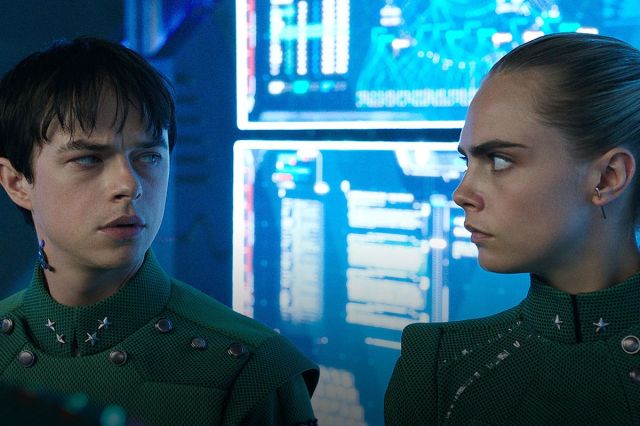
As Valerian, the interdimensional government agent, Dane DeHaan has the inviolate quality of an Ingres portrait. In a movie fraught with entropy, the intenseness of his placidity gives him presence and even a touch of eroticism. But he and Besson haven’t given Valerian’s personality much of a foundation, and his playboy-in-space persona seems like a costume that DeHaan hasn’t quite figured out how to wear. His collaborator, Laureline, played by Cara Delevingne, is more successful. Delevingne has a droll I’m-not-putting-up-with-your-shit quality that seems to grow out of her eyebrows. DeHaan teases her, propositions her; she gives him the Ginger Rogers cold shoulder, and makes him live up to her standards. As a team the pair have little in the way of authentic sizzle, and yet I found them appealing. Either I’m reflexively responding to the classic rom-com tropes, rarely employed in this era of sexual puritanism, or the appeal of the couple lies in the nimble way that Besson employs their lithe physicalities. That nimbleness is also evident in the handling of Rihanna, who makes a brief appearance as a shapeshifting dancer named Bubble. Based on the evidence of “Valerian,” Rihanna isn’t yet much of an actress, but like a lot of singers-turned-actors she’s a natural movie performer, and her vulnerability is about as appealing as her gameness, her willingness to please. Her dance routine is “Valerian” at its best: sensuous, baroque, and exotic.

Posted in Movies, Performers | Tagged , , , , , , , | 3 Comments

Naked Lady of the Week: Keeley Hazell

Fabrizio del Wrongo writes:

kh-cover

I just realized that Keeley Hazell became famous (okay, semi-famous) 12 years ago, but in my mind she’s a contemporary, even up-and-coming, figure. Fuck, I’m old.

In England a young woman can make a name for herself as a pin-up in a way she can’t in the United States. Or at least that was the case at one time.

Is The Sun’s Page 3 still a thing that millions of people pay attention to? I’m not sure. But for a while Keeley was to the ’00s what Samantha Fox was to the ’80s and Jo Guest was to the ’90s — a beautiful British woman known for getting her kit off. You can be sure she’s well remembered by an entire generation of English men.

According to Wikipedia, she was named the top Page 3 girl of all time. The same source claims she’s been trying her hand at acting, even auditioning for the movie adaptation of “Fifty Shades of Grey” on a couple of occasions. Naturally, there’s a sex tape out there. Do we still call them sex tapes even though tape’s a thing of the past? I hope so.

Nudity below. Have a great weekend.

Continue reading

Posted in Photography, Sex, The Good Life | Tagged , , , , , | 2 Comments

Naked Lady of the Week: Lisa Welch

Fabrizio del Wrongo writes:

lw-cover

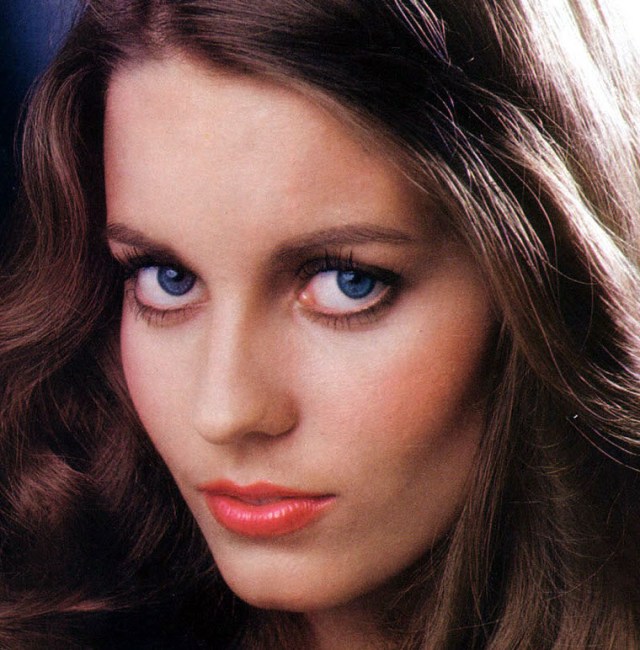
September 1980 Playmate of the Month Lisa Welch strikes me as one of the prettier Playmates of her era. She also strikes me as an almost perfect creature of Playboy — sexily bodacious, yet nonthreatening and wholesome

Looking at her photos reminds me that I often find female fashions of the late ’70s and early ’80s peculiarly erotic. The fashion-plate makeup, the blow-dried flouncy hair, even the overly explicit lighting all remind me of leafing through my mother’s catalogs as a boy and being drawn into the fascination of adult women. Some things you don’t grow out of. To the portion of my brain that registers arousal, foxy ladies look pretty much like they did in 1980. They look pretty much like Lisa Welch.

According to a bio I found on the internet, Lisa now lives on an avocado ranch in California. She and her husband probably needed a ranch to accommodate their nine children. The bigger the impact that women like this have on the gene pool, the better.

Nudity below. Have a great weekend.

Continue reading

Posted in Photography, Sex, The Good Life | Tagged , , , , | 2 Comments

Naked Lady of the Week: Elena Koshka

Fabrizio del Wrongo writes:

ek-cover

Elena’s name might lead you to believe that she is Russian. In fact, she’s from Oregon, though I’m guessing there’s some Russian in there regardless.

She’s six feet tall. I didn’t realize this until I watched one of her hardcore videos, and her male partner said, “Wow, you’re tall” just as I was thinking it. The tallness suits the dewiness communicated by her facial features and you-can-sort-of-still-see-the-baby-fat body; a hint of awkwardness naturally accompanies the physical negotiation of all that body, and this plays into her newly hatched quality. She’s both imposing and little wispy, like a giraffe.

Does she look a bit like Michelle Trachtenberg? I can’t quite decide.

Here is a video interview in which she says that the only thing she doesn’t like about the biz is getting cum in her eye.

Her Twitter is here.

Nudity below. Have a great weekend.

Continue reading

Posted in Photography, Sex, The Good Life | Tagged , , | 2 Comments

Elites and Private Virtue

Fenster writes:

Nils Gilman writes:

Perhaps the most insidious threat facing Western democracies has been the progressive decline of elite accountability and responsibility. “Today’s elite is more talented and open but lacks a self-conscious leadership code. The language of meritocracy (how to succeed) has eclipsed the language of morality (how to be virtuous),” David Brooks observed in 2012. “They have no sense that they are guardians for an institution the world depends upon; they have no consciousness of their larger social role.” This “hollow elite,” as Charles Murray called it in Coming Apart, is doubtless one element of the rise of populisms across the Western world—nor are such observations restricted to right-of-center critics.1 Poll after poll shows a collapse of ruling-class credibility, particularly among the young, and an increasing inclination to embrace strongmen who promise accountability and results.

I think all of that is true.  But why is it the case?

Gilman provides a clue in the quote he uses the open the article:

“Good government is the outcome of private virtue.”

—John Jay Chapman, Practical Agitation

Also true, I believe.

This is hardly news.  Sound government depends on virtue–something that, however nebulous, is inarguably cultural, and not political much less institutional.

We see the sentiment behind this passage in Burke’s Reflections on the Revolution in France:

The effect of liberty to individuals is that they may do what they please; we ought to see what it will please them to do, before we risk congratulations which may be soon turned into complaints.

And we see it in the exchange on the street between Benjamin Franklin and someone asking about the outcome of the Constitutional Convention:

“Well, Doctor, what have we got—a Republic or a Monarchy?”

“A Republic, if you can keep it.”

And it was a republic, not a democracy, that we got.  And that means elites, and elite rule, are all but guaranteed.  So, yes, the question of the private virtues of our elites is an important one.  And if, as Gilman suggests, our current elites are not accountable then we will have problems–indeed we will have exactly the problems we have at present.

What is the answer? Gilman would like a “self-draining swamp”.  That is, it would be wonderful in his view if elites magically adopted and held onto the proper collection of virtues.  But will they?

Our entire structure of government is based on human fallibility, the threat of faction, and the need for checks and balances.  And so we have a structure in which, among other things, the power to act (the Executive) is kept in check by the power to consider (the Legislature) and that is kept in check by the power to judge (the Judiciary).  Rock, paper, scissors.

And since a republican form of government will give rise to elites, and to a split between the elites and the people, one should ask: by what measure should the elites be held accountable?  There are elections, of course, but are elections a sufficient method for guaranteeing elite accountability?  You have only to look at the present moment to doubt that proposition.  If elites run things they can corrupt things.  Indeed, that is exactly why Gilman would argue that virtues such as restraint, honor, duty and public service are essential.

But here we get to a conundrum.  As Madison wrote, if all men were angels we would have no need for government.  That goes for everyone.  Gilman would like a “self-draining swamp”–that is, an elite with strong and permanent virtues, good for all time. But how is that possible if the members of the elite are not angels?

Gilman acknowledges the problem at the end of his article, suggesting that certain institutional mechanisms may have to be considered  that would have the effect of giving the elites a good thwack on the head.  He writes that we may wish to revive

various largely forgotten practices that republics have traditionally used to enable popular control of both economic and political elites. University of Chicago political scientist John P. McCormick, for example, has pointed to three elite-accountability institutions common in pre-18th-century popular governments: magistrate appointment procedures combining lottery and election; offices or assemblies excluding the wealthy and political incumbents from eligibility; and political trials enlisting the entire citizenry in prosecutions and appeals. If elites cannot be relied on to police themselves, and the evidence that they can is not good, then bringing new/old methods to the fore to impose such accountability may be the only option remaining.

That seems like a promising avenue.  But once again we come round to where we started:

“Good government is the outcome of private virtue.”

Yes, and that virtue is not just required of elites.  It is required of the people, too.  The keeping of the republic is not just a matter of elites reminding one another of noblesse oblige.  The most effective check on elite misbehavior will not be institutional.  The true check on elite lack of accountability are the private virtues of the people.

Thus we the people are in large measure complicit in the lack of accountability of our current elites.  If the culture is all about getting for me and the hell with you should it surprise us that the elites might behave in similar fashion?

Posted in Politics and Economics, Uncategorized | Tagged , | 9 Comments