Conrad Black, William Deresiewicz, and David Goodhart. What Manner of Coming Conflict?

Fenster writes:

Three authors have proposed a way to think about current and coming conflicts.  Conrad Black sees the conflict as between the religious instincts of the people and the secular worldview of the elite.  William Deresiewicz thinks that lurking behind today’s elite secularism is a new kind of religion, setting up the conditions for a kind of religious conflict.  And David Goodhart sees the conflict in largely secular terms.  Let’s look at each.

Continue reading

Posted in Education, Philosophy and Religion, Politics and Economics, Uncategorized | Tagged , , | 6 Comments

Movie Posters: “The Reckless Moment”

Fabrizio del Wrongo writes:

The Reckless Moment (USA)

One of the great female-centered noirs, Max Ophuls’ “The Reckless Moment,” first released in 1949, has been ill-treated by whatever multinational entertainment conglomerate owns its video rights. Some 20 years after the dawn of modern video formats it has yet to appear in the United States on either DVD or Blu-Ray. Maybe it’s streaming somewhere?

The U.S. one-sheet issued to advertise the movie, seen above, has pretty explicit emphases. It tells us the plot involves letters and an ambiguous James Mason. The spotlight motif dominates; presumably there’s a risk (or maybe a hope?) of discovery or revelation. Though it’s not the most inspiring design, it adequately represents the movie.

The Reckless Moment (USA)

This independently produced poster would have been available to theater owners seeking something punchier than the studio-issued poster seen at the top of the page. It treats the movie’s woman’s-picture aspects more explicitly; it also foregrounds the sensational nature of the scandal at the heart of the narrative. It’s clear from the text that the Bennett character has entered, or allowed herself to fall into, an unwholesome arrangement. The familiar spotlight element is referenced by the shadows cast by the principals’ heads, but the circular emphasis of the design is now indebted to a whirlpool-like graphic that threatens to overtake the figures. It’s indelicate, but also hard to ignore.

The Reckless Moment (French)

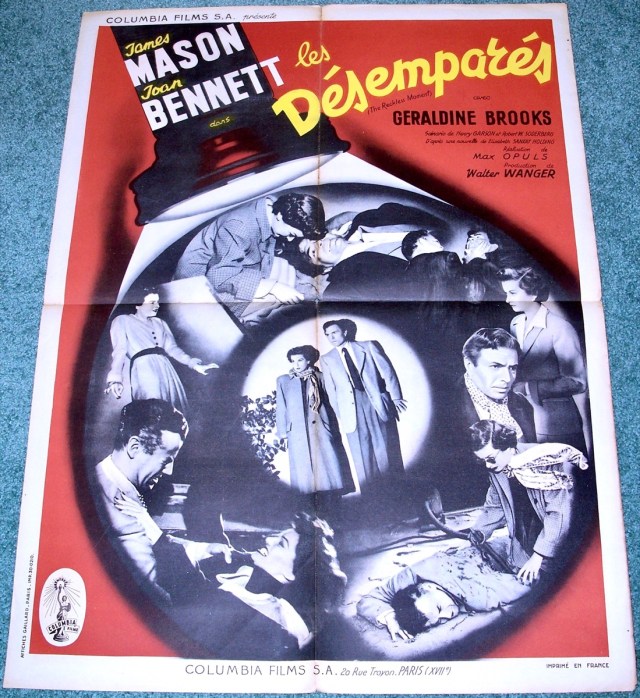
This French poster takes the spotlight motif as its organizing principle, though a whirlpool is also suggested via the photographic reproductions swirling around the central image of Mason and Bennett. I think it’s more clever than successful. My initial impression is one of confusion. That light discovers too much; there isn’t enough mystery.

The Reckless Moment (France)

This larger French poster is, I think, much more successful. It should be — it was designed by one of the great French poster artists, René Péron. Péron manages to synthesize the spotlight and whirlpool motifs without drawing undue attention to either. The focus remains firmly on the figures and the enigmatic turbulence engulfing them. Bennett’s scarf, which both connects her to Mason and strangles her, is a great touch; so are the crisply modeled hands. The poster was created using the quasi-lost art of stone lithography, and it has the velvety depth and richness unique to products of that craft. It’s a great example of technique contributing to meaning: the composition wouldn’t have its peculiarly immersive effect had it been produced using offset printing.

The Reckless Moment (Italy)

Despite my affection for the Péron design, I have a hard time placing it above this Italian interpretation by Alfredo Capitani. Along with Anselmo Ballester and Luigi Martinati, Capitani was among the Big Three of Italian movie illustration. Where French poster artists of the ’40s tended to work in a printmaking mode, the Italian poster, having transitioned to offset printing, was very much a forum for painters. A painterly emphasis on realistic detail and abrupt tonal transitions dominates this composition. So does the characteristic Italian focus on sexualized menace. Where in the other posters we’ve examined Mason tends to look either stoic or wilted, Capitani’s Mason is positively tumescent. That ever-present spotlight doesn’t shine on him, it emanates from him, and Bennett is awed by it; it seems to take all her might just to maintain some measure of composure.

Posted in Commercial art, Movies | Tagged , , , , , , , , , | Leave a comment

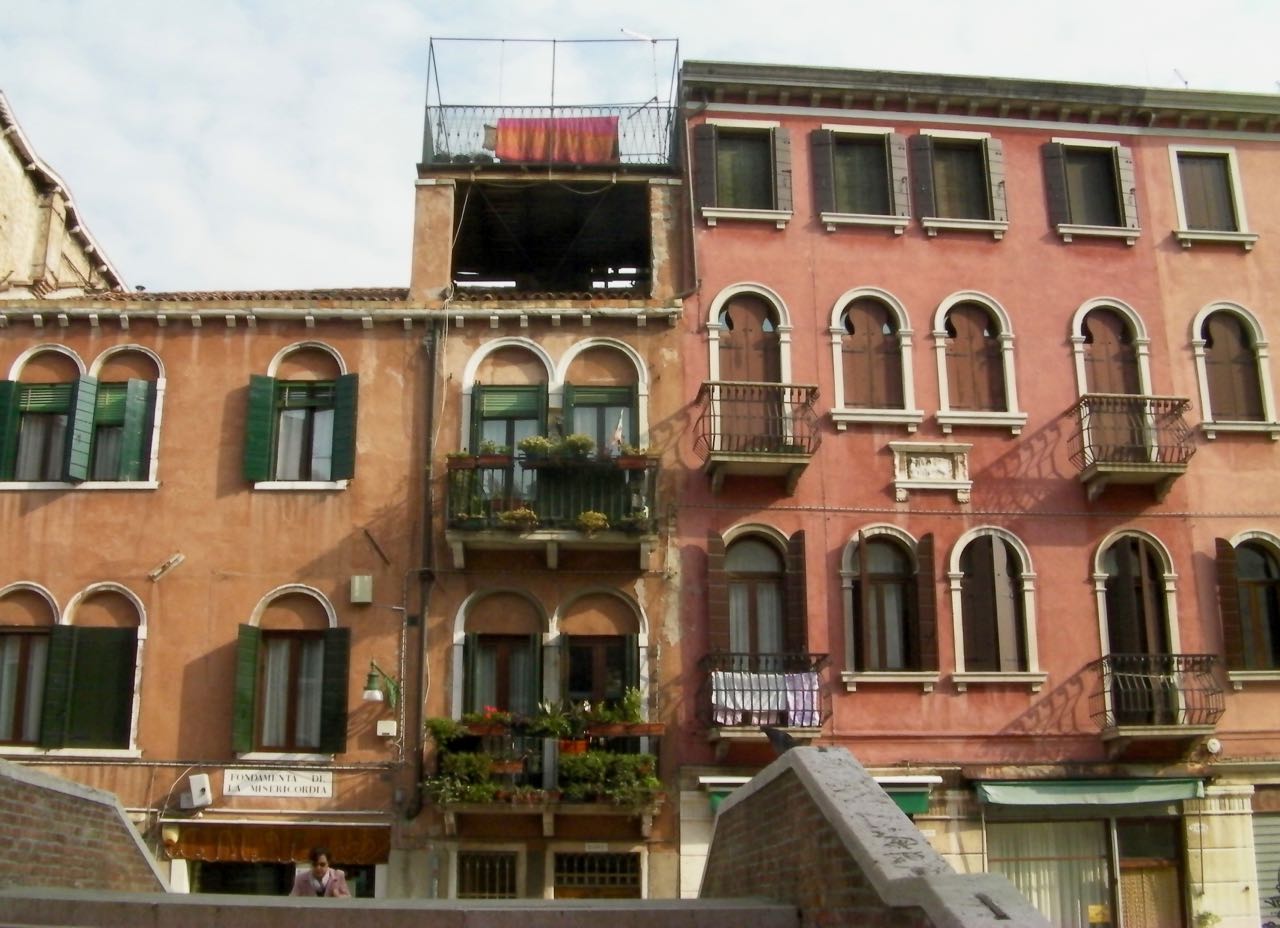
Architecture and Color

Paleo Retiree writes:

Posted in Architecture | Tagged | Leave a comment

Naked Lady of the Week: Lauren Hurley

Fabrizio del Wrongo writes:

lh-cover

Where does one draw the line between cute and sexy? Or does such a line even exist? British model Lauren Hurley strikes me as being endowed with a sexiness that’s inseparable from the the trappings of cuteness. When she smiles, her slightly wonky teeth make her look something like a naughty chipmunk. Naughtiness is probably essential to her charm. She conjures thoughts of torpid afternoons after school in the gymnasium locker room or your best friend’s carpeted basement. And despite her youth and freckled smoothness, there’s a glint in her eye that suggests that whatever you’ve been thinking she was thinking it first. She’s wholesomely uninnocent.

I don’t find much information about her online. She seems to have stopped modelling in the ’00s.

Nudity below. Have a great weekend.

Continue reading

Posted in Photography, Sex, The Good Life | Tagged , , , | 1 Comment

Is the Hysteria About Putin and Trump Finally Tapering Off?

Paleo Retiree writes:

Back in the ’80s and early ’90s, I was one of about six people in the U.S. who were skeptical of what were known as the day-care sex-abuse scandals. Short version: for a number of years, prosecutors and mainstream publications were selling the notion that Satanic ritual abuse was occurring in many of the nation’s day-care facilities. Yup, you read that right. As ludicrous as it may seem today, at the time many of the country’s trusted authority figures were assuring us that young children in a large number of America’s day-care centers were regularly being forced to eat shit, participate in orgies, drink blood and endure being sodomized with crosses.

What was maybe even more amazing was that the great mass of people in the country accepted these tales and allegations. They found them reasonable and believable. Take it from someone who was transfixed and horrifed by the spectacle: protests against these horror-movie scenarios were few and far between. Acceptance of the assertions and allegations was more than widespread, it was essentially unanimous.

Eventually, after numerous expensive trials, investigations and appeals, after lots of accusees spent years in jail, and after mucho heroic work was done by some lone-wolf journalists (the standout, in my view, was Debbie Nathan), the insanity came to an end. None of the abuse had happened. There weren’t hidden caverns and corridors underneath our day-care centers. Animals hadn’t been slaughtered. Child porn hadn’t been produced. The kids whose testimony the whole episode had relied on — the mantra of the day was “Believe the children!” — had been coaxed into inventing fantasies to please bad therapists and ambitious prosecutors. Not a single conviction from those years has held up on appeal or on closer examination. It was all a witch hunt, a moral panic, and a mass hallucination — quite (IMHO) the equal of the legendary Salem witch craziness of the late 1600s.

During the last few months I’ve often been reminded of the day-care sex-abuse episode by the “Trump is Putin’s puppet/together they stole the election” hysteria. Can so many of my bright and lovely lib/Dem friends really believe that — god only knows when and where and how — Vladimir Putin made Donald Trump his bitch, and that together they stole the election from Hillary? On what basis? Relying on what evidence? Doesn’t it mean anything to them that, in the hundreds of articles that have ominously purveyed this fantasy and during the many months the hysteria has lasted, not a single piece of damning concrete evidence has yet turned up?

And when did Russia become the ultimate bad guy in the eyes of lib/Dems anyway? It must have happened very recently, because in 2012 Obama mocked Romney for characterizing Russia as America’s “number one geopolitical foe.” Obama’s response: “The 1980s are now calling to ask for their foreign policy back because … the Cold War’s been over for 20 years.” Dems cheered Obama’s witticism then. What changed since?

I’ve been amazed by how long the hysteria has remained at fever pitch, and I’ve been provoking the ire of lib/Dem friends on Facebook by arguing that the Putin/Trump/election-stealing story seems, to put it mildly, most unlikely. Interesting psychological discovery: people really don’t like being told that they’re acting hysterical, that they’re being used as useful fools by cynical power-driven assholes, and that they might want to calm down and return to reality. Who knew?

But maybe the Putin/Trump/stealing-the-election mania is now finally dying down. I could be wrong, but there have been some encouraging signs.

  • Glenn Greenwald: “Millions of partisan soldiers [are] absolutely convinced of a Trump/Russia conspiracy for which, at least as of now, there is no evidence.”
  • Matt Taibbi: “If there’s any truth to the notion that the Trump campaign colluded with the Russian state to disrupt the electoral process, then yes, what we’re seeing now are the early outlines of a Watergate-style scandal that could topple a presidency. But it could also be true that both the Democratic Party and many leading media outlets are making a dangerous gamble, betting their professional and political capital on the promise of future disclosures that may not come.”
  • Justin Raimondo: “As I’ve been saying for months, there is no evidence that the Russians hacked the DNC: zilch, nada. Yet this false narrative is the entire basis of a campaign launched by the Democrats, hailed by the Trump-hating media, and fully endorsed by the FBI and the CIA, the purpose of which is to “prove” that Trump is “Putin’s puppet,” as Hillary Clinton put it.”

Greenwald and Taibbi are two of our era’s great investigative journalists while Raimondo is a clear-headed, tough-minded peacenik. By no stretch of anyone’s imagination can they be considered pro-Trump hacks.

So it’s possible that, where an episode of national hysteria goes, I’ve been right once again. Whoopee!  (Incidentally, I don’t often get these things right, so when I do I like to crow a bit about it.) Given that I’ve had precisely zero access to background information and inside dope, how to account for my awesomeness where judging this episode goes? To cut to the chase: it’s been (mostly) common sense.

First, a little boilerplate: It may be that tomorrow will bring convincing proof of collusion between Putin and Trump. Gotta remain open to that possibility. Also, like any other grownup, I take it for granted that the major powers are constantly trying to mess with each others’ internal politics. Does Russia get up to no good? Sure, but so do we … and neither one of those facts means that Putin made Trump his bitch and together they stole the election from Hillary.

So, on to my awesomeness.

  • Common sense reason #1 Which seems more likely — that a worldwide conspiracy of supervillains suddenly erupted out of nowhere, or that the Dems are having a hard time accepting that they lost the election fair and square and are coming up with just about any reason they can not to have to look in the mirror and re-evaluate their policies and their pitch?
  • Common sense reason #2 Dozens of bright, tough investigators and journalists have been trying to dig up damning evidence on Putin/Trump for months now. Why have we seen so little in the way of concrete results? It’s occurred to me more than once that if the same hordes of researchers were to ransack my life they’d turn up more suspicious Russia connections than they’ve yet revealed about Trump. One of my great grandparents lived in Russia … And one of my boarding-school classmates wound up working for the CIA … Obviously I’m guilty of treason.
  • Common sense reason #3 Look at the sources. My lib/Dem friends have been relying heavily on the NYTimes, the WashPost, and The New Yorker. They seem to feel that these still-prestigious publications are delivering the objective truth. And since the NYTimes, the WashPost and The New Yorker have all been in agreement, there must be something to the story. Really, that seems to be their thinking: since everyone they read is saying the same thing, it must be true. Er, earth to news-and-politics fans: the Times, the WashPost, and The New Yorker aren’t what they used to be. The Times is downsizing, is desperate for clicks, is deeply committed to multiculturalism, and is partly owned by the Mexican gazillionaire Carlos Slim, an open-borders nut. The WashPost is now owned by Amazon’s Jeff Bezos, another open-borders nut, and has become so transparently partisan that it’s often referred to by the irreverent as “the Bezos Blog.” And The New Yorker has been run for quite a while as a propaganda outlet for the Obama/Hillary Dems by editor-in-chief David Remnick, the author of a hagiographic biography of Obama. Good work, smart people and trustworthy facts still show up in these publications, of course. But can we please stop pretending that these outlets are the dignified, cautious, “objective” news sources they were in 1970?

(Incidentally, and fwiw: I’ve been quite startled by the response I get from my smart lib/Dem friends when I point these current-journalism-biz facts out. They don’t just frown; they go into despair. “Well, who are we to trust then?” they wail. I had no idea my lib/Dem friends were desperate for a small collection of outlets that can give them the One Big  Truth of things. Have they really had such a hard time adapting to the new, freewheeling, everybody’s-got-an-angle media world? I rather like it myself, and — let’s face it — the old world isn’t coming back any time soon. So how to deal with the new media realities? My tips: take it for granted that every outlet is partisan. Read widely, and from many different sources. Compare notes with pundits and friends who have different viewpoints than your own. Reflect on your own experience of the world, then make up your own damn mind. And be prepared to adjust your picture of the world when better information turns up.)

  • Common sense reason #4 Look at the language in the articles that are purveying the Putin/Trump/stealing-the-election story. Here’s where I don’t mind puffing myself up a little bit. I worked for a couple of decades as a researcher and reporter; I sat with other researchers and reporters as well as with editors and lawyers going over hundreds of pieces, deciding what we could legitimately say and what we couldn’t legitimately say. So I’m also familiar with the games journalism outlets play when they’re dying to assert something but they don’t have the evidence they really need to do so clearly and explicitly. And the Putin-Trump-election articles have been constructed of almost nothing but these games. They’re massively short on concrete specifics and chock full of weasel words, unnamed sources and insinuations.

A tip to my lib/Dem friends: There are plenty of reasons to do battle with Donald Trump, but maybe the “Trump-is-Putin’s puppet and together they stole the election from Hillary” tale isn’t one of the better ones.

Which brings me to something I’m finding myself more and more curious about. As the day-care sexual-abuse hysteria finally died down in the ’90s, I often found myself wondering: The country has lived through a kind of psychotic break. How are people going to deal with it? Will there be any kind of reckoning? How many people will one day sit down and think, “You know, I believed what turns out to have been a completely fake story. What can I learn from this experience?” These days, at least if I’m right and the Putin-Trump hysteria is indeed now calming down, I’m curious about similar questions: How are the lib/Dems (my friends, the politicians, the media) going to deal with the evaporation of a narrative they’ve been hysterically attached to for a number of months? Will they ever admit they were wrong? Will they allow themselves to learn from their mistake? Or will they excuse their naiveté and wrongheadedness because, in the battle against Hitler/Trump, everything’s allowed and forgivable?

Related

Posted in Politics and Economics | Tagged , , | 16 Comments

Art Du Jour

Blowhard, Esq. writes:

Posted in Art, Humor | Tagged , | Leave a comment

Architecture and Color

Paleo Retiree writes:

Posted in Architecture | Tagged | Leave a comment

It’s Man’s Things That Really Define Him

Fabrizio del Wrongo writes:

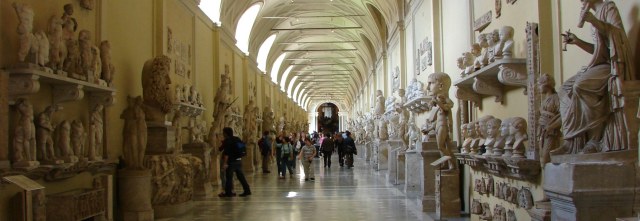
Vatican.Museums

Now, all at once, with his mind at ease, the professor’s stomach began to feel great pangs of hunger. And suddenly he remembered other ravenous flashes, especially those colossal appetites that man falls prey to after nights of well-requited love. Those distant passions were nothing but vague sensations now, recalled without regret. But the meals that had followed in their wake — improvised meals for two, consumed on this very spot — still stood out in his memory, sharp and clear. Great, flat slices of country bread, dark-smoked ham from up the mountain, dried goat cheese from the village, olives from the terraced groves, apricots from the garden, steeped in sunlight, and that wine from the rocky slopes, just a little too tart. It was all still there in the house, all right within reach: the bread, in the cupboard with the cross carved into its lid; the olives, in a stoneware pot; the ham, hanging from the beams in the kitchen; the wine and cheese, outside, under the stairs, like rows of books lined up on dimly lit shelves … In no time at all it was set out, spread over the massive table. For a moment the cork in the bottle held fast. When it finally let go, with a sharp little pop, the familiar sound filled the room with a kind of sensual joy. And it occurred to the old professor that once again, tonight, he was celebrating an act of love.

He poured himself some wine, one hearty glass for his thirst, then one for his pleasure, smacking his lips with a touch of ostentation at the obvious excess. He cut up the ham into fine, thin slices, arranged them neatly on a pewter plate, put out a few olives, laid the cheese on a bed of grape leaves and the fruit on a large, flat basket. Then he sat down before his supper and smiled a contented smile. He was in love. And like any successful suitor, he found himself face to face now with the one he loved, alone. Yet tonight that one was no woman, no living creature at all, but a myriad kindred images formed into a kind of projection of his own inner being. Like that silver fork, for example, with the well-worn prongs, and some maternal ancestor’s initials, now rubbed almost smooth. A curious object, really, when you think that the Western World invented it for propriety’s sake, though a third of the human race still grubs up its food with its fingers. And the crystal, always set out in a row of four, so utterly useless. Well, why not? Why do without glasses, like boors? Why stop setting them out, simply because the Brazilian backwood was dying of thirst, or because India was gulping down typhus with every swallow of muck from its dried-up wells? Let the cuckolds come pound at the door with their threats of revenge. There’s no sharing in love. The rest of the world can go hang. They don’t even exist. So what if those thousands were all on the march, cuckolded out of the pleasures of life? All the better! … And so, the professor set out the four glasses, lined them up in a row. Then he moved the lamp a little to give more light, and they sparkled like stars. Further over, a rustic chest, huge and immovable. Three centuries, father to son, as the young man said, and so sure of it all. And in that chest such an endless store of tablecloths and napkins, of pillow slips and sheets, of dustcloths and fine linen, product of another age, linen that would last forever, in great thick piles, so tightly packed on the outside alone that he never had to use the other household treasures hidden behind them, all lavender-scented, that his mother, or hers, had stacked away so very long ago, never parting with a stitch for their poor until it was worn out and decently patched, but with lots of good use in it yet, convinced — dear, prudent souls that they were — that unbridled charity is, after all, a sin against oneself. Then, after a while, there were too many poor. Altogether too many. Folk you didn’t even know. Not even from here. Just nameless people. Swarming all over. And so terribly clever! Spreading through cities, and houses, and homes. Worming their way by the thousands, in thousands of foolproof ways. Through the slits in your mailboxes, begging for help, with their frightful pictures bursting from envelopes day after day, claiming their due in the name of some organization or other. Slithering in. Through newspapers, radio, churches, through this faction or that, until they were all around you, wherever you looked. Whole countries full, bristling with poignant appeals, pleas that seemed more like threats, and not begging now for linen, but for checks to their account. And in time it got worse. Soon you saw them on television, hordes of them, churning up, dying by the thousands, and nameless butchery became a feature, a continuous show, with its masters of ceremonies and its full-time hucksters. The poor had overrun the earth. Self-reproach was the order of the day; happiness, a sign of decadence. Any pleasure? Beneath discussion. Even in Monsieur Calgues’s own village, if you did try to give some good linen away, they would just think you were being condescending. No, charity couldn’t allay your guilt. It could only make you feel meaner and more ashamed. And so, on that day he remembered so well, the professor had shut up his cupboards and chests, his cellar and larder, closed them once and for all to the outside world. The very same day that the last pope had sold out the Vatican. Treasures, library, paintings, frescoes, tiara, furniture, statues — yes, the pontiff had sold it all, as Christendom cheered, and the most high-strung among them, caught up in the contagion, had wondered if they shouldn’t go do likewise, and turn into paupers as well. Useless heroics in the eternal scheme of things. He had thrown it all into a bottomless pit: it didn’t take care of so much as the rural budget of Pakistan for a single year! Morally, he had only proved how rich he really was, like some maharaja dispossessed by official decree. The Third World was quick to throw it up to him, and in no time at all he had fallen from grace. From that moment on, His Holiness had rattled around in a shabby, deserted palace, stripped to the walls by his own design. And he died, at length, in his empty chambers, in a plain iron bed, between a kitchen table and three wicker chairs, like any simple priest from the outskirts of town. Too bad, no crucifixion on demand before an assembled throng. The new pope had been elected at about the time Monsieur Calgues retired. One man, wistfully taking his
place on the Vatican’s throne of straw. The other one, back in his village to stay, with only one thought: to enjoy to the fullest his earthly possessions, here in the setting that suited him best … So thank God for the tender ham, and the fragrant bread, and the lightly chilled wine! And let’s drink to the bygone world, and to those who can still feel at home in it all!

While the old man sat there, eating and drinking, savoring swallow after swallow, he set his eyes wandering over the spacious room. A time-consuming task, since his glance stopped to linger on everything it touched, and since every confrontation was a new act of love. Now and then his eyes would fill with tears, but they were tears of joy. Each object in this house proclaimed the dignity of those who had lived here — their discretion, their propriety, their reserve, their taste for those solid traditions that one generation can pass on to the next, so long as it still takes pride in itself. And the old man’s soul was in everything, too. In the fine old bindings, the rustic benches, the Virgin carved in wood, the big cane chairs, the hexagonal tiles, the beams in the ceiling, the ivory crucifix with its sprig of dried boxwood, and a hundred other things as well … It’s man’s things that really define him, far more than the play of ideas; which is why the Western World had come to lose its self-respect, and why it was clogging the highways at that very moment, fleeing north in droves, no doubt vaguely aware that it was already doomed, done in by its over-secretion, as it were, of ugly monstrosities no longer worth defending.

— Jean Raspail, as translated by Norman Shapiro

Posted in Books Publishing and Writing, Food and health, Philosophy and Religion, Politics and Economics, The Good Life | Tagged , | 2 Comments

Naked Lady of the Week: Meggan Mallone

Fabrizio del Wrongo writes:

mm-cover

Texan Meggan Malone, who looks a bit like Denise Richards, claims to be part Cherokee. I guess I buy it. She looks more Cherokee than Elizabeth Warren, anyway. Reportedly, the rest of her is Irish and German. Presumably the Irish part accounts for those smoldering green eyes.

She did a lot of amateur-style softcore stuff in the ’00s, then moved into the world of hardcore porn, picking up a pair of fake boobs in the process. I haven’t seen any of her sex videos, but her photographic work shows that she’s quite a talented model. Her impish personality and adventurousness rarely fail to shine through.

An official-looking website can be found here.

Nudity below. Have a fab weekend.

Continue reading

Posted in Photography, Sex, The Good Life | Tagged , , | 1 Comment

Curation: “Rhythm of the Rain”

Paleo Retiree writes:

I always think of the song as “Listen to the Rhythm of the Pouring Rain,” and it’s one that, ever since it was released in 1962, has never failed to cast a little spell on me. Thanks to the miracle that is YouTube I’ve been able to enjoy a lot of different versions of it. Here are my faves.

The original, by The Cascades (a band that named itself after a brand of dishwashing detergent), is in a bland, whitebread-heartbreak mode that I often find irresistible. OK some part of me flat-out identifies with it. Plus: those bells!

Hey, I love a lot of Ricky Nelson’s music too. It seems that part of me will remain a 12 year old mid-American white boy forever.

I’ve also returned many times to the mellow funk and smooth Technicolor masculinity of the Ka’au Crater Boys:

But my fave version of the song is unquestionably this charmer by the Vietnamese-American performer Trish Trang:

The robotic-porn choreography, the adorably cheesy concept and costumes, the genuinely snappy synth bassline and Trish’s demure facial expressions — such a foxy, seductive contrast to the hard and overbright expressions we’re used to in American showbiz — send my brain into a seriously happy whirl. And I find those inanely-funky instrumental breaks a blissful sugar high. Evidently it isn’t just the Japanese who can be geniuses at crossing sexy and cute.

Related

  • I didn’t manage to get hooked by the other Trish Trang performances that I explored, but Trish is unquestionably a pop-music force and talent, so why not sample some of her work for yourself?
  • Cascades member John Gummoe wrote the song. Who’d have predicted that it would last as long as it has? Here’s his website.
  • I enjoyed a live show by the Hawaiian group Hapa.
  • I dug up and passed along a couple of topflight performances by the legendarily erratic Van Morrison.
Posted in Music | Tagged , , , , | 1 Comment