The Gezornenplat House

Fenster writes:

German architect Reinhold Weichlbauer practices freestyle planning, which is based on the idea that, in the words of an HGTV segment profiling one of his houses, “windows and doors are only placed at certain places in the house because humans are creatures of habit.”

Now, it is not necessarily silly to say silly things if such statements, say, promote one’s professional career.  So one cheer for Reinhold for his chutzpah, and if he got some commissions from this. But of course it is silly to truly assert that what we do is “only” a matter of habit.  If one accepts that then a randomized solution is, if you will, the only way out.  And that is indeed Weichlbauer’s solution.

So Weichlbauer places design elements into a randomizing program and–voila–a house with a random assortment of design elements, doors leading nowhere, stairways as gangplanks.  We need, of course, to be challenged.

The most that can be said for this is that if an infinite number of monkeys on an infinite number of typerwriters will eventually produce all the Great Books that sooner or later Weichlbauer and his infinite clone army of architects will produce a masterpiece.  As it is he has fashioned a gezornenplat house.

Posted in Architecture | 2 Comments

The Shock of the Old, when New

Fenster writes:

I am second generation German and third generation Swedish but I grew up in New England in the Fifties and Sixties so it was inevitable that I would have a third identity, just below the level of the conscious, as English.  The German and Swedish sides had no problem co-existing–Nana’s sauerbraten on Sunday but potato sausage and herring on Christmas.  The English side fit in well too, even if at the level of the conscious I knew the genes weren’t there.

Of course I hadn’t yet read Albion’s Seed and I was unaware of the many ways long dead Yankees had a hold on my values, habits and tastes.  All that stuff does run well below the surface.  But even above the surface there was a strong collective tilt towards Albion.  Boston was long gone as the Athens of America by mid-century but you couldn’t tell that to my ancient English teachers, all in their 70s or 80s.  For them, John Greenleaf Whittier might still be living down the street.

I liked this cultural framework well enough most of the time.  It did, however, give off an antiquarian odor that, while interesting enough in 1962 was beginning to show real signs of wear by the late Sixties.  This was the Age of Aquarius, of course, and to be young was very heaven on weekends.  When we said goodbye to the old it all too often meant goodbye to our Yankee past.

In 1967, though, I came across an album of Charles Ives’ choral music and that got me thinking.

61J07oYQ16L._SS500_

Ives (1874-1954) was the quintessential quirky Yankee: by day a mild-mannered insurance agent in Danbury, Connecticut but freed of those professional shackles a pioneer in the composition of music with challenging harmonies and time signatures.  I came across his work in music appreciation and found it oddly compelling.

I was always a sucker for the ripest of the late Romantic composers, like Richard Strauss, and could never stomach the rapid shift to atonalism that so quickly followed.  Yet there was something curiously old fashioned and new fashioned at the same time with Ives, with his madcap blending of upright Yankee hymnals, summer bandstand music and patriotic tunes, all stirred together in several keys and time signatures simultaneously.

The Ives choral music got to me right away.  For one, the recording was ambitous.  The Columbia Chamber Orchestra plus the Gregg Smith Singers plus the Texas Boys Choir plus the Ithaca College Concert Choir.  Enough instruments and voices to shake the rafters, and the rafters they shake.  The music can go from ppp to fff in a heartbeat and it is wise, if your system can handle it, to crank up the sound to get the most from the ppp and to have the fff blow things up.

As a diehard, narrow-minded and callow Aquarian I pretty much thought my generation had a monopoly on cultural criticism, especially of the modern world.  Imagine my surprise when I came across Ives’ The New River.

Down the river comes a noise!

It is not the voice of rolling waters.

It’s only the sound of man,

phonographs and gasoline,

dancing halls and tambourine,

human beings gone machine;

Killed is the blare of the hunting horn.

The River Gods are gone.

Here is one of the album’s highlights: Three Harvest Home Chorales.

I spent more hours than I liked singing hymns in a white Congregational Church in the center of the town where I grew up and generally found hymnals uninteresting.  These three can make my hair stand on end–bits of Lygeti and Sweeney Todd waft in and out, and you are left with a clear impression of a God who not only inspires awe but is also kinda scary.

As far as I know this is still only on vinyl and has not been digitized and sent to YouTube until the versions I just posted, which are included here.  It’s a UR exclusive!

Posted in Music | 1 Comment

Art Du Jour

Blowhard, Esq. writes:

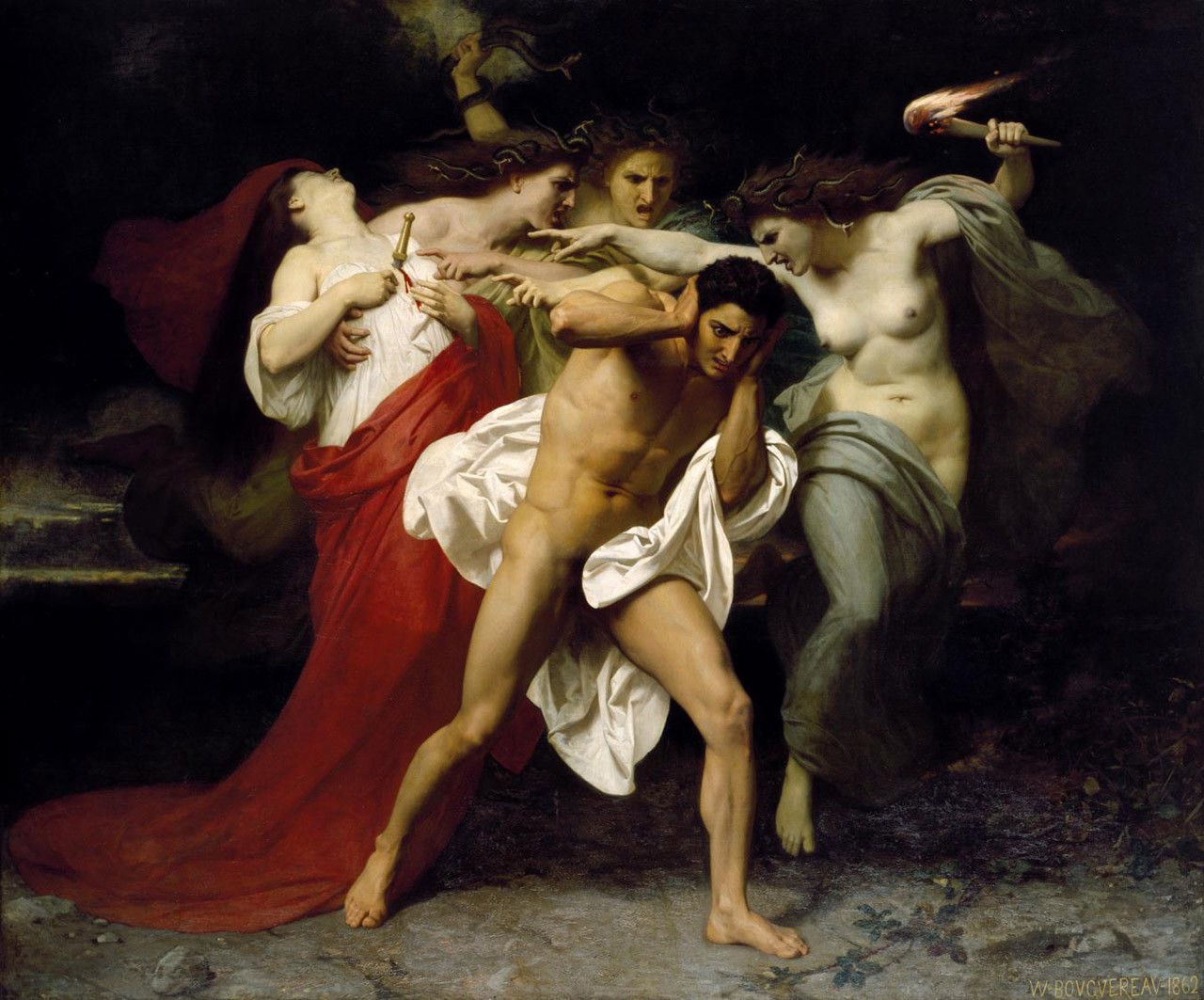
bouguereau-orestes-furies

Adolphe William Bouguereau, “Orestes Pursued by the Furies,” 1862.

An interesting quote:

Bouguereau was the grand master of the French art establishment and set the bar for those painters who aspired to commercial success in the second half of the 19th century. Critics, however, dismissed this painting for its heavy, melodramatic tone. “I soon found that the horrible, the frenzied, the heroic does not pay,” Bouguereau lamented after showing the work at the 1863 Paris Salon.

Click on the image to enlarge.

Posted in Art | Tagged , , , , , | 7 Comments

Naked Lady of the Week: Mia Khalifa

Blowhard, Esq. writes:

mkcover

Like all right-thinking people, we here at UR are big believers in Diversity™. Models featured in past installments have hailed from all over the world including Russia, eastern Ukraine, western Ukraine, northern Ukraine, and southern Ukraine. Therefore, it is with immense pride that we bestow this week’s honor on our first Arab model, Mia Khalifa. (At least I think she’s our first Arab, I’m not about to check the archives. And even though she was raised Catholic, being born in Lebanon is enough to make you Arab, right?)

Ms. Khalifa vaulted to the top of the porn world this year when she traded on her Middle Eastern looks by starring in a hardcore video wearing a hijab. Apparently, some folk out there don’t take too kindly to a young lass performing various amorous arts while clothed in a traditional Muslim headdress meant to preserve one’s modesty. The prudes. Speaking of dogmatism, I’m usually not a fan of enhanced tits, but I’ve been sufficiently indoctrinated in Diversity™ to know that exceptions must be made to every rule. Khalifa seems to have taken to wearing glasses to soften those fierce eyebrows, but I say own ’em, girl.

Nudity below the jump and lots of hardcore action at the tube sites. Happy Friday.

Continue reading →

Posted in Sex | Tagged , , , | Leave a comment

Architecture Du Jour

Blowhard, Esq. writes:

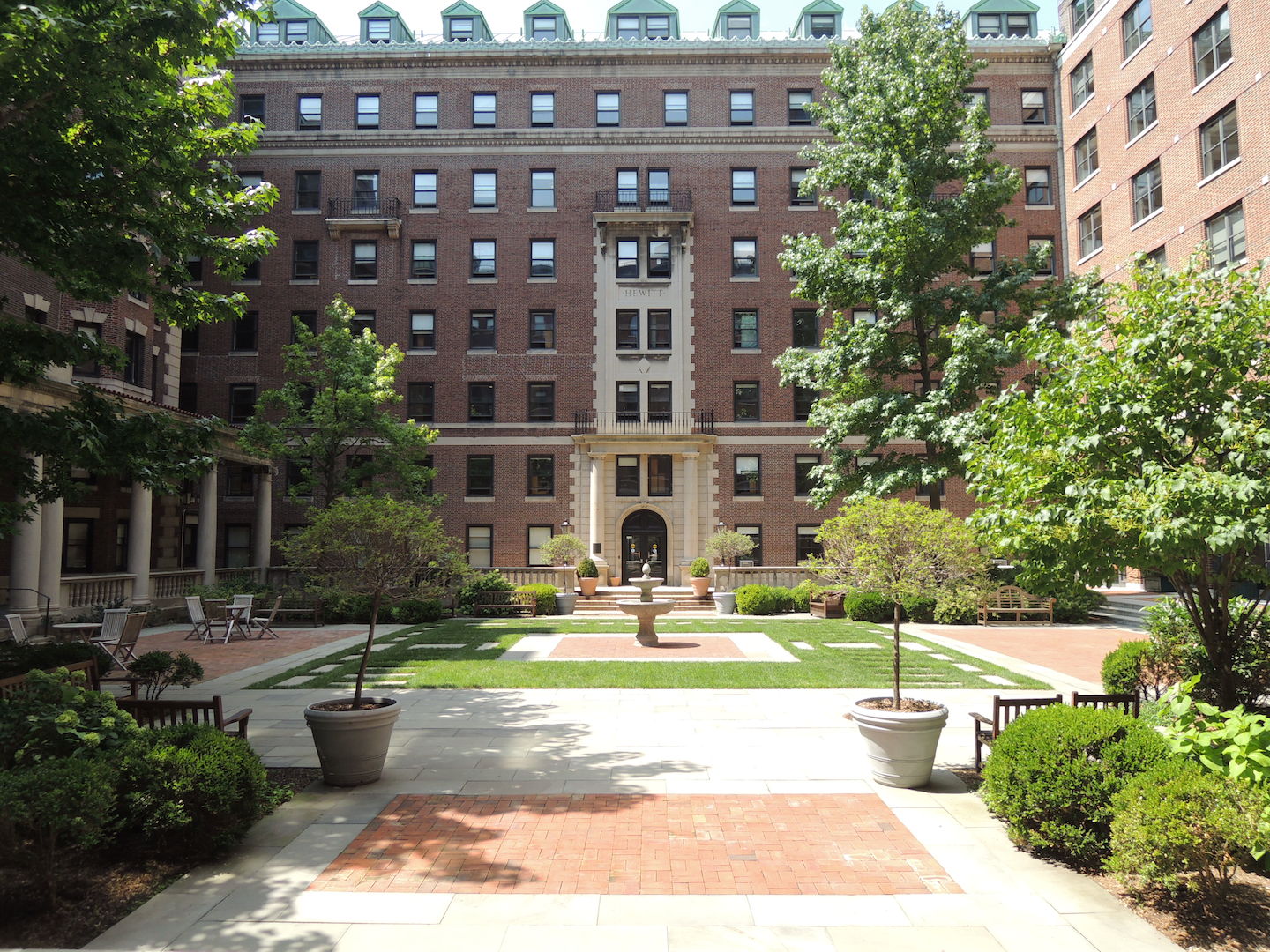
barnard1 barnard2

A courtyard I stumbled across at Barnard College, on Broadway across the street from Columbia University.

Click on the images to enlarge.

Posted in Architecture | Tagged , , , | 2 Comments

Ideas So Stupid Only An Intellectual Would Believe Them, A Continuing Series

Blowhard, Esq. writes:

Via this essay, time to add another entry to my Enemies List — David Shields:

These books made David Shields’s “Reality Hunger” (2010) seem prescient. An earnest “manifesto” against the traditional novel (which Shields finds “unbelievably predictable, tired, contrived, and essentially purposeless”), “Reality Hunger” galvanized many critics and novelists alike. Shields argued that novels are often flashes of “narrative legerdemain”; he calls for “serious writing,” in which “the armature of overt drama is dispensed with, and we’re left with a deeper drama, the real drama: an active human consciousness trying to figure out how he or she has solved or not solved being alive.” He particularly prizes the lyric essay, which forsakes plot and character entirely.

If aspects of “Reality Hunger” were familiar, refrains on old arguments (in fact much of the book consists of direct quotations from other books), Shields’s points are worth considering again, both because he is laudably serious about what literature ought to aim for and because his ideas about the novel are so firmly entrenched in contemporary literary culture. Shields’s belief that the traditional novel is dated and that the way forward—aesthetically, if not commercially—lies in non-novels or at least non-traditional novels now represents the fashionable position in the literary world.

“[A]n active human consciousness trying to figure out how he or she has solved or not solved being alive” — what the hell does that even mean? Like representation in painting, ornamentation and comfort in architecture, plot and character in novels, or melody in music, for at least 100 years intellectuals have been at war with the basic pleasures people look for in art.

Posted in Art, Books Publishing and Writing | Tagged , , , , | 13 Comments

Architects That Don’t Suck: David M. Schwarz

Blowhard, Esq. writes:

In this first installment of Architects That Don’t Suck, I’d like to highlight the work of Washington D.C.-based architect David M. Schwarz. Hey, whaddya know — not all contempo architects specialize in gleaming modernist geegaws. Some builders out there actually respect context, history, and beauty all while subsuming their ego to the larger needs of the project. I dig the variety of styles, colors, and materials Schwarz uses. Kudos also to the developers who had the sense to commission these works.

Related

Posted in Architecture | Tagged , , , , | 1 Comment

9/11 Memorial Visit: Calatrava’s Transportation Hub & the Memorial Pools

Blowhard, Esq. writes:

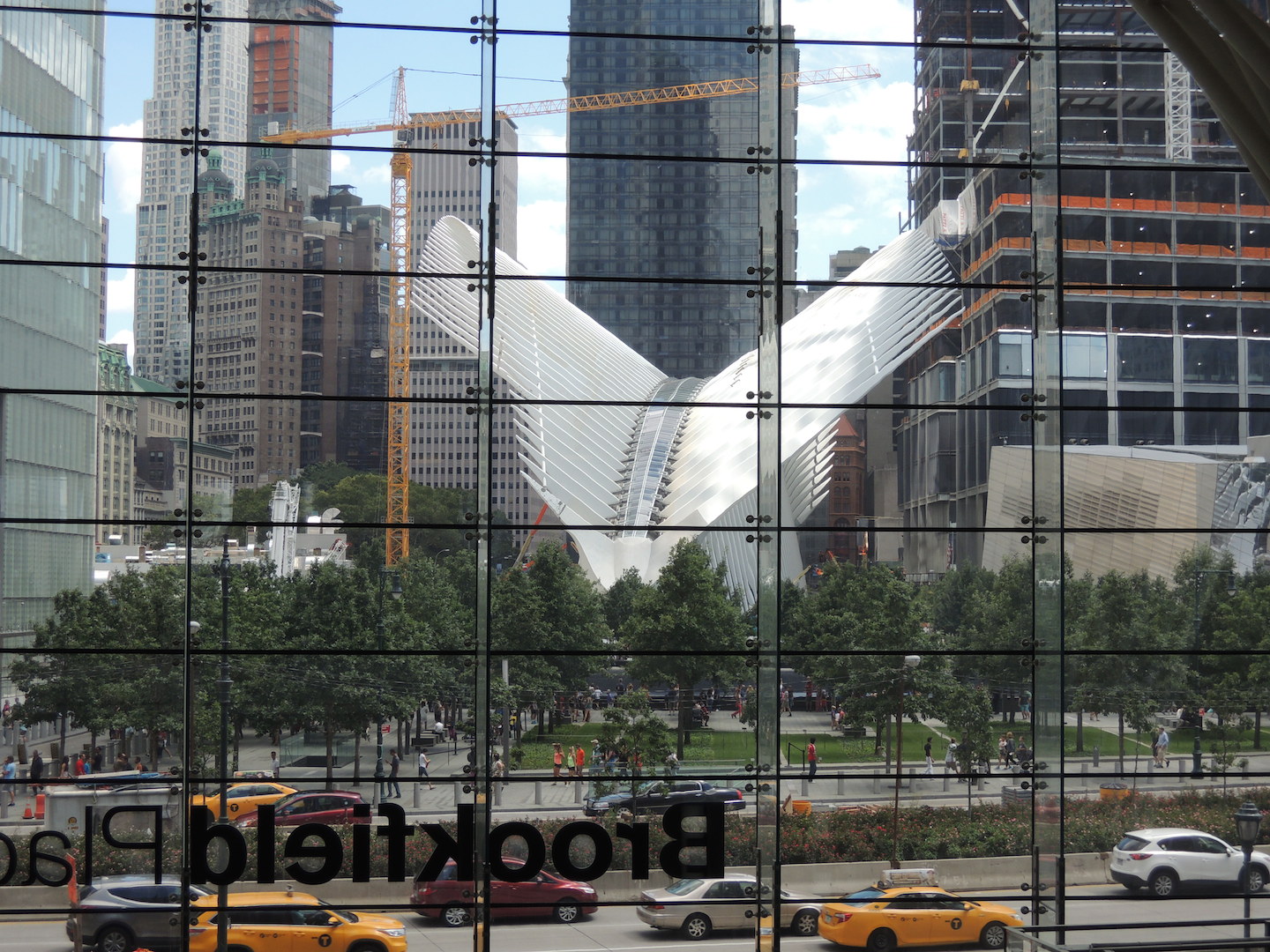
In part one of our 9/11 Memorial Visit, Paleo Retiree did an excellent job analyzing the disaster that is the park. In my tour I’d like to focus on the two main set pieces of the area: Santiago Calatrava’s still-in-progress Transportation Hub and the Memorial Pools. What do the monuments convey? How do they fit into the surrounding urban fabric? First, let’s take a look at the Calatrava. We started at Brookfield Place — a tony mall with a very good food court. It’s supposed to recall a dove taking flight but the way it’s oriented makes it look like bony mosquito trying to suck on those trees.

calatravahubcover

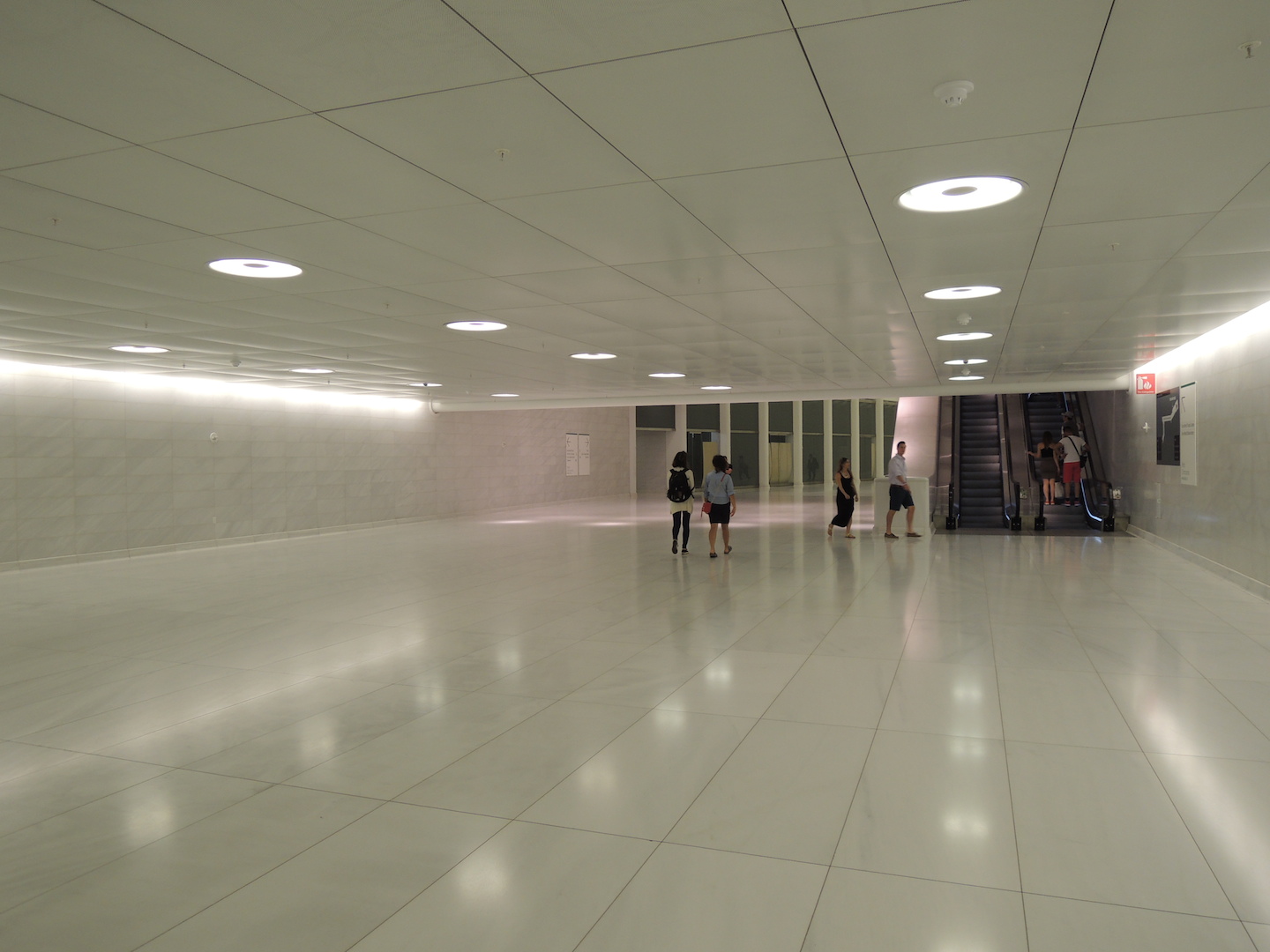
The only interior portion designed by Calatrava that’s currently finished is the underground concourse that connects Brookfield Place to the PATH trains. The actual interior the transport hub above is still under construction, but we’ll get to that in a moment. After descending an escalator we arrived in the gleaming white concourse that looks like something out of THX 1138.
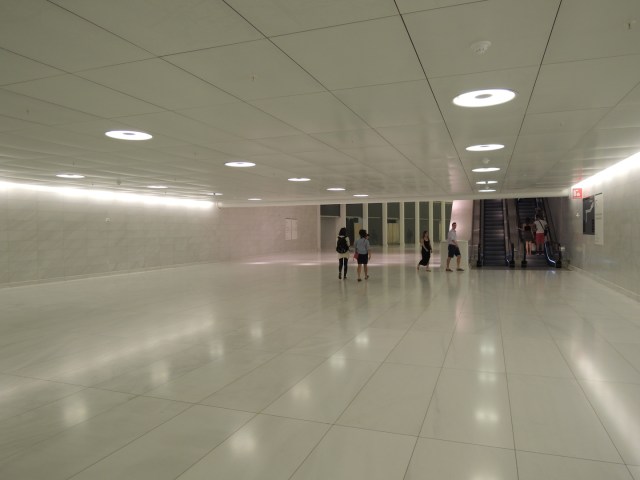
concourse1

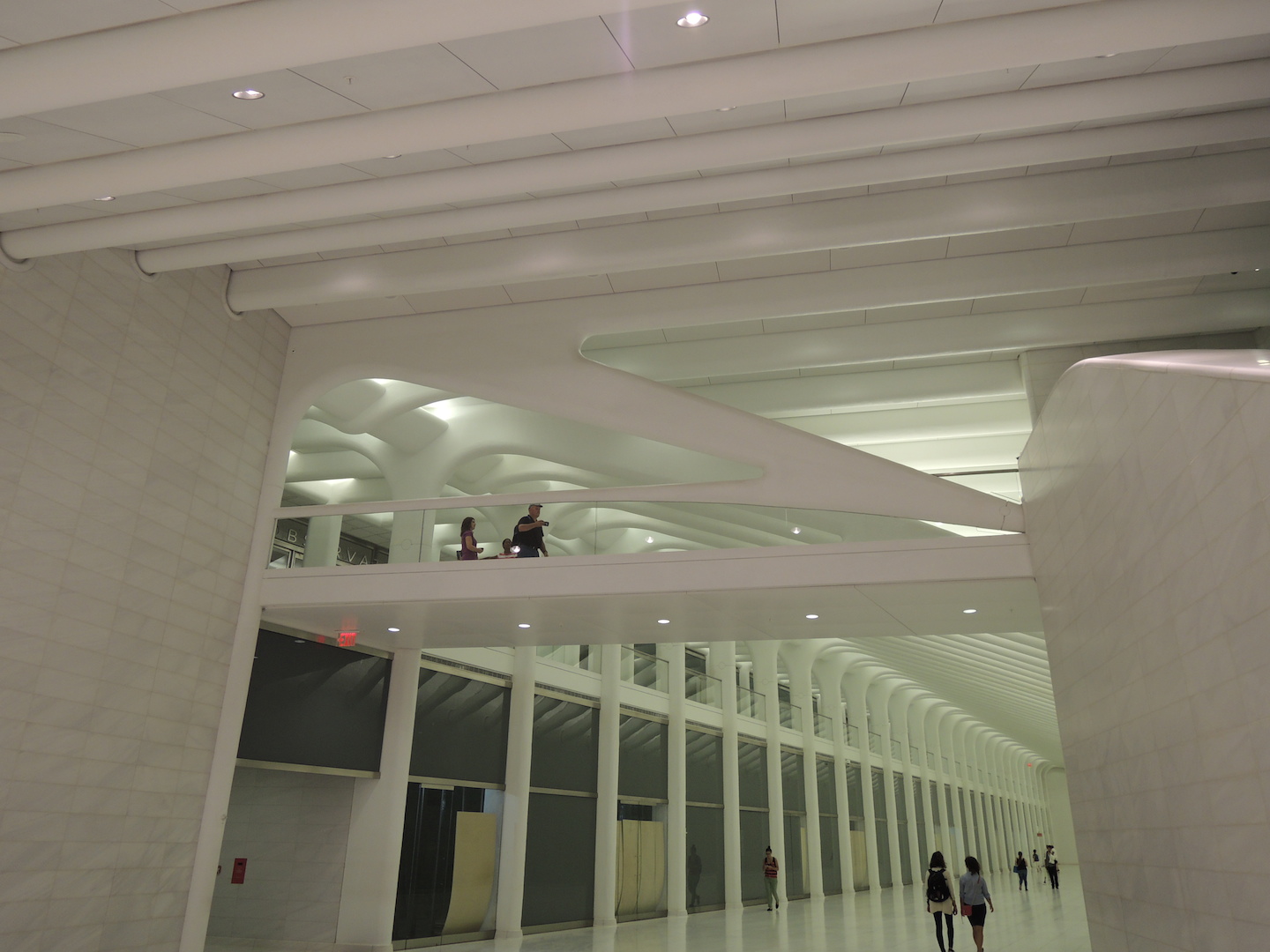
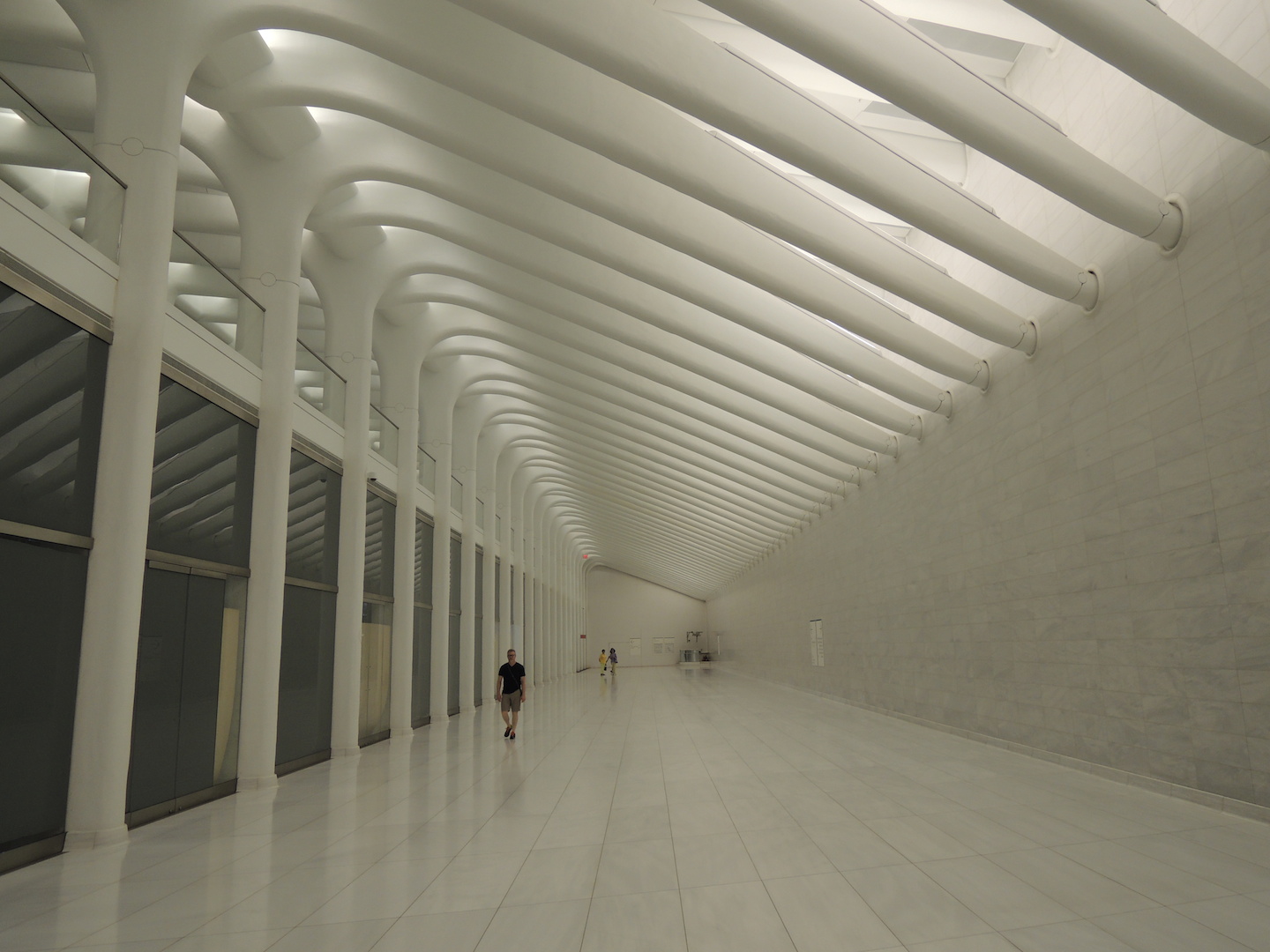
The ceiling is low here, but a few more feet ahead and the space opens up.
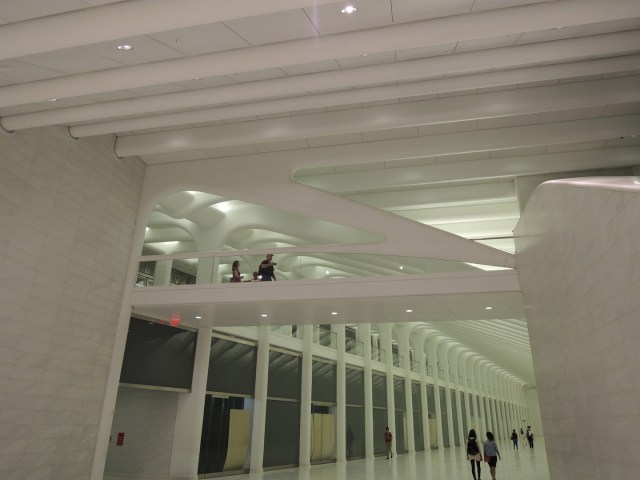
concourse2

Calatrava sure digs those curving white spires, doesn’t he? The ribbing on the left reminds me of the exposed spinal column on a rotisserie chicken.
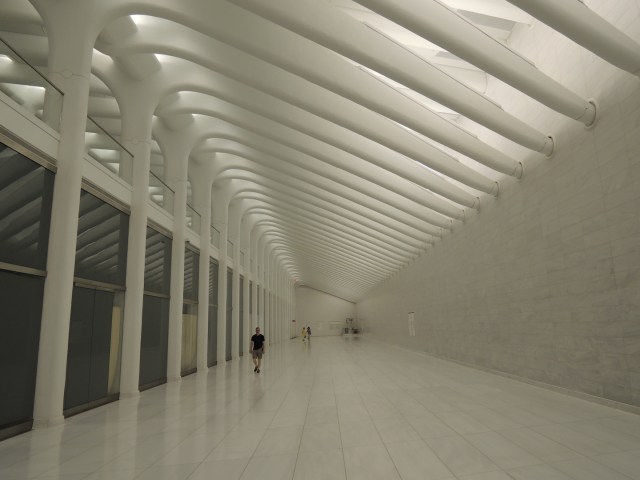
concourse3

I’m guessing the upper balcony on the left will be the scene of a lot of high-class fashion magazine and music video shoots (assuming they still make music videos), but after you admire the impressive engineering there isn’t much else for the imagination to latch on to. Here are some more details from the space from different angles. All these communicate to me are “white,” “swoopy,” and “structural.”

After this space you make your way through some construction areas before emerging into the PATH train station. Then we made our way up an escalator and around some construction barriers to see the transport hub up close.
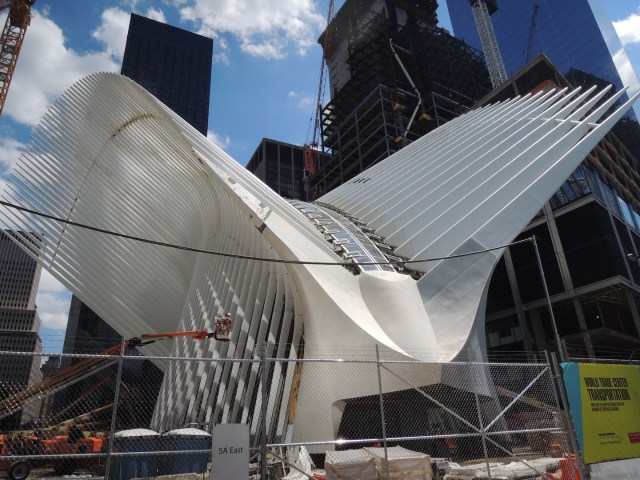
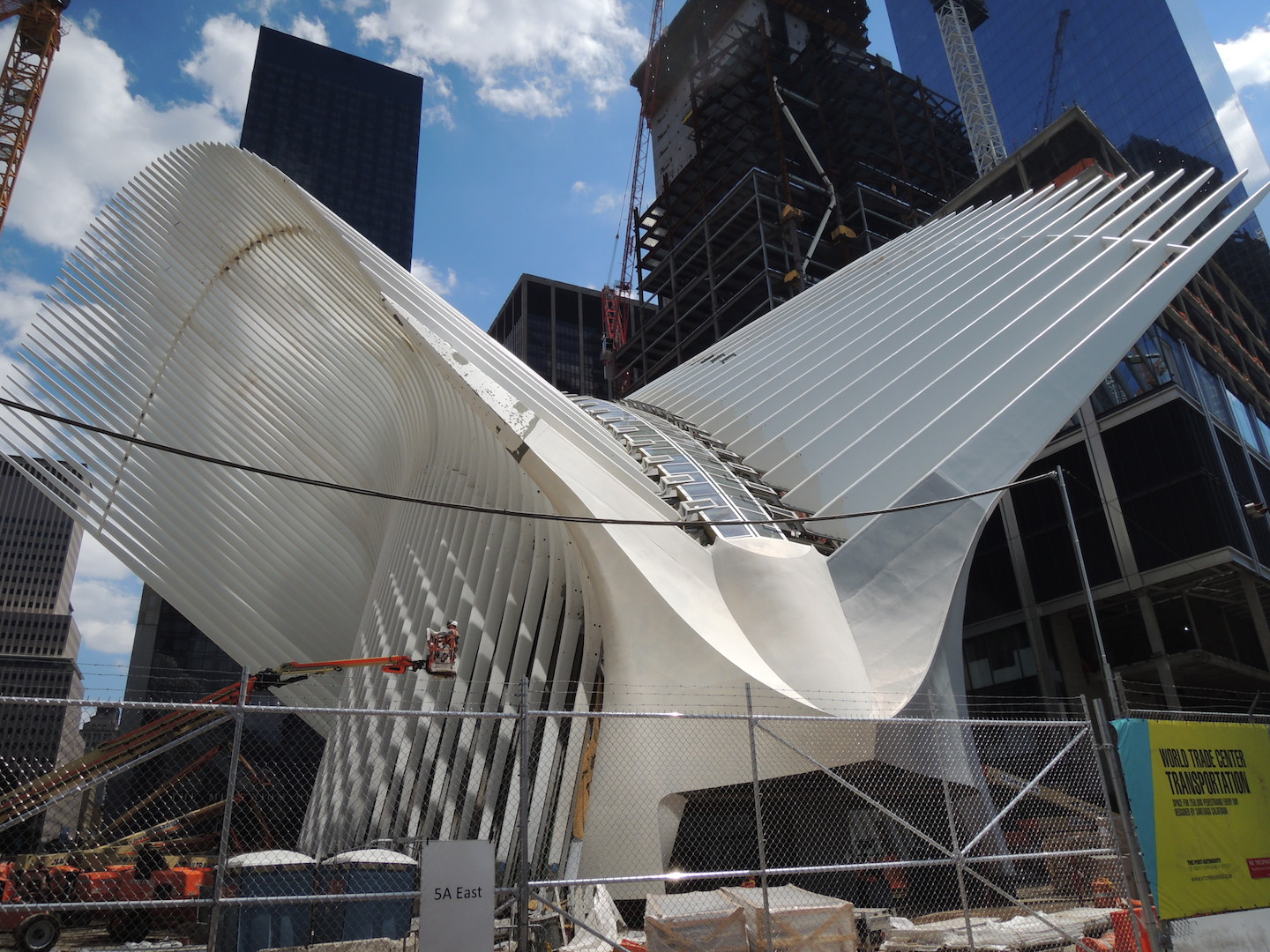
calatravahub1

Good Lord, what an appalling thing. Even up close it reads “skeletal insect” to me. Again, what’s with the excessive whiteness? And what’s so special about swoopy-doopiness? Does this have anything to do with New York? Couldn’t you just as easily transpose this to London, Dubai, Beijing, or Tokyo? Keep in mind, this is essentially a railway station, but it has more in common with corporate public art than architecture as it’s traditionally been understood. For the sake of comparison — to consider the opportunity cost — let’s look at the two most beloved railway stations in New York’s history, the Grand Central Terminal and the old Penn Station:
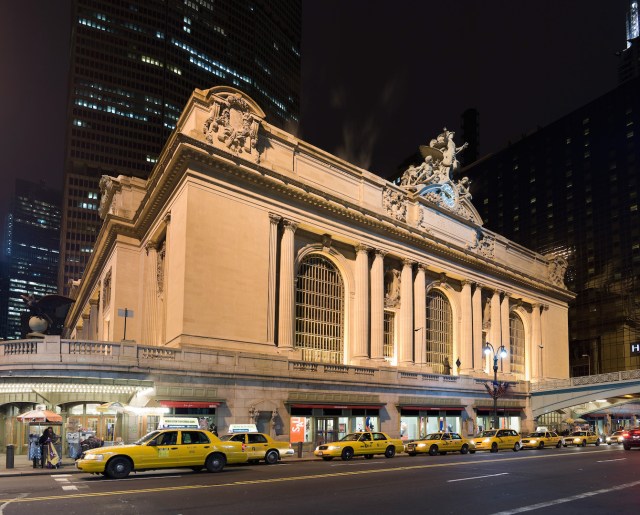
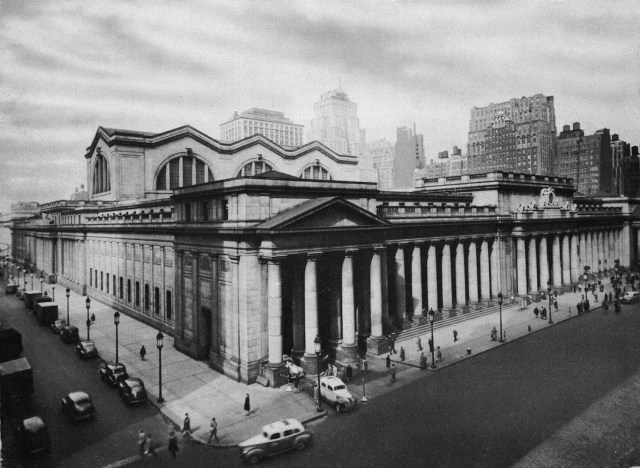
Grand_Central_NightPenn Station

Below is the area that will eventually be the main entrance to the Transport Hub.

calatravahub2

It looks like the wing is going to brush up against that building. From this angle I couldn’t help but think of one of the jets slamming into the towers.

calatravahub3

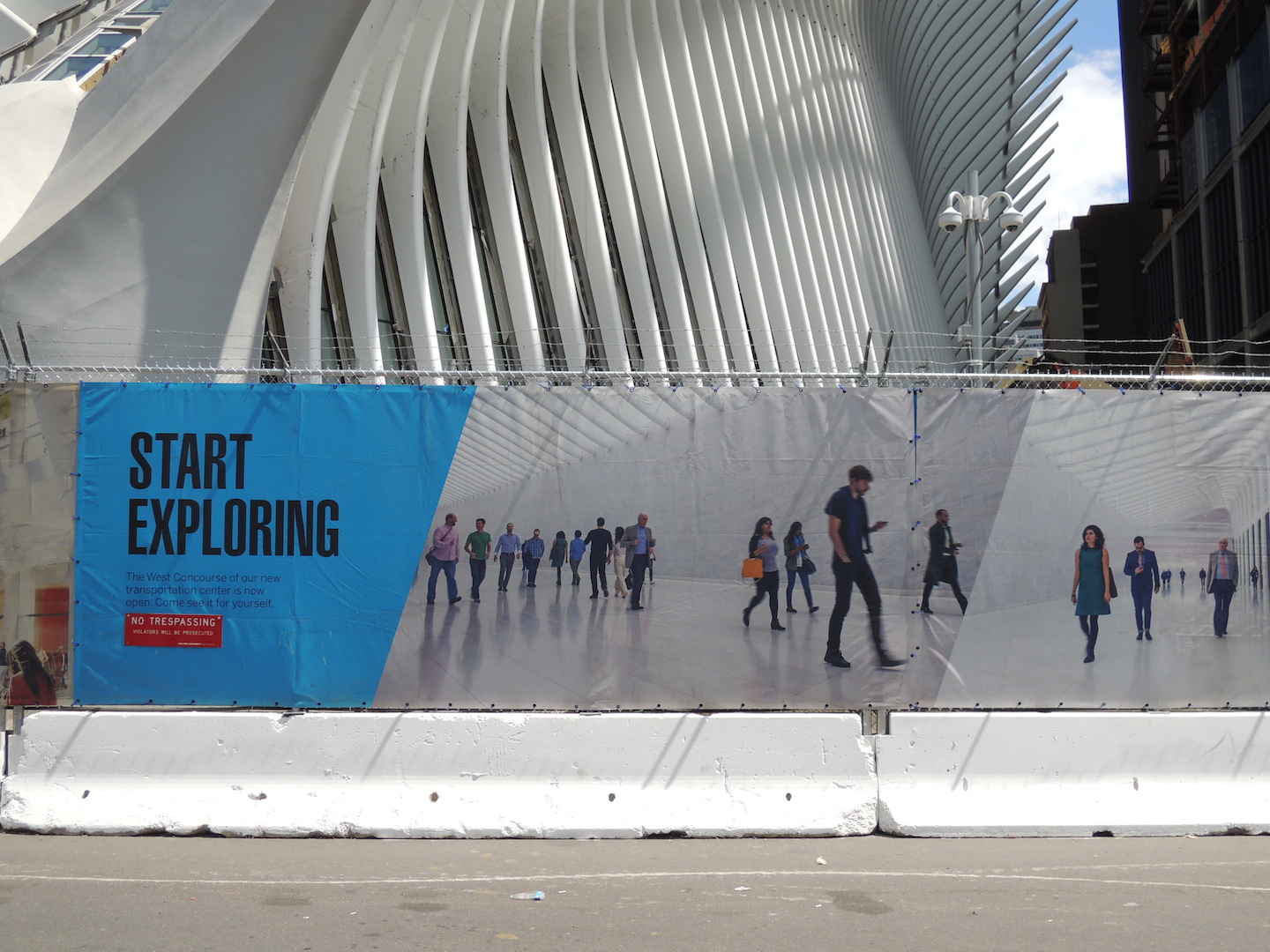
Notice how in this “Start Exploring” banner, which is a reference to the concourse above, everyone seems to be rushing through it or looking at their phone.
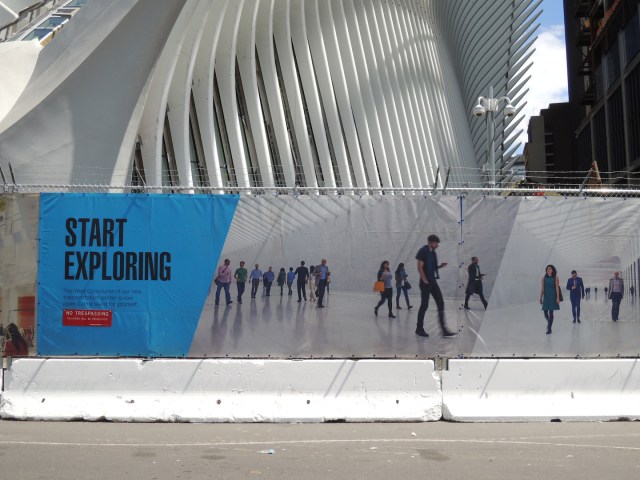
calatravahub4

No surprise to learn that, for all the awesomeness, the showpiece space will eventually be retail — in other words, a flashy shopping mall. In this New York magazine piece, during which Calatrava is likened to both Stanley Kubrick and God, our starchitect proudly notes the space he reserved for a new Apple Store. Grand Central Terminal, which this project’s fans and sponsors like to compare the Transport Hub to, while it may have retail space, didn’t originate as a shopping mall. Here is what the interior will eventually look like.
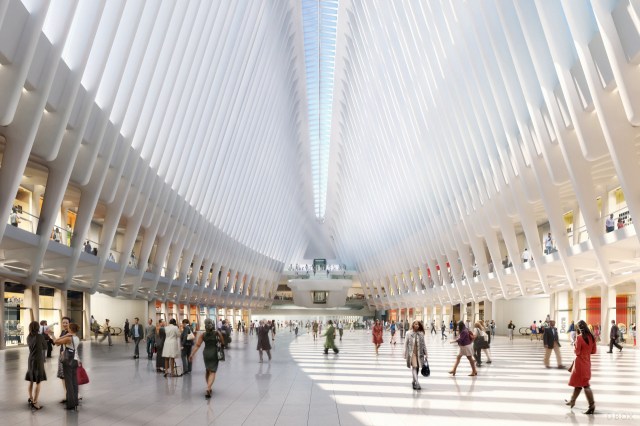
Next, across the street from the Calatrava, there’s the 9/11 Memorial Park and Memorial Pools. In a comment on his post, Paleo Retiree said that he found the Pools to be “grotesque, vulgar and maudlin” to which I’ll add “morbid, undignified and unintentionally insulting.” They reminded me of the lachrymose outpouring after the death of Princess Diana. I understand that it’s supposed to symbolize hope and rebirth, but all of that plunging water reminded me of the towers falling or the people who jumped. And why on Earth is everything falling into a black abyss? These are not Memorial Pools, they’re Memorial Drains. It’s like everything is being flushed down two enormous toilets.

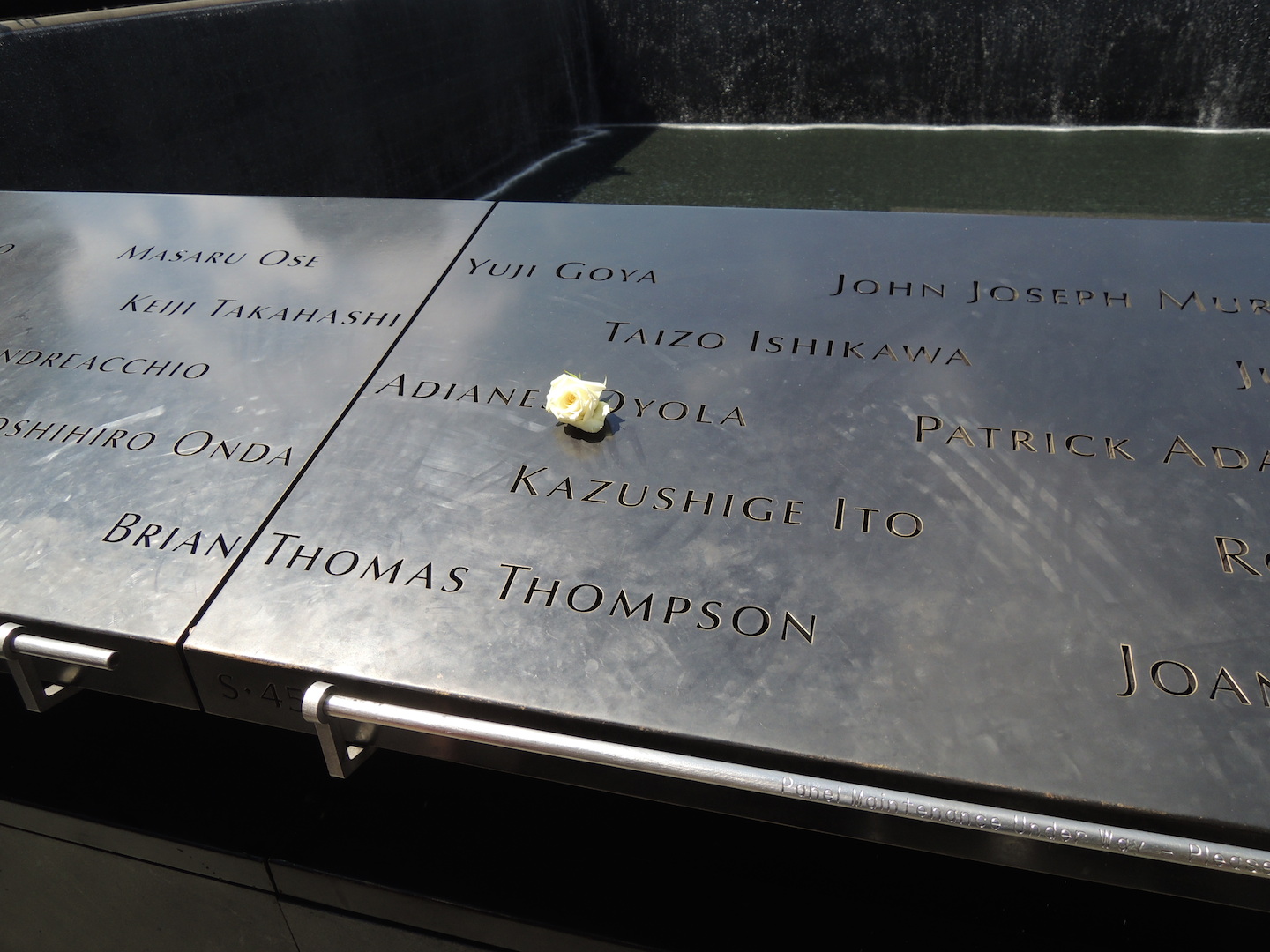
It was a big event, and a big tragedy, but when you recall that the Vietnam War Memorial or the WWII memorial in D.C. are tiny by comparison, it all seems wildly excessive. No disrespect meant to the victims or their families, of course. In a nod to Maya Lin’s Vietnam Memorial (Lin was also on the 9/11 Memorial Jury), the victims’ names are listed on the parapets around the Drains, er, Pools.
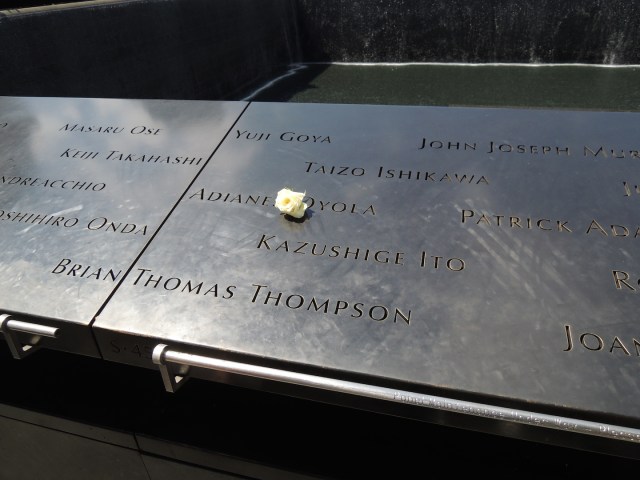
wtcvictims

Turning the two tower footprints into massive fountains, er, Drains, er Pools is the kind of concept that sounds great on paper, and perhaps even looked good in the mock-ups, but is a disaster when executed. Situating them in a plaza without any shape or sense of space, across from a sculptural $4 billion boondoggle-cum-glorified mall, and surrounding them with blinding glass towers all strike me as massive architectural mistakes that will take the city decades to recover from.

But hey, what do I know? The emotional pull of the area might be sufficient in the minds of the public to turn this Memorial Park into one of the most beloved spaces in the city.

Related

Posted in Architecture, Travel | Tagged , , | 6 Comments

9/11 Memorial Visit: The Crap Space Angle

Paleo Retiree writes:

Blowhard, Esq. and I recently spent a few sunny hours exploring the 9/11 Memorial in lower Manhattan. We weren’t interested in touring the museum, so (aside from rolling our eyes at its fashionably toppled-over exterior form) we skipped it. What we intended to experience were mainly two things: Santiago Calatrava’s World Trade Center Transportation Hub, the site’s architectural showpiece; and the memorials themselves, reflecting pool/waterfalls (destruction! renewal!) that have been created within the footprints of the destroyed towers. The Calatrava and the holes are both worth making some remarks about, but what I found myself most struck by was the park itself. (Officially, it isn’t a park, it’s a plaza.)

Blowhard, Esq. will post his reactions to (and thoughts about) the Calatrava and the holes soon. Today, I’m going to treat myself to some rants, observations and jokes about the park, er, plaza, which encompasses the superblock that the Twin Towers stood in. In a word: it struck me as a stellar example of Crap Space. The handy-dandy lesson here is that Crap Spaces — my pet term for dead urban spaces — don’t have to be just leftover stray things that no one gave any thought to; they can be hyper-designed, hyper-intentional creations too.

Continue reading →

Posted in Architecture | Tagged , , , , , , , , , | 34 Comments
More on Triggers

Fenster writes:

I wrote about campus trigger warnings here.  The subject has staying power, fascinatin’ some, amusing others, outraging even more and bringing out the inner hero in all too many.

There’s that article in The Atlantic by psychologist Jonathan Haidt and Greg Lukianoff, head of the campus free speech group FIRE.  They argue that sheltering kids from things they find scary is bad for their health and should be opposed on those grounds.

It is interesting, though I am not sure if it is wise, that the admirable Lukianoff has looked to diversify his free speech argument–usually argued on principle alone–by pushing it into the realm of science, leaning on cognitive whiz Haidt to frame the issue in scientific terms.

Maybe, though I am always leery in these slippery, value-laden areas of the social sciences to lean too hard on science.  There was also that recent piece in Vice that told us, lo these many millennia, that parenting is not good for you.  Who knew?  But so says SCIENCE!

Maybe Haidt is right.  An argument on science, though, is unlikely to win the day, except for some overly intellectualized readers of The Atlantic.

Now comes Megan McArdle, another writer I tend to agree with most of the time.  She is correctly skeptical of the trigger phenomenon but adds a fillip that might take the argument in a different direction.

While sympathetic with the Lukianoff/Haidt “bad for your health” take, her argument takes up the issue of the shifting goals of higher education.  You probably know the argument: in the good old days colleges built character and now they are all about getting a job.  And that nowadays students are just consumers.

OK, maybe it was never so idyllic in the good old days but McCardle is doubtless correct when she writes that “cultural and economic shifts have pushed students toward behaving more like consumers in a straight commercial transaction, and less like people who were being inducted into a non-market institution.”

So they are looking as much for an enjoyable experience–on their terms, as consumers–than they are for enrichment, or character-building.  Consumption not “induction”.  And that that is not good, somehow.

That as well seems right to me.  But what do I know?  Question your instincts.

Haidt is one of those smarty-pants (like his pals Danny Kahneman and Steven Pinker) who knows full well that our first instincts are not always to be trusted.  So maybe we should question the consensus that colleges are “supposed to” accomplish high-minded things.  Who says?

Beware that word “supposed”, or at least try to remember to pinch yourself when you hear it.  Here is how McCardle herself employs it:

A university education is supposed to accomplish two things: expose you to a wide variety of ideas and help you navigate through them; and turn you into an adult, which is to say, someone who can cope with people, and ideas, they don’t like.

That thinking just trips right off the tongue, don’t it?  Fun to read, fun to say, fun to think.

But perhaps, to use a term that has itself jumped the shark, a consumer experience in one’s college years is not a bug but a feature.  After all, as McCardle herself notes:

Mass education, and the rise of colleges as labor market gatekeepers, have transformed colleges from a place to be imbued with the intangible qualities of character and education that the elite wanted their children to have, and into a place where you go to buy a ticket to a good job.

We need critical thinkers in our culture for sure.  But how many?  Perhaps it is the very mass quality that McCardle points to that in an odd way legitimizes the consumer orientation of most (not all) higher education.  Maybe we need to train more people to be consumers than we do critical thinkers.  Maybe the development of higher education along consumer/credential lines is not an error but an adaptive strategy.

Posted in Education | Leave a comment