
Blowhard, Esq. writes:
A few weeks ago, inspired by the book Buildings Without Architects, I put together a number posts about vernacular architecture. That book was no doubt inspired by another, Bernard Rudofsky’s Architecture Without Architects. Have any of you read it? I have but it was years ago, so last weekend I took another look.
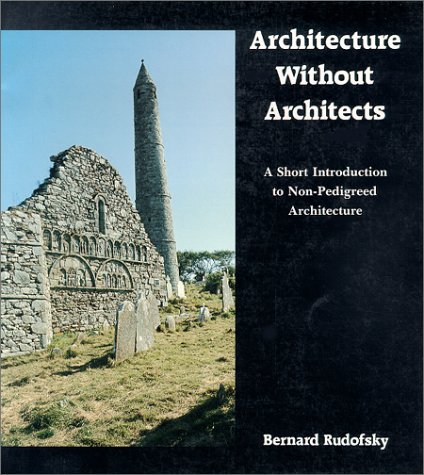
A catalog to an exhibition that ran at NYC’s Museum of Modern Art in the mid ’60s, it’s a short, easy read — 145 pages consisting mainly of 156 photographs with brief text here and there. The book can easily be read in an hour but it has a deep, meditative quality that will alter the way you look at your environment. Rudofsky, an Austro-Hungarian educated in Vienna who immigrated to the United States, states in his introduction that he wants to “break down our narrow concepts of the art of building by introducing the unfamiliar world of nonpedigreed architecture.” What does he mean by “nonpedigreed architecture”? Most Western art history classes focus on a few cultures and a select group of monumental, grand buildings, but what about the ordinary and commonplace? Like Alan Lomax who trudged through the Deep South with a tape recorder to preserve rustic folk songs, Rudofsky wanted to bring attention to the communal and archaic as opposed to the individual and sanctioned.
The book isn’t a treatise nor does it present any kind of grand theoretical framework. Rudofsky is merely trying to nudge us into opening our eyes to what has been previously ignored. Organized conceptually, his tour glides easily and informally across the globe and across cultures as he observes how peoples have built dwellings below ground, out of rock, or on water. Everything from Italian hill towns, African villages, European arcades, and Pakistani housing are surveyed.


Despite the variety of structures sampled, themes begin to emerge. The buildings are durable and practical, many of them hundreds or thousands of years old. Like evolutionary organisms, each is adapted to its particular niche and uses local materials — they’re “green.” The buildings have a rough-hewn quality that ages not just well, but beautifully. In addition to bringing a keen eye to his subjects, Rudofsky describes them in vivid and lyrical prose. The twisty streets of Zanzibar “run erratically, like raindrops on a windowpane.” Trellises from semi-covered streets “distill the raw sunlight into a sort of optical liqueur.” The seemingly random variation of a Greek village is “no more accidental than the voices of a fugue.”
Given that this enduring and useful art arose spontaneously and organically, an observer might be tempted to ask, hey, who the hell needs architects anyway? (Save your breath pedants. I’m aware that “architect” may simply mean “dude who designs a building.” I mean the word in the sense of a specially-trained artist/engineer who seeks to express his or her own unique vision.) Generalizing even further, how many problems truly require an expert’s input? Instead of always seeking the top-down approach of the technocrat, why do we ignore the bottom-up wisdom of the spontaneous order?


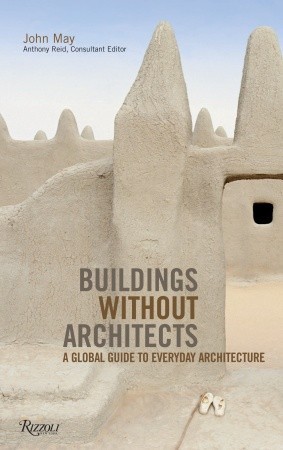
Whereas Rudofsky’s book is an introduction to the concept of vernacular building, Buildings Without Architects is a sourcebook. The volume systematically collects dozens of examples of indigenous buildings from around the world. Two pages are devoted to each example, on one page is a brief description of the building and its geographic location, on the other are simple line drawings that point out various features. It’s good for browsing and makes a nice companion to Rudofsky.
Although I collected the images, the posts below all feature excerpts from BwA:
- The Russian Izba
- The English Cob House
- The Yemen Tower House
- The Italian Trulli Stone Houses
- The Wooden Churches of Eastern and Central Europe
- The Fujian Tulou
- The Caribbean Chattel House
- The New Mexico Adobe House
- The Wooden Churches of Chiloe, Chile
- The Shaker Style
- The Hallenhaus House Barn
For decades Modernist and Postmodernist architects argued that avant-garde, nontraditional buildings aligned with progressive politics but as John Massengale points out, today’s starchitecture wouldn’t be possible without globalist 1% capitalism. The children of Corbu rely on Russian and Middle Eastern petrodollars. These neglected folkways offer a true populist alternative.
Related
- Brain Pickings’ Maria Popova is a fan.
- Michael Blowhard wonders if any architect is better than no architect.
- Another MB post on the pleasures of a traditional beach pier.
- PR on traditionalism in Nevada City and the American porch.
- Sir Barken on Silver City, New Mexico.
- Some pictures I took of Victorian homes and California bungalows.
- A time-lapse of an Amish barn raising.

 Blowhard, Esq.
 Callowman
 Sherbrooke
 Eddie Pensier
 Enzo Nakamura
 Epaminondas
 Fabrizio del Wrongo
 Fenster
 Brundle Guy
 Glynn Marshes
 Paleo Retiree
 Atypical Neurotic
 Question Lady
 Sax von Stroheim
 Sir Barken Hyena
 The Mistaken
 Uncouth Reflections
Excellent summary of the issue. The principle can be applied to so many areas of art, religion and social life. When inspiration and expertise need to be sanctioned within a corporate hierarchy, the result is inevitably stagnation and/or disaster.
LikeLiked by 1 person
Great writeup of a great book. And as Lloyd says, this way of seeing and thinking about things has lots of applications in other fields too.
LikeLiked by 1 person
Pingback: Fall Back Mini-Linkfest | Patriactionary
Pingback: Architecture Du Jour | Uncouth Reflections
Pingback: The Best of UR 2014 | Uncouth Reflections
Pingback: On Architectural Contrast | Uncouth Reflections
Pingback: Listing Books: Anti-Modernism | Uncouth Reflections