Monday Klassic Musik: Joni Mitchell / Black Crow

Sir Barken Hyena writes:

In the way of musical influences on le Barken, Joni Mitchell certainly looms large. At first, this seems a surprise. Why would a space and drug music addict like me have a good word for this weepy, introspective and very female chick singer-songwriter? Well, not all is as it appears.

Sure, she’s often lumped in with the likes of Carly Simon and Carole King, but that’s just pop music’s squinty-eyed vision. She’s nothing of the sort, and bears little resemblance to those lightweight talents, when properly understood. What we have here is a talent on the order of Miles or Picasso in their realms. I chose those two references carefully: for both exhibited the ability to reinvent themselves and stay relevant long past their sell-by dates, and yet retain their essence.

And so with Mitchell: from her debut as hippy flower child she never held back from her vision, whatever the commercial and artistic risks. At the height of her success and popularity she chucked it all by pursuing her own vision of a jazz-pop music revival. This earned the censure of Dave Marsh of Rolling Stone, who today needs an attribution, while Mitchell doesn’t.

The word that most comes to mind with Mitchell is “inventive,” followed by “restless”. Surely her future as a songwriter was assured after the success of “Clouds” as performed by Judy Collins, but that wasn’t it for her. Mitchell had questions in her mind, questions about what music could be, about, in the end, what she herself could become. And to make this vision real, she’s learned to make her art fire on all cylinders.

There are many excellent songwriters, excellent guitarists, excellent singers, excellent arrangers…Mitchell is all of them at once. She can breathe seductive lines of melody like incense smoke, spice her rhythms with unexpected and challenging syncopations, spin dark landscapes of unexpected new chords, and weave it all around her own unique poetic voice, one that rarely has recourse to stock phrases and cliches.

Mitchell is now in the hospital, with conflicting news of her condition. I hope she is well but in a sense she really can’t die. Far too many souls are walking around with her within for that.


Posted in Music | Tagged | 7 Comments

Linkage

Blowhard, Esq. writes:

Posted in Linkathons | 8 Comments

Mad Men Notes: S7, Ep11 — “Time & Life”

Blowhard, Esq. writes:

Lane-Pryce-Mad-Men1

1. Nice to see that this episode was directed by Jared Harris. And speaking of dudes coming off the bench, I’ve noticed that Robert Towne has been named a consulting producer in the closing credits. I wonder if Towne will get co-writing credit on any of the scripts. Is Weiner saving him for the finale?

2. “Greenwich, Connecticut is built on divorced money!”

mccann

3. The major plot development this episode is Sterling Cooper physically moving to the McCann offices — from the Time & Life building to 622 Third Avenue. (Above is what the New York McCann office looks like today.) McCann of course frames it as a promotion but Roger, Don, and the rest of the gang view it as a defeat. At first it looked like they would flee to California (maybe Joan still will to be with Captain Pike?) but they seem to have grudgingly accepted it for now.

speed-racer

4. Lou was given his send-off this episode — to make a cartoon of “Scout’s Honor” with the studio that produced “Speed Racer.” Has anyone seen the Wachowskis’ movie version of SR? Might be time for me to check it out.

petemad

5. Loved the comic bit where Pete squared off against the school headmaster — the Campbells v. the McDonalds, a WASP version of the Hatfields v. McCoys, I guess.

Posted in Television | Tagged , | Leave a comment

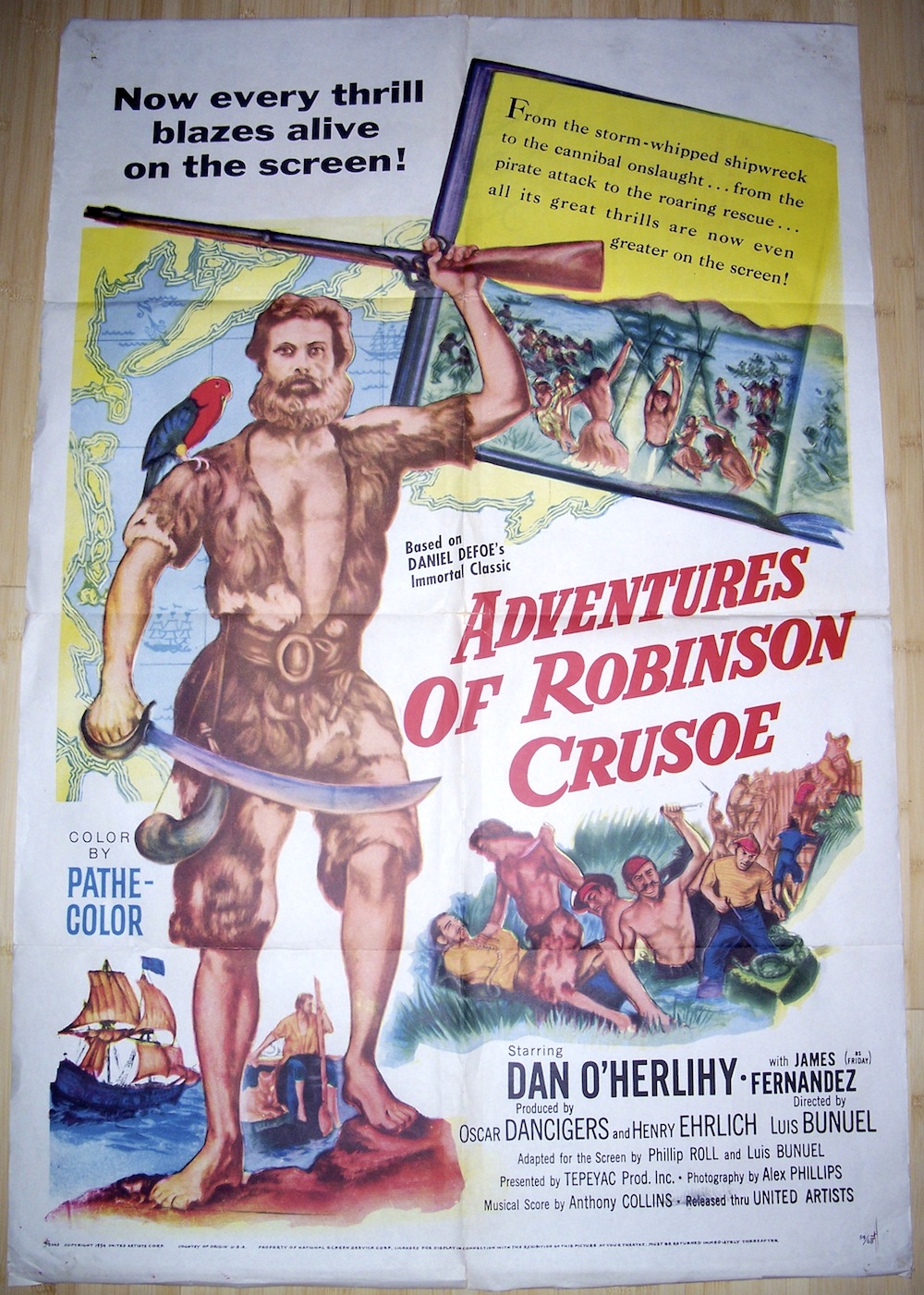
Four Movie Posters for “The Adventures of Robinson Crusoe”

Fabrizio del Wrongo writes:

Though it’s rarely talked about, I’ve long considered this adaptation of the Defoe novel to be major Bunuel.

The Adventures of Robinson Crusoe (USA)

This American poster features the key artwork of the campaign: an image of Dan O’Herlihy as Crusoe holding aloft a rifle. Whoever came up with this image didn’t want to leave anything out: You know a man means business when he comes at you with his firearm, his cutlass, and his parrot.

The Adventures of Robinson Crusoe (Danish)

The Danish poster replaces the cutlass with a parasol. Still got the parrot, though. The Danish movie poster tradition favors strong outlines and simplified, almost cartoon-like, coloration.

The Adventures of Robinson Crusoe (French)

This French take adds some line-art adventure vignettes; they seem drawn from the more fully realized ones on the American poster.

Did a parrot even feature in the Defoe novel? I’ve read it, but I don’t recall a parrot.

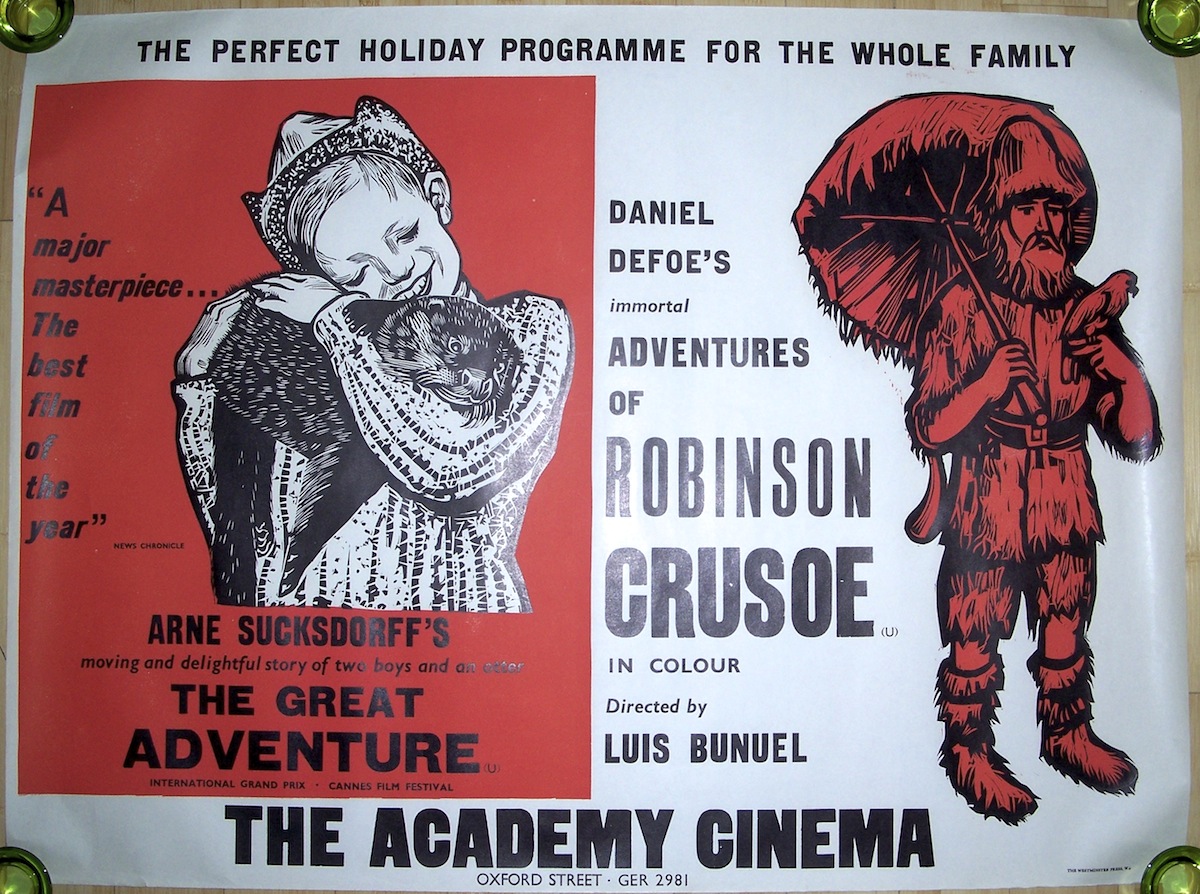
Tje Adventures of Robinson Crusoe (UK)

In England, The Academy Cinema used this poster to advertise a double-bill featuring the Bunuel film. Designed by famed woodcut artist Peter Strausfeld, it features a less warlike Crusoe and a parrot that prefers fingers to shoulders.

This is the way I tend to think of Crusoe: as a resigned and rustic hermit.

I’ve never heard of the other movie on this double-bill, even though someone at the time considered it a “major masterpiece.” The tagline — “[A] moving and delightful story of two boys and an otter” — sounds vaguely salacious.

Posted in Commercial art, Movies | Tagged , , , , , , | 3 Comments

Naked Lady of the Week: Anetta Smrhova

Fabrizio del Wrongo writes:

as-cover

Czech beauty Anetta Smrhova more commonly goes by Anetta Keys, presumably because she resembles American singer Alicia Keys. Her coffee-and-cream coloring is distinctive in a girl of Eastern Europe heritage. Gives her a touch of the exotic.

I don’t think she’s active these days. She’s over 30 now.

Nudity below the fold. Have a great weekend.

Continue reading

Posted in Photography, Sex, The Good Life | Tagged , , , , | Leave a comment

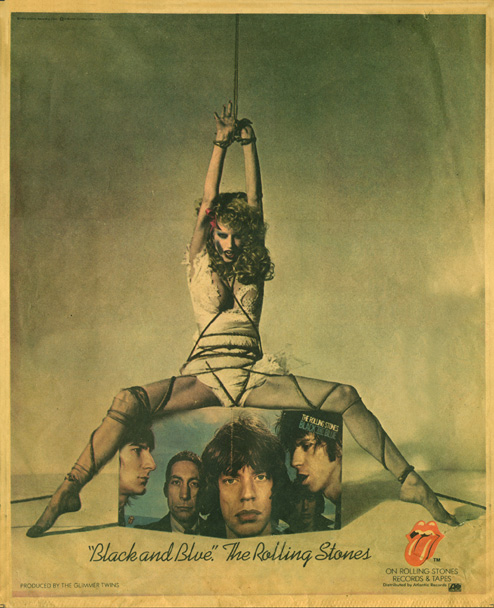
Couldn’t Do It Today

Blowhard, Esq. writes:

blackbluead

blackbluebillboard

Posted in Commercial art, Music, Sex | Tagged , , | 11 Comments

Architecture Du Jour

Blowhard, Esq. writes:

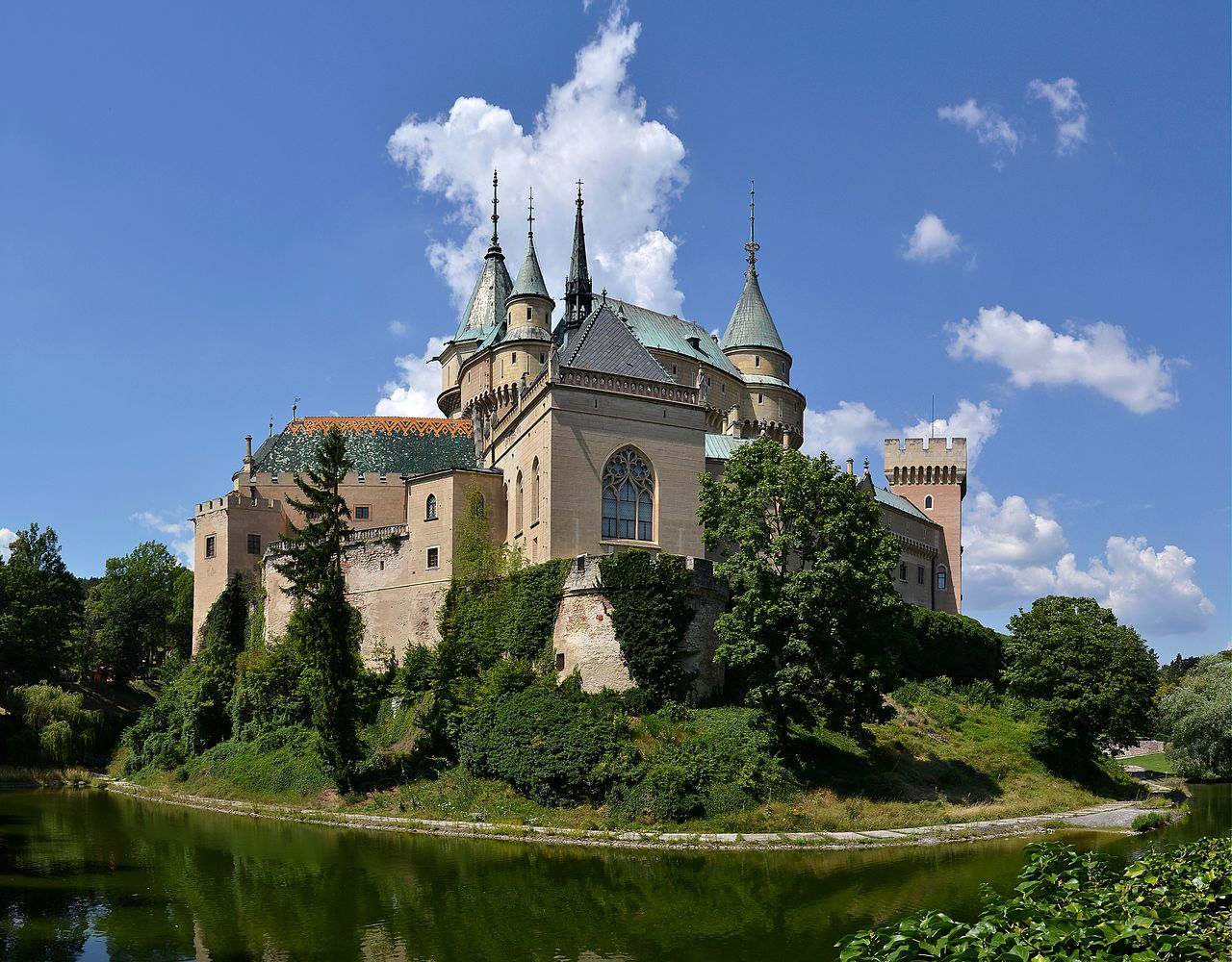
Bojnice_(Bojnitz)_Castle_(by_Pudelek)

Bojnice Castle, Slovakia.

Click on the image to enlarge.

Posted in Architecture | Tagged , , | 2 Comments

“Ex Machina” (2015)

Blowhard, Esq. writes:

Ex-Machina-Gallery-02

I’ve been a fan of Alex Garland since I read his novel The Beach years ago. The Danny Boyle adaptation was lame, but I did enjoy the Boyle-Garland collaborations 28 DAYS LATER and SUNSHINE. Oh yeah, the Garland-written-and-partially-directed DREDD reboot was pretty boss, too. So I was primed to enjoy EX MACHINA and did for the most part. The movie plays like HER meets FRANKENSTEIN but written as a European chamber play/sex thriller. But the movie could’ve lost 20 minutes and I thought the ending was predictable. The actors are all interesting. The growing sexual tension and manipulation between Domhnall Gleeson and Alicia Vikander is fun to watch, and I particularly liked Oscar Isaac, here playing a cross between Sergey Brin, Mark Zuckerberg, and Steve Jobs. This is the third movie I’ve seen with him (the other two being INSIDE LLEWYN DAVIS and THE TWO FACES OF JANUARY) and I’ve come to like him quite a bit. He has those sad, angry, contemptuous eyes that make me wonder what he’s going to say and do next.

Eddie Pensier writes:

machina_a

EX MACHINA surprised me on several levels. First of all, the pace is fairly meditative: not a lot strictly “happens” in the first hour, and it’s definitely more talk than action.  (It could, without a lot of trouble, be converted into a stage play with three speaking roles not unlike SPEED-THE-PLOW.) Secondly, it operates on an intellectual level higher than most sci-fi movies. There are some pretty deep meditations on the nature of consciousness and humanity, and the film doesn’t pretend to have the answers to every question–the ending leaves a lot of ambiguity in the viewer’s mind. Garland and his cinematographer Rob Hardy produce some stunning visuals, my favorite being the (mild spoiler) Bluebeard-like scene where Caleb discovers closetsful of Nathan’s previous, discarded AI experiments (end mild spoiler).

Of the three excellent main actors, I was most impressed by Alicia Vikander’s Ava, who pitches her performance at just the right level of is-she-or-isn’t-she to intrigue us (and Gleeson’s appealingly schlubby Caleb). However, her bird-like head movements, each accompanied by tiny electronic sounds, along with the glowing plasticky sheen of her artificial skin, never lets us forget what (who?) she really is. Oscar Isaac too manages to keep the smarmy technobro trappings to a minimum while bristling with obvious intelligence.

Sax von Stroheim writes:

ExMachina

Based on his previous works, my take on Alex Garland was that he was trying to smuggle in ideas, themes, and characters from J.G. Ballard’s science fiction novels into more standard genre movies. This was clearest with his screenplay for SUNSHINE, partly because the turn from Ballardian sci-fi to a last act that devolved into standard scary movie shtick was so pronounced. So, I thought that on his own movie, working on a smaller scale, without the need for the conventional tactics that marred the end of SUNSHINE, he’d give us something that hewed closer to the Ballard novels that seem to be his major inspiration. And that’s kind of what we get in EX MACHINA: an Everyman engaging in a battle of wills with a Man Who Would Be God, with the evolution of humanity (or post-humanity) at stake. But it’s only “kind of” what we get, because, as it turns out, even on his own, working on a smaller scale, Garland goes for a turn towards more conventional genre fare by the end, which doesn’t quite mar the movie, but makes it more familiar, and more comfortable, than the sci-fi novels (by Ballard and others) that inspired it. While I can’t say I didn’t like it — it’s smart, the acting is terrific, there’s a low-rent Edgar Ulmer vibe to the production that I really dig — I also wasn’t terribly moved by it — it engaged my intellect more than my imagination (it doesn’t help that it looks pretty cruddy). It’s one of those movies that I didn’t mind sitting through, but where, on the way home, I couldn’t help think of other, similar movies that I had liked better (Ulmer’s own, for example, or, thinking of other recent small scale indie sci-fi, Brandon Cronenberg’s ANTIVIRAL). And, although it’s completely unfair and unreasonable of me, I guess I’m a little disappointed that Garland’s own ambitions aren’t quite as grand (or at least as refined) as I had imagined them to be.

Posted in Movies | Tagged , , , , | 4 Comments

DON CARLO, Metropolitan Opera (Review)

Eddie Pensier* writes:

NOBODY expects the Spanish Inquisition!

I’ve always had big problems with Verdi’s Don Carlo. It always struck me less as a cohesive music-theatre piece and more of a collection of scenes and arias, rather like a concert program. It never really juggles the political drama, family drama, and romance aspects to my satisfaction. The title character is rarely done justice. The million different editions provoke infuriatingly pedantic arguments among opera nerds over which is best and Most Authentic™. And it features possibly the lamest, most pathetic cop-out of an ending to soil a major opera by a genius composer with (usually) unerring theatrical instincts.

Shame then, that the music is so damn good. Pretty much the perfect mix of arias, duets, and ensembles. Just the right amount of mid-period Verdi grandeur balanced with hushed moments of introspection. I love hearing all the parts of Don Carlo, but I hate sitting through Don Carlo, if that makes sense.

I did though, on the opening night of the Metropolitan Opera’s revival of Nicholas Hytner’s production on March 31. It’s described on the Met website as “handsome”, and I guess that’s true in the way you tell an 8-year old “My, aren’t you a handsome boy!” Nothing particularly pretty or striking about it, but nothing hideously ugly either, and it mostly allows the action to hew closely to the text, for which one ought to be grateful in this day and age. There wasn’t a whole lot of stage direction, and the singers engaged in more than a little “park and bark” without a theatrical hand to guide them.

The exception was Ferruccio Furlanetto, who is justly famous for his portrayal of King Philip. Furlanetto’s coal-black bass has the right authoritative weight to deliver Hardass Philip, but manages to soften with the sadness/humiliation/old-man exhaustion necessary to make Romantic Philip genuinely empathetic.

Barbara Frittoli is the real deal: a serious Verdi lyric soprano with a glittering voice and a lovely, regal bearing. Is her voice a teensy bit more tattered than it was a decade ago? Sure. But she sang with such exquisite attention to detail that I was willing to forgive the occasional pinch in tone.

Dmitri Hvorostovsky is a known quantity, he of the flowing white hair and  velvety chocolate-brown baritone and sadomasochistic music videos and inhumanly long phrasing. The thing about that last one though: you get so seduced by the entire paragraphs sung in one breath, that you don’t notice the hilariously loud, labored gasps for breath in between them, until you purposely listen for them. And once you do, you can never un-hear them. Even so, there’s probably nobody on earth singing Posa this well, and he was a credit to the cast.

The Eboli of Ekaterina Gubanova was well-sung but a bit cold: she lacked the vengeful, bitchy touch that elevates the best Ebolis. Yonghoon Lee cut a dashing figure as Carlo and has a real, proper Italianate voice (if only mediocre Italian pronunciation) but he was the one most handcuffed by the lack of effective direction and often looked adrift.

Veteran basso James Morris was a great if not hugely elegant Philip in the prime of his career. Here he took the role of the Grand Inquisitor and made a growly, menacing meal of every line.

At this point I could easily churn out more words about how impeccable, stylistically correct, and sympathetic the conducting of Yannick Nézet-Séguin was. But I’ll simply quote my seatmate, who got it in a nutshell:

He did everything he was supposed to do, and nothing he wasn’t supposed to do.

Quite.

*A few readers have been kind enough to enquire about my absence from these pages for the last several months. I have been caring for a bedridden parent for much of that time, and my writing muse took the opportunity to go on an extended vacation. Can’t guarantee that she’ll stick around, but I’ll do my best to keep her nearby and well-fed.
Posted in Music, Performers, Personal reflections, The Good Life | Tagged , , , , , , , , , , | 2 Comments

Art Du Jour (Anzac Day 2015 Edition)

Eddie Pensier writes:

Peter Wegner, Dog With Gas Mask, 2013

Related

  • Previous ANZAC-themed ADJ here and here.
Posted in Art | Tagged , , | 2 Comments