Back when I worked for a major media outlet, we staffers would sometimes joke that there was no better guarantee that a trend had gone past its peak and begun its decline than being chosen by our magazine for coverage. Spotted at the newsstand the other day:
And spotted while walking around downtown NYC:
Speaking of trends …
What’s with the preoccupation with “eating clean”? What’s even meant by “eating clean”?
I have no idea what this girl’s name is. At Femjoy she’s Katalin, so we’ll go with that. As far as I can tell she hails from Ukraine, though in some of her photos she has a Mediterranean quality. (Where does it come from? Perhaps from the bravura, sculpted-by-Donatello hair?) I imagine her out in the fields happily stomping on this season’s grape harvest. She’s not the most beautiful girl, to be sure, but what a beguiling set of lines she has, and what a charmingly earthy aura. (Credit her photographers too, of course.) I particularly like the earlier sets, in which she has a little baby fat clinging to her. A couple of these photos caused me to flash on Renoir’s generously upholstered nymphettes.
Looks like she’s no longer active. Which brings me to another point: Most of her photos seem to derive from the late 2000s, which now seem to represent the high point of “the new nude,” a movement in cheesecake photography that emphasized nature, unaffectedness, youth, sophistication, and natural lighting. Some of the sites that pioneered this style are still around, but they tend not to emphasize these values to the same degree. An unfortunate development? I think so.
These shots come from Amour Angels, Femjoy, Pretty Nudes (defunct?), DOMAI, and Girls In Nature (defunct?). Hey, DOMAI seems to be one of the few sites hewing to the old natural-is-better ethos. Kudos to them.
Blowhard Esq. did a very nice job recommending recent documentaries about pop music. Here’s another: Beware of Mr. Baker, available on Netflix Streaming.
“he personally is what drums are all about” (Stewart Copeland) . . . . “the world’s greatest drummer” . . . “he’s a rogue, a lovable rogue” (Eric Clapton) . . . a force of nature” (Carlos Santana). . . “he is certifiably nuts” . . . “I think he was fairly consistently horrible to people and to himself” . . . .”he pulled a knife on me and said ‘you’re fired'” (Jack Bruce) . . . “Ginger Baker just hit me in the nose” (the film’s director).
If you have a little over four minutes to spare, take a listen to the sound file below. It is snipped from an NPR podcast entitled Pop Culture Happy Hour. The full series is available for download for free on i Tunes.
By way of preface, I am interested in pop culture as much as the next person, which is another way of saying way, way more than I should be interested given what passes for culture in the pop realm. So I thought to give PCHH a listen. The show is hosted by Linda Holmes, an NPR editor, who has a rotating cast of other NPR editors and writers involved with books, music, comic books and the like.
Now I am not one to usually go on a tear about diversity, but this show could use a large dose of The Other. I couldn’t really tell the correspondents apart. It was like one person was having a conversation with other himselves and herselves. OK, the voices coming at me were in two separate registers–male and female–but other than that I felt like I was listening to one person going on and on about how enlightened they/we/I were.
I am also not one to go on a tear about NPR liberal bias either. I agree with Forbes that in terms of audience–the network of people that consumes the network’s content–NPR tilts left, but not by much and in a generally mainstream way. But there is little doubt that the individuals who work for NPR tilt left, and further left than news content indicates.
Here’s Bob Garfield from NPR’s On the Media, quoted by Bernie Goldberg:
If you were to somehow poll the political orientation of everybody in the NPR news organization and all of the member stations, you would find an overwhelmingly progressive, liberal crowd.
OK so now maybe give a listen to this snip from PCHH. In this segment, Holmes and her alter-egos were bemoaning the state of the casting for the new Star Wars movie. It just wasn’t diverse enough for her/their liking(s). You really have to listen to the whole thing to catch the clueless richness of the swirling, self-regarding opinion mash-up.
How is it that when doing a space opera set in a future time you “just get a better story” with a more diverse cast? Is Samuel Jackson supposed to do his tough guy routine, a la Tarantino? Or maybe bring on a hip-hopper to get real?
And note the smug collective snickers when Aronofsky’s Noah comes up. The host acknowledges the film was not “made in Sweden”, implying that at least it is not overly biased in favor of a Nordic look. Still, the cast is a white one, and that is what in the final analysis offends.
Spokesmen for the film argued–with merit, IMHO–that a cast comprised of a mixture of all races risked the Benetton effect. Hey, these are local tribesman in the Caucasus, not in the upper reaches of the Nile, and ethnic homogeneity is to be expected in the name of verisimilitude . Why would it make for a “better story” (in the words of one) to have a cast interspersed with minority actors that reflect our 20th Century obsessions?
But the assembled PCHH crowd can’t get enough of Aronofsky’s foolishness in thinking a racially homogenous cast would be most appropriate. Chuckles all around, with one correspondent slapping herself in the face as though to wake from a bad dream, remarking “is this coming across on mike? This is me palming my face so hard you can hear it.”
Jeez, they do seem to follow an unforgiving god.
At one point Holmes (I think) says:
If I look at a bunch of people in a room and they are all white guys it stands out for me right away. It’s not something like where I have to sit there and say “now I have to audit the case for diversity.”
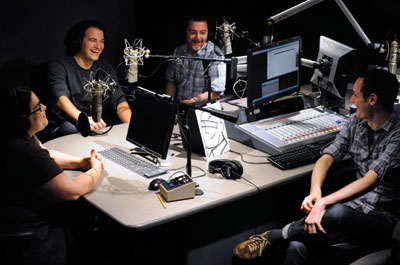
OK and I don’t have to audit the cast of PCHH either. I also have just to observe. Here is a recent photo.
I think maybe I have a better idea now why folks like this are preoccuppied with diversity and white privilege.
Sir Barken was recently divorced from his long time she-hyena, which means I might just might be on the prowl for candidates for the New Lady Barken. Having been out of circulation for a century or two, I was a bit puzzled about how to proceed. Back in the day we just roamed the plains waiting for a whiff of a she hyena’s hind glands. Of course, today things are much more efficient!
In no time, fortune smiled and, once the word was out that Sir Barken was about, some tender shooting stars fell in my lap, from these new internet apps. So I’ve been gently trawling these new chat waves to see what great fishes this internetty sea has in it, just waiting to be harpooned.
Ahem.
OK, I’ll dispense with the purple shit prose and get to the point.
There’s something marvelous about flirting with women via today’s various chat apps. In some ways, it might be as innovative as the phone, which facilitated much easier and more credible lying, a big help in forming relationships in that tender young stage. But today, we have much more at our fingertips! The benefits are legion:
Don’t have to look interested, nod and go “uh huh”
Can watch girls who don’t talk have sex while waiting for message ding
Can easily document chain-pulling of females, for future hilarious humiliation in public.
Can actually be making a sandwich, though in all honestly she should be doing this for you.
Can always keep the upper hand by viewing message with no comment, then bailing. Let THEM wonder what fuck “seen @6:21 pm” means!
Can send pictures of dick with email address watermarked over. Hey, it could go viral, who knows right? (sir.barken.hyena@gmail.com for those who want to get on that mailing list)
Can actually GET pictures of hot and nasty nakkid gurls. The jaw drops.
Can safely weed out the batshit insane without fear of being followed home and knifed.
And the list goes on. Yes, it’s true that my fishing has yet to yield a tender she-bitch craving my brand of love. But in the mean time, I’m having a great time out there, thanks to this strange new world we find ourselves in. God I love the internet.
Gotta go, I just caught the scent of hind glands coming off my smart phone, catcha later.
Ladies, this could be you! I mean, just look at that grin.
Since last week’s Monday Prog Selection actually came up on a Tuesday (Hyena’s know nothing of Memorial Day) I thought we’d just go with it. “Honor they error as a hidden intention” says the Oblique Strategy.
Here we have a fine presentation of pre-peak Genesis. It’s all there, the basic sound that each musician would go on to refine in the next few years. Hackett’s got his yin/yang between slow atmospheric sweeps and washes, and blazing speed, and his one of kind vibrato is there. Collins has started to go against the grain of dull soft thudding drums, letting the drums ring and splash wildly, the beginning of the sound that would eventually take over the 80s. Banks and Rutherford lay a bank of rich trademark chords and textures. The only missing ingredient is Bank’s solo synthesizer, which would come along with next year’s “Selling England by the Pound”. And Gabriel is Gabriel, instantly recognizable tone and phrasing.
First, let’s note in awe a world where a band like this would have a whole show broadcast on TV (I believe this was from Belgian TV). Now let’s listen:
This 1967 crime picture, directed by Toshio Masuda, has a light, off-the-cuff quality. It’s perhaps too casual to qualify as lyrical, yet it seems to inhabit a musical universe, like one of Rene Clair’s early sound pictures. The hero, Goro (Tetsuya Watari), constantly whistles his own theme song; he’s in thrall to some internal hipster cadence. At one or two points in the movie the rest of the world picks up on his groove. He slugs a guy in a nightclub, and his followers fall into step behind him, all of them bobbing in unison as though they’d blipped, en masse, into a Stanley Donen picture.
“Velvet” is in the mode of the mid-century Japanese Yakuza film, the kind of thing Seijun Suzuki is known for. But it’s also a cynical gloss on “Breathless.” Goro suggests what Belmondo’s wannabe hood might have turned into had he lived: an assassin so post-everything that he can’t help but see through his own act. This may be what Masuda is hinting at when he shows us Goro peering through a slit he’s made in the brim of his fedora. It’s a peephole in the shell of his persona.
An accomplished director with a long history in genre films, Masuda gives the picture a strong graphic quality. He likes to shoot at an angle, his subjects framed in the distance by interstitial details. He then typically cuts to tight shots of their enormous, looming noggins. (On a few occasions I was reminded of the work of Yasuzo Masumura, a master of widescreen composition.) Shot on location in Kobe, the movie’s look manifests Goro’s contradictions: It’s a tug-of-war between bright pop sensationalism, mainly evident in the nightlife scenes, and drab, rusted-hull realism. (Goro says that Kobe smells like the ocean, and it looks like it.) “Velvet” loses a bit of steam when the two things that Goro cares about — semi-anonymous sex and his brother — come into conflict. It’s a drag watching this cynical prince go earnest.
Related
As far as I can tell, “Velvet Hustler” is not on DVD, but you can stream lots of other Yakuza films via Hulu. I can recommend “A Colt is My Passport,” also released in 1967.

 And spotted while walking around downtown NYC:




 Blowhard, Esq.
 Callowman
 Sherbrooke
 Eddie Pensier
 Enzo Nakamura
 Epaminondas
 Fabrizio del Wrongo
 Fenster
 Brundle Guy
 Glynn Marshes
 Paleo Retiree
 Atypical Neurotic
 Question Lady
 Sax von Stroheim
 Sir Barken Hyena
 The Mistaken
 Uncouth Reflections