“Predator”

Fabrizio del Wrongo writes:

predator

Bro, you got an extra canister of camouflage makeup? I’m all out.

“Predator” is reminiscent of the Ford-Nichols “The Lost Patrol”: its slimness, seemingly lunkheaded at first, is what makes it feel kind of daring. The screenplay, by Jim and John Thomas, uses a familiar action-movie set-up as a lure for the sci-fi-cum-horror hook: just as you’re getting acclimated to the “Rambo”-like plot, the picture ambushes you. You might say the movie operates in a way that mirrors the titular beastie’s manner of taking down its prey — it materializes out of the jungle, then zaps you silly.

The characterizations are flat but vivid; they’re built up from anatomical details (mainly chins and biceps) and mostly sidestep the wateriness of backstory. In fact, nearly every character feels like a side detail pulled from the edges of some bigger, more complicated production. This goes even for Schwarzenegger’s Dutch, a cartoon sketch of a commando with things like “cocky” and “determined” scribbled in its margins.

Working on his first big-time film, director John McTiernan finds a style that gives form to the fear and anxiety that are the story’s main drivers. He’s especially fond of compositions that are stepped in depth, sometimes rack focusing between individual elements in order to make your eye feel worked to its limit. (The cinematography is by Donald McAlpine.) When combined with the natural overabundance of the jungle setting this amounts to a kind of makeshift expressionism — a satisfying blend of location, perception, and state of mind. When the movie switches to the villain’s point of view the expressionistic inclination becomes more explicit. We see what the creature sees — a bugged-out world of rainbow-striated heat impressions (it’s a bit like pop Brakhage).

All of this is so efficient that it’s easy to forget what’s less than satisfying in “Predator.” A female character adds almost nothing to the movie; her presence just detracts from the vaguely homo mood induced by all those guns and forearms. And the final sequence, in which Dutch fights the baddie mano-a-monstruo, is impressive but somehow incongruous. It feels like part of a more conventional movie.

Related:

  • There’s ample evidence that Arnold is something of a dick, but at least he doesn’t take himself too seriously.
  • The end feels like a separate movie in part because it was shot separately, after a lull in shooting necessitated by the decision to create a new creature from scratch. This is discussed in this nice making-of documentary. It must be said: The design of the creature, by the great Stan Winston, is among the most memorable in movie history.
  • Get to dah choppaaaaa!
Posted in Movies | Tagged , , , , , | 9 Comments

“Baby Face”

Blowhard, Esq. writes:

Baby-Face

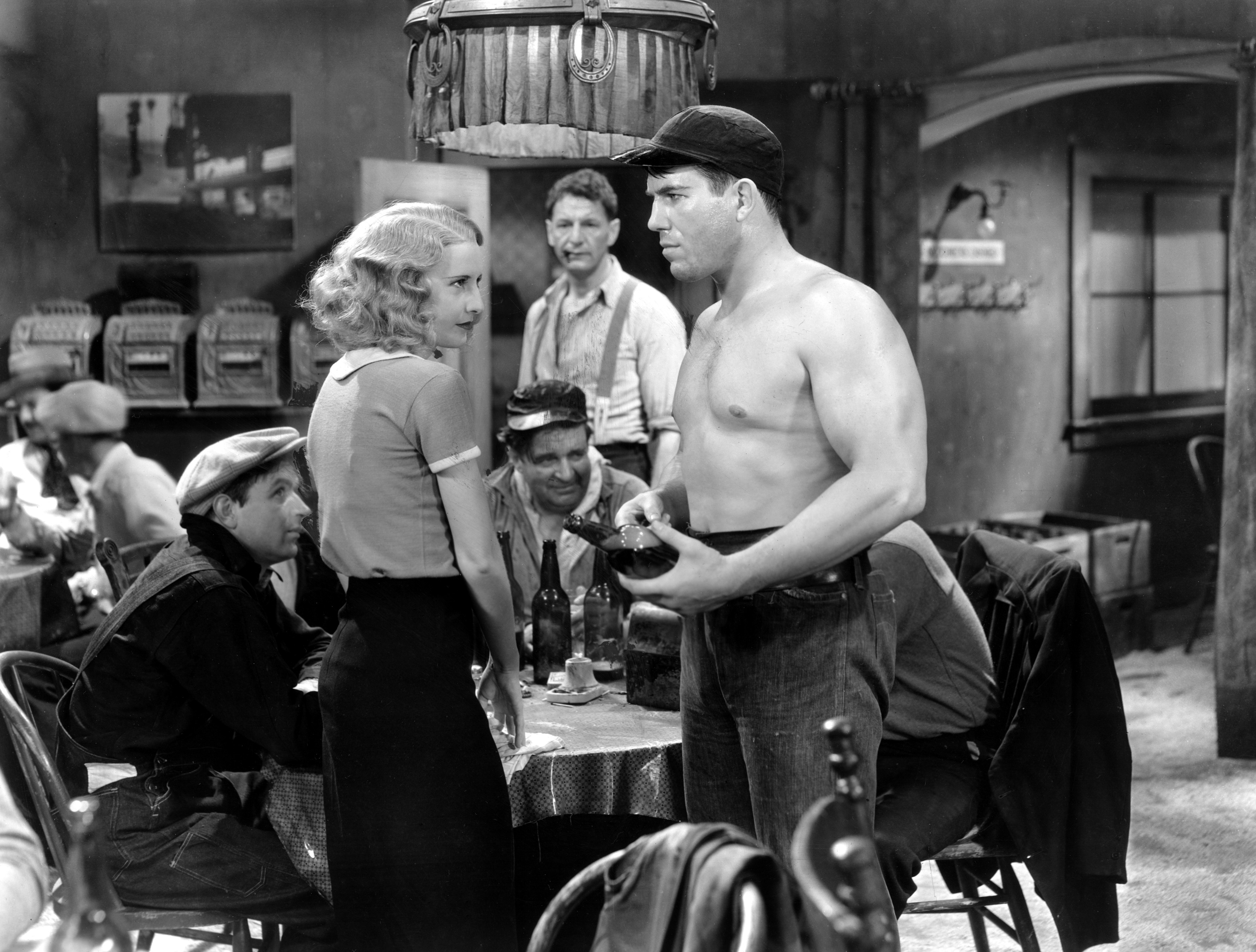
Barbara Stanwyck and her legs star in this engaging Warner Bros. pre-Code Hollywood work from a story by Daryl Zanuck writing under a pseudonym. A sort of femme fatale Horatio Alger story, Stanwyck plays a teenage tramp pimped out by her father in an Albany speakeasy who learns to use sex to exploit men. When daddy is dispatched, and under the kindly direction of a German professor-type spouting Nietzschean philosophy (“Crush out all sentiment!”), Stanwyck moves to New York City and sleeps her way to the top, floor by floor, of a major bank. She’ll have sex with anyone, anywhere, to get what she wants — a railroad bull in a filthy boxcar, a midlevel accountant in a work washroom, or her stuffy boss in his office. There’s a blink-and-you’ll-miss-him appearance by John Wayne playing her goofy boyfriend.

The sex is suggested of course, but the camera does linger lasciviously on Stanwyck’s figure and the sweaty men who all but lick their chops. A crisp 75 minutes, director Alfred Green keeps the action moving, which also includes a murder-suicide and some Parisian excursions, and even manages a couple of arty shots of Stanwyck reflected in mirrors to emphasize her two-faced duplicity. Also given that it was made in early 30s, there’s some nice Art Deco sets and costumes. The ending attempts to redeem Stanwyck but manages to eek out a note of ambiguity.

More

Posted in Movies, Sex, Women men and fashion | Tagged , , , | 6 Comments

“The Ghoul”

Fabrizio del Wrongo writes:

The-Ghoul-Poster

Starring Boris Karloff and featuring a plot derived from “The Cat and the Canary,” this British Gaumont production seems like an attempt to mimic the success of Universal’s monster series. It’s only half-way successful. Karloff’s ghoul, a combination of his mummy and Frankenstein’s monster, lacks the creepy charisma of the Universal fiends, and the production has some of the creakiness of a theatrical spook show. (Like so many early horror films, it was adapted from a stage play.) But in visual terms “The Ghoul” is just about in a class by itself. Shot by Gunther Krampf, who’d worked in Germany with the likes of Pabst, Wiene, and Murnau, the film looks both expressionistic and unfussy, deep shadows and strategically placed pools of light combining to create a velvety, charcoal look that in some ways anticipates film noir — the work of John Alton for instance. So often in these “old dark house” movies the interiors feel divorced from the fog-strewn exterior scenes: they’re afflicted with a squareness that stinks of the proscenium. But Krampf and director T. Hayes Hunter are careful to make their settings overlap. They use windows and filtered shadows to bring movement and visual interest indoors, creating the impression of a nighttime world that is continuous in both space and tone. Look for a very young Ralph Richardson giving what is probably the best performance in the picture.

Related:

  • “The Ghoul” looks so good in part because the DVD was mastered from the original  nitrate camera negative, which was rediscovered in the ’80s. For many years the picture was believed to be lost. More here.
  • A nice write-up of the movie.
  • John Willard’s 1922 play “The Cat and the Canary” must be one of the most influential pop culture things of its era. A great many early horror films stole from either it or one of the many similar stage plays that followed in its wake. The 1927 movie version, directed by Paul Leni, inaugurated the Universal cycle of horror films.
  • Though it doesn’t discuss “The Ghoul,” probably because the film was out of circulation for many years, Carlos Clarens’ “An Illustrated History of Horror and Science-Fiction Films” is one of the great books ever devoted to a single movie genre. Buyable here.
Posted in Movies | Tagged , , , , , , , | Leave a comment

Linkage

Fabrizio del Wrongo writes:

  • Shouting Thomas is having bear troubles.
  • Have you noticed how many scientific and/or academic studies are done on toys? In fact, it wouldn’t surprise me to learn that some college is offering a degree in Barbie Studies. Anyway, some group of eggheads has determined that the faces on Lego people have gotten progressively less cheery. What this is supposed to indicate, I’m not sure. One thing I feel sure of: Over the last 30 or so years, stuff aimed at kids has gotten considerably “edgier.” So I’m not at all surprised that contemporary Lego people display a bit more ‘tude.
  • It’s “1984” all over again.
  • Matt Forney entertainingly throws a bunch of bombs at a feminist writer, and at feminists in general.
  • Pretty sure you’d get tossed in jail if you recorded this today. Question: Why isn’t Lonnie Johnson as well-known as Robert Johnson and Charlie Patton? I think he’s one of the all-time greats. Anyone have an under praised blues artist they’d like to call attention to?
  • Summer camp, Hamas style.
  • The tradition of the cute animal movie goes back to Edison. But it took the film medium over a 100 years to discover the wonders of dogs plus citrus.
  • Foseti on Cormac McCarthy’s “Blood Meridian.” Some interesting discussion in the comments. I read it about 20 years ago and was both impressed and kind of bored by it. Our own Blowhard, Esq. had some fun at McCarthy’s expense back here.
  • Armond White on a couple of long-in-coming DVD releases. I love Lubitsch’s “The Merry Widow,” which is the last operetta he made and the only one he made at MGM. On the other hand, Bogdanovich’s efforts at homage-ing classical Hollywood have never done a whole lot for me. But maybe I’ll take this as an opportunity to revisit “At Long Last Love.”
  • One of the more entertaining Wikipedia bios I’ve come across. What a character Mizner was! The great Hollywood screenwriter Anita Loos, who had a bit of an affair with Mizner, claimed that Warner Brothers paid someone to follow him around and record all his wisecracks, some of which ended up in the mouths of Cagney and Bogart. His brother, Addison Mizner, was the guy who popularized the Spanish Revival style of architecture. Here’s Paleo Retiree/Michael Blowhard on his work.
  • Sandwich shaming.
  • Great Movie Scenes: With its movement through multiple planes, its crack choreography, and its wonderfully comic timing (the editing is spot on), this opening set-piece, from the 1961 “Hercules and the Captive Women,” feels a bit like something out of a Buster Keaton comedy or a MGM musical. You rarely see anything this lovingly put-together in an action movie today.
Posted in Animals, Architecture, Books Publishing and Writing, Linkathons, Movies, Music | Tagged , , , , , , , , , , , | 6 Comments

“Survival Island”

Paleo Retiree writes:

kelly_brook_survival_island_cap_35_o1NQaqn.sized

Enjoyably cheesy, made-for-Showtime flick from 2005 that crosses a shipwrecked-on-a-Caribbean-island adventure story with a lot of heavy-breathing  sexual suspense. For most of the movie, Billy Zane, Kelly Brook and Juan Pablo Di Pace (a fiery young Latin Lover type) are the only people on screen. Storywise, the movie is about the faceoffs between the two men as they bid for Kelly Brook’s attentions. Juan Pablo throws off a lot of smoldering Banderas-like sparks, and Billy Zane chews the usual — ie., awesome — amount of Billy Zane scenery. Gotta wonder why hip directors don’t make a showy point of casting Zane in their movies. He’s as distinctively flamboyant in C-movie ways as Christopher Walken.

But — and let’s be frank and cut to the point — the movie’s main attraction is the gorgeously upholstered Kelly Brook, who washes up on the island dressed in a white bikini and a silk wrapper, and who proceeds to galumph, run, snooze, agonize, and make love on the beach and in the ocean. Curvy, thy name is Kelly. The acting chops don’t amount to much, but what a likable pinup girl she is. According to webrumors, Brook asked the film’s producers to cut out a few of her nude scenes, and they refused. Knowing that fact — or at least thinking that I know that fact — was part of the fun of watching the movie too.

Related

Posted in Movies, Sex | Tagged , , , , | 7 Comments

Linkage

Blowhard, Esq. writes:

  • How Japan keeps Muslims at arm’s length.
  • A short interview with Nassim Taleb. (H/T Paleo Retiree)
  • The Cathedral begins the smearing of Ed Snowden.
  • 25 Things to Know About Sexism & Misogyny in Publishing. The incoherence is telling. What exactly is he upset about? The fact that guys hits on girls? (Point #9) Sexy book covers? (Points #10, 11, 12) That there aren’t enough women in publishing? (Points #4, 18) That people aren’t nice enough to each other? (Points #5, 6, 23, 24, 25) Honestly, though, my first thought after reading this was, “I wish people got this worked up about the financial crisis.” But I guess the point is to signal to his readership that he Really Cares A Lot.
  • VICE profiles Law Enforcement Against Prohibition. Key quote: “Right, and whenever I’m speaking at a Rotary Club or a Lion’s Club, and I ask the same question, not a hand goes up – nobody. I say, then let’s be honest. There will never be a drug-free America. Drugs are always going to be a part of our culture. So, the question becomes: Who do you want to control the marketplace – gangsters, thugs, and terrorists, or licensed businesspeople with regulation and control? That’s the only discussion we can have, and it’s the one we’re not having.”
  • A portrait of an optimist:

goose

Posted in Animals, Books Publishing and Writing, Linkathons, Philosophy and Religion, Politics and Economics | Tagged , , , , , | 13 Comments

Dr. Strangecurrency or: How I Learned to Stop Worrying and Love Bitcoin

Sir Barken Hyena writes:

First some background. If you don’t agree with the assumptions below, you might still enjoy the rest of the post in a “what a tin hat maroon” sort of way. But one disclaimer: I have no idea what I’m talking about, I’m just a guy on a blog.

OK, the premise:

The global financial system of credit and trade will collapse, sooner rather than later. This will be triggered by US Government default and the radical devaluing of the dollar, ending its reign as a reserve currency. Unemployment will skyrocket. Loans will be almost impossible to get, for anybody. A new Great Depression will begin.

As this crash happens, there will be a panic flight of capital into gold and precious metals and other stores of wealth. Pure fiat currencies will be abandoned in favor of pegging to the price of gold.

Agree or disagree, doesn’t matter – that’s where I’m starting from. I’m not saying this will all happen, making no predictions here. It’s just one scenario of many.

So now enter Bitcoin. Could these bizarre non-things provide a store of value similar to gold, or maybe even better? I believe it could happen.

It’s really important to carefully unpack the issues around this new financial instrument to understand what’s going on. If you want some background on Bitcoin generally, this is a good place to start.

First there’s the software that runs the bitcoins themselves. This is an open source project, the code is transparent and available to any who want it. Bitcoin is the hottest emerging thing in the geek world and so has attracted the best programmers. I am convinced that the Bitcoin system is absolutely sound, that the coins are impossible to counterfeit, and are immune to manipulation. For years the best hackers have tried to break it, and what vulnerabilities were there have long since been addressed. So I trust the integrity of the coins.

Secondly, there is the software that runs the services that surround the coins. This is the layer that allows for trading and storing bitcoins, and any other imaginable application. This layer is much less mature than the bitcoin system itself, for the simple reason that it’s only needed if there is a real economy surrounding the coins. The smartest money in Silicon Valley jumped on this about two weeks after the price plunge in April was recouped and the price held at higher then pre-spike values. Clearly they think Bitcoin’s time has come. The kind of thing that is needed here is not rocket science: the geeks of the world know very well how to build the type of services and security that’s needed, it’s just a matter of getting it done. And it is getting done. So I trust that this part of the Bitcoin universe has no serious future potential for failure.

But now we come to the frayed edges of the global financial system that Bitcoin needs to work within, and of course here lies the real danger of failure. Some advocates paint a future of an all Bitcoin economy but that’s not realistic to me. Bitcoins will have to be easily convertible to other currencies to be useful and that will require the consent of the banking industry. How they will respond is the big question.

And I think they won’t respond at all, at least not until it’s too late. They won’t respond now because they simply have nothing at all to fear from Bitcoin. Partly it’s is pure hubris. Printing $85 billion a month isn’t exactly the sign of a timid and fearful disposition. It’s the opposite.

But also the legal waters have lately been greatly clarified and the major players in the Bitcoin world are scrambling willingly to comply with regulations. The regulatory entities in the US have signaled that bitcoins are to be treated as any other tradable financial instrument. This is great because it tells bitcoin traders how to work within the system. So as of now the picture to me looks like this: the banking industry has no more reason to prohibit conversion of dollars into bitcoins than it does converting dollars to yen or euro. But I’m nowhere near as confident of this conclusion as I am on the tech issues, partly because I don’t know what the hell I’m talking about. But keep reading!

So what about after the crash? If some of the money that would normally flow into precious metals in a crisis goes to bitcoins this time, there could be capital controls put in place to prevent the flight from the dollar, as there were against gold in the Great Depression, or are now in Argentina against converting peso to dollars. This would attempt to isolate bitcoins in their own closed universe.

It’s highly plausible, likely even, but that doesn’t mean it would be effective. First, US banks will be severely hampered in their control of the financial system when their only weapon to wield will be a ruined currency. Also, unlike the Great Depression when the government had cash on hand, this time the government itself will be utterly insolvent, and in a state of total chaos too probably. Remember that the government going into the Great Depression was very lean. “Lean” is not a word often used today to describe our government. And so whatever they try might not work. Similar to how the Argentine government’s efforts to prevent conversion to dollars are widely regarded as a joke in that country. The black market thrives.

And there’s another angle: if Bitcoin becomes Gold 2.0 then of course the major holders will inevitably be the same 1 percent that’s now running the banks (hopefully minus a smattering that ended up face first on the sidewalks after the crash – see? I’m an optimist). They might become it’s biggest defenders.

OK, that’s all science fiction at this point. But nevertheless, in good Anti-Fragile fashion I’ve put my own skin in this game: thanks to a life of loose and dissipated living I don’t have much in the way of assets to speak of, but what little I have I am in the process of liquidating and converting to bitcoins. The way I see it if nothing happens I still have my job and I have a good story to make fun of myself with when I’m drunk. Still time to rebuild. If the crash comes and my bitcoins are worthless, well so would be any savings in dollars and investments in Wall Street so at least I tried. And if they take off, I might just be somewhat protected from the horrors to come.

It’s all upside from where I sit.

So, going forward I suggest we keep our eyes on what happens with Bitcoin outside of the US and the advanced economies. South America, Africa and the Middle East have a lot to gain from adopting bitcoins and they may pave the way forward. And in particular Argentina.

And dissenters: please have at it in the comments, just refrain from calling me part of the Tin Hat Brigade – I’m getting that a lot from friends anyways!

Posted in Computers, Personal reflections, Politics and Economics, Technology | 7 Comments

Just Popping In To Say “Hello” And Also I Support The Overthrow Of The US Government By Violent Means

Sir Barken Hyena writes:

Phew! What a coupla weeks! Scandal and the scent of blood are afoot in the great Capital, what to make of it?

I’m busy lately fiddling while Rome burns mixing my latest album for my eager/meager public, but I did want to take this opportunity to say just briefly that I heartily support the slaughter of innocent people as long as it leads to the overthrow of the United States Government, and in addition anyone reading this at the NSA can suck my left wang for their tomorrow’s breakfast.

That is all and now we return to our normally scheduled bitching.

Posted in Politics and Economics | 6 Comments

“Going Places” (Les Valseuses)

Blowhard, Esq. writes:

valseuses

Not that we’d ever have such a thing, but if we were to have a UR Litmus Test, this movie would be as good as any. Like it? Great! You’ve found the right place. Don’t like it? Great! You’ve found the right place, but be forewarned…

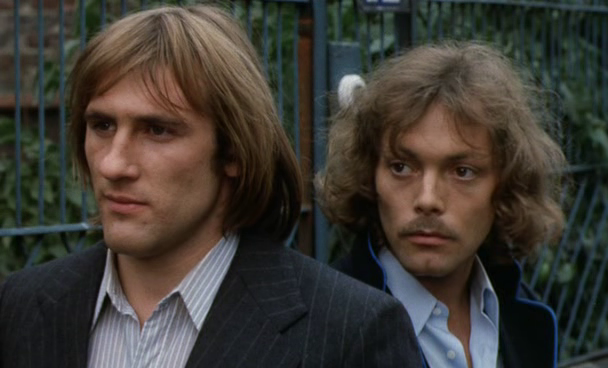
Anyway, this film a hilarious, gross sex comedy starring Gérard Depardieu and Patrick Dewaere as two young horny, brutish ids. The story is picaresque and wonderfully unpredictable. Those who ever wondered how Depardieu became a star need look no further — watch him charm, cajole, browbeat, and threaten all around him while rocking a black leather jacket and purple pants. The delectable Miou-Miou stars as the frigid shampoo girl who discovers her orgasm, Jeanne Moreau is a hot-to-trot ex-con, and a very young Isabelle Huppert loses her cinematic virginity to Depardieu.

Watching this film — scene after scene, joke after joke — I thought there’s no way this could be made today. It’s weird how these sophisticated works can simultaneously seem so innocent and naïve. But hey, I’m a Blier noob and I know some of the guyz around here are big fans of his work. PR, Fabrizio, Sax, (and everyone else) — what say you?

Related

Posted in Movies | Tagged , , , , | 11 Comments

“Carmen Comes Home”

Fabrizio del Wrongo writes:

carmen

This sprightly, sweet-spirited comedy from 1951 was the first full-length Japanese film made in color. It features Hideko Takamine and Toshiko Kobayashi as Kin and Maya; they’re a couple of big-city strippers who cause a scandal when they pay a visit to Kin’s hometown, a bumpkinish enclave out of Japan’s pre-industrial past. The girls are like a pair of exotic birds: wearing garish costumes and singing American-influenced songs, they clop through the town on heels with a blithe indelicacy that recalls the gold diggers played by Jean Harlow. Unable to separate the girls’ apparent sophistication from their obvious decadence, the townsfolk are both fascinated and appalled; some take them as avatars of a new Western “art.”

Director Keisuke Kinoshita shoots the early scenes in subdued earth tones, the figures looming over shallow horizon lines like big paper cut outs. Later, during a festival sequence which highlights the movie’s main conflict, he transitions to milling crowds and primary colors in order to suggest the invigorating effect the girls have had on the populace. Much of the movie works off basic oppositions of this sort: when the town’s blind poet laureate intones a plodding ode to civic virtue, it’s meant as a contrast to Kin’s signature song, a Mae West-like stab at knowing blowsiness in which she claims the ridiculous stage name Lily Carmen.

As is often the case with Kinoshita the movie’s tone is a bit too assiduously homespun (his sensibility suggests a cheekier Norman Rockwell). But when he allows a hint of parody to undercut the wholesomeness he achieves a pleasing tartness. This is particularly evident during two scenes in which Kin and Maya perform. One is a hillside pastoral that gradually turns into a strip tease, the girls’ bare skin attracting the attention of a group of hikers and some wayward cows (the images have the flesh-on-nature rosiness of a photograph by Bunny Yeager). The other is a screwball-ish bit in which Kin and Maya put on their big “dance” show. Here Kinoshita implies the effects of nudity by intercutting the performance with the rapt faces of audience members, but he also lets us see the seriousness with which the girls approach their act. They maintain that seriousness even as the band conductor gets a little over-excited at the prospect of boobies and exceeds his tempo (the film speeds up along with him).

There’s a real generosity at work here — an acknowledgement of the inadequacy of art labels and an unwillingness to disregard the pleasures of “low” culture. Afterwards, as the girls ride out of town, they’re followed by all the men who saw and will never forget their clunky little performance. Meanwhile, the blind poet reasserts order by reprising his lame paean.

“Carmen Comes Home” can be streamed via Hulu+.

Related:

  • Kinoshita directed a sequel in 1952, called “Carmen’s Innocent Love.” It plays like a Japanese attempt at screwball comedy, and it pokes frenetic, satirical fun at many elements of post-war Japanese society. It, too, is available on Hulu+.
  • In fact, a ton of Kinoshita-directed movies are available on Hulu+. Though he’s never been highly regarded in the West, Kinoshita was an important guy at the Japanese studio Shochiku, and he deserves to be recognized as one of the major figures in Japanese movie history. Here’s his Wikipedia entry. Looks like a biopic based on his life was recently released in Japan.
  • Kinoshita was the mentor of Masaki Kobayashi, whom I wrote about back here.
  • Kin and Maya do their thing:
Posted in Movies | Tagged , , , , , , , | 4 Comments