“Why Not Have a Beautiful Home?”

Blowhard, Esq. writes:

I’ve been focusing too much on crappy buildings lately. Let’s pay attention to the positive, shall we? Southern California has plenty of well-kept, modest, charming neighborhoods, if you’re willing to look. All of the following homes are within a few blocks of one another in Tustin, CA.

Built in 1881, this was the southern California retreat of David Hewes, “the maker of San Francisco” who provided the golden spike at Promontory Point. Hewes is buried in Mountain View Cemetery, the final resting place of the wonderful Julia Morgan.

Hewes Mansion

Continue reading

Posted in Architecture, Photography | Tagged , , , , , , , , , , , , | 12 Comments

Quote of the Day

Blowhard, Esq. writes:

God bless the straightforward writer, and God bless those with the ability to amuse, provoke, surprise, shock, appall.

The purpose of literature is to Delight. To create or endorse the Scholastic is a craven desire. It may yield a low-level self-satisfaction, but how can this compare with our joy at great, generous writing? With our joy of discovery of worth in the simple and straightforward? Is this Jingoism? The use of the term’s a wish to side with the powerful, the Curator, the Editor. The schoolmaster’s bad enough in the schoolroom; I prefer to keep him out of my bookshelf.

David Mamet

Posted in Books Publishing and Writing, Education | Tagged , | 1 Comment

Juxtaposin’: Argumentation

Fabrizio del Wrongo writes:

Posted in Performers, Politics and Economics, Sports, Television | Tagged , , , , , , , , | Leave a comment

Linkage

Paleo Retiree writes:

Posted in Art, Books Publishing and Writing, Food and health, Politics and Economics, Science | Tagged , , , , , , , , | 4 Comments

News from the Academy

Fenster writes:

From the Chronicle of Higher Education:

The interim dean of Saint Louis University’s law school is stepping down after making a series of controversial comments, saying that he is too politically incorrect for the job, according to the St. Louis Post-Dispatch.

Thomas Q. Keefe took over the position last year amid controversy, when the law school’s dean resigned abruptly over disagreements with the Jesuit institution’s president, the Rev. Lawrence Biondi. But Mr. Keefe raised eyebrows when he said he would exercise independence in the role and would not be Father Biondi’s “butt boy.” Other comments landed him in more trouble, including one in which he said he got “drunker than 10 big Indians,” a remark that he does not deny making, according to the newspaper.

Posted in Education | 6 Comments

The Dark Enlightenment and the Eco Fringe

Paleo Retiree writes:

Fair warning: the following posting contains a substantial number of old-fart musings. Surf elsewhere now if your tolerance for such behavior is low.

Hard to believe, given its gooey and sanctimonious reputation today, but back in the 1980s the environmental world was throwing off the kind of buzz that today’s online Dark Enlightenment world is. The mainstream movement (Sierra Club, Nature Conservancy, etc) hadn’t yet sold out completely to the Democratic Party, and the fringes were downright crackling with excitement and exuberance. Activists, writers and thinkers like Peter Berg, Dave Foreman, Arne Naess, Bill Devall and many, many others were up to a lot of seriously trenchant mischief, attacking shared pieties and undermining polite assumptions at a very deep level. It was a crazy, far-out, head-banging era. Underground publications like the Earth First! Journal and its even-more-radical spinoff Live Wild Or Die were kickass delights that I looked forward to in the way I looked forward to the next Gang of Four release.

(I don’t want to make too much of my own involvement in the eco-fringe, by the way. I was at best on the fringes of the fringe, and I was infinitely more caught up in the reading-and-writing-and-thinking end of things than the activist end. Nonetheless: I did attend meetings, I did disguise myself and romp in protest through Wall Street, I did study up on a lot of biology, and I did get to know some people in the movement.)

These days, I love tracking and exploring the Dark Enlightenment, and it’s great fun to steer a few people to provocative examples of it. There’s a buzz happenin’ there that reminds me of the buzz I felt from the old eco-fringe. I confess, though, that my own appreciation of the DE is partly aesthetic: “Wow,” I marvel, “is this part of the world ever fizzy with energy, insight, contributions and brains!” It’s heartening to see bright people throwing off the shackles of conventional thought and discover a larger world extending beyond what the newspapers, profs and elites want us to be aware of. And, opportunistically speaking, I know perfectly well that one of my strengths as a culture-observin’ blogger is simply being a radar screen: “Hey, come on over and take look at this! There’s something going on here!”

As to the content of the Dark Enlightenment: while I’m very sympathetic to the critique it offers, I’m less thrilled by the positive side of the vision. I respect the vision, I’m just not moved by it. The DE’s proposed replacement for modern liberal society strikes me as, to be blunt, pretty stuffy. Now, I certainly do have my own reactionary sides and tastes. (Part of what’s great about being an anarchist is that you get to be open to what you think is worthwhile in all traditions and schools. It’s the team-that-is-not-a-team.) My own stuffiness comes out most strongly where architecture and urbanism go. If people were to plan and build in traditional ways, our shared physical spaces and lives would be many times more pleasing and soul-nourishing than they currently are. I don’t know how that statement can be disputed; even modernists have admitted that modernism has contributed to making a terrible mess of public space. I often wonder: Where architecture-and-urbanism goes, why is “design innovation” needed at all? (Leon Krier is the genius of the reactionary wing of the architecture and urbanism world. Check him out.) And I’m definitely open to the notion that a truly conservative society — fair warning: I’m not talking “Republican,” I’m talking “paleo conservative” — would be one that would suit most people a lot better than present-day liberal society does.

Me, though … Well, I’m not most people. So far as life-in-civilization goes, my tastes and pleasures are generally pretty darned bohemian. So far as the basics go: I don’t have kids; I have a modest but still hard-to-ignore nature-boy side; my religion, such as it is, isn’t Western; and I delight in science without thinking that it can, or ever will, supply all the answers. In other words: When in civilization, I relish the deracinated quality of life there; and when I want to connect with rooted things, I’m more likely to turn to nature than to history.

As a consequence, I resonate to the positive vision offered up by the extreme eco world — a vision called bioregional anarchism. Short version: let things fall apart, then let them re-grow along patterns based in biology. It’s all about the human scale, baby. Some links to explore for the curious: Leopold Kohr. Kirkpatrick Sale.

Still, there’s a lot of overlap here. Part of what the bioregional-anarchist and the DE movements share is a reaction — horror-struck, amazed, bewildered, disbelieving, amused — to life in modern “liberal” society. Another part of what they share is a desire for some kind of rootedness. The ground of the Dark Enlightenment vision is tradition (and the findings of evo-bio); the basis of the eco vision might be said to be the ground itself — biology, nature. Of course, tradition and nature are both organic things. And both movements express a yearning for a life that’s more of a direct outgrowth of genuine and deeper things than what we currently experience. That’s a yearning that’s been a longtime companion of mine.

By the early 1990s, the fizz had started to go out of the eco-fringe. A few bombs went off where they shouldn’t have. The FBI and the courts scared some people silly. Many early participants decided that the time had come to re-enter the mainstream and have families. The drippy, leftie, “social justice” crowd — politically-driven scholars, animal-rights activists and eco-feminists, mainly — took over the movement. By the mid-late 1990s, earnest, concerned faces had almost completely replaced cranky and mischievous ones; Deep Ecology stopped being an eye-opening provocation and turned into a very wet and draggy laughingstock. For a fan and onetime participant, it has been a sad process — like watching the punk rock world morph into a voter-registration booth at Lillith Fair.

Ah well: The high is great while it lasts but it never does seem to last. Gotta get used to that fact, I guess. A few other stretches of peak cultural exhilaration from my own lifetime: early rock ‘n’ roll, the ’70s movie world, Motown, skateboard style, the early days of blogging and Flickr, ‘zine culture, punk rock, early-digital-era graphic design … All of them took off like rockets; none have sustained their own energy.

Does a similar fate await the Dark Enlightenment? Will it run out of gas and turn into something frozen and laughable? If my antennae are still good, the DE is still on the upswing. It should be fun to track it for a while yet.

Bonus links

  • “If a Tree Falls” (available on Netflix streaming) is a pretty good low-budget documentary that offers a glimpse of the what remained of the eco-fringes by the 1990s.
  • You don’t hear much about Edward Abbey today, but in his time (he died in 1989) he was a giant: a gifted fiction-creator (a novel of his, “The Monkeywrench Gang,” was an inspiration for Earth First!), a brilliant essayist (“Desert Solitaire” is in a class with the best of Thoreau and D.H. Lawrence where nature-poetry-in-prose goes, IMHO), and a spikey, ornery public figure and controversialist. He pissed a lot of people off while thrilling many others. Check out this brilliant essay about immigration for a sample of his polemical style. 
  • Wikipedia’s entry on Deep Ecology is informative and useful where the facts go but fails to evoke the crackle-and-excitement angle that I’m emphasizing in this posting. Its entry on Earth First! is much better.
  • Dave Foreman’s 1991 book “Confessions of an Eco-Warrior” looks back on the all-too-brief halcyon days of the eco-fringe.
  • What kind of anarchist are you? Me: 95% anarcho-primitivist.
  • Here’s Nick Lind’s loonnngggg essay about the Dark Enlightenment.
  • John Derbyshire’s blogposting about the DE is a treasure trove of tips and links.
  • The baffling and fascinating Mencius Moldbug remains a key DE figure. He started out as a genius blog-commenter; one of my proudest moments as a blogger came when I got him to pull some thoughts together and write his very first blogposting.
  • For dependably urbane yet trenchant reaction, it’s hard to beat Foseti and Slumlord.
Posted in Personal reflections, Politics and Economics, Science | Tagged , , , , , | 19 Comments

“14 Western Stories” by Lloyd Fonvielle

Sir Barken Hyena writes:

This recent collection has been generating some buzz around my Facebook circle, which includes the author, so I thought I’d give it a try. Now, I read hardly any fiction, but I can see that’s going to have to change because I’ve been missing out. Not only hardly any fiction, I’ve never read any Western fiction at all, though I am in fact a Westerner (albeit a transplant, but I’ve heard it said we’re the true Westerners).

I am a fan of the genre in film though, and I feel that Westerns touch on some of the most important aspects of life: how to be good and civilized when nothing is backing you up but your own conscience, and how to be a man – and how to be a woman, in the face of all that. I see the experience of the veterans of the World Wars as key to the genre in a way, since these issues were lived by so many in such desperate circumstances. And this makes the genre a tonic to those like myself who feel like the world today has lost its way in insignificance and trivia, and narcissism too.

So with no priming in literary Westerns, I’m free to approach these stories without prior expectations or preferences. I find they match the very best in Western film, in character, in atmosphere, in deep examinations of the issues I touched on earlier, and in sheer story-telling bravado.

Fonvielle meets my first requirement in prose: I dig his voice. You’ll find no purple prose here, no convoluted thesaurus odysseys, though he will throw in an occasional flash of eloquence when it’s needed. He can do it, he just doesn’t need to. He gets out of the way like a good writer should and lets the stories carry you off. You feel like you’re listening to some dude around a campfire telling a great tale.

Another requirement that’s met: unpredictability. You get a sense of where things are headed but you’re never right. And where the stories end up often casts a new light on events prior, so there’s a nice layered quality to the action. These stories echo around your mind long after you’ve finished reading them.

Given my ignorance of the genre, I can’t compare to others, but I was often was reminded of two authors: my dear departed brother Douglas Fletcher, and Paul Bowles. Doug was a bluegrass song writer, and his lyrics were of a kind with Fonvielle’s stories. Here’s an excerpt from his song Bad John:

BACK IN THE OLD DAYS IN KENTUCKY
UP WHERE THE MOUNTAINS HIDE THE SUN
THERE WAS A MAN MADE LIKE NO OTHER
AND THE PEOPLE CALLED HIM DEVIL JOHN

SOME SAID THAT JOHNNY HE WAS EVIL
SOME SAID THAT HE WAS THERE TO SAVE THE LAW
BUT WHEN THEY LAID HIM DOWN IN THAT COLD GROUND
THEY KNEW
HE WAS THE TOUGHEST MAN THOSE MOUNTAINS
EVER SAW

DEVIL JOHN YOU RODE PROUD LIKE A HERO
& YOU ALWAYS DID YOUR TALKING WITH A GUN
AND IT’S TRUE THAT IN THE END YOU GOT SAVED
THROUGH AND THROUGH
STILL THEY’LL ALWAYS CALL YOU DEVIL, JOHN

THEY SAID HE WAS THE LOVER OF THE VALLEY
‘COS HE TOOK A WIFE ON EVERY OTHER RIDGE
AND I’M NOT ONE TO GO AROUND TELLING STORIES
BUT THEY SAY THAT HE HAD 27 KIDS

I WONDER JOHN WHEN JESUS COMES TO TAKE US
AND OUR EARTHLY GRAVES THEY ALL GO OPEN WIDE
WILL YOU GO RIDING WITH THE ANGELS
OR GO HUNTING FOR ANOTHER BRIDE
GO HUNTING FOR ANOTHER BRIDE

He sounds like a character right out of 14 Western Stories. To me, it’s the same resonance, the same scent of inhuman humanity.

As for Bowles, I’ve read his short stories and they remind me of Fonvielle’s not on stylistic or substance terms, but more the strange atmosphere of possibility, extremity and unreason. And a contained jewel-like brevity. But there’s a big difference: there was no tenderness in Bowles’ world, but there’s a beautiful romanticism under the horror and senseless violence in Fonvielle’s world. Rather than a world that’s all strange with no meaning, it’s world where sometimes, by chance and by struggle, things really do work out O.K. And then others times, not. And that makes for a very balanced and full reading experience. These stories fire on all cylinders.

Available from Amazon

Posted in Books Publishing and Writing | Tagged | 2 Comments

Sturgeon’s “Law” is Crap

Blowhard, Esq. writes:

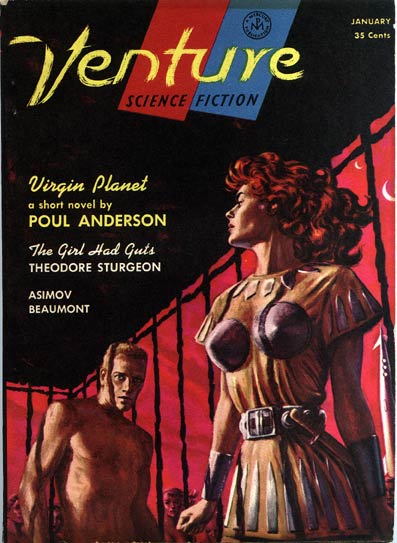
You may not know it had a name, but if you’ve spent any time talking about the arts, you’ve surely come across Sturgeon’s Law, coined by science fiction author Theodore Sturgeon: “Ninety percent of everything is crap.” The original quote appeared in a 50s pulp magazine:

I repeat Sturgeon’s Revelation, which was wrung out of me after twenty years of wearying defense of science fiction against attacks of people who used the worst examples of the field for ammunition, and whose conclusion was that ninety percent of SF is crud. Using the same standards that categorize 90% of science fiction as trash, crud, or crap, it can be argued that 90% of film, literature, consumer goods, etc. are crap. In other words, the claim (or fact) that 90% of science fiction is crap is ultimately uninformative, because science fiction conforms to the same trends of quality as all other artforms.

Venture Science Fiction

In other words, Sturgeon was originally defending science fiction from the snobs. OK, I can totally get behind that. I can agree that science fiction “conforms to the same trends of quality as all other artforms.” I wish he would’ve left it at that. But in his haste to defend science fiction from those who refused to take it seriously, Sturgeon instead, in an ironic twist, supplied generations of culture snobs with a cliché to justify their close-mindedness; that is, the blanket dismissal of 90% of all art.

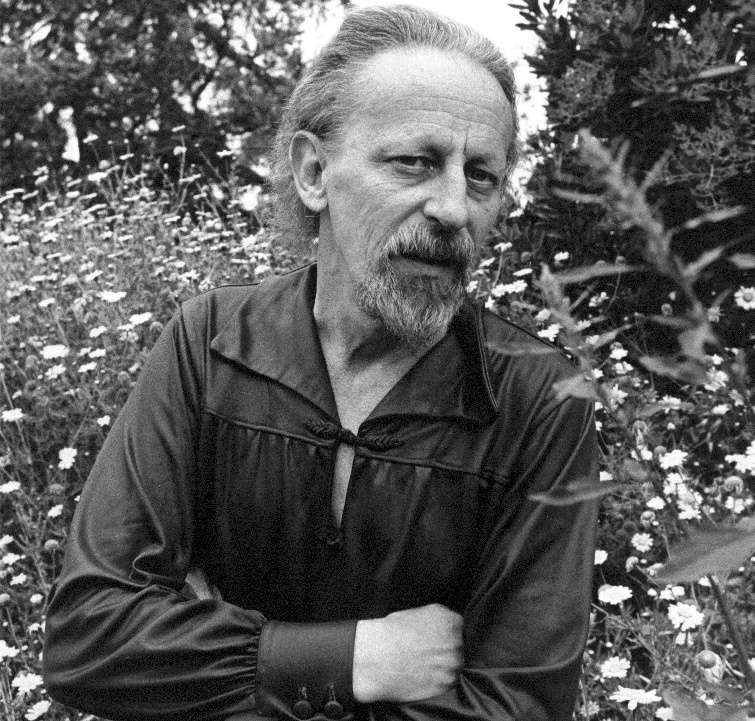
Theodore Sturgeon

Sturgeon is judging you for not being sufficiently judgmental.

But doesn’t Sturgeon get the 90% almost exactly backwards? Assuming art follows a bell curve (and why shouldn’t it?), you’re looking at, let’s say, 5% genius, 5% garbage, and 90% falling somewhere in the middle. In other words, 95% of an artform doesn’t suck, but is in fact excellent to OK. Hey culture snobs, I just outscienced you with science.

Bell Curve

I have no idea what these variables mean. Probably something about “standard deviations,” whatever the hell those are.

So can we please be a little more forgiving and receptive, please? Of course, all bets are off if we’re talking about a genre I hate. In those cases, Sturgeon is a visionary who is directly on point.

Posted in Art | Tagged , , , , | 15 Comments

Linkage

Paleo Retiree writes:

Posted in Food and health, Philosophy and Religion, Politics and Economics, Sex | Tagged , , , , , , , , | 4 Comments

Juxtaposin’: Celebrity Spokeswomen

Fabrizio del Wrongo writes:

Posted in Movies, Performers, Television | Tagged , , , , , , , | 5 Comments