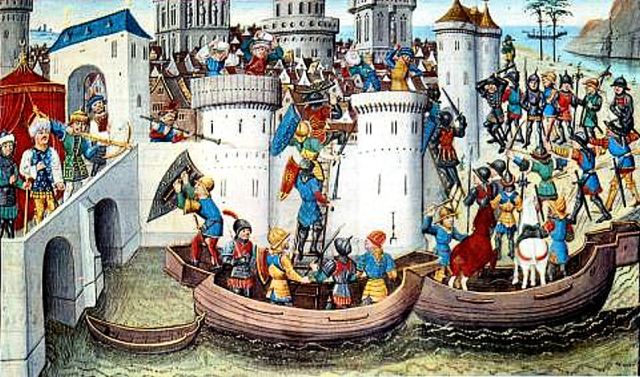
Near three months, without excepting the holy season of Lent, were consumed in skirmishes and preparations, before the Latins were ready or resolved for a general assault. The land fortifications had been found impregnable; and the Venetian pilots represented, that, on the shore of the Propontis, the anchorage was unsafe, and the ships must be driven by the current far away to the straits of the Hellespont; a prospect not unpleasing to the reluctant pilgrims, who sought every opportunity of breaking the army. From the harbor, therefore, the assault was determined by the assailants, and expected by the besieged; and the emperor had placed his scarlet pavilions on a neighboring height, to direct and animate the efforts of his troops. A fearless spectator, whose mind could entertain the ideas of pomp and pleasure, might have admired the long array of two embattled armies, which extended above half a league, the one on the ships and galleys, the other on the walls and towers raised above the ordinary level by several stages of wooden turrets. Their first fury was spent in the discharge of darts, stones, and fire, from the engines; but the water was deep; the French were bold; the Venetians were skilful; they approached the walls; and a desperate conflict of swords, spears, and battle-axes, was fought on the trembling bridges that grappled the floating, to the stable, batteries. In more than a hundred places, the assault was urged, and the defence was sustained; till the superiority of ground and numbers finally prevailed, and the Latin trumpets sounded a retreat. On the ensuing days, the attack was renewed with equal vigor, and a similar event; and, in the night, the doge and the barons held a council, apprehensive only for the public danger: not a voice pronounced the words of escape or treaty; and each warrior, according to his temper, embraced the hope of victory, or the assurance of a glorious death. By the experience of the former siege, the Greeks were instructed, but the Latins were animated; and the knowledge that Constantinople might be taken, was of more avail than the local precautions which that knowledge had inspired for its defence. In the third assault, two ships were linked together to double their strength; a strong north wind drove them on the shore; the bishops of Troyes and Soissons led the van; and the auspicious names of the pilgrim and the paradise resounded along the line. The episcopal banners were displayed on the walls; a hundred marks of silver had been promised to the first adventurers; and if their reward was intercepted by death, their names have been immortalized by fame. Four towers were scaled; three gates were burst open; and the French knights, who might tremble on the waves, felt themselves invincible on horseback on the solid ground. Shall I relate that the thousands who guarded the emperor’s person fled on the approach, and before the lance, of a single warrior? Their ignominious flight is attested by their countryman Nicetas: an army of phantoms marched with the French hero, and he was magnified to a giant in the eyes of the Greeks. While the fugitives deserted their posts and cast away their arms, the Latins entered the city under the banners of their leaders: the streets and gates opened for their passage; and either design or accident kindled a third conflagration, which consumed in a few hours the measure of three of the largest cities of France. In the close of evening, the barons checked their troops, and fortified their stations: They were awed by the extent and populousness of the capital, which might yet require the labor of a month, if the churches and palaces were conscious of their internal strength. But in the morning, a suppliant procession, with crosses and images, announced the submission of the Greeks, and deprecated the wrath of the conquerors: the usurper escaped through the golden gate: the palaces of Blachernæ and Boucoleon were occupied by the count of Flanders and the marquis of Montferrat; and the empire, which still bore the name of Constantine, and the title of Roman, was subverted by the arms of the Latin pilgrims.
Constantinople had been taken by storm; and no restraints, except those of religion and humanity, were imposed on the conquerors by the laws of war. Boniface, marquis of Montferrat, still acted as their general; and the Greeks, who revered his name as that of their future sovereign, were heard to exclaim in a lamentable tone, “Holy marquis-king, have mercy upon us!” His prudence or compassion opened the gates of the city to the fugitives; and he exhorted the soldiers of the cross to spare the lives of their fellow-Christians. The streams of blood that flowed down the pages of Nicetas may be reduced to the slaughter of two thousand of his unresisting countrymen; and the greater part was massacred, not by the strangers, but by the Latins, who had been driven from the city, and who exercised the revenge of a triumphant faction. Yet of these exiles, some were less mindful of injuries than of benefits; and Nicetas himself was indebted for his safety to the generosity of a Venetian merchant. Pope Innocent the Third accuses the pilgrims for respecting, in their lust, neither age nor sex, nor religious profession; and bitterly laments that the deeds of darkness, fornication, adultery, and incest, were perpetrated in open day; and that noble matrons and holy nuns were polluted by the grooms and peasants of the Catholic camp. It is indeed probable that the license of victory prompted and covered a multitude of sins: but it is certain, that the capital of the East contained a stock of venal or willing beauty, sufficient to satiate the desires of twenty thousand pilgrims; and female prisoners were no longer subject to the right or abuse of domestic slavery. The marquis of Montferrat was the patron of discipline and decency; the count of Flanders was the mirror of chastity: they had forbidden, under pain of death, the rape of married women, or virgins, or nuns; and the proclamation was sometimes invoked by the vanquished and respected by the victors. Their cruelty and lust were moderated by the authority of the chiefs, and feelings of the soldiers; for we are no longer describing an irruption of the northern savages; and however ferocious they might still appear, time, policy, and religion had civilized the manners of the French, and still more of the Italians. But a free scope was allowed to their avarice, which was glutted, even in the holy week, by the pillage of Constantinople. The right of victory, unshackled by any promise or treaty, had confiscated the public and private wealth of the Greeks; and every hand, according to its size and strength, might lawfully execute the sentence and seize the forfeiture. A portable and universal standard of exchange was found in the coined and uncoined metals of gold and silver, which each captor, at home or abroad, might convert into the possessions most suitable to his temper and situation. Of the treasures, which trade and luxury had accumulated, the silks, velvets, furs, the gems, spices, and rich movables, were the most precious, as they could not be procured for money in the ruder countries of Europe. An order of rapine was instituted; nor was the share of each individual abandoned to industry or chance. Under the tremendous penalties of perjury, excommunication, and death, the Latins were bound to deliver their plunder into the common stock: three churches were selected for the deposit and distribution of the spoil: a single share was allotted to a foot-soldier; two for a sergeant on horseback; four to a knight; and larger proportions according to the rank and merit of the barons and princes. For violating this sacred engagement, a knight belonging to the count of St. Paul was hanged with his shield and coat of arms round his neck; his example might render similar offenders more artful and discreet; but avarice was more powerful than fear; and it is generally believed that the secret far exceeded the acknowledged plunder. Yet the magnitude of the prize surpassed the largest scale of experience or expectation. After the whole had been equally divided between the French and Venetians, fifty thousand marks were deducted to satisfy the debts of the former and the demands of the latter. The residue of the French amounted to four hundred thousand marks of silver, about eight hundred thousand pounds sterling; nor can I better appreciate the value of that sum in the public and private transactions of the age, than by defining it as seven times the annual revenue of the kingdom of England.
In this great revolution we enjoy the singular felicity of comparing the narratives of Villehardouin and Nicetas, the opposite feelings of the marshal of Champagne and the Byzantine senator. At the first view it should seem that the wealth of Constantinople was only transferred from one nation to another; and that the loss and sorrow of the Greeks is exactly balanced by the joy and advantage of the Latins. But in the miserable account of war, the gain is never equivalent to the loss, the pleasure to the pain; the smiles of the Latins were transient and fallacious; the Greeks forever wept over the ruins of their country; and their real calamities were aggravated by sacrilege and mockery. What benefits accrued to the conquerors from the three fires which annihilated so vast a portion of the buildings and riches of the city? What a stock of such things, as could neither be used nor transported, was maliciously or wantonly destroyed! How much treasure was idly wasted in gaming, debauchery, and riot! And what precious objects were bartered for a vile price by the impatience or ignorance of the soldiers, whose reward was stolen by the base industry of the last of the Greeks! These alone, who had nothing to lose, might derive some profit from the revolution; but the misery of the upper ranks of society is strongly painted in the personal adventures of Nicetas himself His stately palace had been reduced to ashes in the second conflagration; and the senator, with his family and friends, found an obscure shelter in another house which he possessed near the church of St. Sophia. It was the door of this mean habitation that his friend, the Venetian merchant, guarded in the disguise of a soldier, till Nicetas could save, by a precipitate flight, the relics of his fortune and the chastity of his daughter. In a cold, wintry season, these fugitives, nursed in the lap of prosperity, departed on foot; his wife was with child; the desertion of their slaves compelled them to carry their baggage on their own shoulders; and their women, whom they placed in the centre, were exhorted to conceal their beauty with dirt, instead of adorning it with paint and jewels Every step was exposed to insult and danger: the threats of the strangers were less painful than the taunts of the plebeians, with whom they were now levelled; nor did the exiles breathe in safety till their mournful pilgrimage was concluded at Selymbria, above forty miles from the capital. On the way they overtook the patriarch, without attendance and almost without apparel, riding on an ass, and reduced to a state of apostolical poverty, which, had it been voluntary, might perhaps have been meritorious. In the mean while, his desolate churches were profaned by the licentiousness and party zeal of the Latins. After stripping the gems and pearls, they converted the chalices into drinking-cups; their tables, on which they gamed and feasted, were covered with the pictures of Christ and the saints; and they trampled under foot the most venerable objects of the Christian worship. In the cathedral of St. Sophia, the ample veil of the sanctuary was rent asunder for the sake of the golden fringe; and the altar, a monument of art and riches, was broken in pieces and shared among the captors. Their mules and horses were laden with the wrought silver and gilt carvings, which they tore down from the doors and pulpit; and if the beasts stumbled under the burden, they were stabbed by their impatient drivers, and the holy pavement streamed with their impure blood. A prostitute was seated on the throne of the patriarch; and that daughter of Belial, as she is styled, sung and danced in the church, to ridicule the hymns and processions of the Orientals. Nor were the repositories of the royal dead secure from violation: in the church of the Apostles, the tombs of the emperors were rifled; and it is said, that after six centuries the corpse of Justinian was found without any signs of decay or putrefaction. In the streets, the French and Flemings clothed themselves and their horses in painted robes and flowing head-dresses of linen; and the coarse intemperance of their feasts insulted the splendid sobriety of the East. To expose the arms of a people of scribes and scholars, they affected to display a pen, an inkhorn, and a sheet of paper, without discerning that the instruments of science and valor were alike feeble and useless in the hands of the modern Greeks.
Their reputation and their language encouraged them, however, to despise the ignorance and to overlook the progress of the Latins. In the love of the arts, the national difference was still more obvious and real; the Greeks preserved with reverence the works of their ancestors, which they could not imitate; and, in the destruction of the statues of Constantinople, we are provoked to join in the complaints and invectives of the Byzantine historian. We have seen how the rising city was adorned by the vanity and despotism of the Imperial founder: in the ruins of paganism, some gods and heroes were saved from the axe of superstition; and the forum and hippodrome were dignified with the relics of a better age. Several of these are described by Nicetas, in a florid and affected style; and from his descriptions I shall select some interesting particulars. 1. The victorious charioteers were cast in bronze, at their own or the public charge, and fitly placed in the hippodrome: they stood aloft in their chariots, wheeling round the goal: the spectators could admire their attitude, and judge of the resemblance; and of these figures, the most perfect might have been transported from the Olympic stadium. 2. The sphinx, river-horse, and crocodile, denote the climate and manufacture of Egypt and the spoils of that ancient province. 3. The she-wolf suckling Romulus and Remus, a subject alike pleasing to the old and the new Romans, but which could really be treated before the decline of the Greek sculpture. 4. An eagle holding and tearing a serpent in his talons, a domestic monument of the Byzantines, which they ascribed, not to a human artist, but to the magic power of the philosopher Apollonius, who, by this talisman, delivered the city from such venomous reptiles. 5. An ass and his driver, which were erected by Augustus in his colony of Nicopolis, to commemorate a verbal omen of the victory of Actium. 6. An equestrian statue which passed, in the vulgar opinion, for Joshua, the Jewish conqueror, stretching out his hand to stop the course of the descending sun. A more classical tradition recognized the figures of Bellerophon and Pegasus; and the free attitude of the steed seemed to mark that he trod on air, rather than on the earth. 7. A square and lofty obelisk of brass; the sides were embossed with a variety of picturesque and rural scenes, birds singing; rustics laboring, or playing on their pipes; sheep bleating; lambs skipping; the sea, and a scene of fish and fishing; little naked cupids laughing, playing, and pelting each other with apples; and, on the summit, a female figure, turning with the slightest breath, and thence denominated the wind’s attendant. 8. The Phrygian shepherd presenting to Venus the prize of beauty, the apple of discord. 9. The incomparable statue of Helen, which is delineated by Nicetas in the words of admiration and love: her well-turned feet, snowy arms, rosy lips, bewitching smiles, swimming eyes, arched eyebrows, the harmony of her shape, the lightness of her drapery, and her flowing locks that waved in the wind; a beauty that might have moved her Barbarian destroyers to pity and remorse. 10. The manly or divine form of Hercules, as he was restored to life by the masterhand of Lysippus; of such magnitude, that his thumb was equal to his waist, his leg to the stature, of a common man: his chest ample, his shoulders broad, his limbs strong and muscular, his hair curled, his aspect commanding. Without his bow, or quiver, or club, his lion’s skin carelessly thrown over him, he was seated on an osier basket, his right leg and arm stretched to the utmost, his left knee bent, and supporting his elbow, his head reclining on his left hand, his countenance indignant and pensive. 11. A colossal statue of Juno, which had once adorned her temple of Samos, the enormous head by four yoke of oxen was laboriously drawn to the palace. 12. Another colossus, of Pallas or Minerva, thirty feet in height, and representing with admirable spirit the attributes and character of the martial maid. Before we accuse the Latins, it is just to remark, that this Pallas was destroyed after the first siege, by the fear and superstition of the Greeks themselves. The other statues of brass which I have enumerated were broken and melted by the unfeeling avarice of the crusaders: the cost and labor were consumed in a moment; the soul of genius evaporated in smoke; and the remnant of base metal was coined into money for the payment of the troops. Bronze is not the most durable of monuments: from the marble forms of Phidias and Praxiteles, the Latins might turn aside with stupid contempt; but unless they were crushed by some accidental injury, those useless stones stood secure on their pedestals. The most enlightened of the strangers, above the gross and sensual pursuits of their countrymen, more piously exercised the right of conquest in the search and seizure of the relics of the saints. Immense was the supply of heads and bones, crosses and images, that were scattered by this revolution over the churches of Europe; and such was the increase of pilgrimage and oblation, that no branch, perhaps, of more lucrative plunder was imported from the East. Of the writings of antiquity, many that still existed in the twelfth century, are now lost. But the pilgrims were not solicitous to save or transport the volumes of an unknown tongue: the perishable substance of paper or parchment can only be preserved by the multiplicity of copies; the literature of the Greeks had almost centred in the metropolis; and, without computing the extent of our loss, we may drop a tear over the libraries that have perished in the triple fire of Constantinople.










 Blowhard, Esq.
 Callowman
 Sherbrooke
 Eddie Pensier
 Enzo Nakamura
 Epaminondas
 Fabrizio del Wrongo
 Fenster
 Brundle Guy
 Glynn Marshes
 Paleo Retiree
 Atypical Neurotic
 Question Lady
 Sax von Stroheim
 Sir Barken Hyena
 The Mistaken
 Uncouth Reflections