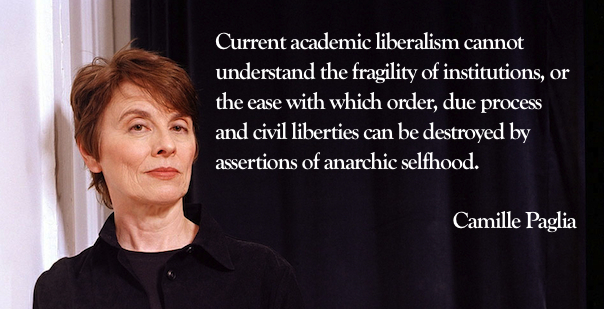
One of the most fascinating spectacles of 2015 was the hilarious and horrifying student protests across American universities. The Red Guard hysteria spread from one campus to another with a voraciousness that would make the Bubonic plague jealous: Mizzou, Yale, Claremont McKenna, Amherst, Occidental, University of Kansas, University of Vermont, Princeton, Hamilton — the list just keeps growing. Through it all, two thoughts kept occurring to me: 1) “Is the revulsion that I’m feeling what my grandparents went through when the student radicals took over colleges in the ’60s?” and 2) “Why the fuck would any sane person want to go to college now?”
Besides, given the widespread availability of quality college lectures, cheap ebooks, and other online resources, it’s easier than ever to educate yourself. So with that in mind, my nerdy list-making instinct kicked into action and I decided to create a DIY liberal arts curriculum. Looking for an ambitious and probably unrealistic New Year’s resolution? Here ya go. If nothing else, consider it a proof of concept.
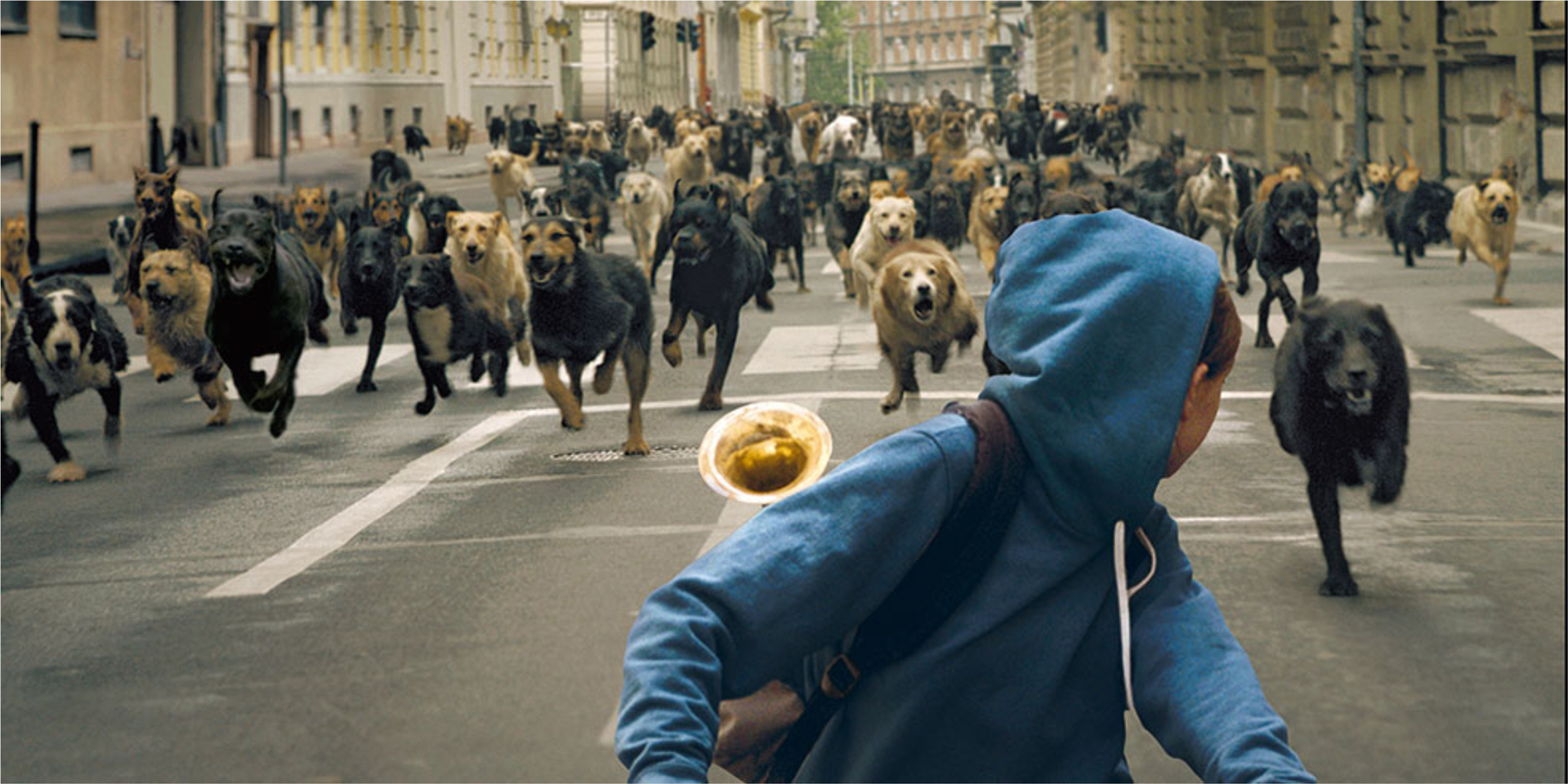
Artists have used animals to comment on the human condition since Homer. There’s often something to be gained in recognizing that animals experience the world through alien eyes — that their existence isn’t necessarily contingent on the exigencies of culture, civilization, etc. Perhaps that realization is part of what makes us human. In “White God,” Hungarian writer-director Kornél Mundruczó uses animals not to comment on our experience but to indict it. It’s an almost anti-human film, one that owes as much to the exploitation-bred revenge fantasies of Quentin Tarantino as to the frontier yarns of Jack London.
Narratively, Mundruczó borrows the strategy of the recent “Planet of the Apes” reboot: He encourages us to identify with his dogs, then marinates us in their suffering. All of that suffering is caused by humans, each one portrayed by an actor who seems chosen for his ability to fill out a dastardly outline. By the movie’s final third you’re primed for bloodletting. There’s no suspense or prurient horror-movie kick to the inevitable dog-on-human violence; it’s grim, hard-edged stuff. And I fear you’re supposed to experience satisfaction, or perhaps even a vicarious thrill, as you watch the wrongdoers get their comeuppance. It’s become common for movies to revel in the persecution of ideological malefactors. The victims in “White God” are stand-ins for nationalists: it’s made clear they favor Hungarian purebreds. Am I the only one who finds this trend off-putting?
The best moments in the movie are those in which the dogs are shown roaming the streets, doing dog things, and seeming to act according to a script and direction. Here Mundruczó reveals a psychological sensitivity that compliments his grasp of tone and detail. You can feel him inside the animals’ heads, the way Carroll Ballard is in his best movies, and George Miller was (in a very different way) in his great “Babe: Pig in the City.” It’s a pity that sensitivity doesn’t extend to his human subjects. There’s a complimentary story in “White God,” concerning a little girl and her estrangement from her father and pooch, but it lacks resonance, and it’s overpowered by the revenge material. It has a nice capper, though: A mystical scene in which the girl soothes the wild beasts. It wouldn’t be out of place in one of the Grimms’ fables.
The Ukrainian Maria — known by Mila, Zerra, and other working names — was in the news a few years back after some government-connected dude was filmed beating her in a cafe located in the city of Luhansk. I just learned about this while reading about her on TheNudeEU, where she is rated as a top-ten model. She seems to be working steadily, so I trust she’s recovered nicely. Let’s hope so, anyway.
There’s something elegant about her, but also something coltish, and maybe a little ungainly. Can you be elegant and ungainly at the same time? I think young women often can — especially ones with rangy, fashion-model bods. Though Maria’s well into her 20s, you get the sense that she’s still growing into herself. Hopefully she’ll always project that. It’s charming.
“Gett: The Trial of Viviane Amsalem” intends to condemn the divorce laws of Israeli, yet it’s more interesting for the debate it poses between personal liberty and traditional authoritarianism. What is the last movie to put the former value-system on trial? The movie, written and directed by siblings Ronit and Shlomi Elkabetz, is at its best when it’s at its most impartial. When it’s proselytizing for women’s rights, it’s often a bit ridiculous, all the more so because the female Elkabetz — she’s the co-writer, co-director, and star — portrays the yearning-to-be-divorced Viviane as a rigid pillar of contempt. We’re meant to take this rigidity as noble, and to sympathize with Viviane because she hasn’t been given what she’s asking for. Elkabetz, who looks something like a Semitic Valkyrie, has no trouble evoking nobility, but she either takes your sympathy for granted or is incapable of drawing you into a character — her Viviane is a shrill, inelegant slab of characterization, more a feminist figurehead than a person. (It doesn’t help that Elkabetz’s face is sometimes held in long close-up, a device that seems intended, like much of the movie, to evoke Dreyer’s “Joan.” Are the Elkabetzes suggesting that traditional marriage entails female martyrdom?) The filmmaking, though, is quite effective, especially in the way it allows an image of Viviane’s marriage to coalesce out of the reliable back-and-forth form of the courtroom procedural. And the Elkabetzes are sensitive and generous enough to give substantial voice to the opposition: Viviane’s husband, ably portrayed by Simon Abkarian, is never demonized, and he has the familiarly pathetic quality of a man whose wife has gone sour on him. (Abkarian succeeds in making him read as both high-handed and hurt.) The frankness and evenhandedness that comes through in the cataloging of the couple’s gripes yields an appealingly untidy sketch of humanity — one that I found far richer than that offered by the message-bound figure of Viviane.
Because who can imagine being interested in actual people?
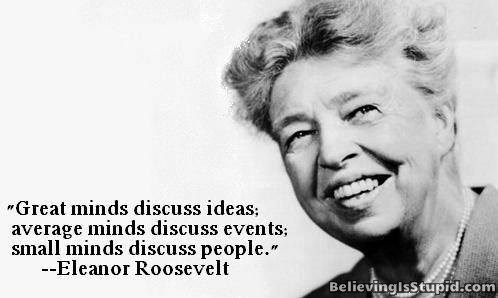
Listening to Meryl Streep impersonate the persnickety, dying-quail voice of Eleanor Roosevelt in Ken Burns’ “The Roosevelts: An Intimate History,” you get the sense that this is the role she’s been waiting to play since she hatched fully formed from a green alien pod at Yale. The production would be about twenty percent shorter absent her painstakingly overdone, sloowwwwly enunciated pronouncements regarding poor people, dams, etc. “Meryl,” you want to say, “spit it out already so we can get to George Will’s next howl-inducing metaphor concerning the American spirit.” A few episodes in, my interest was maintained by one topic only: Eleanor’s connection to lesbianism. (You can’t help but wonder why all of her gal pals favor slacks.) But Burns and co. are too square, too reverential to address it. I’d love to see someone make an historical-figure travesty along the lines of “Abraham Lincoln: Vampire Hunter” in which Eleanor, transposed to the swinging ’60s, dresses like Monica Vitti in “Modesty Blaise” and engages in hot lesbo action with a similarly transposed Mamie Eisenhower. Where “intimate histories” are concerned, I think dykes are more germane than dams.
Suggested titles for future Ken Burns projects:
“The New York Times: Ode to a Gray Lady”
“Paul Robeson: Black on the Outside, Red on the Inside”
Back here Blowhard Esq. summed up UR’s philosophy in a nutshell by quoting Frédéric Bastiat, which makes us classical liberals in economic matters I think. I don’t object since that line of thinking is agreeable. Plus, I didn’t see Blowhard Esq. as plumping for the kind of doctrinaire approach I am averse to. Let a hundred flowers bloom, I say, and keep the Roundup handy.
But it got me thinking about my philosophy, or relative lack of one.
I am hardly spiritual. There’s not much I can do about that. I am not wired to have Buddha on the brain, as JayMan puts it. But I don’t draw from that a firm atheistic world view either.
When I was in college and first read about pragmatism I thought I didn’t get it since it was so transparently weightless. Is that all there is? Over time I turned the question on its head and decided that if I had an identity in terms of ideas pragmatism was it. Thus when I came across a quotation like the famous one by Holmes on the law
The Life of the law has not been logic. It has been experience.
I got a pleasant little ping feeling in my brain. Of course the law did not descend from heaven–it evolved through trial and error, right?
The same ping when I read Ambrose Bierce’s definition of “decide” in The Devil’s Dictionary:
To succumb to the preponderance of one set of influences over another set.
This style of meme itself evolved–in Holmes’ case as a result of the dual impact of Darwin and the trauma of the Civil War. Bierce was a contemporary of Holmes, too, and also profoundly affected by his experience as a Union soldier.
Over time, I came to see that, as a Northern European by genes and as a quasi-Yankee New Englander growing up in the shadow of such ideas I was powerless to escape them. My initial resistance to pragmatism, I concluded, was that of the fish that does not recognize it is in water. And as an increasingly thoroughgoing pragmatist, I was obliged to turn my philosophy back on itself, and to recognize, ruefully for the most part, that my thoughts were hardly my own but bound up with biology, history and culture. Pragmatism included. It is not a particularly heroic fate, but in the end all heroes are bores, and who wants to be that?
For me, the first rule of pragmatism: no skyhooks. Cranes yes; skyhooks no. Church doctrine? Uh-uh. Natural rights? No thanks. And so on and so forth with all those conversation stoppers from the sacredness of the free market to the holiness of Emma Lazarus’s creed.
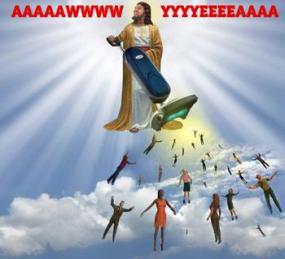
The Rapture? Good luck with that. One rather yuge skyhook.
So I am a receptive audience for Matt Ridley’s new book, The Evolution of Everything: How New Ideas Emerge.
Ridley’s book is at first glance an ambitious one. Ridley takes the general theory of evolution, something that he sees at work in the universe as a whole, and applies it to successive iterations of humans and their products. The chapters are set up to consider such facets serially: evolution and genetics, evolution and culture, evolution and population, leadership, religion, government, money, the internet.
As such, evolution is portrayed as having a kind of “magic key” quality. Look through its lens and you can now see everything–everything–the way it is, not the way you might want it to be. And what is it really? A bottom-up, not a top-down, process.
It is, in short, a long brief against skyhooks. Sometimes it goes down easy. Look over there at money . . . you think you see a skyhook there? Sorry, no. Look over there at religion. A skyhook for sure, right? No again.
Other times I am not so sure. Kings? We don’t need them (but: never did?) Planning? Beware that urge (but: where is the line between centralized and decentralized plans?) The internet? It is not part of a command world but an organic one (but: what about the NSA and the Great China Firewall?)
To say nothing about open borders. Heck, let people go where they will!
In the end, Ridley’s book is not quite as ambitious as I thought going into it. All of history is, as it turns out, just one damned crane after another, even if we have been blind to the obvious.
Am I persuaded about the illusion of skyhooks? Well, yes, in the sense that I don’t think I could really see things in any other way. I am an easy target.
But was I totally satisfied? No, not really. But how can I be? The pragmatic/evolutionary viewpoint would not be greatly comforting in it core, if a core it had. There is a pesky inherent discomfort in the evolutionary worldview.
There’s also a little naturalistic fallacy risk. Even if all, or most all, things are best viewed as mostly bottom up, does that mean we should view them that way as we conduct our lives? What we think and what animates our actions are not always the same thing. Indeed, they are seldom aligned all that well–a central insight of the very evolutionary thinking Ridley depends on.
There’s also the universal acid problem. Ridley acknowledges Daniel Dennett’s notion that Darwin’s idea is a dangerous one, a kind of universal acid that will work through anything.
It is hard dealing with that dang universal acid. Most of the time you have to make allowances.
And Ridley does. Thankfully, he doesn’t fully embrace the no skyhook rule. After all, skyhooks may not exist but the belief in skyhooks surely does. And so the question, from an adaptive point of view, is whether the belief in skyhooks, however fanciful, is better than a belief in cranes. Better how?
It is here that Ridley needs to tiptoe more gently. He cannot deny the existence in the belief in skyhooks–they have been central to, or simply in, the development of civilization. But he nonetheless feels the need to make the case for cranes.
But what is that case?
That we should all believe in cranes because c’mon let’s face it skyhooks don’t exist?
That the belief in skyhooks was once adaptive but no longer is because of . . . ?
That the development of the skyhook idea was just a kind of wrong turn, and we’d all be much better off had we stuck to cranes all along?
That we ought to pay more attention to cranes than skyhooks, for whatever reason?
Ridley seems to end up with the latter, more or less. But it is all pretty muddy. While his book is an excellent brief for the way reduced power of skyhooks I really see it as tackling the question of “how ideas emerge” in a fundamental way. Doing that would require a deeper reflection into the difficult and tricky relation between circumstances and ideas. A natural history of memes, as it were.









 Blowhard, Esq.
 Callowman
 Sherbrooke
 Eddie Pensier
 Enzo Nakamura
 Epaminondas
 Fabrizio del Wrongo
 Fenster
 Brundle Guy
 Glynn Marshes
 Paleo Retiree
 Atypical Neurotic
 Question Lady
 Sax von Stroheim
 Sir Barken Hyena
 The Mistaken
 Uncouth Reflections