
Paleo Retiree writes:
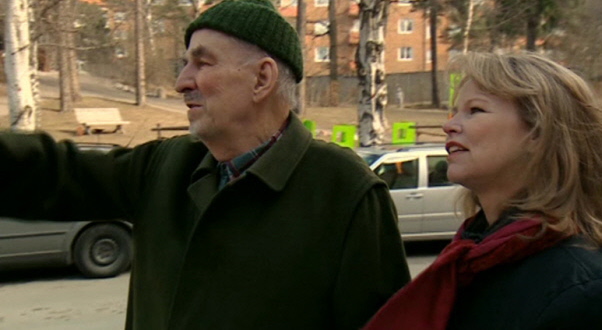
This produced-for-Swedish-TV doc by Marie Nyreröd is basically an informal visit with a very aged Ingmar Bergman. The legendary film and theater director is living out his final years on the little island of Fårö. He’s 86 and alone — his fifth wife died 8 years previously.
Bergman drives Nyreröd around the flat, rural-to-wild, sparsely-populated island. He walks her through his ranch house, showing off trinkets and relics. Everything in the place — modernist but rustic, full of irregular textures and natural materials — is beautiful, modest, subdued and tasteful. He thumbs through snapshots and newspaper clippings; he shows Nyreröd some home-movie and backstage film footage, sharing recollections and ruminations along the way.
Nyreröd makes some efforts to include enough information about Bergman to supply an overview of his life — the childhood, the ambition, the women, the fame, the tax exile, the return. But she doesn’t spend much effort on introducing the man, or on selling you on his importance; she takes it for granted that her intended audience has shown up with the proper reverential attitude, as well as with some familiarity with the outlines of the biography. The general attitude seems to be “We’re lucky to have any kind of audience with the great man, so we’re just going to go along with whatever he’s willing to give us.”
Despite the haphazard quality of the movie — it’s an edited-down segment from a three-part series that Nyreröd made about Bergman and his work — the Question Lady and I enjoyed sitting through it. What a visit to another era it is, to a time when artists took themselves really, really seriously and worshipful civilians eagerly ate the solemnity up. In today’s leveled-out, compulsively irreverent, web-ified world, is there anyone who can get away with this kind of self-serious carrying-on?
Bergman talks — slowly and reflectively, as though he’s Erland Josephson experiencing a particularly hard-to-process revelation — about his fears, his weakness, his flaws. He clutches thick sweaters with gnarled, old-man fingers, and he helps himself to epic hesitations and ponderings. What’s being conveyed by his manner is that deep metaphysical and personal truths, painful to connect with and even more agonizing to divulge, are being attained. In fact, the content of his speeches is surprisingly banal, along the lines of having been a child who was afraid of the dark. But Bergman delivers these micro-monologues with enormous, if glacially-paced and feeble-voiced, relish. 90% of what he has to say concerns his shortcomings, his lies, his deceitfulness. He apparently didn’t have it in him to be much of a husband to his many wives, and was an even worse father to his nine kids. You can be certain that he doesn’t neglect to dwell on his present-day feelings of isolation. Hey, he’s Bergman. Would you want him not to overwhelm us with his suffering?
The facet of the film that struck me most was the juxtaposition of the young and middle-aged Bergman who we see in newsreel and home-movie footage with the old man we’re hanging out with in the present. This isn’t just because of the usual “Is this what it all comes to?” aspect, though that certainly has its unavoidable impact. It’s also because of a contrast and a continuity. The contrast: The Bergman we see from the ‘50s thru ‘70s — an era when the “foreign art movie” reigned supreme and when Bergman was universally regarded as one of the world’s great creators — is confident, funny, swaggering. He’s got vigor as well as a magic touch; he isn’t just going from one artistic triumph to another, he’s going from one world-class woman to another. (And what women they were. Among his lovers: Harriet Andersson, Bibi Andersson and Liv Ullmann.) He’s jaunty, sexy and full of himself. The Bergman we spend time with in the doc’s present tense is a querulous, lonely, ponderous old man, moving his bony hands anxiously, playing slyly on our sympathies, and pondering his failures in a voice that’s frequently whiney. The continuity: though his levels of vigor have certainly declined and though his personal style has certainly changed, Bergman was apparently always and everywhere a man of the theatre, taking his moments, leaping on his opportunities, and imposing his vision. Once a hambone, always a hambone, I guess.
All that said, Fårö — where Bergman made some of his more austere films and where he then had his house constructed — is ravishing in its bleak way; the house itself is a beauty; and it’s fun to be reminded of the man and his era. The doc made the Question Lady and me want to re-watch a few of his films and catch up with a few of the Bergmans we somehow missed first time around. The pretentions and ambitions of the era may look a little ludicrous in today’s light, but there’s no question that Bergman was a giant.
Related
- We streamed the doc on Hulu+.
- The Gotland website, where you can learn more about Fårö.
- A New York Times visit to Fårö. Fun passage: “When Bergman died, the details of his funeral were kept under wraps. ‘People kept the secret from the press until the grave was dug the night before,’ said Mr. Soderlund, who provided the wood that was used to make Bergman’s coffin. ‘These were his instructions. He directed his own funeral’.”
- Civilians who visit Fårö seem to love the place.
- Bergman died in 2007 but the annual celebration of him and his work rolls on.
- A few titles to start with for those who haven’t done their Bergman yet: “Summer With Monika,” “Smile of a Summer Night,” “Wild Strawberries,” “The Seventh Seal,” “Persona,” “Scenes from a Marriage,” “The Magic Flute,” “Fanny and Alexander.”








 Blowhard, Esq.
 Callowman
 Sherbrooke
 Eddie Pensier
 Enzo Nakamura
 Epaminondas
 Fabrizio del Wrongo
 Fenster
 Brundle Guy
 Glynn Marshes
 Paleo Retiree
 Atypical Neurotic
 Question Lady
 Sax von Stroheim
 Sir Barken Hyena
 The Mistaken
 Uncouth Reflections