Mmmmm, Puritan Spread

Glynn Marshes writes:

@Fenster–

Years ago I picked up a book, “The Development of Central and Western New York,” from Gutenberg Books on Monroe Ave. in Rochester.

It’s a collection of “contemporary accounts,” compiled by Clayton Mau, published in 1958 — and one of those accounts is about the Mormons in Upstate New York; it is taken from a book by Orsamus Turner, who claims to have known the Smiths when they lived in Palmyra, and seems to have formed a rather dim opinion of them 🙂

And happy day — the bits of Turner’s book that cover the Smiths are out there on the Interwebs:

Joseph Smith, the father of the prophet Joseph Smith, jr., was from the Merrimack river, N. H. He first settled in or near Palmyra village, but as early as 1819 was the occupant of some new land on “Stafford street,” in the town of Manchester, near the line of Palmyra. * “Mormon Hill ” is near the plank road about half-way between the villages of Palmyra and Manchester. The elder Smith had been a Universalist, and subsequently a Methodist; was a good deal of a smatterer in scriptural knowledge, but the seed of revelation was sown on weak ground; he was a great babbler, credulous, not especially industrious, a money-digger, prone to the marvellous; and, withal, a little given to difficulties with neighbors, and petty law-suits . . .

Mrs. Smith was a woman of strong, uncultivated intellect; artful and cunning; imbued with an ill-regulated religious enthusiasm. The incipient hints, the first givings out that a prophet was to spring from her humble household, came from her; and when matters were maturing for denouement, she gave out that such and such ones — always fixing upon those who had both money and credulity — were to be instruments in some great work of new revelation. The old man was rather her faithful co-worker, or executive exponent. Their son, Alvah, was originally intended or designated, by fireside consultations and solemn and mysterious out-door hints, as the forthcoming prophet. The mother and the father said he was the chosen one; but Alvah, however spiritual he may have been, had a carnal appetite; ate too many green turnips, sickened and died. Thus the world lost a prophet, and Mormonism a leader; the designs, impiously and wickedly attributed to Providence, were defeated; and all in consequence of a surfeit of raw turnips. Who will talk of the cackling geese of Rome, or any other small and innocent causes of mighty events after this? The mantle of the prophet which Mrs. and Mr. Joseph Smith and one Oliver Cowdery had wove themselves — every thread of it — fell upon their next eldest son, Joseph Smith, Jr.

Btw the title of the Turner book is:

History of the Pioneer Settlement of Phelps and Gorham’s Purchase, and Morris’ Reserve; Embracing the Counties of Monroe, Ontario, Livingston, Yates, Steuben, Most of Wayne and Allegany, and Parts of Orleans, Genesee and Wyoming. To Which is Added, A Supplement, or Extension of the Pioneer History of Monroe County. The Whole Preceded by Some Account of French and English Dominion—Border Wars of the Revolution—Indian Councils and Land Cessions—The Progress of Settlement Westward from the Valley of the Mohawk—Early Difficulties with the Indians—Our Immediate Predecessors the Senecas—with “A Glance at the Iroquois.”

Here’s a pic, which I wish I hadn’t seen because I now want a copy, and not only because it has such a mind-bogglingly gorgeous title.

Sadly $850 is a bit out of my Kindle-calibrated budget 😉

Posted in Books Publishing and Writing, Travel | Tagged , | 8 Comments

Linkathon

Paleo Retiree writes:

Posted in Linkathons | Tagged , , | 3 Comments

The Lost Tribe of Massachusetts

Fenster writes:

The political and cultural commentator Walter Russell Mead is always entertaining and almost always spot-on (though IMHO he can sometimes can miss the boat).  He recently wrote about what he termed the Mormon utopia in Utah, by which he mostly meant that a Gallup Poll indicated Utah was a pleasant place to live.

Now, Mead does like to point out Blue State foibles, but he didn’t go out of his way to pick a fight with this post, which for the most part could be taken at face value.  But we are in a polarizing place at the moment in our culture, so a number of his commentators decided to read the post in blue and red terms, and to point out seeming contradictions.  One sneered that if Red States are happier, why is Minnesota number two in the poll?  Another wrote:

Right up there with Utah is that increasingly blue state, Colorado. Down at the absolute bottom are Obama-loathing West Virginia and Mississippi.

Take that Doctor Mead!!

It is a bit of a muddle until you bring Albion’s Seed into the picture.  That’s the book by David Hackett Fisher that documents the continued importance of the four separate English folkways in the United States: the Puritans (settling New England), the Cavaliers (the South), the Quakers (the mid-Atlantic) and the Scots-Irish (the back country).  As Razib has written, Mormons, while seemingly conservative, are far from classic Red Staters in Albion Seed terms.  Rather, they are in effect descendants of the Puritan tradition, not the red-meat and red-state lovin’ Cavaliers or Scots-Irish.  Under this reading, Utah and Minnesota are the truer kindred spirits.

This may account for why, despite my being flummoxed over Mormon doctrine, I feel totally comfortable and at home with Mormons as opposed to say, rural Americans of the Scots-Irish variety.

This may also account for my partiality, as a native New Englander, for upstate New York. Readers of Albion’s Seed will know that the Puritan tradition spread west from New England through upstate New York and into the Upper Midwest.  By contrast, the Scots-Irish spread up through Appalachia as far as Central Pennsylvania.  Which may explain why I feel somehow at home with rural New Yorkers but slightly out of place with rural Pennsylvanians, at least those west of the Quaker-Scots-Irish divide in the eastern part of the state.  And yes, the trees are the right height in Puritan country too.

Posted in Politics and Economics | Tagged , , , | 2 Comments

Upstate New York

Fenster writes:

There’s an old saying to the effect that the little stations are happy because the big trains pass them by.  Something like that is at work in upstate New York, a place that is charming in direct relation to its longstanding bad economics.  The place exports more people than apples.  In New England, where we live, it is common to meet upstate emigres, having moved (often as a result of college) and never returned.

Many would like to.  I recall a professional colleague who waxed eloquently about learning to sail on Irondequoit Bay, and how much she would love to move back.  But the job picture is just not that cooperative.  My wife grew up in upstate and her circle of friends in New England has somehow ended up consisting of other expatriates.  She says she finds them to her liking because of their directness and unpretentiousness.  I agree.  So our summer place is in deep upstate.

There are two kinds of places that don’t support chain restaurants: those that are too wealthy to allow it, and those that are sufficiently. . . umm . . . insufficiently resourced as to remain behind the curve.  Our place is in the latter kind of town.  It is hardly perfect but it beats Southampton, I’ll tell ya, and not just on the issue of home prices, which are ridiculously low by coastal standards.  The people are wonderful and the scenery is at this time of year just about perfect (though that could be because I grew up in a geographically similar environment and find the trees just about right).

Yesterday at the local farmer’s market (excellent produce BTW) they were selling ice cream sodas for a buck.

Image

Then I went over to the library, where the bake sale was running down and a cake had been marked down from $5 to $2 to free.

Image

I’ve never seen a cake so red, and this odd affect no doubt accounts for the drastic markdown.  It was tasty, though.

A few miles from our place I came across this historical marker in village of Port Byron.

Image

Who knew Port Byron was the home of that stuff?  You have to like the sense of humor of the guy who wrote the text for the monument.  It isn’t enough to mention that the factory burned down; he also had to point out that the inventor’s patent was voided.

Well, I guess that says something about the fortunes of upstate.  The Economist predicts that the area is due for a resurgence.  And that makes sense if only because of the principle of buy low sell high.  And it would be churlish of me to prefer the place remain in its current state.  It deserves a comeback.  It would be nice if it were handled well.

Posted in Personal reflections, Photography, Travel | Tagged , , | 5 Comments

Put Down That Bacon

Fenster writes:

My first post here and I am thinking about how and whether the site will cohere or whether it is likely to be pretty shaggy and wide-ranging.  I favor the latter.

Still and all, it might be nice from time to time if threads were to converge and my first posting is in that spirit.  I know that, true to his handle, Paleo Retiree is into paleo eating.  And I am, due to my professional background, into higher education.  Is is possible to come up with a post that touches on both.  Yes!

The president of Paul Quinn College has just announced that henceforth the campus will be pork free.  This is not in the name of something as grounded as religious doctrine–while not much of a believer myself I am a believer in the ability of private colleges to link their practices to their missions, and if pork is a problem (as at Brandeis, say) fine and dandy.  But here the situation is much more heavy handed in a way that is hard to relate to the college mission.

Beyond that there are all the paleo issues to consider.  Bacon has been banned but carbs remain on the menu.  Go figure.

Posted in Education, Food and health | Tagged , , , | Leave a comment

“Lifeforce” and Dan O’Bannon

Sax von Stroheim writes:

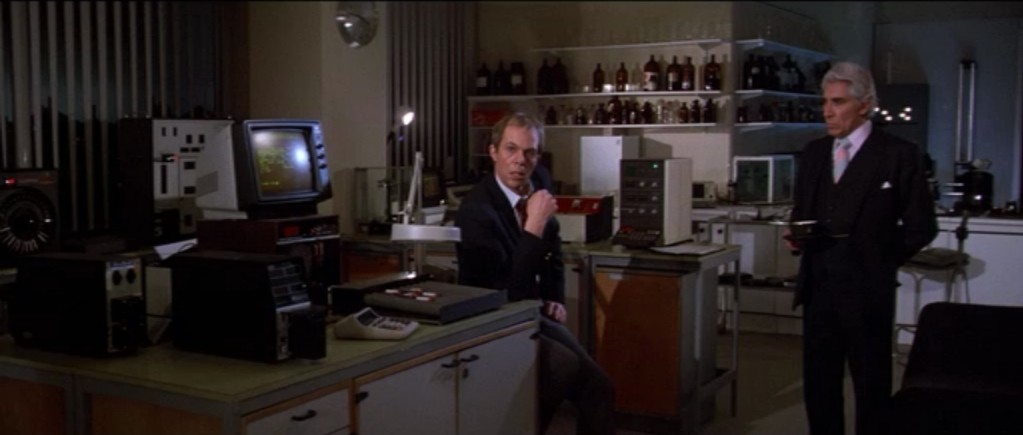
Considering the kinds of movies I like (lots of horror, sc-fi, action/adventure), I’m surprised that it took me so long to finally watch “Lifeforce”, a 1985 horror movie directed by Tobe Hooper. I know that I came close to renting it at the video store at least a half a dozen times; what kept me from pulling the trigger was a vague sense that it wasn’t an especially well-loved film. Still, since it’s written by Dan O’Bannon – one of my favorite screenwriters – it was only a matter of time before I finally got around to it (it’s currently available for streaming on Netflix Instant).

I’m glad that I waited: it’s a strange, ambitious movie, and I’m not sure that I would have appreciated all of its idiosyncracies when I was younger. “Lifeforce” is a kind of “everything but the kitchen sink” horror movie. It starts out seeming like it’s going to be a sci-fi horror movie along the lines of “Alien” (also written by O’Bannon)…

…but it comes back to Earth looking more like an update of the “Quatermass” series…

…before touching in on Gothic Horror…

…and the Zombie Apocalypse:

It’s like a catalog of the filmmakers’ favorite sci-fi and horror movie elements. The plot involves a space vampire, preying upon (and taking possession of) various unwitting humans. There’s not much in the way of plot-logic, but Hooper holds everything together through his filmmaking.

Some other things I liked about the movie:

O’Bannon and his co-writer Don Jakoby always zig when you expect them to zag: as the movie shifts through subgenres, it also seemingly shifts protagonists, and it isn’t until the movie is halfway over that we’ve settled into following the guys who turn out to be the movie’s “heroes”. This gives us the sense that the story is really unfolding organically rather than dutifully hitting all of the conventionally required beats.

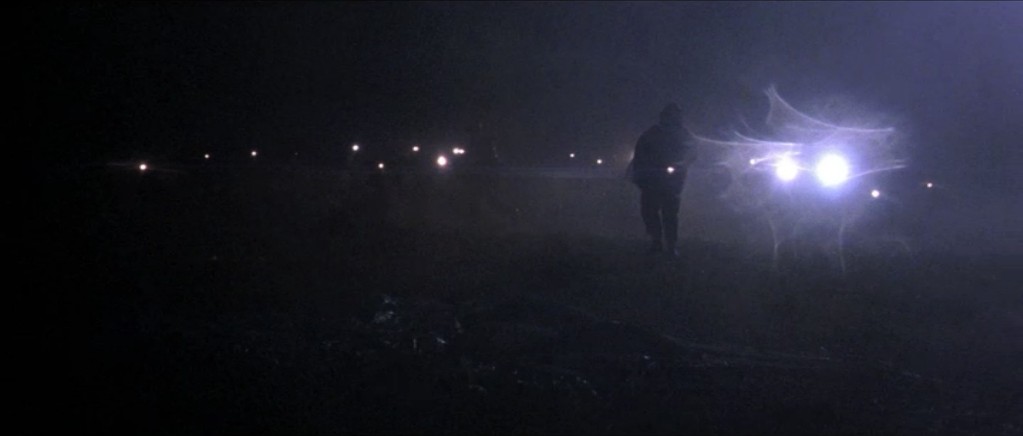
There are a lot of inventive special effects (the movie cost $25 million and it shows) and the cinematography, by Alan Hume, is terrific throughout.  As an aficionado of lens flare, I really dug images like this:

I also liked that it isn’t a kids/teen movie. That isn’t to say it’s a “grown-up” movie, necessarily, but Hooper handles the material with a kind of integrity and seriousness that gives unexpected emotional weight to the ending. There are a number of legitimately over-the-top moments, but nothing is ever played for camp.

O’Bannon is one of my favorite underknown figures in American movies. He co-wrote “Dark Star”, John Carpenter’s directorial debut, and worked on Jodorowsky’s abandoned “Dune” project – during which time he collaborated with the great French cartoonist Moebius on a comic strip that would end up inspiring the visual design of “Blade Runner”:

He had the biggest success of his career with his screenplay for “Alien” (co-written with Ronald Shusett, and then re-written by Walter Hill and David Giler), but his key movie is “The Return of the Living Dead”, which he also directed. “Return” is the greatest splatterstick movie of all time: a raunchy, irreverent horror comedy seemingly inspired equally by EC’s Horror Comics and Kurtzman’s Mad Magazine.

O’Bannon’s healthy disrespect for authority and suspicion of conventional Hollywood heroic narratives lie at the heart of what makes his work distinctive, and those are elements that seem to be sadly absent from most of today’s fx-driven adventure flicks. It’s instructive to compare the recent remake of “Total Recall”, with a script by Kurt Wimmer and Mark Bomback, to the original movie, which O’Bannon wrote with Ronald Shusett: the new movie is the kind of straightforward action movie power fantasy that the earlier movie spent much of its time subverting. I wish there was more room for subversives like O’Bannon in Hollywood today.

Posted in Movies | Tagged , | 5 Comments

“Two Days in Paris”

Paleo Retiree writes:

The Wife and I managed only 20 minutes of this charmer-wannabe, written and directed by the French actress Julie Delpy, before giving up. It’s about a spatting/loving couple (Adam Goldberg, not very appealing, and Delpy herself), and it seems intended as a female take on a Woody Allen movie. It completely failed to engage us, though. But we watched the interview with Delpy that’s included on the DVD, and we both liked her. She’s smart, and she has a real performer’s put-it-out-there guts. The movie is currently available on Netflix streaming.

Posted in Movies, Performers | Tagged , | 4 Comments

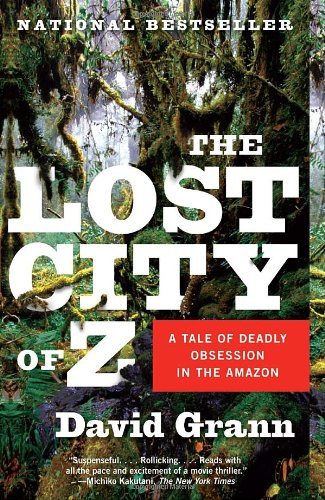
Book Notes: The Lost City of Z

Blowhard, Esq. writes:

Image

Just as Into Thin Air made me never, EVER want to go anywhere near Mt. Everest, this story makes me never, EVER want to go anywhere near the Amazonian jungle. The two landscapes are so different it’s hard to imagine them existing on the same planet. Whereas Everest seems to wear you down with its unrelenting bleakness and desolation, the Amazon overwhelms you with life that is, essentially, constantly trying to eat you. Insects and other animals will literally burrow into your flesh and consume you from the inside out.

The book is the story of Percy Fawcett, a gentleman-explorer who disappeared into the Amazonian jungle 85 years ago. Considered one of the great explorers of his era, he was one of the models for Indiana Jones. But the “gentleman” part is debatable. He ignored his wife (who died penniless and demented) and showed little interest in his children. He was a maniacal obsessive whose compulsions ruined many men. (Shades of Aguirre). He was blessed with a preternaturally hardy constitution and grew very cross when others could not keep up, thus driving his men to exhaustion, mutiny, and sometimes death. Like another Krakauer hero, civilization held no interest for him and he was only at home in the wild. While searching for the lost civilization of El Dorado his obsession finally did him in, killing him and his son.

Reading the book, I kept thinking of those manic CEOs who seem to sacrifice everything to succeed in business. People who have no interest or time for those people or that do not further their project, corporation, or bottom line. They have a magnetic charisma, attracting other like-minded obsessives and repelling those who do not share or cannot fathom their vision. (See Walter Isaacson’s Steve Jobs.)

I gave the book 4 stars on goodreads b/c, absorbing as it was, it was still too long at 320 pages. Lucky for you, it was expanded from a New Yorker magazine piece that, while quite lengthy, is more manageable. Read it here.

Posted in Books Publishing and Writing, Travel | Tagged , , | 3 Comments

The Camera Loves…

Blowhard, Esq. writes:

The camera loves Anna Karina

…Anna Karina.

Posted in Movies, Performers | Tagged , , | 2 Comments

Photo of the Day: Long Beach, CA

Blowhard, Esq. writes:

Photo of the Day: Long Beach, CA

Can a building have too much ivy? No, of course not, what kind of stupid question is that?

Posted in Architecture, Photography | Tagged , , | 1 Comment