Say this about the virus: it has had some positive effects. Of course, opinions differ. In many instances whether an effect is positive or not will be in the eye of the beholder. Some, but not all, might savor the possibility that higher education will be in for a pretty serious comeuppance by the time things settle down.
But some effects of the virus are inarguably positive, and this includes the many ways that it has brought people together. Families are at home sharing meals. People are more prone to take walks with one another, observing simple pleasures together. When strangers pass one another on trailside walks while the appropriate distances are observed one notices more conversation in passing than in the past, in the manner of how community is more readily formed by expats finding themselves alone in a different country.
In my case the positive effects also involve the use of digital means to connect with extended family, including relatives that do not regularly assemble in person. My wife’s side of the family recently met by Zoom in a way that came close to the kind of in-person get togethers we have on Thanksgivings and over summer vacations. And my own side of the family, separated by years and distances and without much recent history of large get-togethers, have been conversing via long and tangled email exchanges that touch on everything from what the kids are doing to Swedish family history.
While the “kids” in the group are younger, relatively speaking, the older cousins running the show are mostly Boomers. And so it was perhaps inevitable that one of the tangled threads in the email discussion would be on the Beatles.
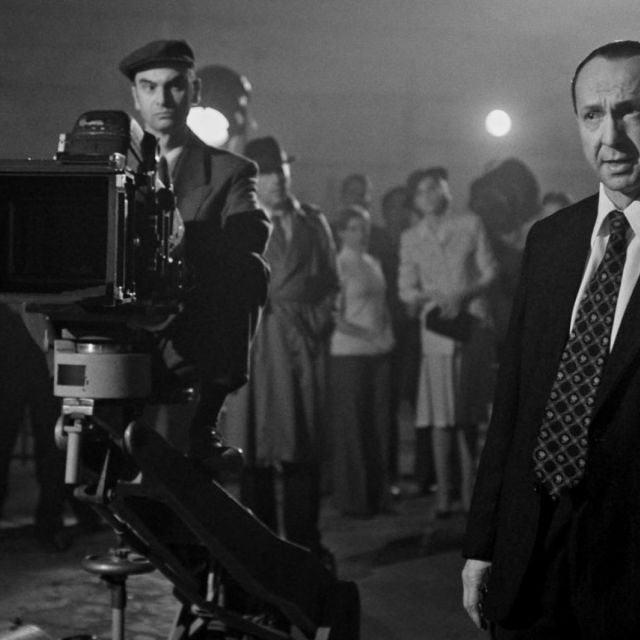
“Curtiz” is a moderately successful Hungarian production that uses the filming of “Casablanca” to examine conflicted reactions to the Second World War. As prolific filmmaker Michael Curtiz, Ferenc Lengyel gives a cagey, intelligent performance. Like Rick Blaine, the hero of “Casablanca,” Lengyel’s Curtiz is an expat who’s found peace in a foreign land. He knows he has it good in Hollywood (an especially commodious hideout), and he doesn’t want entanglements, war and family trouble in particular. His hardened exterior gives him an edge: not only does it allow him to intimidate underlings, it immunizes him against sentimentality and weakness.
“Curtiz” is stylistically arch and filtered through its own sensibility. At first I was put off by the high-contrast black-and-white photography, because to me it suggests arty perfume commercials rather than 1940s Hollywood; but the picture’s artifice gradually won me over. If it were more naturalistic, its strategies, which are also highly artificial, might seem discordant.
Director Tamás Yvan Topolánszky (he also co-wrote the screenplay) encourages us to draw comparisons between Curtiz and Rick, and to acknowledge in the director’s relationship with his estranged daughter an echo of the relationship between Rick and Ingrid Bergman’s Ilsa. It’s a cornball idea, and only partially successful, but the movie’s Curtiz keeps us happily off balance: his complexity denies easy judgements. If he isn’t heroized, as Rick is in “Casablanca,” it’s because Topolánszky doesn’t want us to see his subject as noble. This is part of larger commentary on the glibness of Hollywood mythmaking, presented here as an adjunct of propaganda. Rick is the fantasy, Curtiz the rude stuff that the fantasy papers over.
“Curtiz” reminded me that I’ve always been bothered by the way in which “Casablanca” invites us to see ourselves in Rick, and to pat ourselves on the back for it. (What guy involved in a breakup doesn’t imagine that he’s making a hard sacrifice rather than being dumped?) Topolánszky seems to share my discomfort; what’s more, he homes in on it and gives it an ideological thrust. Rick becomes the side of the war that Americans won’t (or can’t) acknowledge. Indeed, I suspect American audiences will have a hard time making ideological sense of “Curtiz”: it’s one of the few counter-narrative WWII films I can think of. At times it expresses real anger at America, this country that won the war without really suffering.
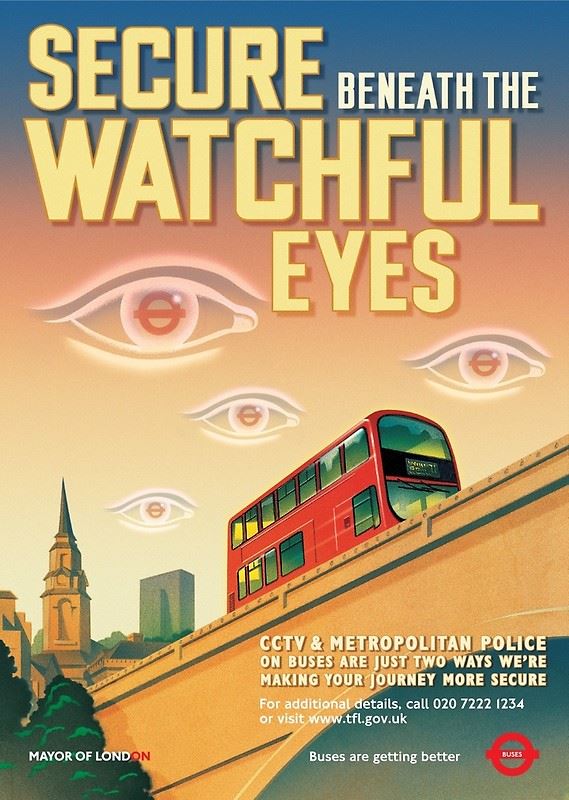
As the virus makes its way through the Sceptered Isle across the pond the activities of the English constabulary are put once again into high relief. Drones flying above the moors in search of walkers too far from home undertaking non-essential activities. Police rummaging through shopping bags to make sure shoppers did not purchase non-essential items when at the store. The Keystone Cops meet the Gestapo.
In the midst of this awful crisis it is wise to remember that bad behavior by English authorities did not begin with the virus. There is of course the long-running matter of the “Asian” grooming gangs, ignored by the cops, courts and press. But here are some other incidents from the last few years.
Which is the more annoying pair: Cuomo and DeBlasio or Newsom and Garcetti?
Our first breakfast on the road was at Whole Foods and so was our last. Those tape marks on the floor have become de rigueur at nearly every grocery store. I just shopped at a Trader Joe’s where they recommended that people travel down the aisles one way.
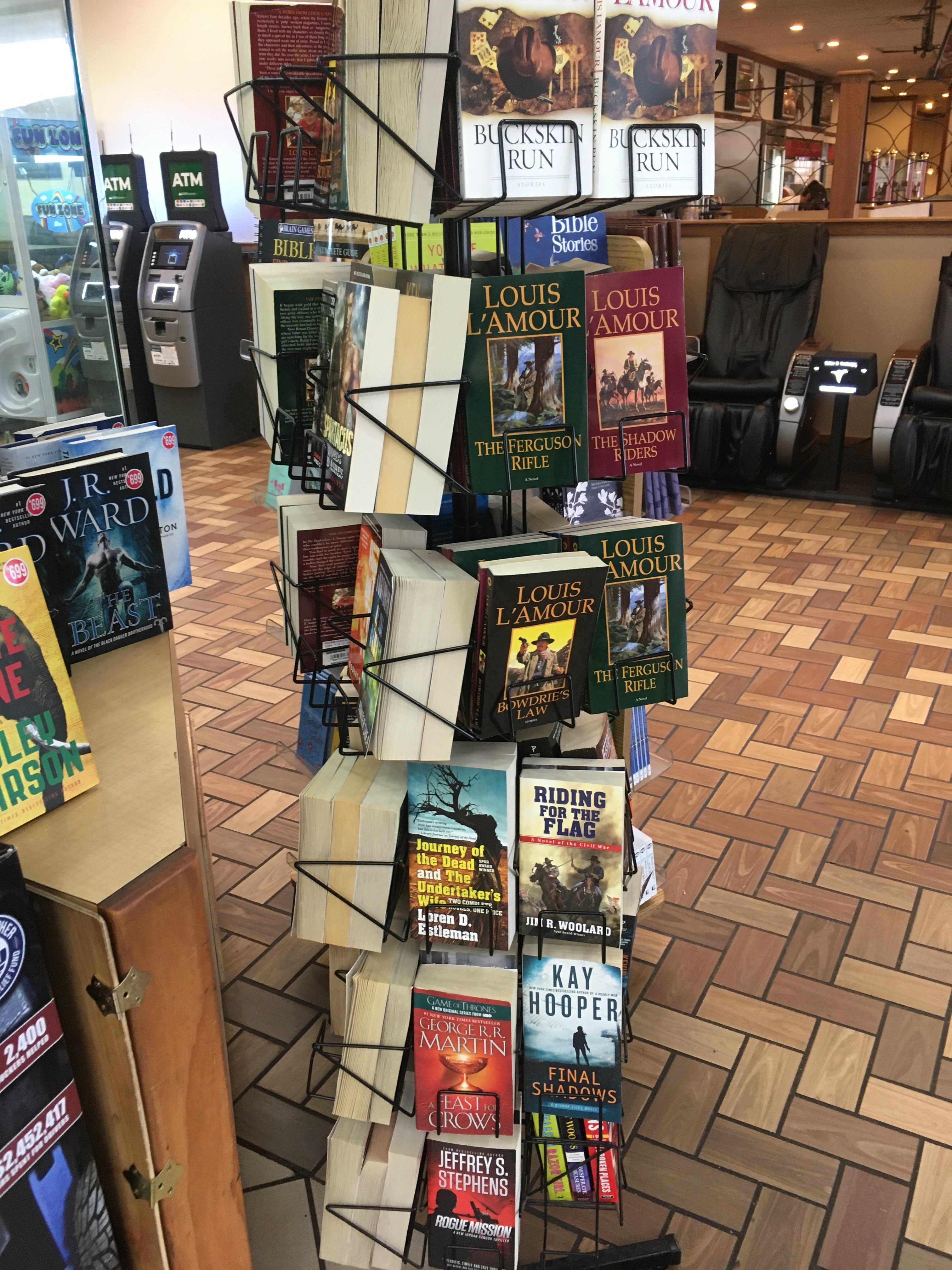
We hit at least one truck stop per day to refuel and for bathroom breaks. Love’s, TA, Pilot, Flying J. The culture of long-distance truck driving seems worthy of its own series. One thing I noticed is that truckers love Westerns, particularly Louis L’Amour. Audiobooks, too. Does Audible market to them?
Just over the Arizona-California border is the tiny desert town of Needles, during the summer one of the hottest places in the United States. The most expensive gas we saw on the trip was here, $3.99 a gallon. I started my trip in Inwood, Manhattan. After Harry died, Bess Houdini moved to Inwood and later died in Needles. Needles isn’t much of a town, but I liked it a lot. Good to be back in the California desert.
A friend recommended we eat at Munchy’s. Even though it’s not a Mexican food town, there are good tacos in NYC. But not like this. The frou-frou tacos you get there are fussy and expensive. Reliable, solid, taco joints like this, which are all over southern California, don’t exist there. (Which is fine, of course.)
And that’s it. That’s basically the end of my trip. Barstow is only a couple hours from Needles and L.A. is only a few hours from Barstow. I’ve driven from L.A. to Barstow many times, on the way to Vegas, so no need to take any more pictures.
What did I learn about this great land of ours as I drove 3,305 from the our most populous city to our second most populous city? I mostly learned that nobody uses their fuckin’ blinker. And no, turning it on for one click after you start changing lanes doesn’t count.
Driving through the desert is one of my favorite things.
In Santa Fe, while I was chatting with the front desk guy — I forget how the topic came up — he informed me that northern New Mexico is the black tar heroin capital of the United States. I wonder if that was a factor in Vince Gilligan’s decision to relocate BREAKING BAD from Riverside, California to Albuquerque. Aside from the sweet tax breaks, of course.
I’ve been to the Petrified Forest before, but not in decades. Considering the gates were closed, I guess I still haven’t been there in decades.
Finally, some shots of the open road.
Flagstaff was cold and windy, conditions that are typical according to the guy at the hotel. There was snow on the ground here and there, those stubborn piles that don’t melt for a week because they’re in dark corners that don’t get much sun. Also, I didn’t realize that its elevation is 6,900 feet while Santa Fe’s is 7,200, both significantly higher than Denver. My brother could immediately feel the difference when breathing, but neither city affected me at all and I’m someone who regards aerobic activities like running to be pure torture.
Flagstaff felt similar to Santa Fe — roughly the same population, roughly the same type of people. (At least as far as I could tell. I admittedly spent a pretty short time in both and Yet despite their similarities the landscape and architecture are distinctive. Flagstaff, in the middle of a forest, feels more like a mountain town and its buildings reflect that. For whatever reason, there were a lot more cars driving through downtown compared to places like Santa Fe and OKC.
In the next and last installment, we make the final push into California, where I’m finally reunited with a decent taco after five years in exile.
Related
While in Flagstaff, we had lunch a Culver’s, considered by some to be the best burger chain in America. I got a double ButterBurger deluxe. It was good, better than Shake Shack and Five Guys.
Market days are Monday and Tuesday. There should’ve been an auction when we were there, but there was nothing. One trucker didn’t get the memo, though, so he had unloaded his cattle trailer. I was able to get pretty close to them. Click on the images to enlarge.
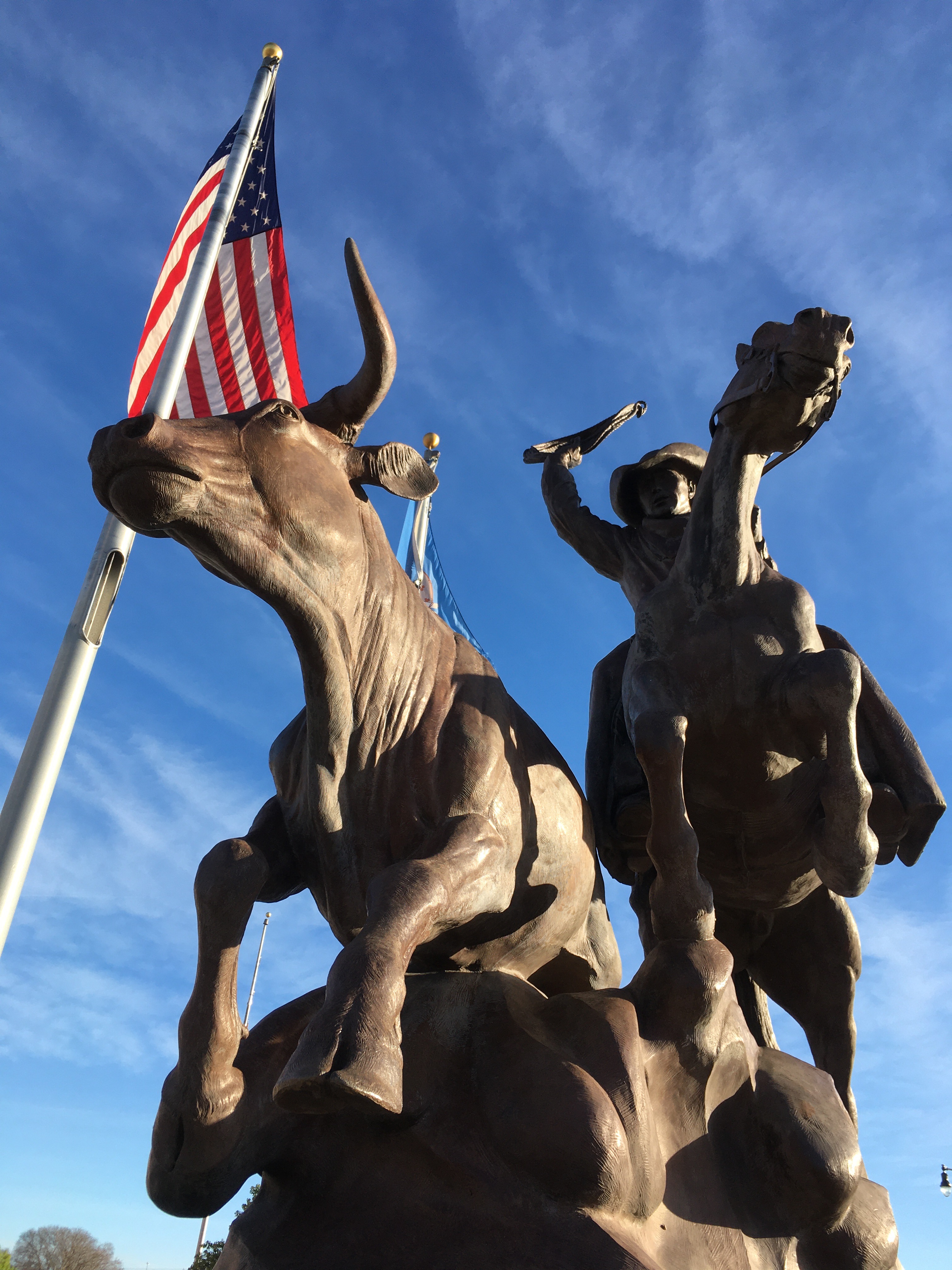
The statue near the gates of the stockyards exchange. America, fuck yeah!
We went south of the Stockyards in search of a grocery store to get our breakfast. Yup, we were in vaquero territory alright.
We were in cow country so I was determined to get a good steak. We figured Amarillo should have some places that were as good as OKC. When we saw the signs along the freeway for the Big Texan Steak Ranch, the decision was easy to make. They had a curbside tent and outdoor tables open. We each ordered the 8oz center cut top sirloin with two sides. He got his rare, I got mine medium rare.
Verdict? Not great. First, while my steak was cooked correctly, his was medium, not rare. Big mistake. Second, the steaks were not well seasoned. They might not have been seasoned at all, there was so little flavor. Third, let’s give the folks at the Big Texan a break. We’re all adjusting to this new normal, maybe they had their B- or C-team working that day. Maybe the guy cooking the steaks was so rigorous in his social distancing he was six feet away from the grill. Who knows? Fourth, hard to enjoy a steak when you’re cutting it with a plastic fork. Just doesn’t seem right. On the plus side, the side of beans was delicious, a good balance of smoky and sweet.
Back on the 40, on to New Mexico, to the desert southwest. The 285 north to Santa Fe. While it was warm in Amarillo, it was getting colder as we gradually climbed in elevation. We arrived in Santa Fe in the late afternoon. There seemed to be slightly more people out compared to other places. Hippies really love their recumbent bikes.
I loved the courthouse, the scale and location being very similar to the one in Oxford.
Oxford and Santa Fe were my two favorite cities. Human scaled, distinctive architecture indigenous to the region (i.e. not interchangeable, you couldn’t mistake one place for the other), streets and parking lots to accommodate cars but that don’t privilege them over pedestrians.
Notice how the word “savages” has been chiseled out. Wonder who did it.
I love the Pueblo Revival style. Maybe it’s corny? No doubt some will recoil. But is it really that much worse than the sci-fi steel gray jumbled geometry of the Clinton Presidential Center? Which will age better? Which has aged better? Which does the public who lives and works around each (not the architectural establishment, but the people who actually use the buildings every day) actually prefer?
Back at the hotel, I asked the front desk agent where we should eat. He recommended Tomasita’s. Good choice. My brother got the tamales with green chile, I got the beef grande burrito with red and green chile, Christmas style. Despite the restaurant’s dire warnings, I didn’t find the chiles hot. I thought the red had better flavor than the green. The sopaipillas were delicious too.
In the next installment we drive from Santa Fe to Flagstaff with a quick stop in Albuquerque for some blue meth.
Related
Somewhere outside OKC we saw a rodeo stadium. Reminded that in the last year I saw three great movies about the rodeo: THE LUSTY MEN, JUNIOR BONNER, and THE RIDER. Three different eras, three very different directors, all highly recommended.
On day four we left the south (*sniff*) for the dusty cow towns of the midwest.
The Clinton Presidential Center was a few blocks from our hotel so we had to drop by before shoving off. Too bad it was closed. I was hoping to ask the head librarian for all their information on Mena, Vince Foster, and the finer points of email server maintenance.
Why must these new prestige buildings always be modernist? The thing looks like a loading dock for the Death Star. The aesthetic choices made even less sense when you realize it’s located right next door to the far more charming Clinton School of Public Service.
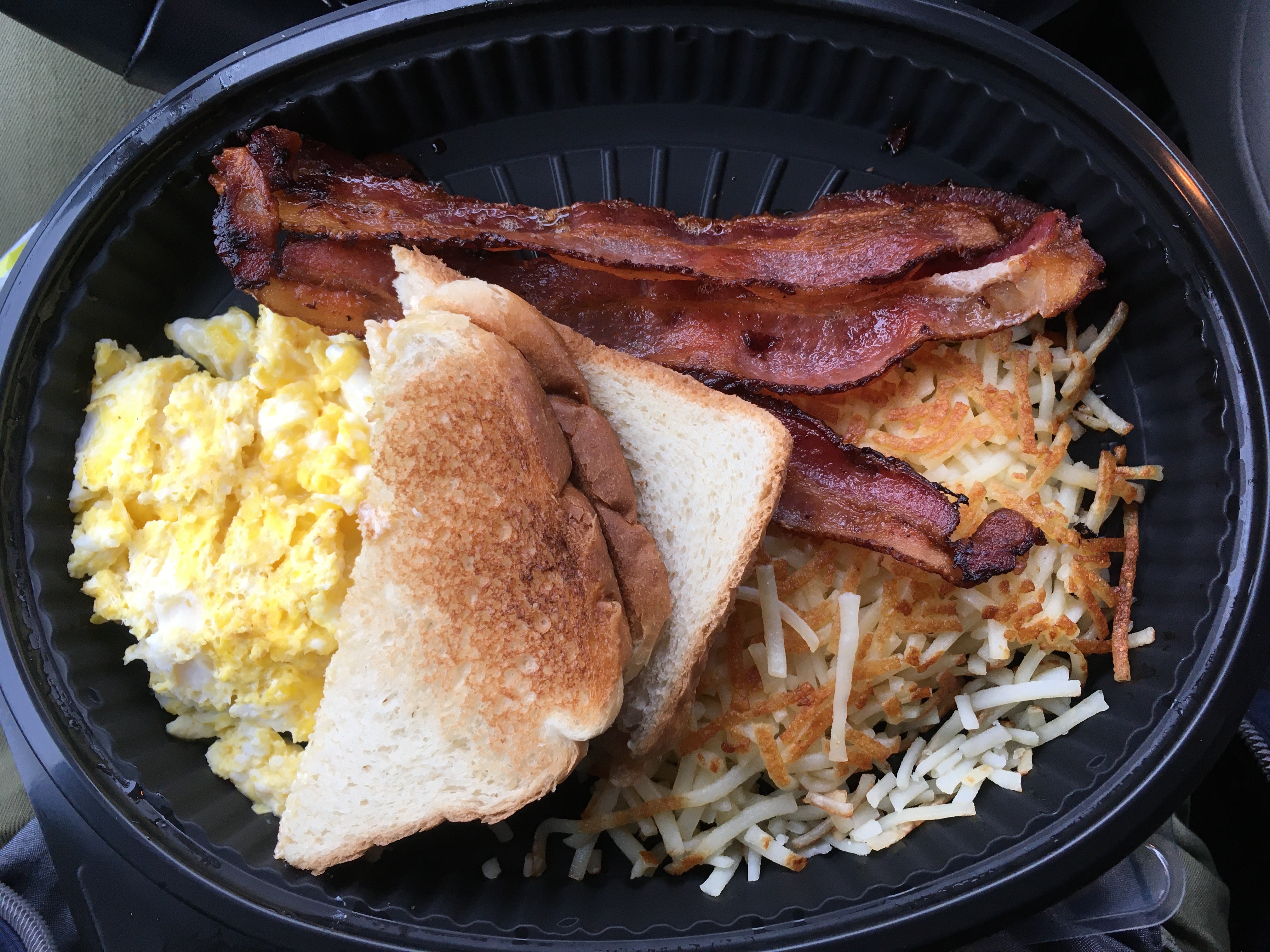
Tired of cold supermarket food, we decided to get breakfast at Waffle House. We pulled into the parking lot and, as my brother spoke to the waitress on the phone, I watched her through the window as she took our order. We stood in the parking lot as our food was prepared but they let us in to pay.
Although I’m from California, I hate eating food in the car. But, given the circumstances, guess I shouldn’t complain.
A few more shots from the Fort Smith National Historic Site, including the old commissary and train station.
On to Oklahoma City. We got back on the 40 and continued west. We passed Checotah, birthplace of one of the great country artists of our time. About 90 minutes outside OKC we saw a gas station that had regular at $1.23 a gallon, the cheapest we saw anywhere on the trip.
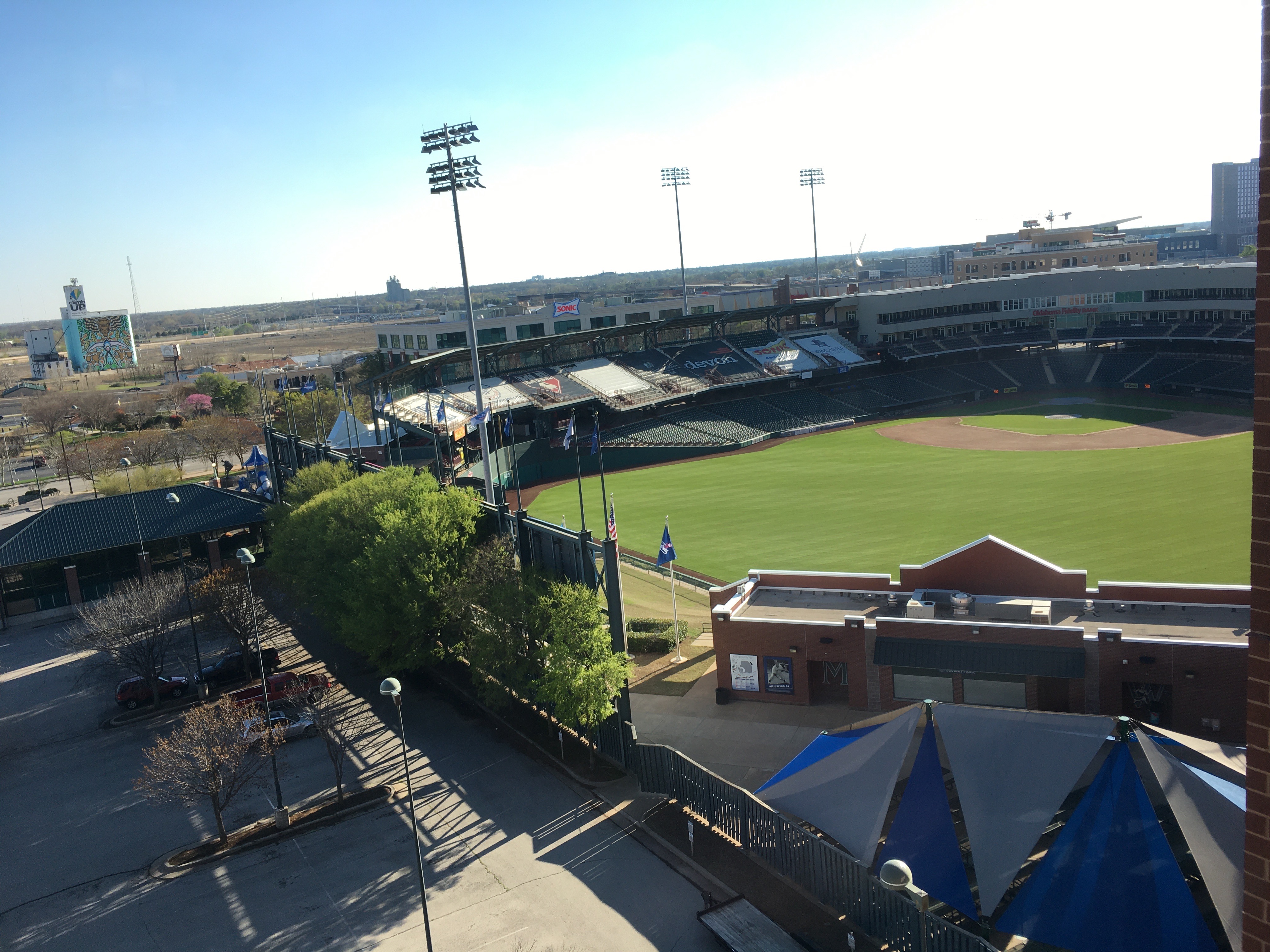
We got a hotel in the Bricktown neighborhood of OKC, an entertainment district that abuts downtwon. The Dodgers Triple-A team plays in the stadium next door. This shot was taken from the window by the elevator on our floor.
I bet Bricktown is a fun place when it isn’t completely abandoned.
The OKC Streetcar was running, so we decided to go for a ride downtown. See that sign kindly asking that riders use headphones? (The NYC subway could use a lot of those signs, not that anyone would pay attention.) We rode the streetcar twice, to downtown and back to Bricktown, but only saw one other rider.
Another downtown, another ghost town. It really was like being on a film set. A film set is only meant to give an impression of being real, the mere suggestion that life exists beyond the facade. What was doubly strange is that people were so assiduously following the rules, that you didn’t see the barest spark of life. No voices carrying, no TVs glowing through windows, no people in their yards, no nothing. Another funny thing was that, when we did observe people on the streets, they were always from one of three demographics: 1) runners, 2) people walking their dogs, 3) homeless. Richmond, Nashville, Little Rock, OKC, Santa Fe, Flagstaff — the same eerie stillness, the same demographics trickling around.
We came upon the Murrah Plaza, a brutalist monstrosity to compete the with the equally depressing complexes that I wrote about in Long Beach and Santa Ana.
My hard-hearted architectural analysis started to make me hungry, so when we spotted a security guard at the memorial we asked him if he knew of any good restaurants that were open. He recommended Hideway Pizza, a few streets over in the Automobile Alley neighborhood. When I mentioned I was coming from New York he quickly tried to manage my expectations, “Well, I like it, but I don’t know how it’ll compare to New York pizza.” It’s OK, dude, calm down, we’re not pizza snobs. LOL, j/k, we’re absolutely pizza snobs. Anyway, the pizza was totally adequate and OK, I guess! (Stick to beef, OKC.)
Hideaway Pizza was doing good business that night.
It was fine!
We took the pizza back to the memorial hoping to find the guard and give him a piece, but he was gone.
In the next installment we drive from Oklahoma to Santa Fe with a stop in Amarillo for a disappointing steak at a famous restaurant. They probably didn’t use propane so we tasted the heat, not the meat.
Related
This documentary about the OKC bombing is full of crazy conspiracy theories so you shouldn’t watch it. Just move along to the latest episode of whatever Florida tiger shit they’re showing on Netflix nowadays.
I should be a lot more embarrassed by how much I love Carrie Underwood’s BLOWN AWAY. Like, the whole album. Wait, Kings of Leon have roots in Oklahoma? That first album was pretty good.
What’s the worst artistic movement of the 20th century and why is it brutalism? Discuss.
On day three we pulled off the 40 and detoured through the back roads of Mississippi and Arkansas. Particularly in Arkansas there was one lane in each direction, semis hauling ass towards you. Hmmm, what would happen if the van broke down out in the middle of nowhere? Probably best not to think about it.
The only other people in the park were construction workers who were rehabbing it.
Barbara Harris’s view.
Get this goofy POS outta there.
A monument to the founder of Nashville.
That was it for Nashville, we got back on the 40. About an hour outside of Nashville, the city of Jackson, we saw this roadside BBQ stand and had to stop. The ladies running it saw me taking a picture and mugged for the camera.
Johnny and June Carter Cash wrote a song about Jackson.
Speaking of music, a quick tangent. We mostly listened to the radio during the drive, taking a break only once or twice for a podcast we had downloaded. I had intended on listening to audiobooks, but I thought the radio would be more evocative. My naive idea was that we’d discover all these quirky country and roots music radio stations to provide the soundtrack. Nope! No matter where we were — east, south, midwest, west — the radio was the same. Same formats, same songs. We heard “In the Air Tonight,” “Hit Me With Your Best Shot,” and “Raspberry Beret” more than a few times. The only time we heard blues music over the radio was in Maryland, on I what I assume was a college station. I remember because we were driving by the NSA. (The station was probably fake and they were just screwing with me.)
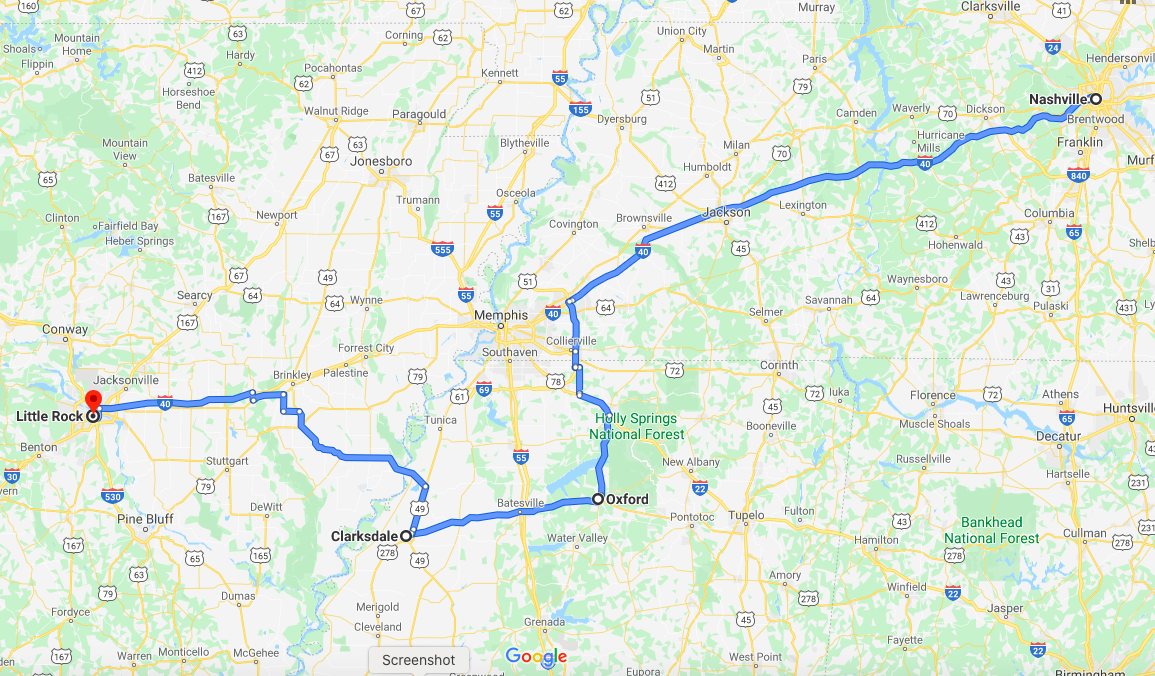
Instead of stopping in Memphis, we diverted off the 40 and headed to Oxford, Mississippi before going to Clarksdale. If I was going to be this close to the Delta, I had to see it. First was Oxford, which we got to around lunch time but, given that nothing was open and I had filled up on BBQ, we settled for wandering around the town square. I wanted to buy an Ole Miss t-shirt at the team store but the girl at the shop wouldn’t open the door. She referred me to their website.
Do people read Faulkner anymore? He seems like one of those midcentury titans, like Fellini, who has fallen off the map. I bet Ole Miss English students get a healthy dose of him, at least.
No stores open, no people about, a couple of restaurants with skeleton crews providing curbside service. Just like everywhere else. We left Oxford and headed for Clarksdale. As we approached we saw acres of fallow cotton fields dotted with modern industrial cotton gin factories. It was pretty cool but I have no pictures, sorry.
We pulled into Clarksdale on Martin Luther King Jr. Blvd., which used to be Highway 61. Downtown was empty.
Some cool signs and graphics.
While we were standing in front of Cat Head, a car pulled up. A guy got out and said, “Hey, you guys wanna come inside the store?” Why, yes sir, we do. He introduced himself as Roger, the owner. He unlocked the door and flipped on the lights. A Ohio native, he moved to Clarksdale 18 years ago to promote the blues and Clarksdale. He’s been on PBS, quoted in the New York Times and The Economist, produced documentaries and records. His store, called one of the 17 coolest records stores in America, was full of great books, music, and swag. My brother and I browsed while we all gabbed about the city and the current corona craziness.
Talk about good timing.
I could’ve spent hours here.
Roger Stolle, proud owner of Cat Head.
A plaque dedicated to one of my favorites right outside the store.
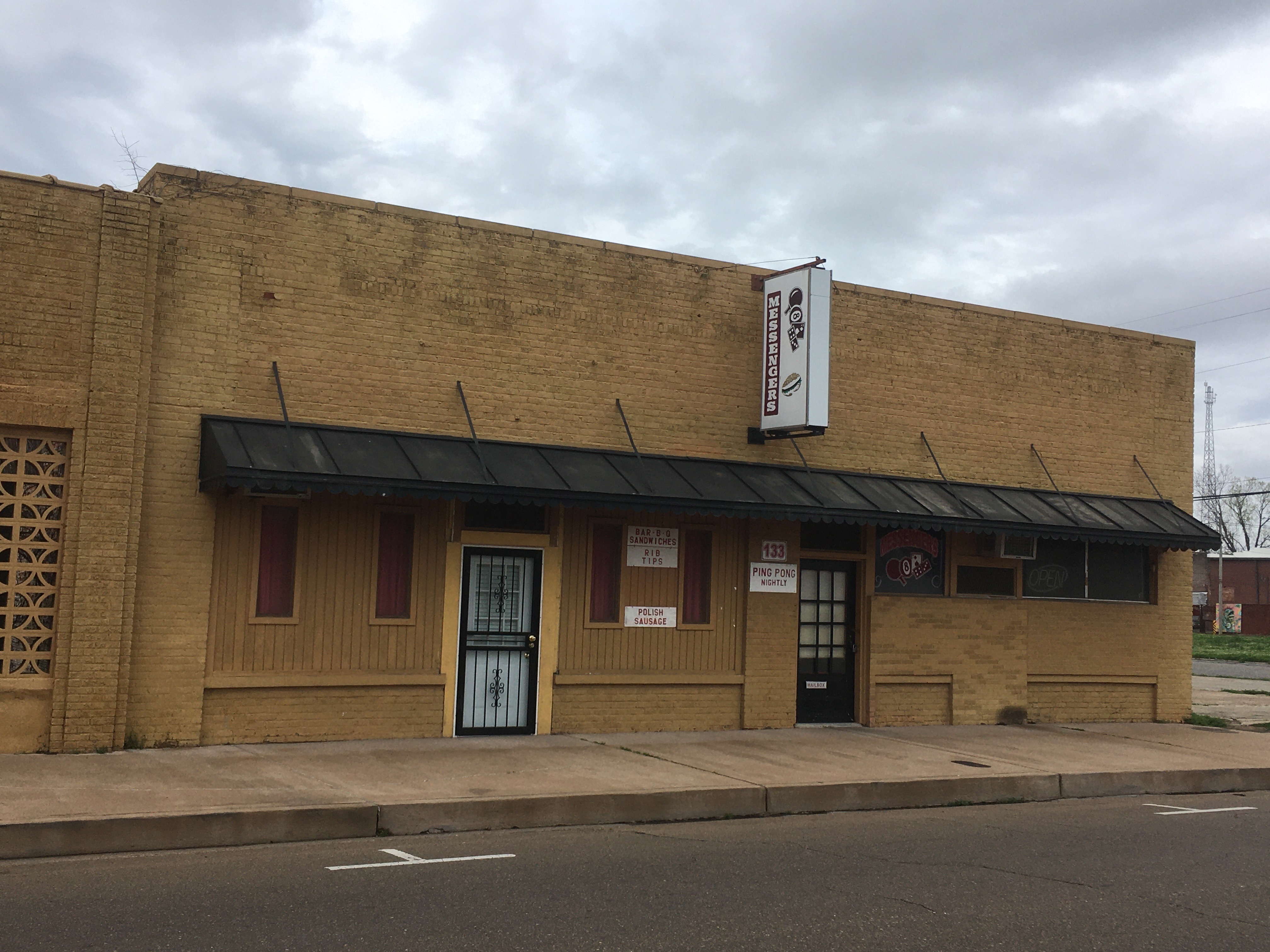
My brother asked, “Where’s a good place to get something to eat or drink around here?” Roger said, “Well, pretty much the only places that’ll be open are those that are, uh, a little lax about health regulations. Try Messenger’s around the corner.” We bought a couple t-shirts, thanked Roger for his hospitality, and headed to the bar. Damn, it was closed. You know things are serious when the local cool dive has shut its doors.
Over the Mississippi and then only a couple hours to Little Rock. We arrived in the early evening, around dusk. The hotels had such low occupancy that we got a suite for the price of a regular room. We dropped off our bags and headed out to the River Market District looking for food.
We saw a few people out on the river front and walking across Junction Bridge. Everyone warily maintaining six feet of distance.
What’s this? Gus’s Famous Fried Chicken? And it’s open? Sometimes the gods bless us. They were 15 minutes from closing but the guy graciously allowed us to order even though making our food would take about a half hour.
It was the best fried chicken and collard greens I’ve ever had.
While researching this I was shocked to discover that THERE ARE FOURLOCATIONSINLOS ANGELES WTF? I was simultaneously elated and disappointed. Elated because that meant I could get this delicious ambrosia whenever I wanted yet disappointed because I planned on obnoxiously bragging about this place I had been to that no one else had. “Oh, you think that’s good fried chicken? That’s cute. This one time when I was Little Rock…” C’est la vie. God gives with one hand and takes with the other.
In the next installment we drive from Little Rock to Oklahoma City with a side trip to Fort Smith to hire a U.S. marshal to avenge our father’s death.
Related
Have you read Paleo Retiree’s essay on NASHVILLE? One of the best pieces of movie writing I’ve ever come across. Those knuckleheads at Criterion should’ve included it on the Blu-ray.
This is the second installment of my series about driving cross-country during the coronavirus crisis. Click here for first post.
On day two we left behind the North and drove deeper into the South.
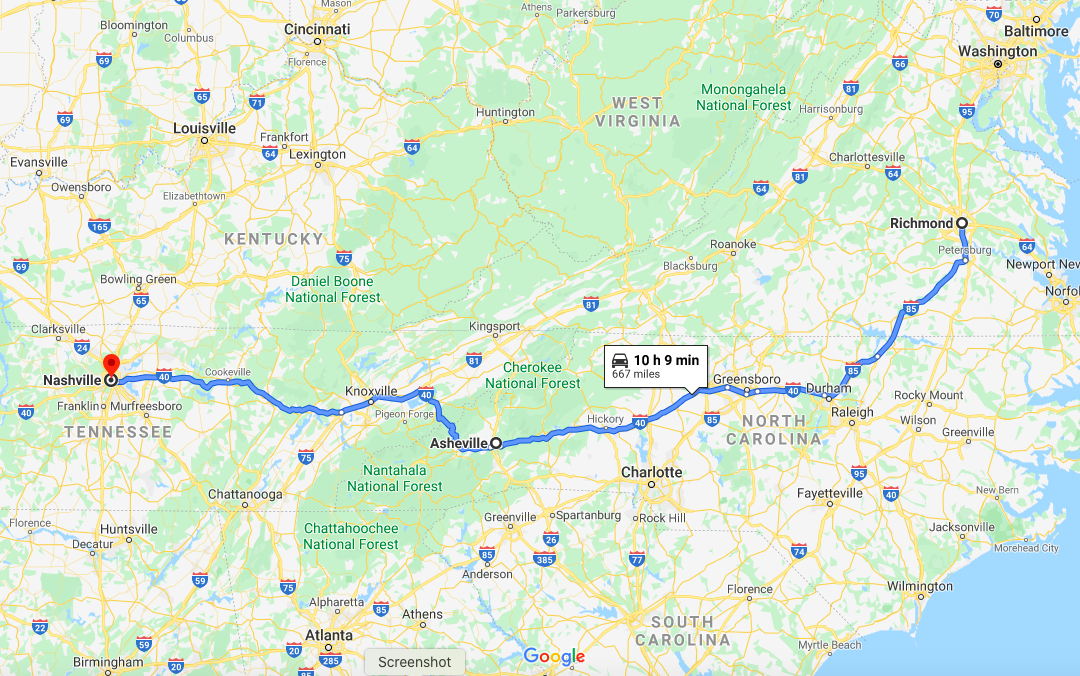
Richmond set the pattern for the rest of our trip. Abandoned streets, few businesses open, us wandering around the downtown area taking pictures of the emptiness. Here’s what Richmond looked like from my hotel room window. Notice the lack of traffic, all the green lights, few cars, no people, nothing happening.
We naively hoped that a breakfast place would be open, so we Googled a local spot in the Fan District, just west of Virginia Commonwealth University, and drove over there. Nope, everything was closed. Don’t think we saw a single person walking the streets either. Click on the photos to enlarge.
Davis saying, “You want America that badly, eh? Sure, go ahead and take it, knock yourself out.”
General Robert E. Lee.
Unlike the statues of Jackson and Davis, there was no dates, quote, inscription, or text on this monument other than “LEE.” Nothing more needs to be said.
The view from the Lee statue looking down Monument Avenue.
A beautiful building along Monument Avenue.
A beautiful building along Monument Avenue.
A beautiful building along Monument Avenue.
We drove by the statue of J.E.B. Stuart (twice, we got lost, despite having GPS) but I didn’t get a picture of it. You’d think that Richmond, the former capitol of the Confederacy and home of these statues, would feel like the South, but it didn’t to me. It wasn’t until we got to Burke County, North Carolina that I felt like I was in Dixie. Why? Because it was in Burke County where we saw our first massive Confederate flag, roughly the size of Delaware, flying beside the freeway. Wikipedia says THE LAST OF THE MOHICANS and THE HUNGER GAMES were both filmed in Burke County.
After skirting past Durham, Greensboro, and Winston-Salem, we ascended through the Blue Ridge Mountains to Asheville. Asheville was a little out of our way, but I heard it was great, so I wanted to take a look. Hey, guess what, it was dead. As we were taking these pictures, we were pretty much the only people on the streets. A woman drove by, her window rolled down, and she shouted to us, “Freaky, isn’t it?!” Yes, it was like being in a TWILIGHT ZONE episode.
I always look forward to visiting local bookstores, but not this time.
A local brewery was selling their wares curbside. My brother bough a 4-pack. The proprietor assured us that she disinfected her point-of-sale iPad after each transaction.
We noticed CBD stores in nearly every city we visited.
Sure, the world may be ending, but keep it positive!
There was one business open, a clothing store selling Asheville-branded souvenirs. I tried to buy a t-shirt but they only had women’s styles. After walking around for an hour or so, we said goodbye to Asheville and headed for Tennessee.
While driving through Knoxville, we could see the Wigsphere, a major cultural landmark, from the freeway.
The last 90 minutes into Nashville it rained pretty hard. Just when it looked like it was clearing up, it started pouring again. We got into Nashville about 8pm after approximately 9 hours of driving. I was pretty tired, it was still raining, so I thought I’d just stay in the hotel room. My brother called me a pussy and said he was going to walk around Nashville rain or not. I joined him.
The Country Music Hall of Fame was a block from our hotel.
The Schmerhorn Symphony Center, home of the Nashville Symphony. A neoclassical building that opened in 2006.
Lower Broadway is normally bustling, but not tonight.
Kind of hard to see but these three people were performing a song to an empty house. The show must go on!
We went into town thinking that Kid Rock’s place would be open, he was a holdout, but it was forced to close.
Some cool Nashville neon.
It wasn’t much of an exaggeration to say we were the only people on Broadway. We found the only business that appeared to be open, the Moxy Hotel, and got in out of the rain. When we arrived there were three people at the bar, two employees, us, and a drunk guitar player performing drunkenly. Pretty soon the other patrons cleared out and it was just the employees, us, and our (very) inebriated troubadour. I ordered a cocktail, my brother got a beer, and I had food delivered from Edley’s Bar-B-Que: a pulled pork sandwich, a hot chicken sandwich, fries, and fried pickles. We ate and drank while playing pool and laughing at the absurdity of the situation. We were more or less the mayors of Nashville that night.
Across the street from the Moxy was this major cultural institution.
In the next installment we drive from Nashville to Little Rock with a quick side trip through the Mississippi Delta to sell our souls at the Crossroads.
If you’re ever in Asheville, stop by the DSSOLVR Brewery. Tell them Blowhard, Esq. sent you. (They will have no idea what that means and will probably throw you out, fyi.) But srsly, ask them what the deal is with that Illuminati tentacle logo.




















 Blowhard, Esq.
 Callowman
 Sherbrooke
 Eddie Pensier
 Enzo Nakamura
 Epaminondas
 Fabrizio del Wrongo
 Fenster
 Brundle Guy
 Glynn Marshes
 Paleo Retiree
 Atypical Neurotic
 Question Lady
 Sax von Stroheim
 Sir Barken Hyena
 The Mistaken
 Uncouth Reflections