
Blowhard, Esq. writes:
I was wandering in the East 40s yesterday when I came across a hipster coffee joint. As I looked at the wooden sign in the window advertising their goods, I had to suppress a snicker: an unfinished wooden sign, the hand-painted lettering, the self-conscious rustic charm. It’s funny how these elements have become design cliches. I was going to snap a picture, but why bother? These places are everywhere and we’re all familiar with the tropes. Just an hour earlier I was enjoying a cold brew at Culture Espresso on West 38th:
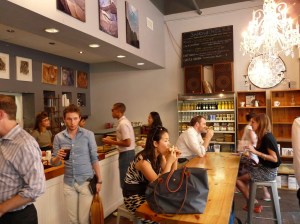
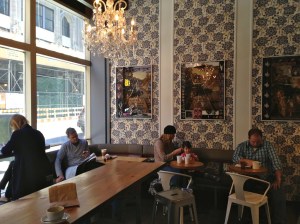
This morning Fenster alerted me to an essay in The Guardian by Kyle Chayka on how the hipster aesthetic is taking over the world:
In an essay for the American tech website The Verge, I called this style “AirSpace”. It’s marked by an easily recognisable mix of symbols – like reclaimed wood, Edison bulbs, and refurbished industrial lighting – that’s meant to provide familiar, comforting surroundings for a wealthy, mobile elite, who want to feel like they’re visiting somewhere “authentic” while they travel, but who actually just crave more of the same: more rustic interiors and sans-serif logos and splashes of cliche accent colours on rugs and walls.
I googled “hipster coffee shop” and put together this gallery which is very representative of the style:


This aesthetic was hilariously parodied by PORTLANDIA (natch):
Mr. Chayka spends the bulk of his piece lamenting the ubiquity of what he sees as a monotonous and boring style:
You can hop from cookie-cutter bar to office space to apartment building, and be surrounded by those same AirSpace tropes I described above. You’ll be guaranteed fast internet, strong coffee, and a comfortable chair from which to do your telecommuting. What you won’t get is anything interesting or actually unique.
There are several causes of AirSpace. The first is that mobility is increasing: more people move more quickly around the world than ever before, mostly passing through the same urban hotspots (London, New York, Los Angeles, Hong Kong), and carrying their sense of style with them. It’s globalisation, but intensified, made more accessible to a wider economic spectrum of people, more of the time. Mobility is not just for the rich anymore: working remotely is increasingly common; you can take a sabbatical to work from Bali and not miss a beat.
Taste is also becoming globalised, as more people around the world share their aesthetic aspirations on the same massive social media platforms, whether it’s Facebook, Instagram, Pinterest, or Foursquare, with their hundreds of millions or billions of users. As algorithms shape which content we consume on our feeds, we all learn to desire the same things, which often happens to involve austere interiors, reclaimed wood, and Edison bulbs, like a metastasised real-life version of Kinfolk magazine or Monocle.
This got me thinking about another international style of design that maybe we can call “neoliberal globalism.” If handmade hipsterism has taken over the third spaces of New York, Los Angeles, London, and Hong Kong, then neoliberal globalist architecture has taken the spotlight in those same places. All of the projects below have been or are in the process of being built in New York, Los Angeles, London, Paris, or Hong Kong:


Can’t one look at the hipster aesthetic as a reaction against neoliberal globalist architecture? One the one hand: natural materials, roughness and charm, warmth, immediacy, spontaneity, a handmade quality that favors local artisans. On the other hand: machined materials, slick and smooth, cool, remote, rigidly mathematical, software engineered on high-end computers by a cadre of international experts.
Furthermore, didn’t we see this same reaction-counteraction over a 100 years ago when the Arts & Crafts Movement bloomed after the Industrial Revolution? Wikipedia notes:
The Arts and Crafts movement was an international movement in the decorative and fine arts that began in Britain and flourished in Europe and North America between 1880 and 1910,[1] emerging in Japan in the 1920s. It stood for traditional craftsmanship using simple forms, and often used medieval, romantic, or folk styles of decoration. It advocated economic and social reform and was essentially anti-industrial.
…
The movement developed earliest and most fully in the British Isles,[5] and spread across the British Empire and to the rest of Europe and North America.[8] It was largely a reaction against the perceived impoverished state of the decorative arts at the time and the conditions in which they were produced.
The same Wikipedia article includes this quote:
Unlike their counterparts in the United States, most Arts and Crafts practitioners in Britain had strong, slightly incoherent, negative feelings about machinery. They thought of ‘the craftsman’ as free, creative, and working with his hands, ‘the machine’ as soulless, repetitive, and inhuman. These contrasting images derive in part from John Ruskin’s (1819-1900) The Stones of Venice, an architectural history of Venice that contains a powerful denunciation of modern industrialism to which Arts and Crafts designers returned again and again. Distrust for the machine lay behind the many little workshops that turned their backs on the industrial world around 1900, using preindustrial techniques to create what they called ‘crafts.’
I googled “arts and crafts furniture” and “arts and crafts interiors” for the gallery below. Any of these pieces would fit in well in any hipster coffee house:
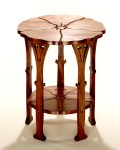

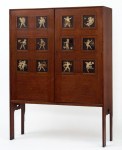

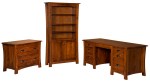

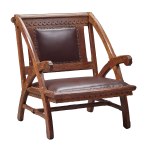
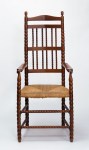
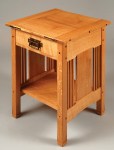


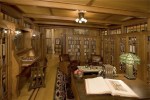


Is the new hipster aesthetic, like neoliberal globalist architecture, a symbol of a particular class? The preferred style of Williamsburg/Silver Lake strivers and wannabes? Sure, no doubt. But I’ll take a bottom-up design style that is freely chosen by independent businesses, as opposed to one that has been foisted on the public from the top-down by our monied elites.















 Blowhard, Esq.
 Callowman
 Sherbrooke
 Eddie Pensier
 Enzo Nakamura
 Epaminondas
 Fabrizio del Wrongo
 Fenster
 Brundle Guy
 Glynn Marshes
 Paleo Retiree
 Atypical Neurotic
 Question Lady
 Sax von Stroheim
 Sir Barken Hyena
 The Mistaken
 Uncouth Reflections