I wrote here about the many relatively reputable news outlets that got suckered by a bogus story about a public masturbation booth in midtown Manhattan. It seems like some stories are just too juicy to pass up. Why bother with shoe leather when hell it is only a quick, pleasurable hit, and others are doing it?
A somewhat similar tale is unfolding. This time, the story is of a Fellatio Cafe planned for the formerly Calvinist Geneva by the end of the year, with one to follow in London and in other swinging locales.
Here is a website that describes the concept and points to the many press outlets that have covered the development. None of the outlets are to my knowledge pure fake news providers, though they vary in terms of how much probity, to use that term correctly, is to be expected. Put another way, the HuffPost is on the list of outlets that have run with a story.
At the high end of the credibility spectrum, Instapundit linked to a story along with a wink-wink-nod-nod just yesterday.
So it’s true, right?
That is not so easy to establish. Your humble correspondent was able to put on some decent shoes and trek over to the site of the alleged masturbation booth in Manhattan to debunk that story. That option is not available here. Not only is a flight to Geneva prohibitive for a mostly pajama-journo such as yours truly but the first cafe is not yet even open. The London cafe is mysteriously off in the distance as well, as are the spinoffs such as a cafe for the ladies in which the tables are turned. That one sounds at least as fishy.
As with the masturbation booth coverage, most all of the stories appear to be virtually identical, as though they were simple rephrasings of promotional language. And that’s one of the problems of getting to “the truth” in our addled era: it is not just a matter of the truly fake news found on bogus sites, or even the relentless big picture narrative promotion at which the mainstream media excel. It is also this pesky matter of the middleground, of stories that might be true, or partially true, but who knows?
I was not about to fly to Geneva but I did spend some time sleuthing, finding the name of the promoter (Bradley Charvet) in one story and using that to Google in other ways, including in the Swiss press. There, the concept is referred to as a Cafe Pipe, since “pipe” is the term used colloquially for fellatio, equivalent to “blowjob”.
The best I can make out is that while Charvet and the idea do in fact exist there was never probably never really a serious attempt to open such a cafe. The impression given is that of a a promoter with a clever idea at self-promotion, a form of ego masturbation all too common in our day and age, and the kind of stunt that our so-called media are only too happy to enable, no penetrating questions asked.
And in fact here is an article from a Swiss newspaper, poorly translated by Google, that reports that the cafe concept is dead.
Cold shower for lovers of morning expressos naughty! The pipe-pipe project will not see the light of day in a public establishment in Geneva. Indeed, the Commercial Service did not validate the coffee at 60 Swiss francs, which was meant to be innovative in Switzerland: fee-based sexual services are still banned in public establishments (see below).
Bradley Charvet, designer of the Geneva project and boss of the escort service www.facegirl.ch gives up: “It is impossible to set up this type of coffee in Geneva in a public establishment. It was a daring idea but for the time being we will not make the project. “In Switzerland, if prostitution is allowed, it must be done in a private setting, so it is impossible to offer a A simple cafe.
What seems most likely is that while prostitution is legal in Switzerland it is regulated and must take place in a private setting. And that Charvet may well have known it was a non-starter but that he also followed Barnum’s dictum: a sucker is born every minute.
The article ran several weeks back. Did Instapundit–the prototypical pajama journalist--bother to check, even from his bedroom computer? No. Will we likely see more coverage of the Cafe Pipe? Probably.
I scarce know how to put my story into words that shall be a credible picture of my state of mind; but I was in these days literally able to find a joy in the extraordinary flight of heroism the occasion demanded of me. I now saw that I had been asked for a service admirable and difficult; and there would be a greatness in letting it be seen—oh, in the right quarter!—that I could succeed where many another girl might have failed. It was an immense help to me—I confess I rather applaud myself as I look back!—that I saw my service so strongly and so simply. I was there to protect and defend the little creatures in the world the most bereaved and the most lovable, the appeal of whose helplessness had suddenly become only too explicit, a deep, constant ache of one’s own committed heart. We were cut off, really, together; we were united in our danger. They had nothing but me, and I—well, I had THEM. It was in short a magnificent chance. This chance presented itself to me in an image richly material. I was a screen—I was to stand before them. The more I saw, the less they would. I began to watch them in a stifled suspense, a disguised excitement that might well, had it continued too long, have turned to something like madness. What saved me, as I now see, was that it turned to something else altogether. It didn’t last as suspense—it was superseded by horrible proofs. Proofs, I say, yes—from the moment I really took hold.
This moment dated from an afternoon hour that I happened to spend in the grounds with the younger of my pupils alone. We had left Miles indoors, on the red cushion of a deep window seat; he had wished to finish a book, and I had been glad to encourage a purpose so laudable in a young man whose only defect was an occasional excess of the restless. His sister, on the contrary, had been alert to come out, and I strolled with her half an hour, seeking the shade, for the sun was still high and the day exceptionally warm. I was aware afresh, with her, as we went, of how, like her brother, she contrived—it was the charming thing in both children—to let me alone without appearing to drop me and to accompany me without appearing to surround. They were never importunate and yet never listless. My attention to them all really went to seeing them amuse themselves immensely without me: this was a spectacle they seemed actively to prepare and that engaged me as an active admirer. I walked in a world of their invention—they had no occasion whatever to draw upon mine; so that my time was taken only with being, for them, some remarkable person or thing that the game of the moment required and that was merely, thanks to my superior, my exalted stamp, a happy and highly distinguished sinecure. I forget what I was on the present occasion; I only remember that I was something very important and very quiet and that Flora was playing very hard. We were on the edge of the lake, and, as we had lately begun geography, the lake was the Sea of Azof.
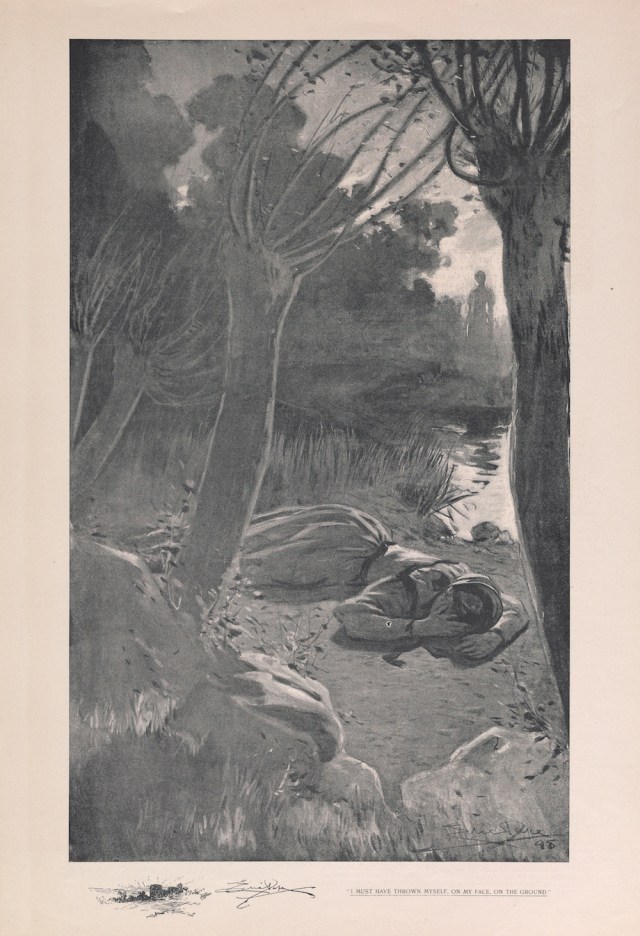
Suddenly, in these circumstances, I became aware that, on the other side of the Sea of Azof, we had an interested spectator. The way this knowledge gathered in me was the strangest thing in the world—the strangest, that is, except the very much stranger in which it quickly merged itself. I had sat down with a piece of work—for I was something or other that could sit—on the old stone bench which overlooked the pond; and in this position I began to take in with certitude, and yet without direct vision, the presence, at a distance, of a third person. The old trees, the thick shrubbery, made a great and pleasant shade, but it was all suffused with the brightness of the hot, still hour. There was no ambiguity in anything; none whatever, at least, in the conviction I from one moment to another found myself forming as to what I should see straight before me and across the lake as a consequence of raising my eyes. They were attached at this juncture to the stitching in which I was engaged, and I can feel once more the spasm of my effort not to move them till I should so have steadied myself as to be able to make up my mind what to do. There was an alien object in view—a figure whose right of presence I instantly, passionately questioned. I recollect counting over perfectly the possibilities, reminding myself that nothing was more natural, for instance, then the appearance of one of the men about the place, or even of a messenger, a postman, or a tradesman’s boy, from the village. That reminder had as little effect on my practical certitude as I was conscious—still even without looking—of its having upon the character and attitude of our visitor. Nothing was more natural than that these things should be the other things that they absolutely were not.
Of the positive identity of the apparition I would assure myself as soon as the small clock of my courage should have ticked out the right second; meanwhile, with an effort that was already sharp enough, I transferred my eyes straight to little Flora, who, at the moment, was about ten yards away. My heart had stood still for an instant with the wonder and terror of the question whether she too would see; and I held my breath while I waited for what a cry from her, what some sudden innocent sign either of interest or of alarm, would tell me. I waited, but nothing came; then, in the first place—and there is something more dire in this, I feel, than in anything I have to relate—I was determined by a sense that, within a minute, all sounds from her had previously dropped; and, in the second, by the circumstance that, also within the minute, she had, in her play, turned her back to the water. This was her attitude when I at last looked at her—looked with the confirmed conviction that we were still, together, under direct personal notice. She had picked up a small flat piece of wood, which happened to have in it a little hole that had evidently suggested to her the idea of sticking in another fragment that might figure as a mast and make the thing a boat. This second morsel, as I watched her, she was very markedly and intently attempting to tighten in its place. My apprehension of what she was doing sustained me so that after some seconds I felt I was ready for more. Then I again shifted my eyes—I faced what I had to face.
Oliver was one of three judges during the trials held after the Boston Massacre. Thomas Hutchinson was pleased with the work that Peter Oliver did, and made him chief justice of the Superior Court in 1772. Oliver complained often about how low his salary was as chief justice. The British proposed a plan to raise the justice’s salary, paid for by the crown. All of the justices declined this offer except for Oliver. He was impeached in 1774 because of the public outrage against him for doing so. In January, 1776, Oliver, who believed absolutely that the Revolution, which he consistently referred to as the “Rebellion,” was illegal and destined to fail, wrote a letter to Massachusetts troops entitled “An Address to the Soldiers of Massachusetts Bay who are now in Arms against the Laws of their Country.” Oliver essentially argues that the Rebellion is illegal and destined to fail and that the Massachusetts troops have been lied to by their officers about the potential for success against Great Britain, which he characterizes as the “mildest government to live under.”
You can buy Oliver’s book, Origin & Progress of the American Rebellion, here.
Though Jordan Peele’s “Get Out” is set among the suburban white elite of Everywhere USA, its concerns are firmly rooted in the plantation. It ascribes to white liberals the motivations of slave-holders, and then asks them — its principal audience — to cheer their own annihilation. As a satire the movie is curiously unpointed; it rarely connects with observable reality. The servile blacks who toil obediently in Massa Whitey’s geranium beds seem like figures of the 1950s rather than the 2010s. Either Peele is pretending that it’s still common for blacks to hold this type of position, or he doesn’t realize that Guatemalans exist, and that they’re cheaper and complain less. The picture I take to be Peele’s model, “The Stepford Wives,” was at least timely. Peele, by contrast, is skewering attitudes that were expunged by his subjects 70 or more years ago (if they ever held them at all). Perhaps he’s not skewering these attitudes so much as trying desperately to prop them up, to keep them alive in our imaginations? Their rhetorical value is obvious even when their satirical value isn’t.
The movie might have worked had Peele brought us inside the mentality of the black man who yearns for white acceptance, and then used that yearning to generate, and comment on, racial anxiety — the kind of anxiety one senses in Barack Obama when he tries to appeal to urban audiences. But for it to operate in that manner we’d have to understand hero Chris Washington’s attraction to his exploiters, to feel his desire to win favor with white society. Peele doesn’t bother with any of that: His suburban whiteopia is nearly as creepy and menacing as the Overlook Hotel in Kubrick’s “The Shining”; whatever it is that’s happening there, we want no part of it. Since it’s obvious from the start that the family has done something awful to its black servants, there’s no thrill in Chris’ slow realization of the underlying horror, and this forces Peele to fall back on schlocky gross-out effects to fulfill the requirements of the genre. Meanwhile, Chris looks uncomfortable and makes panicked phone calls, and the movie develops into a grim and rather inert affair involving a patriarch who, like a Bizarro World Yakub, surgically creates zombie blacks to trim his hedges. The narrative drive of “Get Out” becomes inseparable from its inevitability: There isn’t much to do but wait for the virtuous bloodletting. I’ve previously expressed my distaste for the ideological revenge picture. Is it a feeling of righteousness that people get out of these movies?
If the experience of watching “Get Out” feels a bit like sitting on a barstool and waiting to be punched in the face, it’s partly because Peele makes Chris a sacrificial victim on the altar of white villainy. The blaxploitation movies of the ‘70s were often explicitly anti-white, but we could appreciate them as black fantasies about putting the white man in his place, and their heroes were charismatic and larger than life. Chris has one interesting character trait: he smokes; and even that isn’t used in a way that’s interesting. (His having lost his mother as a boy is just another aspect of his virtuous put-uponness.) While his white girlfriend, Rose (a devilish Allison Williams), is vivid and opinionated, it’s never made clear what Chris thinks of race relations or interracial dating, and actor Daniel Kaluuya is content to fill him out with an anodyne, “it’s all cool, bro” passivity. It’s possible that this is part of Peele’s commentary, and that he intends Chris to embody the placidity and inoffensiveness that he imagines whites require of blacks who try to assimilate. But by making Chris so colorless, he resigns him to being a device. It’s odd to see a movie ostensibly derived from Ta-Nehisi Coates’ writings on racism treat its hero as a “black body,” but that’s largely what Chris ends up being: Like Camille Keaton’s rape victim in “I Spit On Your Grave,” he’s there to sustain abuse, and to justify the compensatory carnage. (Don’t get your hopes up, exploitation fans: “Get Out” has little of the nervy visceralness of “Grave.”)
It’s also possible that Peele disapproves of Chris, and that he’s punishing him for being an Uncle Tom. This would explain why Peele seems more interested in Chris’ friend, Rod. An airport security agent, Rod is played by the wonderful LilRel Howery, who gives the character a warmth and an energy sorely lacking in the rest of the picture. Also, Rod provides “Get Out” with one of its few flashes of observational sharpness: Blacks dominate the staff of some major airports, and it’s funny that it’s the airport guy, and not the hated police, who rides to Chris’ rescue. (Another funny moment: Rose listening to “Time of My Life,” from “Dirty Dancing,” while idly browsing photos of half-naked black men and munching Froot Loops.) I suspect Peele’s sympathies lie with the suspicious, race-conscious Rod, and that the drab, conciliatory Chris is intended as a warning to blacks against the dangers of allowing white people to use them as a “black bodies.” But if that’s the case, what Peele is offering is little more than a demonstration of theorized victimhood — one unlikely to impress the viewer who thinks Ta-Nehisi Coates is full of shit.
Reduced to the basic message of its title, “Get Out” suggest that blacks are best if they avoid whites and stay out of the suburbs. This raises the question: Has Peele made a pro-segregation movie? If I felt that was his intent, I might appreciate “Get Out” as a work that, at the very least, attempted to take the piss out of contemporary social protocol. But I think “Get Out” is better understood as something much more conservative: As an expression of a symbiotic relationship between blacks whose claims of exploitation give them political power, and whites whose feelings of racial guilt found their morality. If the allusion to this peculiar nexus, the basis of so much in contemporary politics, doesn’t constitute a message on the part of Peele, it’s the fulcrum on which his movie pivots, and I take it to be the key to understanding the overheated response from white critics who have fallen all over themselves in praising a work that condemns them for feelings they’ve likely never experienced. If a major critic’s recent apology for daring to find sexual interest in “Wonder Woman” didn’t convince you that masochism is a prime driver of contemporary cultural discourse, perhaps the RottenTomatoes score of “Get Out” will: Only two mainstream critics failed to praise it, and one of them — Armond White — is black.
I devote so much space to the movie’s messaging because if one isn’t dwelling on what Peele is trying to say in “Get Out,” there’s not much to train your intellect on while watching it. (Stylistically, it’s as flatly meretricious as an number of indie films made be any number of white people.) All things considered, my hunch is that Peele is simply grasping at the straws of political convenience, and that he hasn’t bothered to vet his gripes for internal logic or consistency. At times he seems to be working at cross-purposes. For example: He both ascribes to whites a desire to use blacks for sex, and condemns the stereotype of black potency. It’s as though he hasn’t realized that, if the stereotypes were baseless, there would be little point in acting on them. Perhaps the movie is most enjoyable when used as a springboard for examinations of this and similar glitches in the ideological matrix. My favorite such glitch: “Get Out,” beloved of progressives across the land, is the most popular anti-miscegenation film since “The Birth of a Nation.”
I know nothing of this week’s Lady other than that she’s from Belarus. Actually, come to think of it, I know nothing of Belarus…
I find her face very appealing. Whatever it is that makes for an appealing face, it’s damn subtle. I suppose it has something to do with the proportions of the features, and probably someone can provide a link showing that some asshole used a computer to plumb the depths of facial attractiveness. Still, I feel sure that we’re incapable of demystifying the effect it has on us. (Or maybe I’m just not interested in demystifying it?) Even a slightly unusual face is capable of striking me as captivating.
In Pearl’s case, the effect is somewhat diminished when she opens her mouth. Her teeth are a little oversized. But for me that just adds to the charm.
Nudity below. Hope you’re looking forward to a long weekend.
It’s been a couple of months since the last time I watched a feature film, fiction division — easily the longest time I’ve gone without watching a feature film since the late 1960s.
Given that I was a serious and devoted moviebuff for many decades, I find myself struck by this development. The fact is that I’ve had dwindling interest in new films for so long that a couple of generations of stars (Bradley Cooper, Emma Stone … it’s a long list) have come along whose work I’ve never watched. And even when I do play with the possibility of sitting down with a feature film, the only ones that genuinely entice me these days are old movies. One fun project I might (or, more likely, might not) get around to some day: filling in the blanks in my movie-viewing from my own era. I still haven’t watched “Jeremiah Johnson,” “The Mechanic” or “Wayne’s World,” for god’s sake.
When I think about how to explain my lack of interest in current movies, I come up with a couple of explanations. One of them has to do with me, and is age. Fiction seems to me these days like something for younger people — a way of trying out alternative life paths, adventures and possibilities. It’s something to play with while your spirit is still fizzy and optimistic, and while you still have a sizable future in front of you. Me, now that I’ve entered my 60s I seem to be in a reflecting-on-what-it’s-all-been-about phase. Not, perhaps, conducive to exploring fiction.
The other explanation has to do with the movies themselves: maybe movies have just turned into an entertainment form that I can’t come up with any enthusiasm for. Silent movies: an art form a-borning. ’30s, ’40s and ’50s films: studio perfection. ’60s and ’70s films: sex, art and revolution. I was passionately interested in all the above. These days? Well, I’d venture that most of what’s in movie theaters isn’t what I think of as movies at all, but then I’m an old crank.
While I understand that some nerds and geeks really do have a genuine passion for cartoons and superheroes, generally speaking the sight of good minds having conversations and arguments about “Wonder Woman” amazes and dismays me. I’ve been forced to conclude that there are people out there, some of whom are friends, who just love movies per se and who are going to continue to be moviebuffs no matter what the medium turns into. I’m not one of them. I can think of a million ways I’d rather spend my time than watching a souped-up digital fantasy-spectacle. I’d like to say that I have some anthropological curiosity about movies today, but — nope — not even that.
I still like watching audiovisual-thru-time entertainments and documents, though. Nothing so pleases and moves me as a David Attenborough nature show. My wife and I are in the habit of snoozing off at the end of the day to true-crime TV episodes. We recently enjoyed “Killer Couples,” “Conman Case Files” and “Killer in the Family,” and these days are making our way through the French-Canadian series “Occult Crimes,” which is available on Netflix Instant. Freaky stuff! And I’m still drawn to documentaries, even though I often find myself wishing that documentarians weren’t so locked into the 90-120 minute, “feature-length” model. Wouldn’t many subjects really be better treated at 27 (or 13 or 48) minutes’ length? For some reason, I LOVE docs about cults and cult leaders. Here’s one I recently enjoyed. It’s an amazing yarn.
What I’m most tired of where fiction-feature films go, though, is what you can often sense behind and through them: the hysteria, the hype, the egos, the (let’s be frank here) personality disorders. Even granted that the people involved in feature films are often super-talented and are often working at a very high level, I’d just rather not be around them, let alone be subjected to their hustle and overbearingness. I spent decades working in the NYC media world. It was a seriously high-pitched and ultracrazed environment. I’m tired of it and I’m done with it. Give me something easygoing and informal instead, please. I’m done with excitement, perhaps. Where culture generally goes, I sometimes feel these days like a baseball fan who, at this point in his life, would far prefer to drop by the local softball fields than to be part of the keyed-up crowd at the World Series. Even where reading goes, I’d much rather browse Reddit than rush out and read the latest buzzed-about Great Novel. Real people — what they get up to, and how they express themselves and share — are terrific, you know? Or at least they’re nearly always interesting. In any case, they’re almost never hard-driving egomaniacs.
I don’t by any means feel obliged to sit through every clip that I click on, btw. Browsing, grazing, exploring and enjoying this stuff as I see fit and on my own terms is a key part of the pleasure of real-people video for me.
Brief pretentious filmbuff digression: In the history of intellectuals-talking-about-movies, there was once a dream that movie technology would eventually escape out of the hands of big money and big studios and become just another tool that everyday people use to express themselves. There wouldn’t be one cinema, there would be many cinemas. People would swap movies like they wrote letters.
Well, hey: we’re there, right? Cat videos, sexy GIFs and vidcam monologues may not be what high-minded filmbuffs were once hoping for and anticipating. I myself was expecting real people to avail themselves of many more traditional movie techniques than they usually turn out to. It’s understandable, though: film editing is a picky pain in the ass, and staging and acting are maybe best left to pros who know what they’re doing. But that doesn’t mean real people aren’t doing interesting things with video. Au contraire. And, in any case, why not celebrate having arrived at this lovely, and much-yearned-for state?
So that’s what I’m going to do every now and then here on this blog — highlight and appreciate (and, heck, even muse about) some of the real-people video I’ve run across and enjoyed.
Today’s real-people videomaker is Tanya Waller, a sweet, big-in-many-ways (big-hearted, big-personalitied and big-bodied) D.C. soul-food cook who goes by the name SoulfulT. SoulfulT posts both cooking-instruction videos and what she calls “On the Couch” videos, clips where she turns on the camera and, often accompanied by friends or family, yaks about whatever’s on her mind, whether it’s politics, friends or an episode of a television show.
Here’s one of her cooking vids:
Here’s another. Macaroni and cheese done right, baby:
And here’s one of her On the Couch videos:
Now, it’d obviously be impossible to make a case for SoulfulT’s videos as slick, professional-level productions. But if slick and professional are what you’re looking for, why aren’t you watching the Food Network? I watch SoulfulT’s videos enjoying her delight in food-creation and her spirit and humor, and I’m grateful to feel like I’ve gotten to know a memorable and vivid character. Is there anyone like SoulfulT to be found and enjoyed on network TV?
Watching SoulfulT’s videos, I’m reminded of the glory days of public-access TV as well as the early days of blogging, when I was overwhelmed by how many people had something worthwhile to contribute as well as fresh and fun ways to make their contributions. They said and did things that professionals would never do, god bless them. What a joy it was to encounter all these people, free from the slickness and hype of commercial TV.
Hey, a few of SoulfulT’s stylistic quirks.
She has a rapport with her cameraman, who’s often apparently one of her sons. They banter. He teases her and makes appreciative noises about her food. She frowns and scolds him lovingly. Their byplay makes me wonder: Why don’t more TV hosts interact with their crew-people? When you think about it, isn’t it weird and artificial that they don’t? Why does commercial TV so often maintain the pretence that there isn’t a crew behind the camera?
The cameraguy is often a physical presence in the videos. His hand will sometimes sneak onscreen to help SoulfulT search for a knife or ingredient, for instance. In the pro-video world, such moments would be seen as mistakes and would be edited out. But what could be more natural? In one great moment, the cameraguy drops his camera into the pie crust SoulfulT is preparing. “My bad,” he says cheerfully. Could happen to all of us, right?
The lighting and sound aren’t sweetened at all. The light appears to come from whatever bulbs happen to be on, and the sound seems to come straight off of a consumer videocam. In fact, you can nearly always hear noises coming from the rest of SoulfulT’s house — kids romping or wailing upstairs, or a TV in another room. But isn’t this what nearly always shows up on everyday-people video footage? Why pretend otherwise?
This may all be technical carelessness or it might be genius. Maybe it’s neither; maybe it’s both. For decades the highbrow darling Jean-Luc Godard made a point of recording sound and light that were more real — more raw — than what studio films delivered. In his films, Godard was being ultra-contrary and was making deliberate aesthetic points. With SoulfulT, probably not. She and her sons are most likely trying to have a good time throwing together entertaining little limited-means/no-budget videos. But does it really matter? The filmmaking, so to speak, is out there, and is there to be enjoyed, and that’s what really counts.
After spending time with SoulfulT, commercial food-TV looks obscene and empty to me. I acknowledge the amazing professionalism in a video like this one …
… but I can’t really see the point it. All the backlighting, the focus-pulling, the miraculous cutting and precision sound effects, the jigged-up energy … Impressive as it all is, why do the producers think I need or want any of it? Are Deluxe and Awesome Production Values really all that distinguishes professional media from amateur stuff? Which is a thought that, btw, often occurs to me when I thumb through magazines these days: Why on earth are they so lavish? Is the lavishness all they really have to sell me? If so: thanks but no thanks. I’ll take real stuff and real people over contrived jigged-up stuff and creatures any day.
Speaking of the Food Network, in fact: Why doesn’t someone at the Food Network look at SoulfulT and see the potential there? Good lord, talk about a lot to relate to and a personality that would stand out, as well as a lot of good cooking advice. My wife, a first-class home chef, enthusiastically endorses SoulfulT’s recipes and methods, as well as her general go-for-broke attitude towards taste and goodness. But I’m not the only person who’s had this reaction to SoulfulT. In this heart-rending video, in which she talks to camera while driving, SoulfulT tells a story about how she was contacted by a guy claiming to represent the Food Network, only to discover that in fact she was the victim of a hoax. I shed a couple of tears in sympathy with SoulfulT. What kind of asshole would monkey sadistically with a good woman’s feelings? And, like that, I was sucked deeper into the SoulfulT universe. It’s a real-life soap opera I genuinely enjoy having as part of my life.
Question du jour: Does it really matter if innovations and techniques are intended, aesthetic choices?
Hard to know who to root for. Transpeople vs. feminists is one of the more entertaining current shitshows, IMHO. I wonder how it’ll eventually sort itself out.






 Blowhard, Esq.
 Callowman
 Sherbrooke
 Eddie Pensier
 Enzo Nakamura
 Epaminondas
 Fabrizio del Wrongo
 Fenster
 Brundle Guy
 Glynn Marshes
 Paleo Retiree
 Atypical Neurotic
 Question Lady
 Sax von Stroheim
 Sir Barken Hyena
 The Mistaken
 Uncouth Reflections