“Before Midnight”

(Welcome Marginal Revolution readers.  Feel free to browse.  This is an eclectic blog and you might find something to catch your interest.)

Fenster writes:

Film may be better at war-war than jaw-jaw, but if you love words as I do you are not going to let a mere medium get in the way of that love. Filmed versions of Pinter? Sure. My Dinner with Andre? Love it. I even like talky oddities like Mindwalk.

So despite not being a romance fan, I am a total sucker for love stories if they are verbally compelling, better yet if the dame is brainy. So I fell for Before Sunrise and Before Sunset, Richard Linklater’s bookend films exploring the charged relationship between Jesse (Ethan Hawke) and Celine (Julie Delpy). Which may be another way of saying I fell for the gabby but brainy and charming Delpy.

At least I thought they were bookend films, a couple destined to remain alone and together forever. The symmetry of the titles alone– Sunrise, Sunset–suggest a dyadic relationship. A dyad about a dyad.

The first (1995) explores Jessy and Celine’s accidental meeting on a train in Europe and the weekend they spend together in Vienna that may or may not be their last. They are 25.
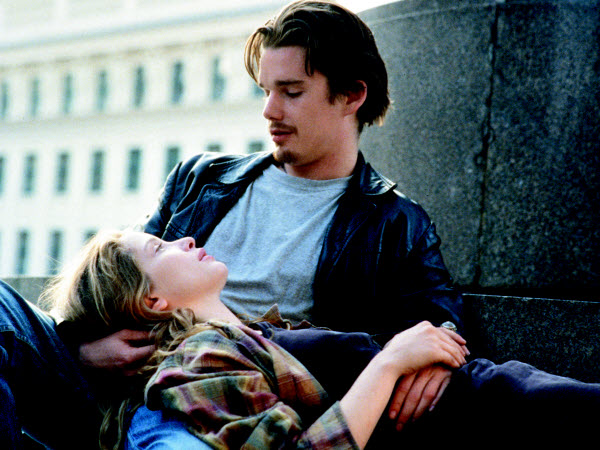
1995 version

1995 version

The second (2004), was filmed, and is staged to take place, nine years later, when the actors and the parts they play are in their early to mid 30s. Here, it is revealed that fate separated the lovers before they could meet again, but meet again they do. This time it is a weekend in Paris, and once again the viewer is left hanging about whether they will find happiness. Under movie convention rules, that means stay together as a couple. How little mortals know.
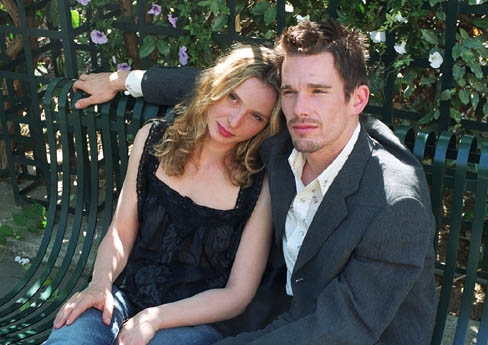
2004 version

2004 version

Despite the dyadic symmetry of the two films, the fact that the viewer is left hanging at the end of the second suggested a need to continue. And now after another nine years, Linklater brings us back to Jesse and Celine, and we see the road they have traveled and where they are now, in 2013. Now they are in their early 40s.
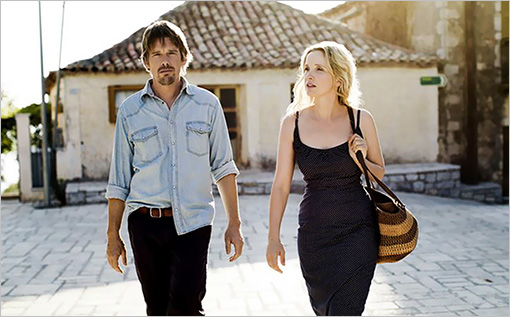
2013 version

2013 version

Below the fold spoiler alert

Continue reading

Posted in Movies | Tagged , , , , , | 13 Comments

“Ask the Dust”

Blowhard, Esq. writes:

askthedust

Written and directed by Robert Towne from the novel by John Fante, you’d never know from watching this film that the source material was one of Charles Bukowski’s primary influences. Set in Depression-era Los Angeles, Fante’s novel is a story of desperate, marginal figures and the wounds they inflict on each other while Towne’s film scrubs all the rough edges clean. A long-time dream project, I get the feeling the script went through a few too many rewrites.

The movie is at times too reverent and not reverent enough. The first three quarters of the film follow the novel pretty closely, but the two leads — Colin Farrell as a first-generation Italian transplant from Colorado and emerging writer, Salma Hayek as the Mexican waitress he falls in love with — never generate much heat or tension as Towne dutifully puts them through their paces. In the last quarter of the film, Towne alters the story considerably for the worse by turning it into a conventional tale of racism and immigrant aspirations, whereas the novel was more ambiguous and existential.

Farrell is terribly miscast. In the novel, the character is an unattractive, guilt-ridden Catholic boy who’s a loser with women. Hey, did the Farrell sex tape — y’know, the one where he bangs a Playboy model — come out before or after this film? The role calls for a young Steve Buscemi or Paul Giamatti type. (Maybe the financing was contingent on Farrell?) Meanwhile, Hayek is asked to play a “fiery,” poor, illiterate, pot-smokin’, TB-infected, victimized Latina who, gee, just wants some nice fella to marry her. You do get to see her boobs a couple times, though, so it’s a not a total loss. Caleb Deschanel’s photography is classy and kudos to the production team for turning South Africa into a believable stand-in for 30s Los Angeles, even though there were a couple shots of some heavily wooded areas that were a bit jarring.

Related

Posted in Movies | Tagged , , , , , , | 5 Comments

Taking Down Krugman

epiminondas writes:

“The Republican party is still defined by a coalition of Church people, Chamber of Commerce people, and Military people. And as anyone who has so much as flipped through an issue of Reason or The American Conservative can report — this is an exercise Krugman seems never once to have tried — there are plenty of each kind of person controlling the GOP who are, despite their identity group, in no important way politically conservative.”

More here.

Posted in Politics and Economics | 1 Comment

“Marked for Death”

Paleo Retiree writes:

Reluctant no longer

Reluctant no longer

Steven Seagal movie from 1990, and — not that I’m a scholar of Seagal’s work, mind you — one of his best, IMHO. It’s slickly directed (by Dwight H. Little), amusingly designed (by Robb Wilson King), and extremely well-lit in a “48 Hrs.” kind of way (by Ric Waite, who I was sad to learn recently died), and it features a lot of terrific supporting players, including a spectacular and terrifying turn by Basil Wallace, a Jamaican-born actor who plays the charismatic, possibly psycho leader of a Jamaican drug gang. (The film makes a big deal out of contrasting the serenity and sweetness of middle-class American life with the nest-of-vipers quality of the brutal, Obeah-believin’ Jamaican thugs.) Plus I really liked “John Crow,” a Jimmy Cliff song that the movie features. 

The Question Lady and I had our usual good time chuckling over Seagal’s portliness and clueless acting, and roaring over action-movie clichés. Has there ever been a more unlikely action hero than Steven Seagal? Or one to whom stuntmen have been more generous? And how long can an audience reasonably be expected to watch a Reluctant Action Hero act out his reluctance before finally, reluctantly, shifting into action gear? 30 minutes? 45? But the film handles some of the conventions ingeniously, it’s genuinely engaging and effective, and it works up a decent amount of excitement and tension.

In this one, Seagal is a fed-up DEA agent who quits his job, then returns to what he’s hoping will be peace and quiet in the paradisal Chicago ‘burbs. But a drug war is happening there, and his skills are needed. With the wonderfully soulful Joanna Pacula — what a pro she is — as a sexy plot device, and Elizabeth Gracen (former Miss America and Clinton bed-partner) as Seagal’s sister. Given that a lot of the movie consists of watching a white dude kick black-guy butt, the filmmakers were probably wise, or at least shrewd, to make both of Seagal’s good-guy sidekicks black.

Related

Posted in Movies | Tagged , , , | 2 Comments

Of Kings, Coinage, and Castration

Fabrizio del Wrongo writes:

Henry_II_Penny

I recently watched the first two seasons of “Monarchy,” a BBC series covering the history of the English kings and queens going back to the late Roman period. Despite the ridiculously affected speech of narrator David Starkey (which is good for a few laughs, at least), I enjoyed it. It provides a good, CliffsNotes-y overview of English history, and it succeeds in making a rather complicated story at least partly comprehensible.

One thing I found myself thinking while making my way through the series: Boy, I’m sure glad I wasn’t a medieval king! The fairy tale image of courtly magnificence and untrammeled power seems like a lot of guff. In fact, being a king was a lot closer to being a don in a modern-day mafioso family. There was always some creep hoping to knock you off, and it was more likely than not that your reign would end in either imprisonment or murder.

Well, fuck that shit. I’d rather be a court musician or something along those lines, gulping down mead and charming the wenches with my mad lute skills. But, then, though I once had a subscription to “Nintendo Power,” I’ve never had much of a thirst for real-world power. The idea of bossing people around — it mostly gives me the heebie jeebies. I don’t even like the idea of being responsible for a bunch of stuff external to my immediate bubble. Other folks’ problems — who wants to deal with ’em? I guess that’s why I’ve never been fascinated by politicians. To me, they seem like . . . borderline sociopaths.

One of the details covered in “Monarchy” that struck me as amusing concerns Henry II. Henry was the first Plantagenet king. Dates: 1154 to 1189. One of the challenges he faced upon being anointed was stabilizing the English currency. You see, the “moneyers” in charge of his mints were clipping the edges off of silver coins, melting down the shavings, and creating new coinage. Instant money! Inevitably, this resulted in rampant inflation, as everyone began to realize that the coins in their purses contained less silver.

Henry’s solution to this problem was pretty novel. In the words of Toby Birch, he:

Summoned the various Mints to Winchester (then the capital of England) in what was called the ‘Assize of Moneyers’. Two thirds of them were found guilty of debasing the currency and either had their right hands cut off or were castrated. History does not record as to whether they were given a choice between the two options.

As Birch points out, we’re dealing with something similar in the 21st century. Only now the activities of “moneyers” like Ben Bernanke aren’t viewed as warranting castration. On the contrary, they’re condoned acts of state. Meanwhile, the Paul Krugmans of the world tell us we’re crazy for being outraged at our savings being devalued so that government can create money in order to pay debts and cajole special interests. Progress, eh?

Related

Posted in Movies, Personal reflections, Politics and Economics | Tagged , , , , , , , , , | 7 Comments

Letter from China: In-flight Rhetoric

Fenster writes:

Sponsored rhetoric will always reflect the interests, and interest, of the sponsor. We get that automatically in the Era of Spin, that you can’t much trust any statement on its face, and that your brain has to automatically and unconsciously cogitate to discern interest in any piece of communication.

When I  am stuck on an airplane without much to read I will often go for the in-flight magazine just to see the words and pictures.  And I really don’t think much of it that such things are written in a kind of corporate-speak.  That only makes sense given the magazine’s sponsorship: the airline itself (directly) and the Chambers of Commerce and Tourism Commissions of the airline’s destination (indirectly).  Twenty-eight pages on the glories of Greenville-Spartanburg, South Carolina when US Air expanded service!  And here is a recent spread on Charlotte leading with the fact that Charlotte is “where business soars”.

No surprise, perhaps, that in-flight magazines in China would read a little differently?  It is, after all, the People’s Republic of China, so rather than glorify corporations, you’d expect it to perhaps glorify labor.

Continue reading

Posted in Politics and Economics, Travel | Tagged , , , | 2 Comments

A Day at the Ballpark

Blowhard, Esq. writes:

field

Went to a Dodger game this weekend for the first time in many years. A few random observations:

  • The most annoying thing was the constant music/sound efx to keep the crowd amped up. There was dance music before the game during batting practice and music clips between every pitch and inning during the game. We were constantly exhorted to clap, cheer, whatever. Every batter had walk-up music. Rihanna, Daft Punk, The Who, Stone Temple Pilots, Marilyn Manson, The Black Keys — JFC, will someone turn off the goddamn radio? And let the dude working the boards know there’s no Oscar for Major League Sound Effects Editing. It’s like sports fans aren’t happy unless they’re in the middle of a Nike ad. Also, I wonder how Beethoven would’ve felt knowing the four note sound of his imminent death is used whenever someone strikes out?
  • Not all fat guys are loudmouths, but why are all loudmouths fat guys? Do the surplus lipids strengthen their vocal cords and compel them to constantly shout stupid shit?
  • Remember Susan Sarandon in Bull Durham? Yeah, those girls were easy to spot in the stands.
  • Vin Scully will never die, right? I’m still not over Chick Hearn‘s passing.
  • As you can see in the picture below, lots o’ Mexicans in sportscrap! I’d say about 80% of the crowd in our section were Hispanic. Everyone from the kiddies to the grandmas were festooned in Dodger logo-emblazoned blue. But isn’t it great how all the races have their own sport? Mexicans have baseball, whites have football, blacks have basketball, and Asians have classical music.
  • I’m pleased to report that every staff member at the park was exceedingly friendly and helpful. Having the corporate brand tarnished when a fan is nearly beaten to death in the parking lot wonderfully concentrates the front office’s mind. Regardless of why, from the security people at the gate, to the concessions workers, the girls at the souvenir stand, the ushers — all seemed genuinely pleased to be there and wanted you to have a good time. When some dude walking up the steps spilled that disgusting nacho cheese everywhere, I went and asked if they could get someone to clean it up. A worker showed up within three minutes. One other thing: I used a restroom during the 5th inning and it was surprisingly clean. Didn’t Dostoevsky say that you can judge a civilization by the cleanliness of its major league ballpark toilets?
  • But what you’re really wondering is how much this all cost. It was $40 for the ticket, which was in the right field pavilion in a special all-you-can-eat section — unlimited hot dogs, nachos, popcorn, peanuts and soda. (I had four hot dogs over the course of about 6 hours, a bag of peanuts, and water.) I got a hat for $40. Yeah, that’s right, I bought some sportscrap — fuck you guys, I’m losing my hair so it’s a practical necessity, OK? Finally, parking was $10 and a program was $5, for a grand total of $95. Expensive, but if you cut out the souvenirs that halves the bill.

crowd

When was the last time you went to a major sporting event? (Or minor one, for that matter.) What was your experience like?

Posted in Photography, Sports | Tagged , , , , , , , | 16 Comments

Cocktail Du Jour

Paleo Retiree writes:

The “Wry Lemon” cocktail at Greenwich Village’s great Cornelia Street Café: Templeton Rye, Cynar, lemon juice, simple syrup, and Dutchess Colonial bitters. The drink is special to the Cornelia Street Café but it’s so excellent, and in such a self-evident and straightforward-seeming way, that I found myself wondering why it hasn’t already attained classic status. The murky-yet-crisp, sweet/bitter/whiskey thing was most of what was going on, but it was enough to make the whole evening feel like a giddy swirl of funky downtown elegance. Cynar, I learned from our friendly bartender, is a versatile bitter Italian liqueur based on (get this) artichokes. Sipping bliss.

Posted in Food and health, The Good Life | Tagged , , | 6 Comments

Lloyd Fonvielle on “A.I.”

Fenster writes:

A thank you to Lloyd Fonvielle for writing a wonderful and insightful piece on Spielberg’s A.I.  Thanks for the piece itself, which is an excellent read, and for sparing me the trouble of writing at too much length about this film myself.  I have been wrestling for quite a while with A.I., wanting to write about it, but Lloyd’s piece relieves me of that, other than the few comments to his piece that I will make here.

Like Lloyd, I had confused and conflicted feelings about the film the first time I saw it.  But I went back numerous times to see all or parts of it, and have come to a similar place as Lloyd: that if what Spielberg and Kubrick were doing was on purpose,

 then perhaps A.I. does become one of the greatest movies made in our time — an analysis of the narcotic cinema that distracts us from real things. If they did it by accident, then it still might be one of the most important films made in our time.

Lloyd’s first reaction was that the film was “just a kind of philosophical mess”.  Much of his piece represents a kind of working through of that reaction.  For me,  of course it will appear messy at first, since it is a sincere attempt to reconcile Kubrickian aridity with Spielbergian schmaltz.  It doesn’t feel like a marriage that can be made without creating a philosophical mess.  But does it fly?  For Lloyd–me, too–yes it does, and it is all the more powerful for not fully reconciling the competing demands of the two auteurs.

Spielberg retelling Pinocchio?  My God, a project like that would seem a prime candidate for Spielberg’s brand of over-ripeness.  And every bit of that director’s emotional palette is on display.  But so is the “emotional subersiveness” (Lloyd’s term) of Kubrick’s nihilistic tendencies.  Pinocchio is, and remains, a puppet, and there is no magical happy ending.  Well, magical maybe, but not happy.*

Adding Spielberg’s melodramatic and crowd-pleasing skills to the mix, then, heightens the force of the film on the viewer–this viewer, at least.  You are authentically sucked into the parental love but continually reminded that you are not quite seeing and feeling what you think you are in David.

Moreover, the cold Kubrickian intention is, I think, to remind the viewer that humans themselves are perhaps not much different from robots in the first place.  Yes, we are made of meat, with a squishy gray processing center inside our skulls.  But is David’s love for his mother much different, really, from that of his mother for him?  So we start by feeling the tragedy of David–that he feels from the inside out that his love is authentically his when it is “merely” a function of his program.  But we then move on to the tragedy of us–that we are not much different.

Maybe this would have been one of Kubrick’s most devastatingly cold films had he directed it.  Or maybe not.  Kubrick handed the troubled project to Spielberg before his death, so maybe he saw that pessimism is all the more powerful when real love runs right through it.  And maybe Spielberg took the project on for the flip side: to show that true love is real even in a possibly meaningless universe.

osment

There’s so much of this movie that is parental.  I am not sure it would have been nearly as powerful had it not been about a kid, and if I myself were not the parent of a son who was about David’s age when the movie came out. Perhaps the movie was just engineered for my program as a human parent.

Related

  • Here’s Spielberg on the ending to the film, and how it is not a schmaltz set-up but part of Kubrick’s initial vision.  I agree that the ending only looks schmaltzy, and that it is as rigorous as the rest of the film.
  • And here is Lloyd on The Wild Bunch–very much worth reading though this time I find myself on the opposite side, for now at least.
Posted in Computers, Movies | Tagged , , | 7 Comments

“Rust and Bone”

Fabrizio del Wrongo writes:

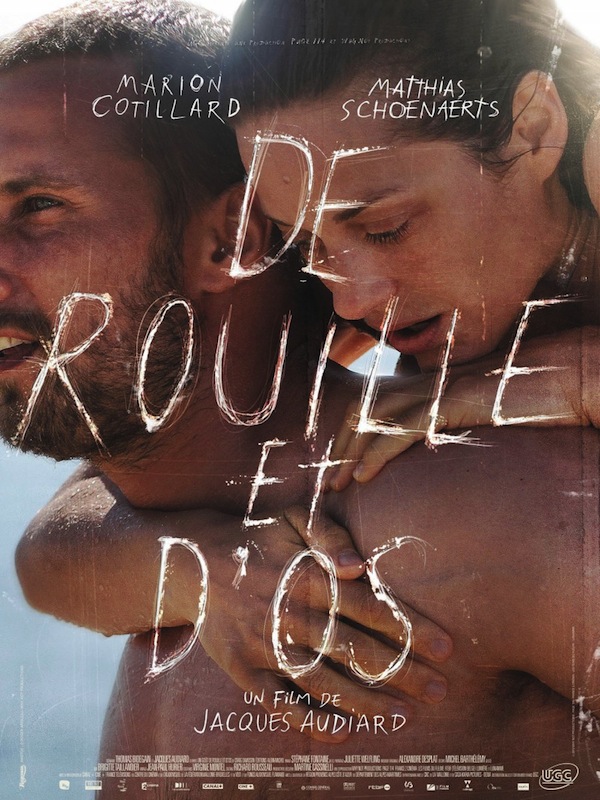
Rust-and-Bone-2012-movie-poster

This movie might have been something had director Jacques Audiard bothered to give it a shape and some conciseness. I love Marion Cotillard; she reminds me a bit of Nadia Sibirskaia, though there’s a smidge of Gollum in there as well. She would have been great in silents; you’re never not sure what she’s thinking. Matthias Schoenaerts, who plays the thuggish street fighter, is good too. I like how his eyes are too close together, like they’re on the verge of breaching his nose and blobbing into one another; it lends his face a suspenseful quality that’s lacking in more conventionally handsome actors. (Schoenaerts seems destined to star in “The Vladimir Putin Story.”) But his character’s narrative is largely extraneous; I kept wondering why I was being asked to care about his relationship with his son and his involvement in an illegal surveillance scheme. (A scene in which he saves his son from drowning is good but unintegrated — it’s like a little movie unto itself.) Acting aside, the best thing about “Rust and Bone” is its treatment of Cotillard’s baser instincts. She’s a sensualist who finds a sort of erotic solace in her interaction with big, uncontrollable forces (whales, fighters, the ocean), and the movie doesn’t try to explain that away or apologize for it. And bless Audiard for avoiding the claptrap that typically accompanies movies dealing with the disabled. If anything, Cotillard becomes less noble upon losing her legs: precariously perched inside a nightclub, she looks at the slender gamines in their tiny miniskirts, and shades of envy glide across her face.

Posted in Movies, Performers | Tagged , , , , , , | 2 Comments