Wither Colleges?

Fenster writes:

Blowhard Esq. advocates here that students consider college on a do it yourself basis.  That idea has a lot of appeal.  Here is a book on DIY University.  And the recent film on higher education, The Ivory Tower, has several interesting segments on do it yourself approaches, AKA hacking higher education.

We will see a lot more of this in the future I am sure but how much and how far in the future are questions that are yet up in the air.  Higher education has vast inertia and has mostly been successful to date in holding off the kinds of changes that have been breathlessly prophesized.   But while the future tends to come later than true believers initially predict, with the result that prophecies get discounted, come it will eventually, often catching people off-guard when it does.  Sometimes it comes in disguise, too, since inertia may spawn unexpected workarounds and mutations.

The largest factor holding back DIY approaches is the dominant theme in higher education today of credentialism.  If higher education were all about self-improvement–the old myth–then DIY would work just fine.  But nowadays it is mostly about presenting an employable package to the market, one that employers can understand in simple ways.  A Harvard degree means a very smart person, even if little education was imparted while residing in Cambridge.  Stanford Computer Science sends a different signal; Rhode Island School of Design another.

It doesn’t have to be this way.  I wrote here in 2012 (wow, ancient UR history) about what has been called alternative credentialing–essentially hacking the system by assembling merit badges.  The merit badges you assemble may or may not constitute a recognized degree from an accredited institution but if employers understand what the badges add up to, and if they value that package, you are employable.

Work continues apace on this.  But, per the above caution about the future never appearing as quickly as proselytizers confidently assert, here we are almost three and a half years after my post and things have not changed all that greatly.  People still rely on the simpler coding available from the US News rankings and from accreditation bodies (bodies which are, no surprise, constituted by the industry they regulate).

So if DIY will be delayed a bit more, what might be the vector of a more imminent change?  What mutation might develop that will be the new cutting edge?

Perhaps it will be an old-fashioned college, made new in certain key respects.

And I mean that term “old-fashioned” literally–i.e., the kind of college that used to exist that no longer does.  Mostly teaching.  Not that much of an emphasis on faculty research.  Little by way of general administration or student affairs.

A place like this can have facilities.  It can have a faculty.  It can be accredited.  So we would not be asking employers to take on the job of decoding a series of possibly unconnected merit badges that may or may not lead to something resembling a baccalaureate education.  But, like colleges of old, it would consciously strive to devote most of its resources to . . . . (drumroll) . . .  teaching! 

Teaching and instruction are the smaller part of the expenditure picture in higher education.  The Delta Cost Project does the most systematic job of analyzing what money is spent on in higher education.  Here is its most recent report, just out, that looks at higher education spending from 2010-2013.

The report acknowledges that instruction takes a back seat to other spending in many ways but puts the matter diplomatically as follows:

Educating students is the common thread that weaves across all colleges and universities, but it takes more than just faculty to run institutions. Student services (such as admissions, registrar services, and student counseling) are often key to a successful college experience. And other support functions (including academic and institutional support and operations and maintenance) contribute indirectly by providing an infrastructure that supports learning. Institutions may also engage in sponsored research and public service activities or in hosted auxiliary operations, such as food service, book stores, and sometimes even hospitals.

Note that while this language recognizes that of course it takes more than instruction to run a college, it is silent on whether all of those expenditures are needed or wise.  Perhaps there is an arms race for facilities.  Perhaps faculty aren’t spending enough time teaching.  Perhaps near universal education has spawned the felt need for large bureaucracies to handle new student needs and problems.  The Delta Cost Project mostly reports what it finds.

And what does it find?

Public and private four-year colleges and universities boosted spending on student services per FTE student by 2 to 4 percent in 2013, outpacing the instructional spending in terms of average growth (1 to 2 percent), but not the dollar amount invested . . .

The rise in student services spending is an ongoing trend. On many college campuses, the growth may reflect a greater emphasis on career counseling and academic advising by professional staff, as well as students’ expectations about access to campus mental health services. Student services was among the fastest growing spending categories during the prior decade—particularly at private institutions and selective public institutions, where spending per student increased by more than 20 percent between 2003 and 2013.

Spending on administrative and maintenance functions increased faster than instructional spending at many four-year institutions in 2013. In particular, academic support expenditures per student (e.g., libraries, information technology, deans’ offices) rose by an average of 3 percent or more . . .

Take the category of private bachelor’s colleges (please!)  While this category includes a wide variety of places with different costs and tuition levels, you probably have some feel for the high sticker price of private higher education.  But in this category, the Delta Cost Project reports that instruction costs per student are only about $9,000.  That is a fraction of tuition.

Where are the rest of the costs?  Take student services.  There the costs per student were fully half the amount of instruction, around $4,500.  But of course that’s not all.  Institutional support (non-academic overhead) costs were higher yet than student services, around $5,000.  And academic support (more overhead, but the running of the academic enterprise such as dean’s offices) came to over $2,000.  Ditto Operations and Maintenance.  All of these together come to over $25,000, of which the $9,000 on instruction in just a fraction.

Oh, and this does not include spending on things like public service, sponsored research and auxiliary enterprises like food service and dorms.  Those are other categories in the Delta scheme.

It’s all a more complicated picture than this small snapshot suggests, but the snapshot is suggestive nonetheless.

What this means is that in theory there is an opportunity out there for someone to actually build a new institution that sheds many of these costs.  Yes, consumers want the new rock climbing walls and fine dining and extra counseling services and so forth.  But they have never been given the option of the budget model!  A friend of mine is hard at work on the development of one of these colleges, and is pretty far down the road with the business model, the funding and the regulators.

That model suggests that a stripped down for action college is feasible at a tuition level of $8,000.  A new library is not needed if the college has sufficient journal privileges and an inexpensive contract to use the first-rate library of a nearby college.  Faculty will not be encouraged to vacate their classrooms to develop publications but the reverse: faculty will have beefed up teaching loads and will be evaluated mostly on teaching rather than research, which is the obsessive preoccupation of academics elsewhere.  Student affairs will be handled, but not with as much hand-holding, without excessive programming, and by relying on outsourcing things like counseling services.

If you build it, will they come?  Hard to say.  But there are a lot of parents out there who will think twice about a $40,000 price tag when there’s a model out there for under $10,000 that is as good, or even just nearly as good.

Posted in Education, Uncategorized | 4 Comments

Architecture Du Jour: King’s Highway in Palm Springs, CA

Blowhard, Esq. writes:

khcover

While in Palm Springs I didn’t get the chance to tour much of its midcentury modern splendor, but I did enjoy this former Denny’s that the Ace Hotel has hipsterized. Dig the cantilevered roof and rock wall, baby.

When you visit, I highly recommend going for breakfast and getting the Moroccan scramble: Merguez sausage, soft scrambled eggs, spiced chickpeas, and crushed avocado served over grilled sourdough. One of the best breakfasts I’ve had in a long time.

khscramble

Posted in Architecture, Food and health, The Good Life | Tagged , , | 4 Comments

Architecture and Color

Paleo Retiree writes:

Posted in Architecture | Tagged , | Leave a comment

Franklin and Montaigne

Fenster writes:

I don’t object to Bastiat being named as a patron saint of UR philosophy, such as it is.  It’s a big tent–not unlimited in size for sure, but capacious enough.

Blowhard Esq. previously nominated Montaigne, and that fits as well, or better, by my lights.

I wrote just yesterday about how people can be unfathomable, and that the normal opaqueness of human motivation can be compounded by the past’s nature as a foreign country.  But the reverse can sometimes be the case as well, and thankfully so.  From time to time you can feel that someone who is long dead is sitting right next to you in the room, talking to you, and that the thoughts expressed are a clear and as refreshing as water.

Montaigne can feel that way.

mont

And another too: Benjamin Franklin.

I have read about Franklin but I never really read much of Franklin’s own words.  My son gave me a volume of Franklin’s writings for Christmas and I have begun, happily, to rectify that deficiency.

fr6

Franklin’s writing gives much pleasure on many dimensions.  For one, while clearly written well before the advent of Hemingway-ish stripped down prose, it is lucid and clear in its colonial fashion.  There’s a wry and mordant wit at work as well, one that would be fully at home in the modern age.  And then of course there is the breadth of interests and subjects–scientific experiments, religion, diplomacy, personal matters.

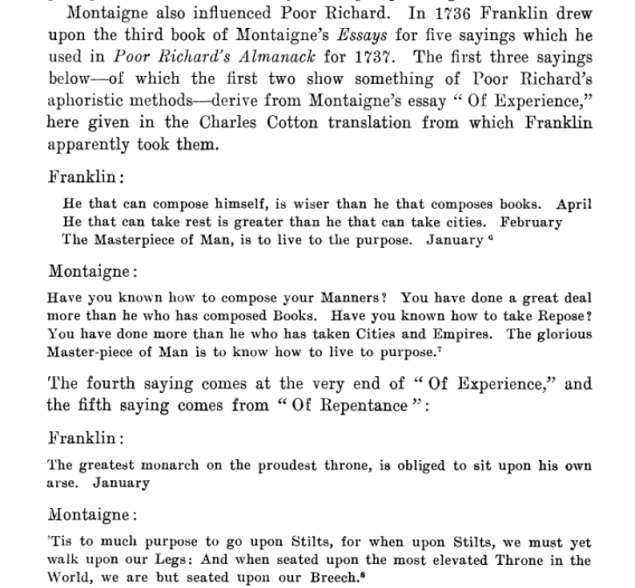
I was not surprised, then, to find that Montaigne was a direct influence on Franklin.  This from a 1957 article in Modern Language Notes:

fm1

fm2

Benjamin Franklin and Montaigne
Robert Newcomb
Modern Language Notes
Vol. 72, No. 7 (Nov., 1957), pp. 489-491
Posted in History, Personal reflections, Philosophy and Religion | Tagged , | 1 Comment

Inside Graduate Admissions

Fenster writes:

A new book takes a look at the admissions process in graduate schools.  It’s Inside Graduate Admissions by Julie Posselt.

And here’s an article about the book from Inside Higher Education.

And further commentary from the insightful Megan McArdle.

Most of the furor over admissions in the United States concerns undergraduate admissions.  More specifically: undergraduate admissions at highly selective colleges.  Most colleges are not all that selective, or selective at all, and most of the hand-wringing over questions like holistic criteria, merit or the benefits of diversity do not apply.  Graduate admissions, even at prestige programs, has been terra incognita.

Admissions is as a general matter a black box proposition–you can see what comes out but you don’t get to see how the sausage was made.  That’s true for undergraduate admissions, where the fate of college seniors is often in the hands of twenty-something staff people, and it’s true for graduate admissions, where the fate of potential scholars is in the hands of faculty sitting in judgment.

Given the black box, Posselt’s method is simplicity itself: listen.  It has been said of public service that you can learn a lot about it just by listening to the people who practice it.  That applies here as well, to faculty involved with graduate admissions.  This straightforward approach, mostly unencumbered by theory, is often the right method to use when looking at something for the first time.  It would be wrong-headed to bring too much ideology or too many hypotheses to black box situations.  Start by listening.  There’s ample time to generate hypotheses after getting a sense of the meaning of things as understood by participants.

That does not mean people should always be taken at face value, to say nothing of the fact that even when carefully listened to people can often appear unfathomable.  But wisdom starts in listening.

What does Posselt hear?

For me the picture that emerges is one of serious scholars who have a hard time balancing their commitment to their field with the demands of their ideological commitments, and in the face of defects in other parts of the higher education world.

Graduate programs are a lot smaller than undergraduate programs and they can be more uncompromising.  There’s less room for error.  And since the process is run by actual faculty rather than callow youth there is an honest sense of obligation to the field that runs through deliberations.

That extends to a heavier reliance on GRE scores than would ordinarily be considered correct.  In part, such a reliance reflects a recognition on the part of faculty that grade inflation and related factors have worked to corrupt academic quality at the undergraduate level.  How much can you trust that 3.8 average, even from a prestige undergraduate school?

Graduate admissions is also where the rubber hits the road on diversity and quality.  Faculty clearly care about diversifying their institutions and their fields–but at what cost?  Highly talented minority candidates are highly prized and as a result possess leverage to move up the quality scale in terms of institutional reputation.  Where does this leave the very-good-but-not great graduate department?  The minority candidates it would select decamp to the next level up and there is some hesitancy at accepting what are perceived to be candidates of lower quality.

This does not render faculty in graduate admissions total realists.  The Force is strong in higher education, and it will come out.

(Posselt) describes one discussion she observed — in which committee members kept to this approach — that left her wondering about issues of fairness.

The applicant, to a linguistics Ph.D. program, was a student at a small religious college unknown to some committee members but whose values were questioned by others.

“Right-wing religious fundamentalists,” one committee member said of the college, while another said, to much laughter, that the college was “supported by the Koch brothers.”

The committee then spent more time discussing details of the applicant’s GRE scores and background — high GRE scores, homeschooled — than it did with some other candidates. The chair of the committee said, “I would like to beat that college out of her,” and, to laughter from committee members asked, “You don’t think she’s a nutcase?”

Other committee members defended her, but didn’t challenge the assumptions made by skeptics. One noted that the college had a good reputation in the humanities. And another said that her personal statement indicated intellectual independence from her college and good critical thinking.

As McArdle puts it “academics are so lefty they don’t even see it.”

This seems to go not only for the faculty that Posselt observes but probably for her as well.  In the end, Posselt emerges from her encounters with a call for . . . a more holistic approach to graduate admissions.

While admissions leaders constantly talk about the value of holistic admissions, Posselt said, it is rare to see up close just what that means. She saw much to admire, she said, in the devotion of faculty members to their disciplines and their intellectual traditions. And she believes holistic review has the potential to help graduate programs (and other parts of higher education) to identify and admit more minority talent.

But she also has worries. “If it’s not executed with care, it can lead to reproducing the status quo rather than seeking diversity,” she said.

If higher education is going to focus on holistic admissions to preserve affirmative action, Posselt said, admissions committees need to be open about what they value and consider whether those values should change.

Posted in Education | Tagged , , , | 4 Comments

Peoples is the Cwaziest Monkeys

Fenster writes:

Lew Lehr said that monkeys is the cwaziest peoples.  I don’t know monkeys so I don’t know if that is true.  I have been around a lot of humans, though, and I believe that you could fairly put that phrase the other way about: peoples is the cwaziest monkeys.

It is easy to forget this, especially if one is well-adjusted and one’s culture is on a solid footing.  A lot of our make-up seems designed to get us comfortable with our surroundings, safe in the knowledge that things make a lot of sense and that people are fairly explicable beings.  Of course as all the best rogues know people are capable of anything.

People can be odd, even seemingly inexplicable.

The easiest way to come face to face with this is through history.  The past is, as they say, another country.  The facts of history are hard enough to come by but even when you have them there is the question of interpretation, which often boils down to what in God’s name people were thinking when they did shit.

Here is a link to the excellent BBC show In Our Time.  In this show, host Melvyn Bragg and his guests, all of whom are eminent historians, are discussing the Salem Witch Trials.  Yeah, I thought, I know all about that.  Grew up nearby.  Learned it at school.  Saw The Crucible. And so forth.  Yet as these historians rifle through various explanations–Indian invasion psychosis, ministerial self-doubt, egotism, ergotism, family rivalries, theological beliefs–they often seem to be brought up short.

They discuss how the people who profess innocence are typically hanged while those who confess often go free.  One proclaims this to be “bizarre”.  Another counters by arguing that it is only bizarre by twentieth century standards and that what happened must have made sense to the participants at the time.  Yes, but how?  The historians snipe back and forth a bit about whether “bizarre” is a fair term to use, but the issue does not really resolve itself.

You can lead a horse to water but you can’t make him drink.  And you can hear directly from the horse’s mouth about actual events–but you can’t always make out what the horse was thinking.  The most straightforward phenomenology can end in mystery.

Well, that’s the past you say.  Of course it will be hard to understand.  Surely the present is not another country.

Alas it is.  Just take a look at Going Clear, Alex Gibney’s documentary on scientology (sorry I refuse to capitalize the term).

Gibney’s POV is clear enough on some facts and some interpretations, including that L. Ron Hubbard was crazy as a loon.  But those are the easy parts.  It is much harder to come to grips with what Hubbard’s followers were thinking as they lied, cheated and worse.  Self-interest?  Maybe but that doesn’t seem to provide a satisfactory answer.  Insanity?  scientology head David Miscavige and Tom Cruise seem insane enough, but most of the others seduced by scientology seem quite sane.  Most of those who have “left the church” seem themselves utterly unable to account for their thinking and behavior when members.

To me there was something profoundly unsettling about this inability to account for one’s self.  Time and again I found myself laughing out loud at the absurdity of this or that behavior, only to realize that my laughter had a nervous quality.  Dogs wag their tails not when they are happy but when conflicted, and my laughter had some of that quality.  Funny, yes, but disorienting too, to think that this now-reasonable person was essentially cwazy.

Razib tackles this issue head-on in a blog post today attempting to make “sense” of Islamic terrorism.  As he points out:

Humans are social creatures, and much of our cognition operates through a social sieve. Our beliefs and preferences are strongly shaped by a tendency to conform to our “in-group.” This is so strong that even if it is clearly irrational humans may still engage in behaviors to maintain conformity to group norms.

Posted in Movies, Philosophy and Religion, Uncategorized | 2 Comments

The Genius of Neon Park

Sir Barken Hyena writes:

Somewhere Over the Rainbow: The Art of Neon Park, Last Gasp 2001

Because of his famous record covers for Zappa and Little Feat, among others, I have been aware of Neon Park since childhood, but until I stumbled on a copy of this wonderful book at LA’s iconic book/toystore/art gallery Wacko, I hadn’t realized the breadth of his art, or the depth of his influence. Spawn of the psychedelic daze of the late 60s Bay Area, Neon Park, born Martin Muller in 1940, fell right in with the burgeoning mind expanding culture of the day, and took it just a but farther himself.

From here I’ll simply let his art speak for itself.

Posted in Art, Books Publishing and Writing, Music | Tagged , | 1 Comment

And Myself Last of All

Fabrizio del Wrongo writes:

615px-Amphora_death_Priam_Louvre_F222

The old man stretching his hands out called pitifully to him:
‘Hektor, beloved child, do not wait the attack of this man
alone, away from the others. You might encounter your destiny
beaten down by Peleion, since he is far stronger than you are.
A hard man: I wish he were as beloved of the immortal
as loved by me. Soon he would lie dead, and the dogs and the vultures
would eat him, and bitter sorrow so be taken from my heart.
He has made me desolate of my sons, who were brave and many.
He killed them, or sold them away among the far-lying islands.
Even now there are two sons, Lykaon and Polydoros,
whom I cannot see among the Trojans pent up in the city,
sons Laothoe a princess among women bore to me.
But if these are alive somewhere in the army, then I can
set them free for bronze and gold; it is there inside, since
Altes the aged and renowned gave much with his daughter.
But if they are dead already and gone down to the house of Hades,
it is sorrow to our hearts, who bore them, myself and their mother,
but to the rest of the people a sorrow that will be fleeting
beside their sorrow for you, if you go down before Achilleus.
Come then inside the wall, my child, so that you can rescue
the Trojans and the women of Troy, neither win the high glory
for Peleus’ son, and yourself be robbed of your very life. Oh, take
pity on me, the unfortunate still alive, still sentient
but ill-starred, who the father, Kronos’ son, on the threshold of old age
will blast with hard fate, after I have looked upon evils
and seen my sons destroyed and my daughters dragged away captive
and the chambers of marriage wrecked and the innocent children taken
and dashed to the ground in the hatefulness of war, and the wives
of my sons dragged off by the accursed hands of the Achaians.
And myself last of all, my dogs in front of my doorway
will rip me raw, after some man with stroke of the sharp bronze
spear, or with spearcast, has torn the life out of my body;
those dogs I raised in my halls to be at my table, to guard my
gates, who will lap my blood in the savagery of their anger
and then lie down in my courts. For a young man all is decorous
when he is cut down in battle and torn with the sharp bronze, and lies 
there
dead, and though dead still all that shows about him is beautiful;
but when an old man is dead and down, and the dogs mutilate
the grey head and the grey beard and the parts that are secret,
this, for all sad mortality, is the sight most pitiful.’

—  Homer, as translated by Richmond Lattimore

Posted in Books Publishing and Writing | Tagged , , , , , | 2 Comments

Naked Lady of the Week: Jessi June

Fabrizio del Wrongo writes:

jj-cover

Southern gal Jessi June is solidly built and charmingly indelicate looking. She’s been featured in most of the big American nudey outlets; she’s even been a Penthouse Pet. I wonder, does the title of Penthouse Pet still mean something?

She’s active on Reddit. Here’s one of her comments in reply to someone who is concerned that her boyfriend is spending too much time on the site’s “Gonewild” forum:

As a girl who is both on gonewild and on pornhub, I’ll say that I think you shouldn’t let this bother you as much with how the girls are more “real”. Is it wrong that you told him it makes you uncomfortable and he’s still doing it? Yes. But I think the insecurities with him looking at other girls is the real issue. Whether they’re professional pornstars or faceless gonewilders or chicks snapchatting, it’s still the say endgame. The amateur stuff just doesn’t have the hair, makeup, and photoshop going into it (sometimes), and these days alot of guys prefer that actually. They don’t want the fake anymore. Also, remember a good amount of girls on the amateur sites are actually still cam girls and girls who do it professionally, so… there’s that too.

He isn’t cheating, he isn’t flirting, and if it’s just comments, I’d let it ride sweetie. If it turns into conversations with the girls or something else, then I’d worry… Otherwise, it’s all just fap fantasy. If anything, why not try to share in it with him and see if that helps? Maybe him going “She’s hot, but your butts so much better” will actually end in a confidence boost? Who knows. I wouldn’t let something like this ruin an otherwise (assuming here) healthy relationship…

This shrewd and worldy (and spoken-from-experience) comment was down-voted by Reddit users, and today has a negative rating.

Continue reading

Posted in Photography, Sex, The Good Life | Tagged , , | 1 Comment

Architecture Du Jour: Celebration, Florida

Blowhard, Esq. writes:

covercelebration

During my Christmas vacation in central Florida I made an impromptu stop in Celebration, Florida, the Disney-designed town located outside Orlando near Disney World. Having never seen a New Urbanist-inspired town like this in person, I was eager to take a look around. I did no research before arriving and spent maybe 90 minutes total there, so take all of my uninformed observations with a grain of salt.

Continue reading

Posted in Architecture | Tagged , , , , | 3 Comments