Paleo Retiree writes:
Sick and housebound with a cold/flu/something-or-other, I’ve been passing the time with a lot of doc-watching via Netflix Instant. Weird the way that illness makes me lose my appetite for fiction films. Why should that be? Is it as simple as the fact that projecting into fiction (the whole effort of making believe, caring about made-up characters and situations, etc.) takes more energy than watching films about real people and real events? In any event, docs have been suiting my low-energy state just fine.
And what an amazing era in docs we’re living through. Film era-style greatness may be in short supply but there’s such an abundance of perfectly-fine-to-pretty-darned-good docs out there, and on such a range of subjects, that someone with a taste for facts presented in movie form can feel like he’s died and gone to heaven.
For no particular reason I’ve wound up watching not just a bunch of docs, but a bunch of docs about movies. Docs about movies, in fact, have seemed to me to be one of the liveliest of movie genres since the 1990s. But I’m suspicious of my hunch; it corresponds a little too closely to the fact that the ’90s were when I began losing interest in new movies. So I won’t try to make too much of it, although I’d be interested in hearing from visitors if they think it’s true too. Anyway, I’ll riff through these films in separate postings. First up:

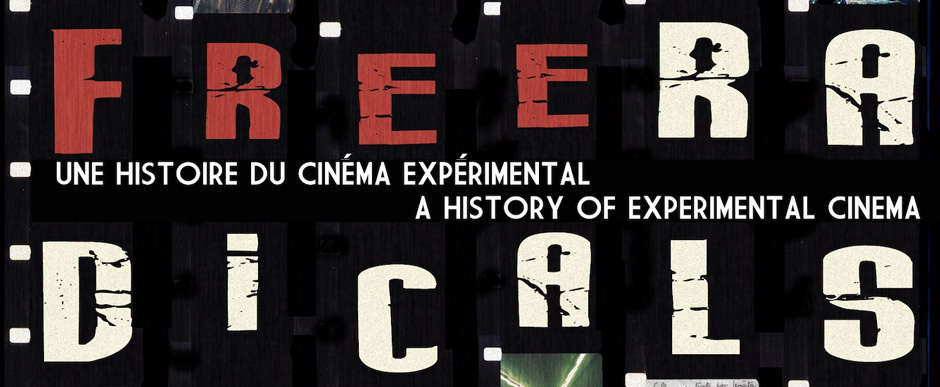
Free Radicals
Personal-essay style doc from 2011 about the avant-garde film years, though mostly focusing on the ’50s through the ’70s and mostly covering American artists. The names of the artists really bring back a couple of eras: Stan Brakhage, Hans Richter, Robert Breer, Jonas Mekas, Ken Jacobs, Peter Kubelka, Stan Vanderbeek … Though it makes no attempt to be comprehensive, the film still manages to sketch in some of the movement’s outlines, its in-person visits are enjoyably informal, and it provides numerous samples of footage that are fun to watch. Pip Chodorov, the film’s director, is a second-generation filmmaker himself; his dad, who provides guidance and yarns, is Stephan Chodorov. Pip is a light-voiced hippie type, and he brings an insider’s perspective as well as a lot of boyish admiration and enthusiasm to his picture. It’s all presented with a lot of familiar “this is an avant-garde film” quirks — super-8 style scratchiness, multiple exposures, end-of-the-roll color-flashes … Are these mannerisms annoying or nostalgic? At this point they seem harmless to me. They constitute their own peculiar language — why quarrel with it?
The Question Lady loved avant-garde films back in the ’70s; she took them as the ultimate in personal filmmaking. I enjoyed some of the movies at the time but I was mainly into feature films and I disliked the strident claims that were made on behalf of avant-garde work. So revisiting the artists and their work now was a nice experience for me. The artists have all mellowed with time; I have too, of course. They’re mostly in a looking-back-ruefully stage of life. Motivated by passion and heedless of practical concerns, they spent their creative years doing crazy experimental things. They achieved some of the effects they were aiming for, and even if they’re still alive and active they now qualify as survivors, like it or not. They recall — with a lot of melancholy/bittersweet smiles and shrugs — how they dreamed of changing the world, how impossible their material lives were, how difficult it was for them to pay the bills, and how small their audiences were. It’s good to see that the passions that drove them still burn, if a little less frenziedly. For myself, I now watch their work and find myself thinking, “Bless ’em, they were up to crazy shit, and why the hell not?” It’s just a different game they were playing, not a better or a worse one. Plus: More of us should pursue a few of our passions heedless of practical concerns, you know? If maybe not with quite such life-wrecking determination …
My main beef with the movie was that I could have used a few more reflections about the situation today. After all, what with computers, the kinds of things that these people were producing is now not just easily accessible but omnipresent. (This doesn’t hold true for Brakhage, who in a lot of his work was fascinated by the specific physical and optical characteristics of celluloid and emulsion.) The visual world we inhabit today and largely take for granted — our digital media world of whirling graphics, abstract effects, and music videos — is as avant-garde as can be, and was anticipated by the avant-gardists much more than by feature filmmakers. What do they think of that? Do they feel responsible for it? Would it have come about without their pioneering? They really had to kill themselves to create their little works. Do they look at modern computers, which make the same effects relatively easy to achieve, with envy? And what do they make of the fact that so much of our media life these days is avant-garde? Has the revolution many of them were anticipating and rooting for come to pass after all? I’d have loved to hear their reflections and reactions.
All that said, I enjoyed the film thoroughly. Pip Chodorov keeps his picture quick and appreciative, his own style and presence are very likable, and the filmmakers (fwiw: aside from Maya Deren, they’re all guys) are excellent company.
Next I’ll yak about “Big Joy,” a doc about the San Francisco filmmaker and poet James Broughton.
Related








 Blowhard, Esq.
 Callowman
 Sherbrooke
 Eddie Pensier
 Enzo Nakamura
 Epaminondas
 Fabrizio del Wrongo
 Fenster
 Brundle Guy
 Glynn Marshes
 Paleo Retiree
 Atypical Neurotic
 Question Lady
 Sax von Stroheim
 Sir Barken Hyena
 The Mistaken
 Uncouth Reflections